
Advanced Flower Capital’s Transition to BDC Status: Earnings Trends and Capital Challenges
An institutional lender focused on cannabis industry financing, AFCG navigates regulatory shifts, earnings volatility, and capital structure constraints amid its conversion to a Business Development Company.
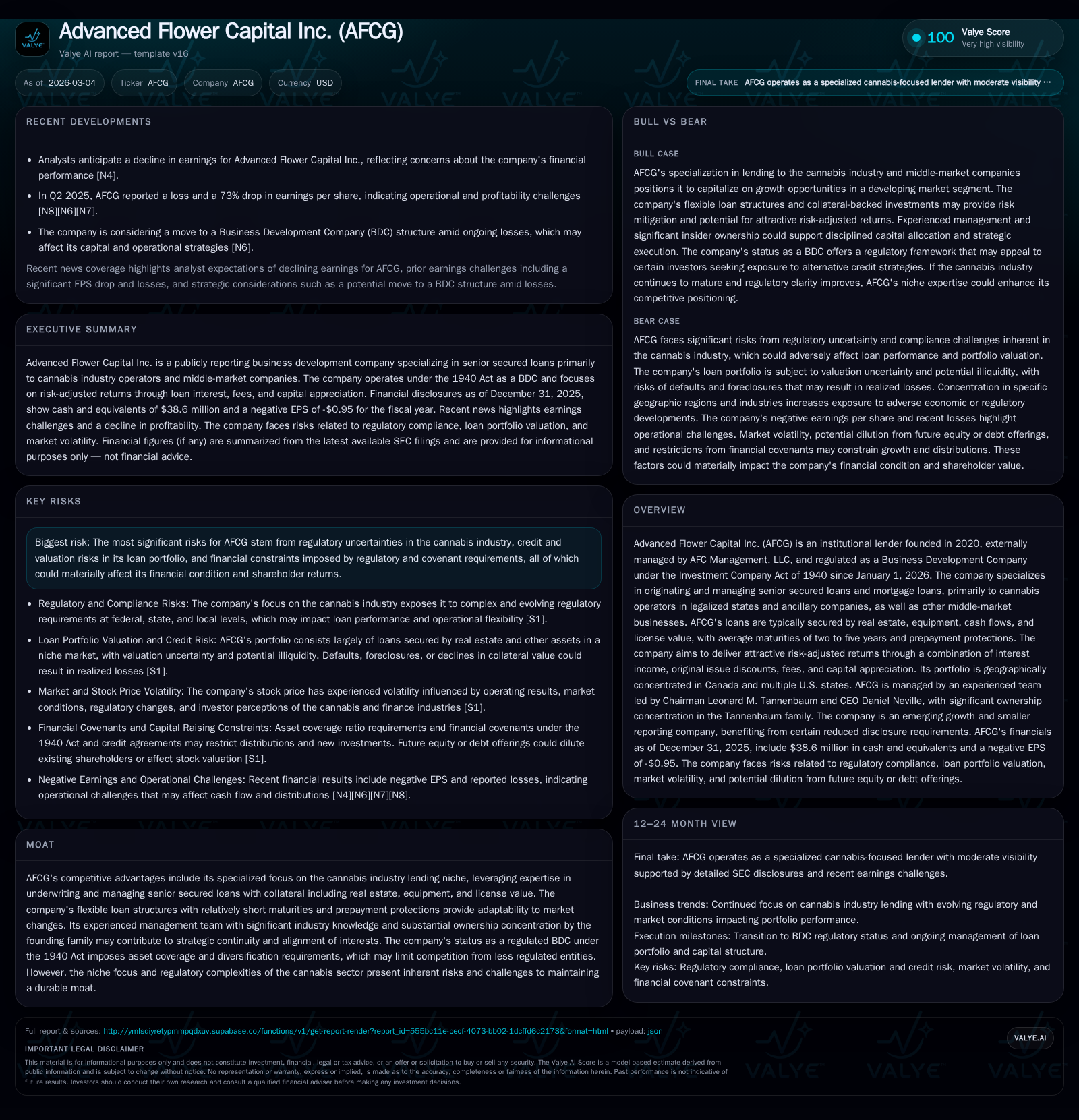
Advanced Flower Capital Inc. (AFCG), founded in 2020, specializes in senior secured loans primarily to cannabis operators and ancillary businesses. The company’s election to be regulated as a Business Development Company (BDC) under the Investment Company Act of 1940 as of January 1, 2026 marks a significant shift impacting its regulatory compliance, capital allocation, and investment strategy. Recent financial disclosures reveal a marked decline in net income and operating cash flow over recent years, reflecting sector-specific credit challenges and portfolio adjustments. AFCG faces material liquidity and leverage risks within the new regulatory framework while balancing dividend obligations that incorporate accrued but unpaid income components. Future growth will depend on managing evolving cannabis industry risks, maintaining qualifying asset thresholds, and optimizing capital deployment within BDC constraints.
Business Model Centered on Cannabis Industry Lending
Established in July 2020, Advanced Flower Capital Inc. (AFCG) is an institutional lender specializing in financing cannabis operators and ancillary businesses operating legally across multiple U.S. states and Canadian provinces [S1]. The company addresses the capital gap created by federal banking restrictions on cannabis-related enterprises by providing senior secured loans typically backed by real estate assets, specialized equipment, operational cash flows, and where permitted, license values associated with cannabis operations [S1].
Loan terms generally range from two to five years and include contractual prepayment protections designed to mitigate refinancing risk inherent in this emerging sector [S1]. This approach supports tailored credit exposure management aligned with the unique operational profiles of borrowers engaged in cultivation, manufacturing, distribution, and ancillary services.
Historical Financial Performance: Earnings and Cash Flow Trends
AFCG’s financial results reveal notable volatility over recent years amid portfolio repricing and credit challenges. Net income decreased by approximately 41.7%, from $35.9 million in fiscal year 2022 to $20.9 million in fiscal year 2023 [F1]. Operating cash flow declined nearly 48%, from about $31.3 million in FY2022 to $11.2 million in FY2025 [F1]. These trends reflect elevated provisioning needs following borrower insolvencies such as Public Company A's bankruptcy filing which led to nonaccrual loan participations and write-offs totaling approximately $1.8 million [S8].
Equity contracted from roughly $339 million at the end of FY2022 to approximately $175.6 million at FY2025 year-end [F1]. Despite this contraction, AFCG achieved an approximate return on equity of 11.9% based on FY2023 net income relative to equity [F1].
Historical performance (annual)
| FY | Net ($mm) | CFO ($mm) | Net YoY |
|---|---|---|---|
| 2025 | 11 | ||
| 2024 | 22 | ||
| 2023 | 21 | 21 | -41.7% |
| 2022 | 36 | 31 | +71.1% |
Source: SEC companyfacts cache [F1].
Capital returns and efficiency (annual)
| FY | ROE% |
|---|---|
| 2025 | |
| 2024 | |
| 2023 | 6.5 |
| 2022 | 10.6 |
Source: SEC companyfacts cache [F1].
Loan Structuring and Borrower Profiles
AFCG’s loan structures reflect the complexities of cannabis industry financing where traditional bank funding is limited [S1]. Senior secured loans are collateralized by a mix of tangible assets—such as real estate and equipment—and intangible assets like licenses critical for operation legality [S1]. Approximately half of borrowers have securities publicly traded on exchanges such as the Canadian Securities Exchange or OTC markets in the U.S., providing some transparency while exposing AFCG to sector-specific market volatility [S1].
The firm aims for attractive risk-adjusted returns combining interest income with original issue discounts (OID) and fees while maintaining underwriting discipline consistent with middle-market lending standards.
Regulatory Transition: Becoming a Business Development Company
Effective January 1, 2026, AFCG elected to be regulated as a Business Development Company (BDC) under the Investment Company Act of 1940 [S1],[S24]. This transition introduces new compliance requirements including:
- Maintaining an asset coverage ratio of at least 150%, limiting leverage relative to equity.
- Investing at least 70% of total assets in qualifying investments defined under the Act [S19].
- Enhanced governance standards including transaction oversight.
- Annual distribution obligations requiring payout of at least 90% of investment company taxable income for RIC qualification continuity.
While these regulations enhance investor protections through transparency and oversight, they constrain AFCG's prior flexibility around debt issuance and portfolio composition [S4],[S19],[S24]. Tax treatment changes require inclusion of OID amounts on loans or PIK interest for tax purposes before cash receipt complicating dividend funding strategies [S1],[S15].
Capital Structure: Debt Profile and Leverage Risks
As of December 31, 2025, AFCG reported total consolidated indebtedness near $98 million excluding debt issuance costs—of which $21 million was drawn under a revolving credit facility [S4],[F1]. Although no absolute cap exists on debt per governing documents or credit agreements [S5], covenants limit excessive leverage increases.
Leverage amplifies both potential returns and downside risks especially amid rising interest rate environments affecting floating-rate borrowings [S7],[S14]. Refinancing risk arises when debt maturities precede those of underlying loan assets potentially pressuring liquidity if capital markets are inaccessible or costly [S10],[S11].
Credit losses from borrower defaults are material; notably Public Company A's bankruptcy resulted in nonaccrual status on related loans followed by write-offs totaling approximately $1.8 million despite full reserves established earlier [S8]. Foreclosure proceedings initiated underscore recovery uncertainties given protracted legal processes despite security interests held [S8].
Dividend Policy and Shareholder Returns Considerations
Historically consistent dividend payments—$41.6 million paid in FY2022 versus $14.4 million in FY2021—face sustainability challenges due largely to accounting recognition timing gaps between accrued OID/PIK income versus actual cash inflows [F1],[S15],[S21].
The BDC distribution mandate requires paying out at least 90% of taxable income including accrued but unpaid components creating potential mismatches with available cash flow that may necessitate financing actions or asset disposals potentially dilutive to NAV per share [S15]. Dividend reinvestment plans impose tax liabilities on shareholders for reinvested distributions not received as cash thus affecting after-tax returns without corresponding liquidity benefits [S1],[S15].
Recent ROE calculations approximate an 11.9% return based on FY2023 figures reflecting moderate profitability amidst equity base contraction from impairments [F1]. Founder-family ownership concentration (~26%) aligns management incentives but centralizes governance potentially influencing capital allocation priorities amid competing shareholder interests [S21],[S26].
Regulatory Environment Impacting Credit Risk Management
Ongoing uncertainty within the cannabis regulatory landscape presents principal macro-level risks including conflicting state-federal statutes affecting collateral enforceability and borrower viability assumptions [S6],[S22]. Licensing authorities impose operational conditionalities whose revocation or alteration heightens default probabilities impacting portfolio valuations adversely [S22].
Although litigation risks remain limited currently for AFCG specifically, latent credit losses driven by sector operational disruptions or competitive pressures could emerge requiring ongoing portfolio recalibration amid evolving market conditions [S22],[S23].
Outlook: Monitoring Key Performance Indicators Post-BDC Conversion
Investor focus will sharpen on quarterly earnings releases validating loan portfolio health under new regulations with early analyst commentary anticipating earnings declines alongside surging implied option volatility signaling uncertainty about future performance prospects amid sector headwinds [N4],[N6]. Peer comparisons against other BDCs serving middle-market niches can provide contextual insights though exposure differences exist given AFCG’s cannabis focus [N5].
Key metrics include:
- Debt service coverage relative to operating cash flows given leverage exposure.
- Ability to refinance maturing debt without dilutive equity issuance.
- Stability and sustainability of dividend payouts aligned with income recognition.
- Incidence rates for loan impairments or foreclosures.
- Compliance with asset coverage ratios mandated by BDC regulation.
- Maintenance of qualifying asset thresholds above statutory minima.
- Management execution effectiveness under heightened BDC operational demands.
This analysis synthesizes facts from SEC filings through March 2026 combined with contemporaneous news sources without speculative forecasting beyond disclosed company guidance parameters where absent. Any forward-looking statements should be considered within limitations disclosed by management documentation available via public records. This report does not constitute investment advice nor recommendation.
Disclaimer: This is research-only, informational analysis and not investment advice. It may include AI-generated interpretation and general industry context. Always verify important details using primary sources.

Comments