
Bancorp, Inc. Boosts Growth with Fintech Partnerships and Loan Expansion
Bancorp’s fintech partnership model supports stable, low-cost deposits that fuel loan portfolio growth and scalable fee income.
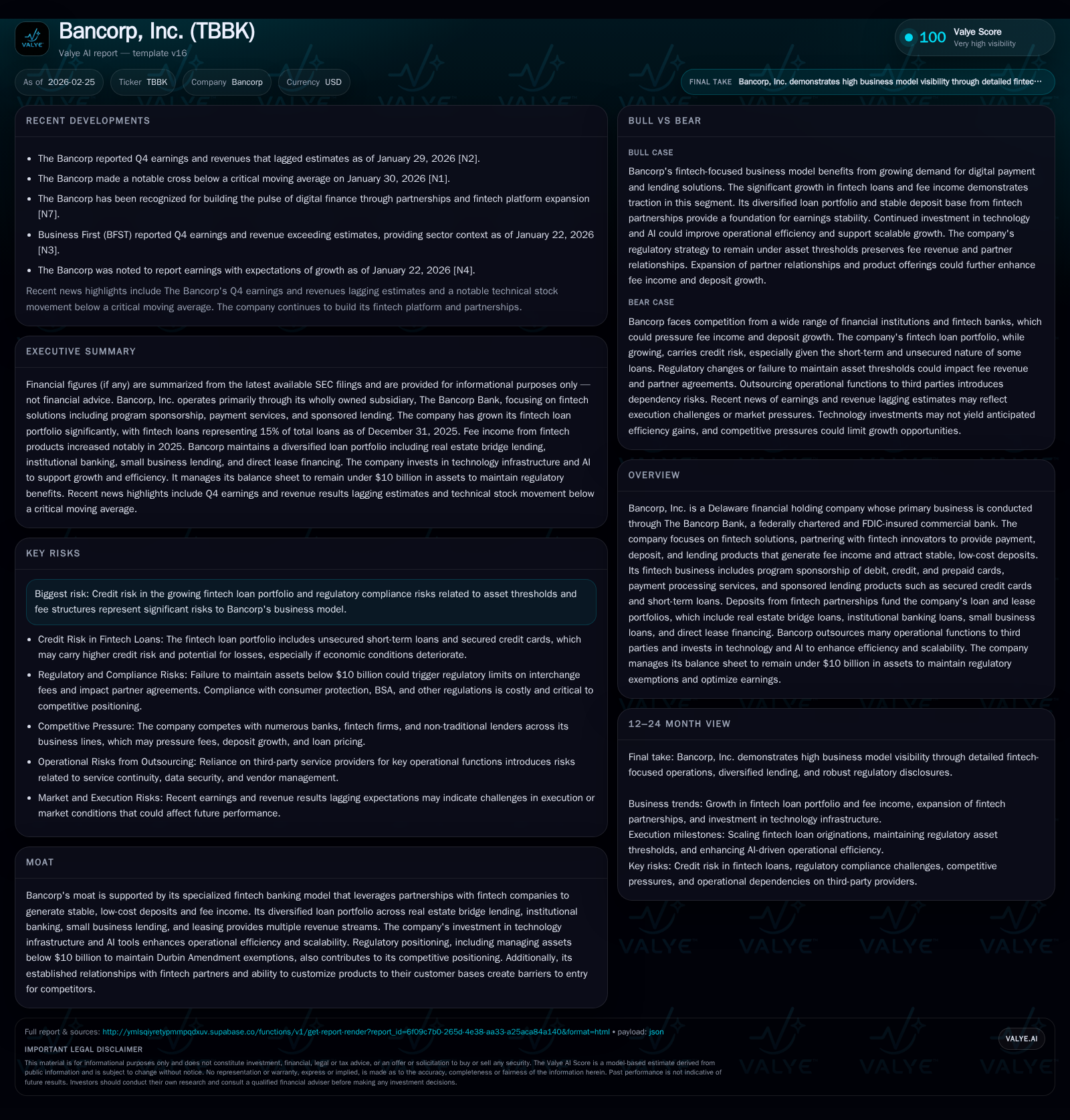
Bancorp, Inc. leverages its fintech solutions via program sponsorships and payment services to generate robust non-interest income and attract stable deposits. Its loan portfolio diversification, notably in real estate bridge loans and institutional banking, has been bolstered by a surge in fintech-originated loans reaching $1.10 billion by end-2025. Capital management prioritizes regulatory compliance to maintain Durbin Amendment exemptions, while sizable share repurchases highlight active capital returns. Investors should monitor fintech loan growth, transaction volumes, and regulatory developments as key earnings drivers ahead.
Fintech Partnerships Fueling Recent Revenue Growth
Bancorp’s distinctive fintech banking model leverages partnerships with technology-focused payment companies to drive revenue growth primarily through program sponsorships of debit, credit, and prepaid cards. These relationships enable Bancorp to generate fee-based income that is notably stable and less sensitive to interest rate fluctuations when compared with traditional banking revenue streams.
In 2025, Bancorp's total fintech fee income increased by a substantial 21%, rising to $141.1 million from $116.8 million the prior year [S4]. This rise was largely fueled by higher transaction volumes on prepaid and debit card products; gross dollar volume for these cards climbed approximately 17% year-over-year to over $178 billion [S4]. Bancorp earns fees both via contractual agreements tied to per-transaction charges from partners as well as interchange fees settled through Visa or Mastercard networks [S25].
Program sponsorship involves Bancorp issuing cards under the names of its partner brands but acting as the bank of record for deposit accounts linked to these cards—a setup granting Bancorp direct access to deposit flows [S25]. This model fosters customer acquisition at lower costs relative to banks building direct consumer franchises.
Net income growth has mirrored these developments with a 4.9% increase over 2024, reaching $228.2 million in fiscal 2025 as the fintech-driven non-interest income base continues expanding [F1]. The growing prepaid/debit ecosystem embedded in Bancorp’s fintech solutions contributes significantly toward stable core funding sources.
Expanding Loan Portfolio and Lending Product Mix
Bancorp’s disciplined balance sheet strategy focuses on employing deposits sourced predominantly via fintech partnerships to fund a diversified loan portfolio that mitigates concentration risk across segments.
As of December 31, 2025, the total loan portfolio stood at approximately $7.29 billion distributed mainly across real estate bridge loans ($2.26 billion or 31%), institutional banking ($1.96 billion or 27%), small business loans including SBA-backed products ($1.01 billion or 14%), leasing ($685 million or 9%), along with the notable fintech loan category [$1.10 billion or 15%, up from $454 million at end-2024] which has recorded over a twofold increase within a single year [S6][S7][S4].
The real estate bridge lending focus—primarily commercial projects involving multi-family workforce housing—features predominantly fixed-rate loans (78%) with conservative weighted average loan-to-value ratios (71%) reflecting collateral quality emphasis [S6]. Institutional banking encompasses Securities-Backed Lines of Credit (SBLOCs), Insurance-Backed Lines of Credit (IBLOCs), and advisor loans characterized by variable rate terms that reprice monthly or fixed term lengths tailored for wealth management clients [S6].
Credit risk management covers fintech loans involving secured credit cards and short-term unsecured extensions with cash collateral typically supporting secured versions [S25]. Almost all fintech loans enjoy credit enhancements per contractual agreements designed to mitigate default risk, though their rapid expansion necessitates close underwriting vigilance.
Scaling Fee Income Through Program Sponsorship and Payment Processing
Bancorp’s non-interest income scale benefits substantially from its integrated payment processing capabilities encompassing ACH services, merchant acquiring functions via card networks, and near-real-time payment transfers [S25]. Fees derived from ACH transactions and other payment clearing services rose sharply from $14.6 million in 2024 to $21 million in 2025 reflecting increasing transaction adoption [S25].
The bank-customized deposit account types span consumer payroll accounts, government disbursement programs, gift cards, medical spending benefit accounts, business payments, rewards programs among others—each aligned with partner-specific branding and user experience requirements facilitating flexible market penetration with embedded financial services [S25].
This scalable program sponsorship framework generates recurring per-transaction fees providing leveraged upside without proportional cost increase compared to conventional interest-dependent revenue models affected by economic cycles.
Evaluating Financial Highlights: Profitability and Operating Cash Flow Trends
The company’s financial performance exhibits steady improvement underscored by rising net income and robust operating cash flow generation:
Historical performance (annual)
| FY | Net ($mm) | CFO ($mm) | Capex ($mm) | Net YoY |
|---|---|---|---|---|
| 2025 | 228 | 265 | 7 | +4.9% |
| 2024 | 218 | 228 | 5 | +13.1% |
| 2023 | 192 | 187 | 13 | +47.7% |
| 2022 | 130 | 121 | 5 |
Source: SEC companyfacts cache [F1].
Capital returns and efficiency (annual)
| FY | Buybacks ($mm) | FCF ($mm) | ROE% |
|---|---|---|---|
| 2025 | 378 | 258 | 33.1 |
| 2024 | 252 | 223 | 27.5 |
| 2023 | 100 | 174 | 23.8 |
| 2022 | 60 | 116 | 18.8 |
Source: SEC companyfacts cache [F1].
Net income advanced consistently each year with a significant uptick post-2022 reflective of successful fintech revenue scaling efforts alongside lending growth [F1]. Operating cash flow reached $265 million in FY25 marking a double-digit increase supported by lending repayment inflows and fee collections.
Capital expenditures accelerated notably (+42%) reaching over $7 million driven predominantly by investments in technology infrastructure upgrades focused on automation and AI enhancements designed for cost efficiency gains amidst volume ramp-ups [F1][S13].
Despite such investment outlays equity declined somewhat compared to prior years largely due to elevated share repurchases totaling $378 million in FY25 compared with $252 million in FY24; buybacks are an explicit aspect of Bancorp’s capital stewardship policy aimed at optimizing equity capital deployment [F1][S20].
ROE stands strong near ~33% reflecting efficient capital use underlying sustained profitability growth fostered by the firm’s hybrid deposit-fee-loan business structure.
Capital Structure Discipline and Shareholder Returns
Bancorp maintains conservative leverage metrics consistent with Basel III capital adequacy regulations ensuring well-capitalized status:
At year-end 2025,
- Total risk-based capital ratio stood at approximately 12% for the holding company and over 15% at the bank level.
- Tier 1 capital ratios were above required minimums at roughly 11% (company) and over 14% (bank).
- Leverage ratios measured at approximately 7.64% (company) and nearly double that internally targeted minimum (~9%) at bank subsidiary level underscoring strong capitalization buffers [S8][S10].
Such capital strength preserves capacity for organic growth and provides cushion against regulatory constraints linked to asset size thresholds under Dodd-Frank provisions impacting dividend payments.
While Bancorp does not presently disclose dividends paid out explicitly, it has pursued aggressive share repurchase programs evidenced by accelerating buybacks from approximately $60 million in FY22 escalating more than sixfold by FY25 ($378 million) indicative of an intent to return excess capital dynamically when feasible consistent with regulatory approvals [F1][S20].
Regulatory Positioning and Risk Management Constraints
Regulatory compliance forms a cornerstone of Bancorp’s strategic management given its business model hinges on managing assets below critical thresholds such as sub-$10 billion total assets required for exemption from restrictions imposed by the Durbin Amendment impacting interchange fees earned on debit card transactions [S11][S13][S24].
Failure surpassing this boundary would materially constrain revenues due to lost fee privileges additionally triggering potential termination rights exercisable by certain partners within fee-sharing contracts thus directly threatening core fintech deposit fueling mechanisms.
Concurrently, credit risk exposure related principally to rapid fintech loan portfolio expansion necessitates stringent underwriting practices augmented by comprehensive credit enhancements engineered into sponsored loans mitigating default probabilities though inherent sector volatility remains a noted risk factor subject to ongoing monitoring frameworks supported by proactive reserve policy implementations [S19][S24].
Cybersecurity compliance aligned with NIST frameworks alongside extensive vendor oversight ensures protection of customer data integrity integral for maintaining partner trust in outsourced operational ecosystems which underpin scalable service delivery without proportionate internal resource escalation risks [S16][S19].
Strategic Outlook: New Partner Acquisition and Technology Investment
Looking forward Bancorp aims to further diversify its partnership network targeting organizations possessing pre-existing member or client bases enabling rapid distribution channels for new product launches within its fintech solutions platform scope including newer credit offerings tailored for evolving market demands [S1][N3].
Investment continues into AI-enabled automation tools poised to improve operational efficiencies delivering enhanced margins as transaction volumes increase without linear cost inflation sustaining scalability advantages inherent in third-party outsourcing models deployed broadly across IT infrastructure frontend/backend processes thus optimizing overall platform economics underpinned by strong compliance governance frameworks facilitating timely regulatory adaption [S7][S13].
What to Watch: Future Milestones and Earnings Drivers
Key metrics warranting close observation include quarterly growth rates within the sponsored fintech loan portfolio tracking momentum or signs of stabilization post rapid expansion phase alongside transaction volume trends within prepaid/debit card ecosystems driving fee income sustainability.
Upcoming earnings releases are expected to provide clarity around guidance updates particularly regarding partner acquisition success rates product innovation rollout schedules alongside any material impacts stemming from regulatory reviews addressing asset threshold compliance paradigms following Q4 results which missed estimates modestly but underpin cautious optimism prevailing among analysts per latest market commentary [N1][N3].
Monitoring Bancorp's ability to sustain its balanced approach between aggressive loan growth while maintaining conservative risk controls alongside prudent capital allocation will remain pivotal for appraising future performance trajectories.
This report is prepared exclusively for informational purposes; it does not constitute investment advice or recommendations regarding securities or sectors discussed herein.
Disclaimer: This is research-only, informational analysis and not investment advice. It may include AI-generated interpretation and general industry context. Always verify important details using primary sources.

Comments