
J.B. Hunt Transport Services: Balancing Growth, Liquidity, and Capital Efficiency in 2025
JBHT's 2025 financial performance reflects steady revenue gains paired with strategic liquidity management under an extended credit facility.
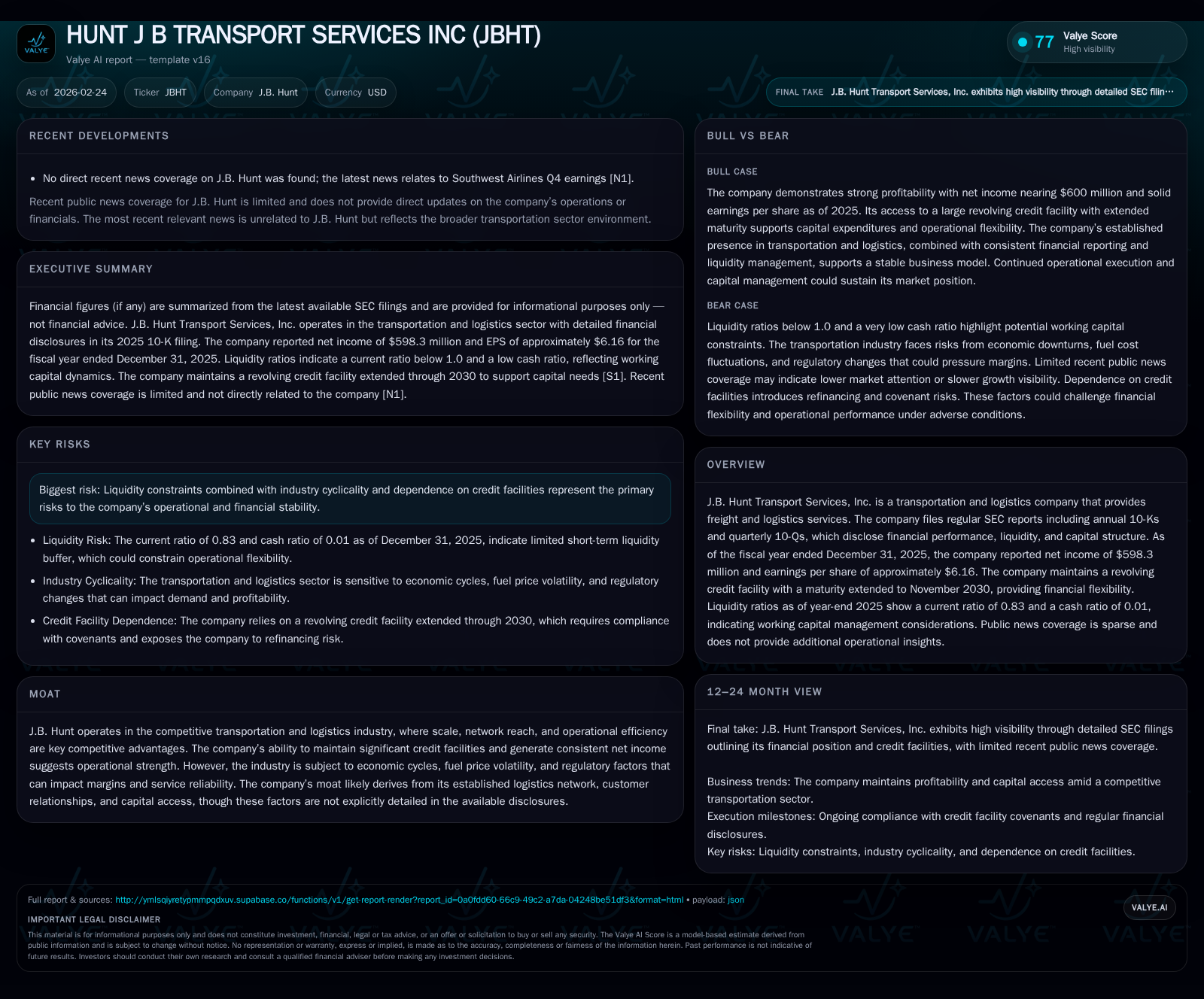
J.B. Hunt Transport Services posted a 15.6% revenue increase in fiscal 2025 while navigating a tighter liquidity profile marked by a current ratio below unity and minimal cash reserves. The company extended its revolving credit line through 2030, enhancing financial flexibility for capital expenditures and share repurchases. Despite modest operating income growth of 4.1%, JBHT maintained strong operating cash flows supporting a robust free cash flow generation of roughly $948 million. Capital allocation heavily favored share repurchases over dividends, indicating a focus on boosting shareholder returns alongside network expansion and operational scale advantages within the competitive logistics sector.
Historical Performance Highlights and Growth Drivers Through 2025
J.B. Hunt Transport Services demonstrated solid top-line momentum in fiscal year 2025, with revenues rising sharply by 15.6% to approximately $8.65 billion from the previous year’s figure of about $7.49 billion [F1]. This growth outpaced operating income increases which only climbed by 4.1% to near $865 million, highlighting margin pressure likely rooted in volatile input costs such as fuel and labor rates commonly impacting trucking operations [F1][S4][S5]. Meanwhile, net income improved by a more contained 4.8%, reaching $598 million alongside reported earnings per share around $6.16—signaling moderately effective operational leverage but constrained profitability expansion [F1]. Operating cash flow further strengthened by over 13%, hitting roughly $1.68 billion as the company sustained strong collections and working capital conversion amid expanding business volume [F1]. This robust cash conversion underpins JBHT’s capacity for sizable capital investments despite cyclical industry dynamics.
Liquidity Profile and Credit Facility Developments: Implications of the 2025 Credit Agreement Extension
In late November 2025, JBHT entered into a Second Amended and Restated Credit Agreement that notably extended the maturity of its $1 billion revolving credit facility until November 2030 with rights for two possible one-year extensions, pushing potential expiry to November 2032 [S8][S9][S13]. The revised agreement also enhanced the accordion feature by increasing potential maximum borrowings to $1.4 billion from prior limits, thus bolstering structural liquidity if additional funding is necessary during economic downturns or capital-intensive periods [S8][S9]. Using this instrument for equipment purchases, refinancing existing debt, share repurchases, and working capital offers operational flexibility amid fluctuating cash positions.
Despite these provisions, JBHT’s liquidity ratios at year-end reveal constraints: the current ratio stands at approximately 0.83, with current liabilities exceeding current assets, while the cash ratio is extremely low at roughly 0.01—indicating limited immediate cash buffers on hand [F1]. This signals reliance on credit lines coupled with efficient payables/receivables management to maintain operations without stalling growth or risking covenant violations.
Industry Context: Operational Moat Amid Economic and Regulatory Cyclicality
The transportation sector remains fiercely competitive with key success factors including dense network coverage and established dedicated contract services—a model JBHT leverages to secure recurring volumes and stable revenue streams [valye_report_excerpt.moat][S4][S5]. Network density improves asset utilization rates while dedicated contracts reduce volatility compared to spot freight markets.
At the same time, external pressures such as fluctuations in diesel prices and tightening regulatory emissions standards constrain profit margins across peers, necessitating continuous operational efficiency improvements along with agile pricing strategies reflective of economic cycles [valye_report_excerpt.moat][S5]. The company’s ability to maintain large capital resources reflects managerial confidence in defending its moat through scale-driven cost advantages and reliable service delivery.
Future Growth Outlook Anchored on Network Scale and Capital Deployments
Although explicit forward guidance by JBHT management is limited in publicly available SEC filings, recent market commentary describes JBHT as a "strong momentum stock" thanks to ongoing network expansion initiatives and technology investments aimed at supply chain optimization [N14][S1][S2]. Key future drivers will likely hinge on successful rollouts of innovative logistics platforms paired with market share gains in less-penetrated geographic corridors while continuing disciplined cost control.
Analysts should monitor fleet upgrade cycles funded via capex plans disclosed historically as well as the utilization rates of enlarged credit facilities as leading indicators of capacity scaling or constraint responses.
Capital Allocation Framework: Share Repurchase Strategy versus Dividend Payouts
JBHT showcases an aggressive shareholder return approach predominantly weighted toward common stock repurchases rather than dividends in FY2025—repurchasing about $923 million shares against roughly $171 million paid out as dividends [F1][S23][S24]. This nearly six-fold greater buyback amount underscores management’s strategy favoring EPS accretion and balance sheet optimization over steady dividend hikes.
Such buyback intensity aligns with a broader industry trend where transportation companies seek flexible capital return mechanisms given cyclical risks affecting sustained dividend growth visibility. Given JBHT’s sizeable free cash flow generation capability, this dual approach balances reward expectations while preserving funds for reinvestment.
Earnings Quality and Cash Flow Analysis with ROE Assessment
The quality of JBHT’s earnings appears stable as operating cash flow outpaces net income across recent years—indicative of solid underlying cash-generating operations free from material accrual distortions [F1]. In FY2025 specifically, operating cash flow reached an estimated $1.68 billion while capital expenditures totaled roughly $731 million yielding a free cash flow near $948 million which supports both organic growth investments and shareholder distributions.
ROE calculated using net income divided by year-end equity ($598 million / $3.57 billion) approximates 16.8%—a robust return suggesting efficient capitalization relative to shareholder equity although somewhat below historical highs due likely to strategic buybacks shrinking equity base steadily [F1].
Risks from Market Volatility And Financing Dependencies
Key risks facing JBHT arise from its liquidity profile combined with sector cyclicality as elaborated in risk disclosures referencing fuel price exposure, labor market tightness, demand swings linked to macroeconomic activity, and regulatory compliance costs affecting operational margins [valye_report_excerpt.risks][S4][S5][S6]. The low current ratio (0.83) paired with minimal cash reserves heightens dependence on credit facilities whose covenants impose discipline but could become constraining under adverse scenarios or covenant breaches.
Working capital management remains critical since tight liquidity could limit nimbleness in responding rapidly to freight demand fluctuations or delays in receivable collections typical during downturns, amplifying solvency considerations even as ample committed credit mitigates outright liquidity crises [F1][S8].[N14]
Key Metrics Summary Table
Historical performance (annual)
| FY | Net ($mm) | CFO ($mm) | OpInc ($mm) | Capex ($mm) | Net YoY |
|---|---|---|---|---|---|
| 2025 | 598 | 1678 | 865 | 731 | +4.8% |
| 2024 | 571 | 1483 | 831 | 865 | -21.6% |
| 2023 | 728 | 1745 | 993 | 1862 | -24.9% |
| 2022 | 969 | 1777 | 1332 | 1541 |
Note: Omitted columns lack sufficient annual XBRL coverage in the provided tags (need ≥2 annual points): Rev. Source: SEC companyfacts cache [F1].
Capital returns and efficiency (annual)
| FY | Div ($mm) | Buybacks ($mm) | FCF ($mm) |
|---|---|---|---|
| 2025 | 171 | 923 | 948 |
| 2024 | 176 | 514 | 618 |
| 2023 | 174 | 160 | -118 |
| 2022 | 167 | 300 | 236 |
Source: SEC companyfacts cache [F1]. *Latest full year; dashes indicate unavailable comparative metric for early years.
All figures based on SEC filings except where noted; operating income data unavailable pre-2022 for comparison purposes; figures rounded for clarity.
This analysis is informational only and does not constitute investment advice or recommendations regarding J.B Hunt Transport Services or its securities.
Disclaimer: This is research-only, informational analysis and not investment advice. It may include AI-generated interpretation and general industry context. Always verify important details using primary sources.

Comments