
Easterly Government Properties Extends Debt Maturities Amid Profitability Pressures
DEA’s growth anchored in stable government leases, but profit margins and covenant adjustments highlight evolving capital and operational dynamics.
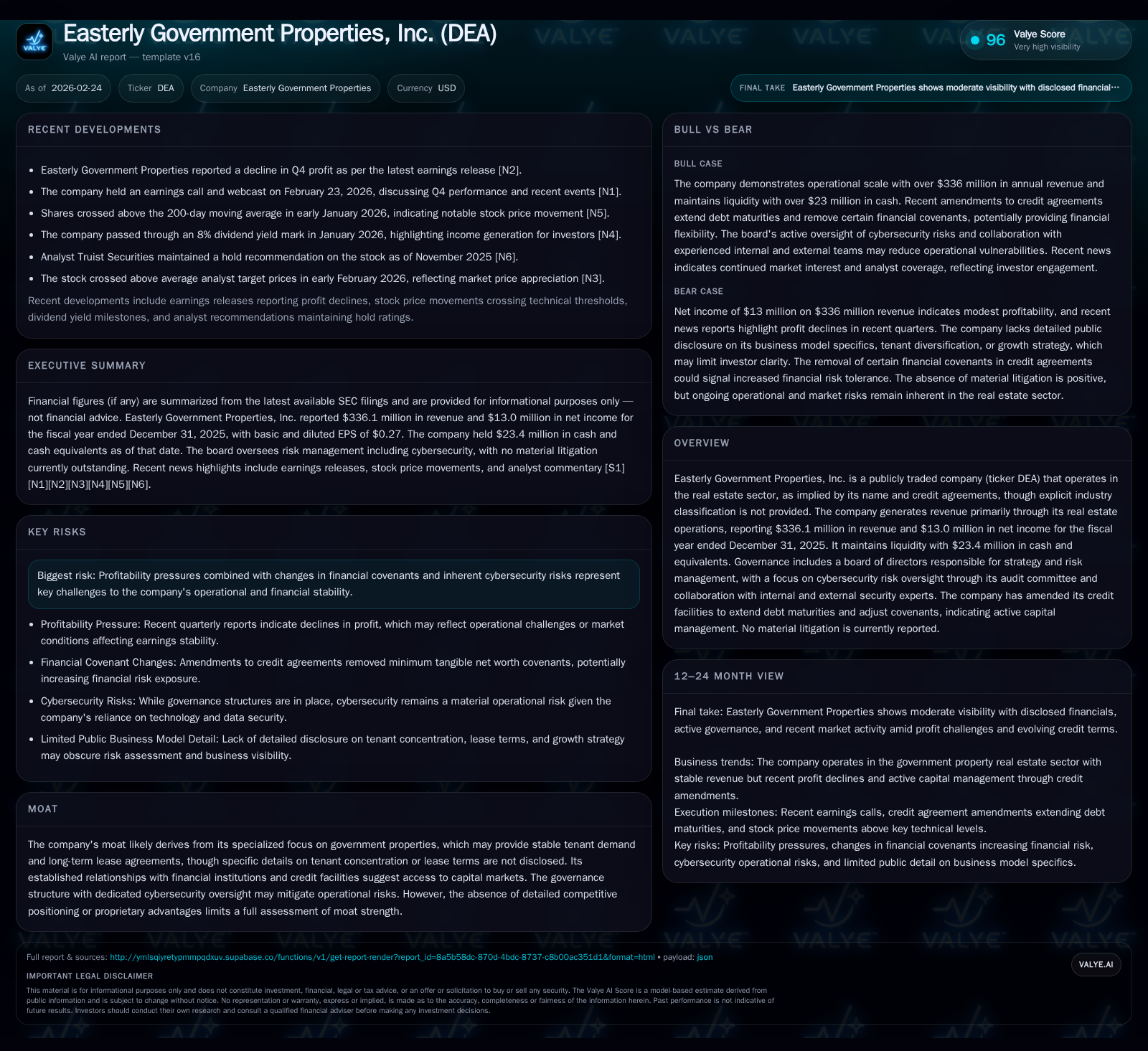
Easterly Government Properties, Inc. (DEA) reported steady revenue growth driven by its specialized government property portfolio, achieving $336.1 million in revenue for fiscal year 2025, up 11% from the prior year. Despite top-line momentum, net income declined by over 30%, reflecting profitability pressures amid higher expenses or non-operating items. The company actively managed its capital structure by extending debt maturities and amending covenants, enhancing liquidity and flexibility. Investors should monitor fiscal performance trends and strategic actions addressing profitability and cybersecurity risks given DEA's concentrated tenant base and governance focus.
Company Overview and Historical Performance
Easterly Government Properties, Inc. (NYSE: DEA) operates as a real estate company primarily focused on government properties, which provide a relatively stable tenant base through long-term lease agreements. This niche focus offers a strategic moat predicated on federal government leasing demand, which tends to be less cyclical than other commercial real estate sectors though details on lease expirations or tenant concentration are not explicitly disclosed.
Over the last several years, DEA has demonstrated consistent revenue growth supported by its government real estate portfolio. Fiscal year revenues climbed from $293.6 million in 2022 to $336.1 million in 2025, marking an approximate compound annual growth rate (CAGR) of about 4-5% over this period [F1]. The latest year alone saw an 11.3% jump from $302.1 million in 2024.
However, while top-line growth accelerated, net income decreased sharply—from $31.5 million in 2022 down to $13.0 million in 2025—a 33.5% decline compared with the prior year [F1]. This divergence suggests rising operating costs or other financial pressures cutting into profitability despite higher turnover.
Operating cash flow paints a more favorable picture: it increased significantly from about $163 million in FY2024 to nearly $259 million in FY2025 (+59%), signaling resilient core cash generation likely aided by stable rental collections and effective working capital management [F1]. Notably, capital expenditures data remain sparse with only a historical capex figure of approximately $20 million reported back in early periods [F1].
Historical Financial Performance Summary
Historical performance (annual)
| FY | Rev ($mm) | Net ($mm) | CFO ($mm) | Rev YoY | Net YoY |
|---|---|---|---|---|---|
| 2025 | 336 | 13 | 259 | +11.3% | -33.5% |
| 2024 | 302 | 20 | 163 | +5.2% | +4.0% |
| 2023 | 287 | 19 | 114 | -2.2% | -40.3% |
| 2022 | 294 | 31 | 126 |
Note: Omitted columns lack sufficient annual XBRL coverage in the provided tags (need ≥2 annual points): OpInc, Capex, Buybacks, FCF. Source: SEC companyfacts cache [F1].
Capital returns and efficiency (annual)
| FY | Div ($mm) | ROE% |
|---|---|---|
| 2025 | 95 | 1.0 |
| 2024 | 116 | 1.5 |
| 2023 | 112 | 1.4 |
| 2022 | 109 | 2.5 |
Source: SEC companyfacts cache [F1].
Note: Operating income and buyback data omitted due to inconsistencies or insufficiency.
Capital Structure and Liquidity Management
DEA has actively navigated its debt profile in recent periods to reinforce liquidity and extend maturities amid evolving market conditions [S5][S6][S27]. The company amended its credit agreement governing a $200 million senior unsecured term loan initially maturing July 23, 2026; the amendment pushed out maturity to August 21, 2028 with optional one-year extensions exercisable twice [S5]. Such extension provides critical runway for refinancing risk mitigation amid macroeconomic uncertainties.
Additionally, the removal of the minimum consolidated tangible net worth covenant represents a meaningful easing of financial covenant restrictions [S5]. This flexibility potentially allows DEA to pursue asset acquisitions or navigate earnings volatility without breaching restrictive covenants.
The revolving credit facility portion of the earlier credit agreement was terminated as of June 3, 2024 [S5], indicating a shift toward term debt reliance rather than revolving liquidity lines.
As of FYend December 31, 2025, DEA held approximately $23.4 million in cash and equivalents providing short-term liquidity buffer [F1]. Despite strong operating cash flows exceeding dividends paid—roughly $95 million marked down slightly from prior levels—the company appears committed to returning significant cash to shareholders through dividends rather than share repurchases which are negligible historically [F1][S17][S20].
Governance and Risk Oversight
The governance framework includes board-level oversight of cybersecurity risks channeled through the audit committee per the audit committee charter [S1][S7]. The enterprise partners with an external information security provider alongside internal audits for ongoing cyber risk evaluation—a necessity given heightened cyber threats facing real estate entities that hold sensitive tenant data and operational control systems.
Management controls technology budgets and integrates cybersecurity with overall risk management strategy [S7], underscoring proactive steps though cyber risks remain intrinsic.
Further legal disclosures confirm no ongoing material litigation nor any known threatened litigation as of filing [S4], preserving operational continuity without legal drag.
Future Growth Prospects
Growth prospects for Easterly hinge on sustaining occupancy within its government property segments where demand is often underpinned by federal budget allocation cycles [N1]. Lease renewals typically span medium-to-long durations providing visibility yet exposing potential portfolio re-leasing risk if government downsizing occurs.
Capital improvements or acquisitions appear constrained given limited capex disclosures but could be supplemented by incremental borrowing capacity from the amended credit terms featuring a $100 million accordion feature subject to standard conditions [S5].
The company's use of performance-based long-term incentive plan units aligned with stock price appreciation [$22.52 baseline price with defined hurdles] targets executive retention and continuity—possibly addressing past leadership turnover concerns that can impact strategic execution [S20][S21].
Profit margin recovery is uncertain; given net income compression even as operating cash flow expands—the narrative implies non-operational items or increasing interest expenses possibly linked with prior debt costs or property-level cost inflation [N2]. Monitoring quarterly earnings releases for margin trends will be important [N1][N2].
Returns and Capital Allocation
Return on equity remains modest at approximately 1% calculated from trailing net income against year-end equity ($1.32 billion) reflecting thin accounting profits relative to asset base size common among REITs dependent on depreciation shield effects [F1].
Dividends form a consistent component of shareholder returns—FY2025 distribution totaled nearly $95 million (around ~$0.70-$0.75 dividend yield range depending on share count), slightly reduced but stable over time [F1][S17][S21]. No recent significant share buybacks have been reported indicating priority on dividends for shareholder payouts.
Industry Context Analysis
In the government properties REIT sector, lease stability differentiates players versus more cyclical office or retail portfolios but also constrains upside rents given bureaucratic tenant budgeting processes. Moreover, operating expense inflation (e.g., facilities maintenance or building upgrades for compliance/security) can pressure NOI margins absent rent escalations tied to CPI or other indices — common lease structures that DEA likely employs but not detailed publicly here.
Debt leverage management is critical given interest rate volatility impacting unsecured term loans pricing—extending debt maturities while removing restrictive covenants signals prudent balance sheet stewardship heading into uncertain macroeconomic environments typical in real estate capital markets today.
What To Watch Next (Analysis)
- Quarterly rental occupancy rates and renewal margins versus expiring leases reflecting tenant demand dynamics.
- Profit margin trends including breakdowns of operating versus non-operating expenses influencing earnings variability.
- Utilization of accordion feature in credit facility amendments enabling strategic acquisitions or property repositioning investments.
- Any shifts in dividend policy amid profitability pressures balancing yield maintenance versus payout sustainability.
- Updates on cybersecurity initiatives responding to evolving threat landscape potentially impacting operations or tenant confidence.
- Leadership stability metrics post-LTIP grants aligned with stock appreciation incentives supporting management continuity.
Disclaimer
This analysis is based on publicly available information including SEC filings and recognized news sources as of February 24, 2026. It is intended purely for informational purposes without offering investment advice or recommendations regarding Easterly Government Properties, Inc.'s securities or business prospects.
Disclaimer: This is research-only, informational analysis and not investment advice. It may include AI-generated interpretation and general industry context. Always verify important details using primary sources.

Comments