
US Bancorp Balances Steady Growth with Regulatory and Acquisition Challenges
US Bancorp's broad banking platform sustains growth against evolving regulatory demands and integration of institutional capabilities.
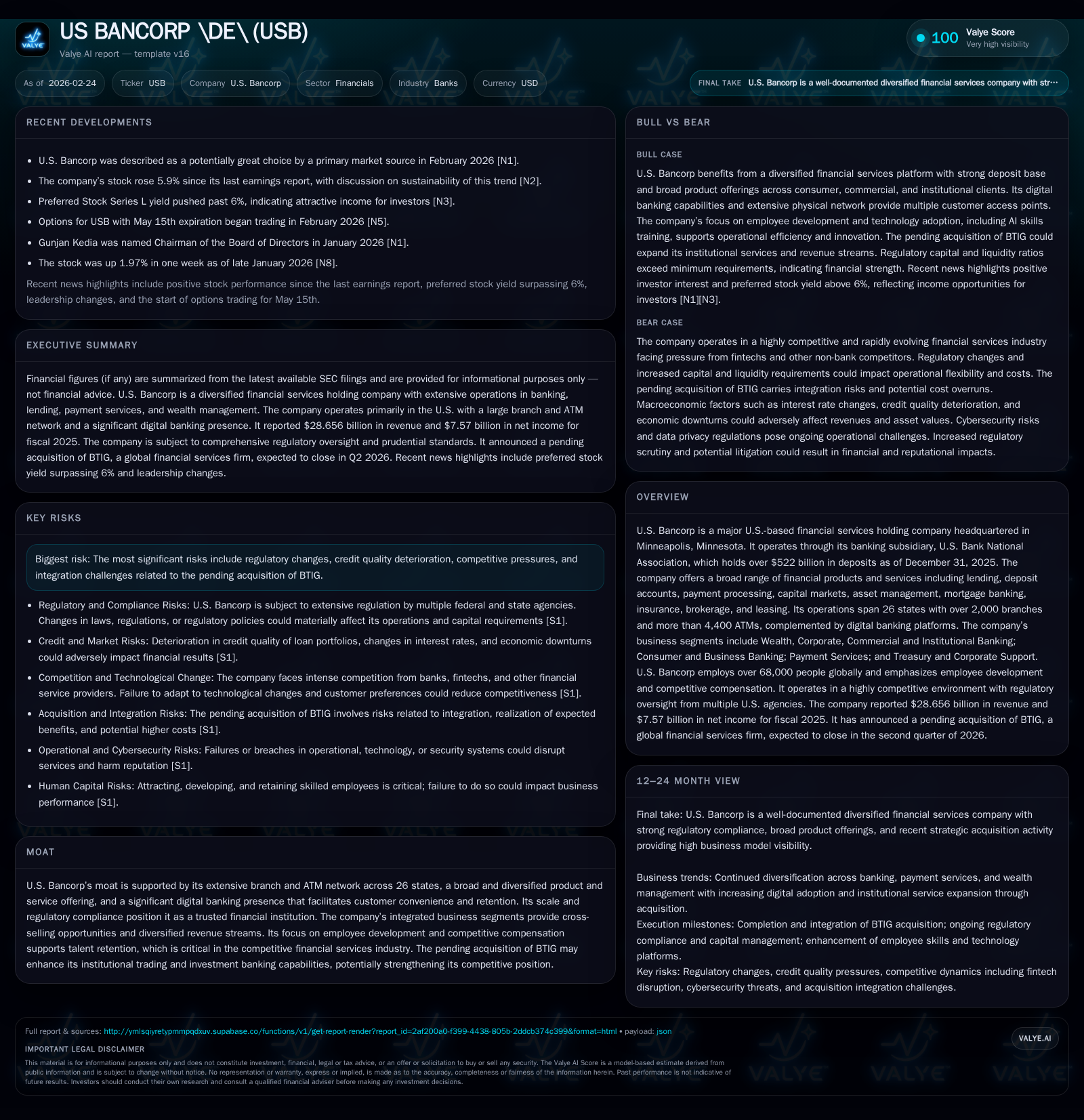
US Bancorp (USB) reported consistent revenue growth reaching $28.7 billion in 2025, driven by diversified financial services across consumer, corporate, and payment segments. The bank’s extensive branch and ATM network, combined with a significant digital presence, underpin its moat, while the pending acquisition of BTIG aims to enhance investment banking capabilities. Regulatory compliance remains a key constraint amid evolving capital requirements and consumer protection regulations. Capital allocation emphasizes dividends with modest share repurchases reflecting cautious deployment amid integration risks. Monitoring execution of BTIG integration and regulatory developments will be critical for US Bancorp's future trajectory.
Overview and Historical Performance
U.S. Bancorp (USB) stands as a major U.S.-based financial services holding company headquartered in Minneapolis, Minnesota, with operations spanning across 26 states featuring over 2,000 branches and more than 4,400 ATMs as of December 2025 [S7]. The core banking subsidiary, U.S. Bank National Association (USBNA), holds deposits exceeding $522 billion, positioning the firm in the upper tier of U.S. regional banks.
The company's comprehensive suite encompasses lending (consumer, commercial), deposit accounts, payment processing, asset management, capital markets services including treasury management, mortgage banking, insurance products underwriting, brokerage services, and leasing products [S1]. Segmentation includes Wealth; Corporate Commercial & Institutional Banking; Consumer & Business Banking; Payment Services; and Treasury & Corporate Support [S12]. This diversified revenue mix provides resilience against sector-specific cyclicality.
Financially, USB has exhibited consistent growth over recent years:
Historical performance (annual)
| FY | Rev ($bn) | Net ($bn) | CFO ($bn) | Rev YoY | Net YoY |
|---|---|---|---|---|---|
| 2025 | 28.7 | 7.6 | 8.0 | +4.4% | +20.2% |
| 2024 | 27.5 | 6.3 | 11.3 | -2.4% | +16.0% |
| 2023 | 28.1 | 5.4 | 8.4 | -6.8% | |
| 2022 | 5.8 | 21.1 |
Note: Omitted columns lack sufficient annual XBRL coverage in the provided tags (need ≥2 annual points): OpInc, Capex, FCF. Source: SEC companyfacts cache [F1].
Capital returns and efficiency (annual)
| FY | Div ($bn) | Buybacks ($mm) | ROE% |
|---|---|---|---|
| 2025 | 3.2 | 489 | 11.6 |
| 2024 | 3.1 | 173 | 10.8 |
| 2023 | 3.0 | 62 | 9.8 |
| 2022 | 2.8 | 69 | 11.5 |
Source: SEC companyfacts cache [F1].
Note: Operating income and capital expenditures are not available from tags.
2025 marked a steady revenue expansion (+4.4%) following a dip in prior year reflecting macroeconomic headwinds during that period [F1]. Net income grew substantially (+20% YoY), indicating improved operational efficiency and favorable credit conditions despite a notable decline in operating cash flow (-29%), which was impacted by higher loan loss provisions and increased working capital requirements entering the year-end reporting period [F1][N2][N3].
ROE derives in the mid-teens; approximately an estimated ~11.6% based on net income over period-end equity—a figure standing in line with the bank’s peer cohort given current regulatory pressures limiting leverage expansion [F1]. Dividend policy remains progressive; dividends increased modestly in absolute terms reflecting capital priorities alongside cautious buyback activity focused on preserving liquidity amid operating uncertainties [F1][S16].
Moat and Competitive Positioning
US Bancorp’s moat is principally anchored by its large-scale physical footprint combined with an increasingly important digital banking platform that services millions of customers across retail and commercial channels [S7]. This multilayered presence facilitates cross-selling opportunities across product suites enabling resilience through economic cycles.
The network strength is critical in consumer deposit gathering—a foundational element for provisioning stable low-cost funding that supports lending activities critical to net interest margin optimization within tight monetary policy regimes . The company’s status as one of the largest providers of corporate card services further buttresses its payment business segment.
Its digital transformation initiatives reflect industry trends emphasizing omnichannel delivery; an increasingly high percentage of consumer transactions occur digitally while branch interactions maintain importance for complex client segments requiring advisory services or cash-intensive operations .
Additionally, USB’s long-established relationships with institutional investors position it uniquely to capitalize on the pending acquisition of BTIG’s broker-dealer operations slated for Q2 2026 close [N25]. This move seeks to enhance institutional sales trading expertise and broaden investment banking offerings—a segment that has historically been smaller compared to larger money center banks but offers meaningful upside potential if execution succeeds.
Industry Environment and Regulatory Landscape
Operating within the mandatorily regulated framework for Category III bank holding companies under the Federal Reserve’s Tailoring Rules exposes USB to enhanced prudential standards including Basel III Endgame reforms affecting risk-weighted assets calculation methodologies for credit risk along with standardized models replacing internal models for market risk assessment [S15][S20]. As of December-end 2025, the Stress Capital Buffer applicable stood at roughly 2.6%, reduced from prior years reflecting slight improvement in supervisory stress test outcomes yet continuing constraints on capital distribution flexibility remain significant.
Consumer protection rules enforced primarily through CFPB regulation remain an area of elevated monitoring given recent staff reductions potentially leading to enforcement paradigm shifts—though state authorities have increased investigative activity compensating for federal staffing adjustments [S4][S10][S18]. Pending litigation over data privacy laws such as California’s CCPA adds compliance complexity particularly as detailed personally identifiable information handling becomes more scrutinized.
The company also contends with competition from non-bank fintechs expanding into payments facilitation via digital wallets and emerging crypto-enabled settlement systems that challenge traditional card networks’ market share albeit regulatory uncertainty tempers rapid adoption rates industry-wide .
Growth Prospects and Risks
US Bancorp’s near-term growth trajectory hinges on several factors:
- Successful integration of BTIG post-acquisition will determine realization of incremental fee revenues from fixed income/equities trading desks plus investment banking advisory mandates presently underpenetrated within USB's Institutional Banking segment [N25][S25].
- Continued expansion of digital wallet capabilities paired with scaling payment merchant acquiring platforms may bolster fee income streams offsetting low interest rate environment pressures expected through monetary tightening cycles [N2].
- Core loan book growth supported by commercial real estate recovery but tempered by credit quality vigilance amid regional economic variations remains essential due to concentration risk exposure particularly around industries like utilities or energy where USB maintains significant exposure [S7].
- Regulatory changes such as potential new CFPB fee caps or revised Basel III implementations could tighten margins or heighten capital charges impacting returns unless pricing power can be preserved or efficiency enhanced via technology investments.
Risks include integration challenges with BTIG deterring anticipated synergies thereby increasing operating expenses disproportionately; heightened regulatory scrutiny leading to fines or business model alterations; adverse macroeconomic events dampening consumer/business demand; competitive erosion from tech-enabled disruptors especially in payments; cybersecurity threats impacting operational continuity; and elevated litigation arising from consumer protection or AML compliance issues given expanding regulatory mandates [S4][S14][S24].
Capital Allocation and Returns
Capital deployment balances maintenance of robust balance sheet metrics with returning value to shareholders via dividends primarily—with dividend payouts rising steadily year-over-year reflective of confidence in sustained earnings generation capacity [$3.17 billion dividend paid in FY25] yet share repurchases remain highly conservative ($489 million FY25) suggesting prioritization of liquidity retention amid strategic transformation efforts including acquisitions [F1][S16].
Capital adequacy at the holding company level supports robust common equity tier-1 ratios comfortably above minimums (~10+% CET1 ratio typical for Category III banks though exact figures not tagged), preserving regulatory buffers given enhanced stress testing frameworks under CCAR cycles managed annually submitting capital plans inclusive of distributions subject to Federal Reserve approvals alongside stringent resolution plans filing every three years demonstrating organizational stability preparedness.
Returns on equity are satisfactory given current environment yet pressure from macro volatility forces management discipline on cost control measures ensuring operational leverage mitigates margin compression where feasible.
What to Watch Forward (Analysis)
- Progress on BTIG acquisition closing timely around Q2 ’26 and subsequent quarters’ ability to integrate new operations delivering accretive revenue beyond just incremental costs.
- Updates from Federal Reserve regarding Basel III Endgame final rules affecting internal model usage which might alter risk weightings materially requiring adaptation.
- Performance dynamics within Payment Services segment notably merchant processing volumes adapting amid economic headwinds balancing fintech disruptor challenges.
- Potential modifications or clarifications around CFPB enforcement landscape affecting credit card late fees or other retail banking fees impacting ancillary revenues.
- Evolution of legal-regulatory environment respecting data privacy laws alongside more rigorous AML sanctions enforcement protocols posing ongoing compliance cost burdens.
Conclusion
U.S Bancorp has demonstrated consistent core financial performance accentuated by diversified product delivery via extensive branch/digital networks contributing to revenue resilience even as it navigates intensifying regulatory demands characteristic of mid-size national bank holding companies classified under Category III prudential standards.
While organic growth remains positive through steady loan formation paired with fee income gains from payments processing initiatives; the company acknowledges integration risks associated with BTIG acquisition aimed at expanding institutional trading prowess—a segment aligned with strategic ambition toward broader vertical diversification beyond traditional community bank roles.
Capital allocation decisions show prudent stewardship balancing shareholder returns primarily through dividends against manageable stock buybacks—all while preserving strong capital metrics required under evolving supervisory frameworks ensuring continued safety & soundness compliance.
Monitoring execution across multiple fronts including regulatory developments impacting costs & margins as well as competitive positioning against fintech entrants will be critical determining USB's ability to sustain above-industry-average profitability coupled with solid growth into the medium term horizon.
This analysis is provided solely for informational purposes based on publicly available information as of February 24, 2026, without recommendation regarding any securities or investment strategy.
Disclaimer: This is research-only, informational analysis and not investment advice. It may include AI-generated interpretation and general industry context. Always verify important details using primary sources.

Comments