
Regentis Biomaterials Advances GelrinC Amid Regulatory and Commercialization Challenges
Regentis Biomaterials focuses on GelrinC to capture unmet needs in cartilage repair leveraging its proprietary hydrogel technology.
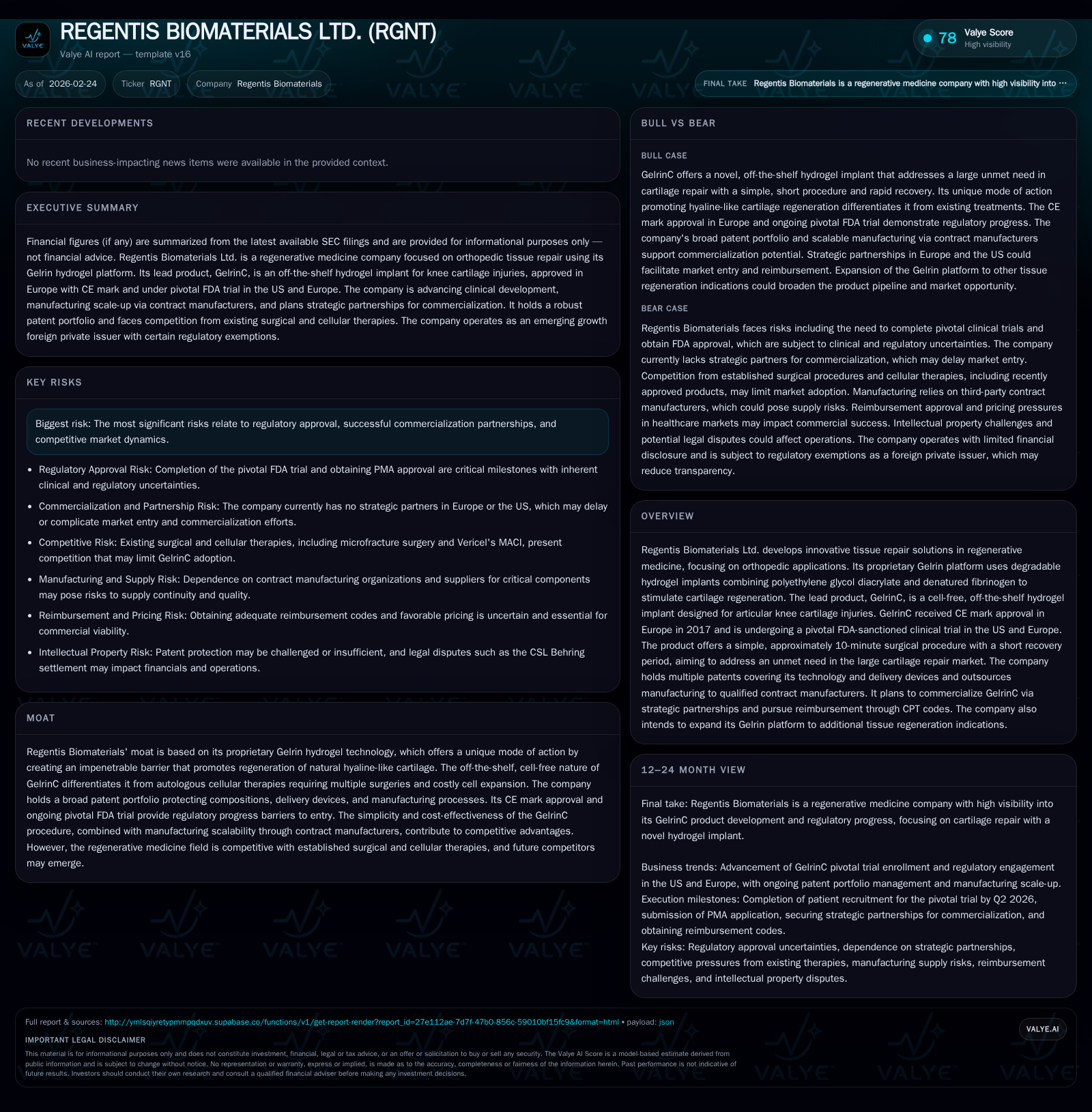
Regentis Biomaterials Ltd. operates as a regenerative medicine company targeting orthopedic cartilage repair through its cell-free GelrinC hydrogel implant, which received CE mark approval in 2017 and is progressing through pivotal FDA trials in the US and Europe. The company’s core moat derives from its unique hydrogel technology that offers a simplified, off-the-shelf treatment alternative to complex autologous cellular therapies, potentially enabling quicker patient recovery. However, it faces significant near-term execution risks related to regulatory approvals, strategic partnerships for commercialization, and competitive dynamics against established surgical and cellular alternatives. Financially, Regentis remains unprofitable with operating losses and negative cash flows but maintains a modest cash position while advancing clinical development.
Company Background and Technology
Regentis Biomaterials Ltd. is a regenerative medicine firm specializing in orthopedic tissue repair solutions, primarily focusing on cartilage injuries in the knee. Its proprietary Gelrin platform centers on degradable hydrogel implants composed of polyethylene glycol diacrylate (PEGDA) combined with denatured fibrinogen—a biologically inactive blood protein—forming a matrix designed to stimulate regeneration of natural hyaline-like cartilage tissue.
The lead product candidate, GelrinC, is an off-the-shelf, cell-free hydrogel implant cured into place during approximately a 10-minute surgical procedure. Unlike autologous cellular therapies requiring biopsies and cell expansion over several weeks before implantation (e.g., Vericel’s MACI), GelrinC offers a single-step approach with reduced surgical complexity [S27][S21]. It functions by creating an impenetrable barrier around the lesion site preventing migration of cells that ordinarily would form fibrotic cartilage; instead, it promotes contiguous regeneration from lesion edges inward.
Historical Performance
Regentis has advanced GelrinC through clinical development with CE marking obtained in Europe in 2017 under the EU medical device directive (now MDR). This regulatory milestone enabled limited marketing authorization within the European Economic Area but commercial presence remains nascent due to lack of strategic partners and ongoing plans to identify distributors.
Financial disclosures do not indicate any recorded product revenue to date [F1]. Over recent years, the company has funded its activities primarily through equity issuances and grants. As per FY2025 data ending December 31, Regentis reported an operating loss of approximately $7 million and net loss of nearly $13.6 million [F1]. Operating cash flow was negative $1.4 million indicating continued investment into clinical programs without cash generation [F1]. Equity stood at just under $4.75 million with cash reserves around $7.4 million providing limited liquidity cushion considering ongoing expenditures [F1].
Historical performance (annual)
| FY |
|---|
| 2025 |
Note: Omitted columns lack sufficient annual XBRL coverage in the provided tags (need ≥2 annual points): Rev, Net, CFO, OpInc, Capex, Div, Buybacks, FCF, ROE%. Source: SEC companyfacts cache [F1].
Note: Revenue data not publicly available.
Future Growth Prospects
The core growth driver hinges on successful advancement and completion of the ongoing pivotal clinical trial under FDA oversight in both the US and European markets [S1][S3]. Achieving FDA PreMarket Approval (PMA) will enable commercial sales expansion, particularly crucial given GelrinC’s competitive differentiation as a simpler, cost-effective alternative for knee cartilage repair [S27].
Additional potential upside lies in expanding indications beyond knee injuries into other joints such as elbow or wrist through post-approval studies [S27]. The company also anticipates leveraging its patent portfolio spanning compositions of matter and delivery devices to defend market exclusivity against competitors.
However, growth could be capped by factors including regulatory delays or failures during clinical trials; inability to secure reimbursement pathways or CPT codes critical for physician adoption; failure to establish effective strategic partnerships especially in Europe where no current partner exists; and intensifying competition from products like Smith & Nephew’s recently approved FDA cleared Agili-C which targets similar indications albeit with different mechanisms [S21].
Forecasts, Milestones, and What to Watch
Explicit guidance remains sparse besides management’s target to complete patient enrollment and follow-up in its pivotal FDA trial as primary catalysts for future commercial approval applications [S27]. Market watchers should track:
- Clinical trial progress updates including enrollment numbers, safety/efficacy readouts.
- Regulatory communications regarding PMA submission timelines.
- Strategic partnership developments especially channel agreements for Europe rollout.
- Reimbursement landscape progress including CPT code assignment.
- Competition trajectory around emerging cartilage repair technologies.
Returns and Capital Allocation
Due to lack of revenue generation, Regentis currently exhibits negative returns on equity; based on FY2025 figures net income relative to equity implies an ROE near -288% reflecting developmental stage losses [F1]. The company has not declared dividends nor engaged in share repurchase activities given its focus on clinical advancement.
Operating cash flow remained negative implying continued consumption of liquidity to fund operations without offsetting inflows from product sales [F1]. Manufacturing is outsourced via contract manufacturers reducing fixed capital needs but amplifying dependency risks related to quality compliance and supply chain robustness.
Competitive Moat and Risks
GelrinC’s moat stems primarily from its differentiated hydrogel technology offering a non-cellular implant that promotes true hyaline-like cartilage regrowth via a barrier effect rather than fibrotic repair [S25][S27]. Its off-the-shelf nature circumvents multi-stage procedures associated with autologous chondrocyte implantation techniques dominant currently in the space.
Patent protection encompassing biochemical composition plus innovative delivery system patents further consolidate defensibility against new entrants [S25]. Regulatory accomplishments such as CE marking strengthen product credibility alongside forthcoming FDA milestones.
Key risks include:
- Regulatory: Failure or delay in FDA approval could materially set back timelines.
- Commercial: Absence of existing strategic sales partners slows market penetration prospects.
- Reimbursement: Uncertain coverage policies may restrict adoption especially if payors classify usage under broader surgical bundles without adequate coding distinctions.
- Competition: Established players with cellular therapies carry entrenched clinician familiarity despite procedural complexity.
- Litigation: Ongoing dispute legacy with CSL Behring involving purchase commitments poses contingent liabilities [S16].
Operational Footprint
Regentis operates out of Herzliya, Israel headquarters leasing office space for approximately $5,500/month inclusive of administrative charges with no owned manufacturing facilities relying entirely on qualified contract manufacturers under stringent quality system regulation adherence required by FDA QSR standards [S19][S20].
This asset-light model economizes capital outlays but necessitates robust supply chain governance given critical medical device output compliance demands.
Conclusion
Regentis Biomaterials remains positioned at a critical inflection point from pure clinical-stage developer toward potential US market entrant pending positive pivotal study results and regulatory approvals for GelrinC. The company’s differentiated hydrogel based treatment presents compelling advantages over existing cellular alternatives if successfully commercialized. Nonetheless, realization of value depends heavily on navigating complex regulatory pathways, securing effective commercialization deals primarily in Europe, obtaining supportive reimbursement structures particularly CPT codes in the US, and contending against established orthopedic product incumbents. Financially constrained currently by developmental expenditures reflected in operating losses and modest liquidity reserves underscores cautious monitoring ahead.
This report summarizes publicly available information as filed with the SEC up to February 24, 2026 and does not constitute investment advice.
Disclaimer: This is research-only, informational analysis and not investment advice. It may include AI-generated interpretation and general industry context. Always verify important details using primary sources.

Comments