
Palomar Holdings’ Growth Fueled by Specialty Product Expansion and Strategic Acquisition
Palomar Holdings has demonstrated robust premium growth and diversification in specialty insurance, supported by data-driven underwriting and an expanded distribution network.
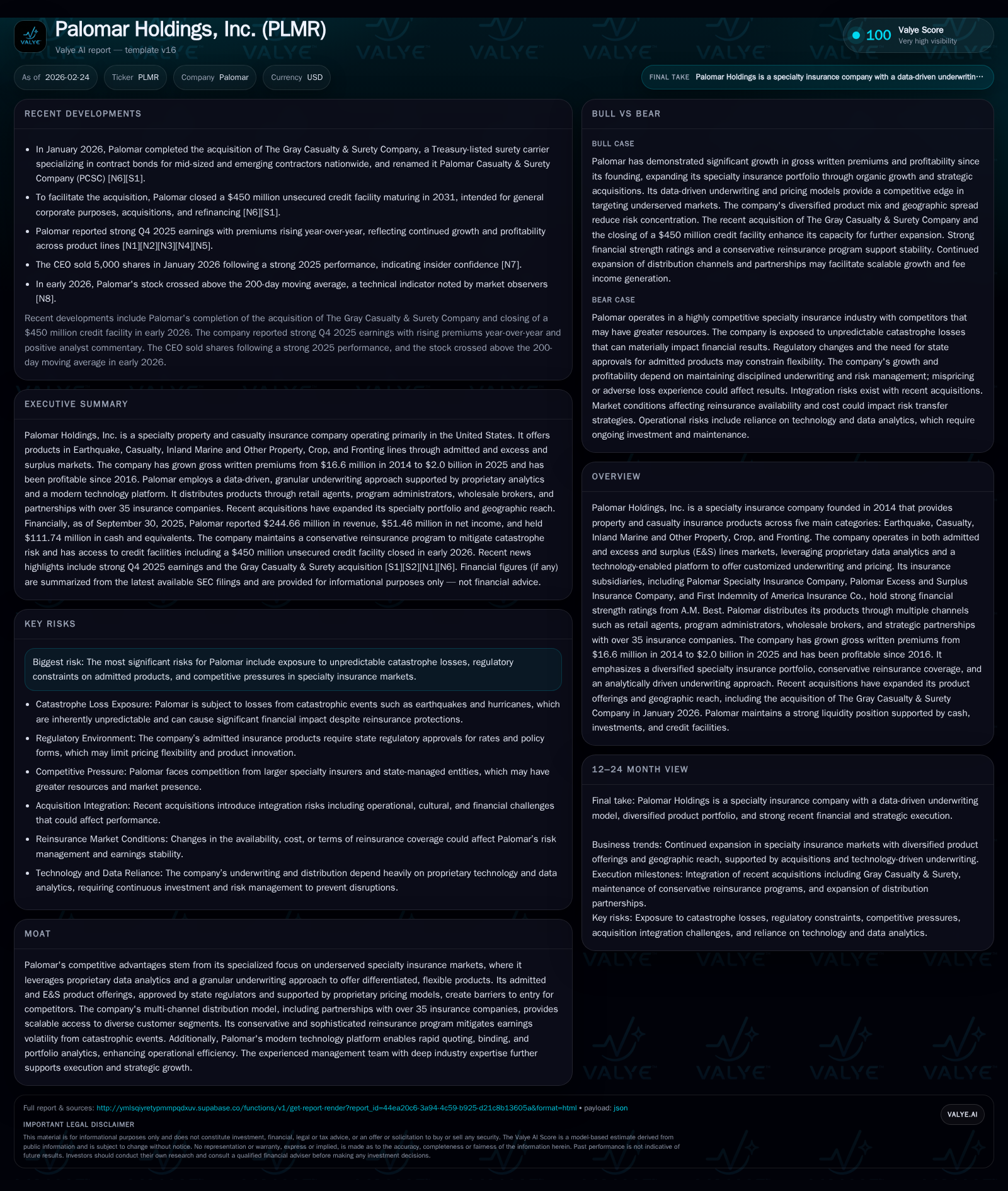
Since its founding in 2014, Palomar Holdings, Inc. has rapidly grown gross written premiums to over $2 billion by 2025, driven primarily by its focus on specialty insurance markets such as earthquake and crop insurance. The company’s utilization of proprietary data analytics for granular underwriting and pricing distinguishes it in a competitive landscape. Recent strategic moves, notably the acquisition of The Gray Casualty & Surety Company, further diversify its product portfolio with surety bonds. While the company maintains strong returns on equity with disciplined risk management including sophisticated reinsurance programs, it remains exposed to catastrophe risk and regulatory constraints. Key metrics show accelerating revenue and net income growth alongside solid operating cash flow generation and meaningful share repurchases, underscoring a robust financial profile.
Company Overview and Market Position
Founded in 2014, Palomar Holdings, Inc. targets underserved specialty insurance markets with property and casualty products across five core categories: Earthquake, Casualty, Inland Marine and Other Property, Crop, and Fronting/Surety lines [S1][S6][S22]. Its operating subsidiaries hold strong financial strength ratings (“A” from A.M. Best), underlining solid capital adequacy [S1][S10].
Palomar's business model emphasizes sophisticated data analytics combined with experienced underwriting to offer finely tuned pricing at ZIP or geocode levels—contrasting with broader industry approaches that rely on less granular models [S10][S11]. This capability is particularly evident in their earthquake insurance line where regional soil types and fault proximity are factored for precision risk assessment.
The company employs a multi-channel open architecture distribution system: retail agents drive personal lines growth while wholesale brokers and program administrators cater to commercial segments [S10][S25]. Partnerships with over 35 other insurers extend reach and flexibility.
Historical Performance Trends
Since inception, Palomar has experienced exceptional growth in gross written premiums (GWP), expanding from $16.6 million in its first year to approximately $2.0 billion by the end of 2025—a compound annual growth rate near 55% [F1][S1]. Revenue similarly surged, increasing by nearly 58% year-over-year from $554 million in 2024 to $876 million in 2025 [F1]. Net income followed suit with a robust jump of almost 68%, reaching $197 million [F1].
Operating cash flow has demonstrated equally strong momentum, advancing from about $261 million in 2024 to over $409 million in 2025 [F1], evidencing effective cash generation aligned with underwriting success.
Historical performance (annual)
| FY | Rev ($mm) | Net ($mm) | CFO ($mm) | Capex ($) | Rev YoY | Net YoY |
|---|---|---|---|---|---|---|
| 2025 | 876 | 197 | 409 | 137000 | +58.2% | +67.6% |
| 2024 | 554 | 118 | 261 | 243000 | +47.3% | +48.4% |
| 2023 | 376 | 79 | 116 | 15000 | +14.9% | +51.8% |
| 2022 | 327 | 52 | 170 | 313000 |
Note: Omitted columns lack sufficient annual XBRL coverage in the provided tags (need ≥2 annual points): OpInc, Div. Source: SEC companyfacts cache [F1].
Capital returns and efficiency (annual)
| FY | Buybacks ($mm) | FCF ($mm) | ROE% |
|---|---|---|---|
| 2025 | 37 | 409 | 20.9 |
| 2024 | 0 | 261 | 16.1 |
| 2023 | 22 | 116 | 16.8 |
| 2022 | 34 | 169 | 13.6 |
Source: SEC companyfacts cache [F1].
Note: Operating income data is not available from provided tags; no dividends have been declared as per filings.
This scaling reflects the firm’s effective penetration into specialty niches such as California earthquake — where it ranks second-largest insurer — along with national expansion in crop and casualty insurance markets [S6][S14].
Growth Drivers and Future Outlook
Palomar's growth trajectory is supported by several strategic initiatives:
- Product Portfolio Diversification: The company has expanded beyond earthquake insurance into Crop, E&S Casualty, Surety (via Gray Surety acquisition), and Environmental Liability products broadening its specialty portfolio [S22][N6].
- Geographic Expansion: Licensed nationally across all U.S. states through admitted subsidiaries enables geographic diversification beyond California concentration (~31% GWP) [S14][S29].
- Technology Platform: Proprietary analytics enable rapid quoting and underwriting at granular levels enhancing competitive positioning and operational efficiency [S11][S25].
- Multi-channel Distribution: An open architecture model incorporating retail agents for personal lines plus wholesale brokers and program administrators for commercial lines supports scalable market access [S10][S25].
- Strategic Acquisition: In January 2026, Palomar completed the acquisition of The Gray Casualty & Surety Company funded via a new $450 million unsecured credit facility expanding specialty offerings into surety bonds rated “A-” by A.M. Best [N6][S13][S22].
Challenges remain around exposure to catastrophic events influenced by climate change trends; regulatory complexities especially related to admitted product approvals; plus competitive pressures from established carriers such as Chubb and government-affiliated entities like the California Earthquake Authority [S1][S21].
Financial Health: Capital Allocation & Returns
Palomar delivers attractive returns highlighted by an estimated return on equity near 21% for FY25 based on net income relative to shareholders' equity ($943 million) reported at year-end [F1]. This underscores efficient capital utilization amid industry cyclicality.
Operating cash flows of approximately $409 million comfortably exceed minimal capital expenditure needs ($0.14 million), resulting in substantial free cash flow ($409 million) available for reinvestment or shareholder returns [F1].
Share repurchase activity resumed strongly with $37 million executed during FY25 after no buybacks the prior year, reflecting management confidence in value creation without dividend payments as yet declared [F1][S18].
Risk management is supported by a comprehensive reinsurance program that caps net losses per catastrophic event—for example, earthquake losses are capped near $20 million—mitigating earnings volatility relative to total equity [S25]. Liquidity remains strong with over $106 million cash equivalents at fiscal year-end backed by high-quality fixed income investments consistent with preservation objectives [F1][S19].
Industry Context & Competitive Positioning
The specialty insurance market is highly competitive and cyclical due to catastrophe frequency/severity dynamics alongside evolving regulatory environments governing admitted versus surplus lines carriers.
Palomar’s differentiated approach leverages proprietary analytics allowing precise risk pricing at very granular geographic levels—especially in earthquake coverage—targeting underserved niches overlooked or inefficiently served by generalist insurers relying on broader rating zones [S10][S11][S14]. Competitors include specialized insurers like Kinsale Capital Group as well as public programs such as the National Flood Insurance Program influencing market conditions [S12]. The company’s “A” ratings from A.M. Best support credibility essential for broker/agent partnerships critical for scaling distribution.
Conclusion
Palomar Holdings continues to build on its data-driven underwriting expertise combined with a diversified specialty product suite distributed across multiple channels achieving significant premium growth and profitability since inception. Recent strategic moves—including the Gray Surety acquisition supported by newly arranged credit facilities—enhance diversification prospects balancing exposures across property-catastrophe to surety bonds. Strong financial metrics demonstrate efficient capital deployment complemented by substantial operating cash flows underpinning buyback initiatives amid absence of dividends. Nevertheless, risks related to catastrophe loss volatility driven by climate trends plus regulatory constraints require ongoing disciplined management. Investors should monitor upcoming quarterly results for premium growth sustainability, loss ratio developments post-catastrophes if any arise given recent weather patterns, reinsurance renewal terms/pricing shifts, integration progress of acquisitions, and regulatory developments affecting pricing/coverage frameworks.
This report is prepared for informational purposes only; it does not constitute investment advice or recommendation.
Disclaimer: This is research-only, informational analysis and not investment advice. It may include AI-generated interpretation and general industry context. Always verify important details using primary sources.

Comments