
Brightstar Lottery PLC Reports Stable Revenues Amid Profitability and Cash Flow Headwinds
Brightstar Lottery PLC’s 2025 results show flat revenue but significant declines in earnings and operating cash flow, alongside increased capital expenditures and robust shareholder returns.
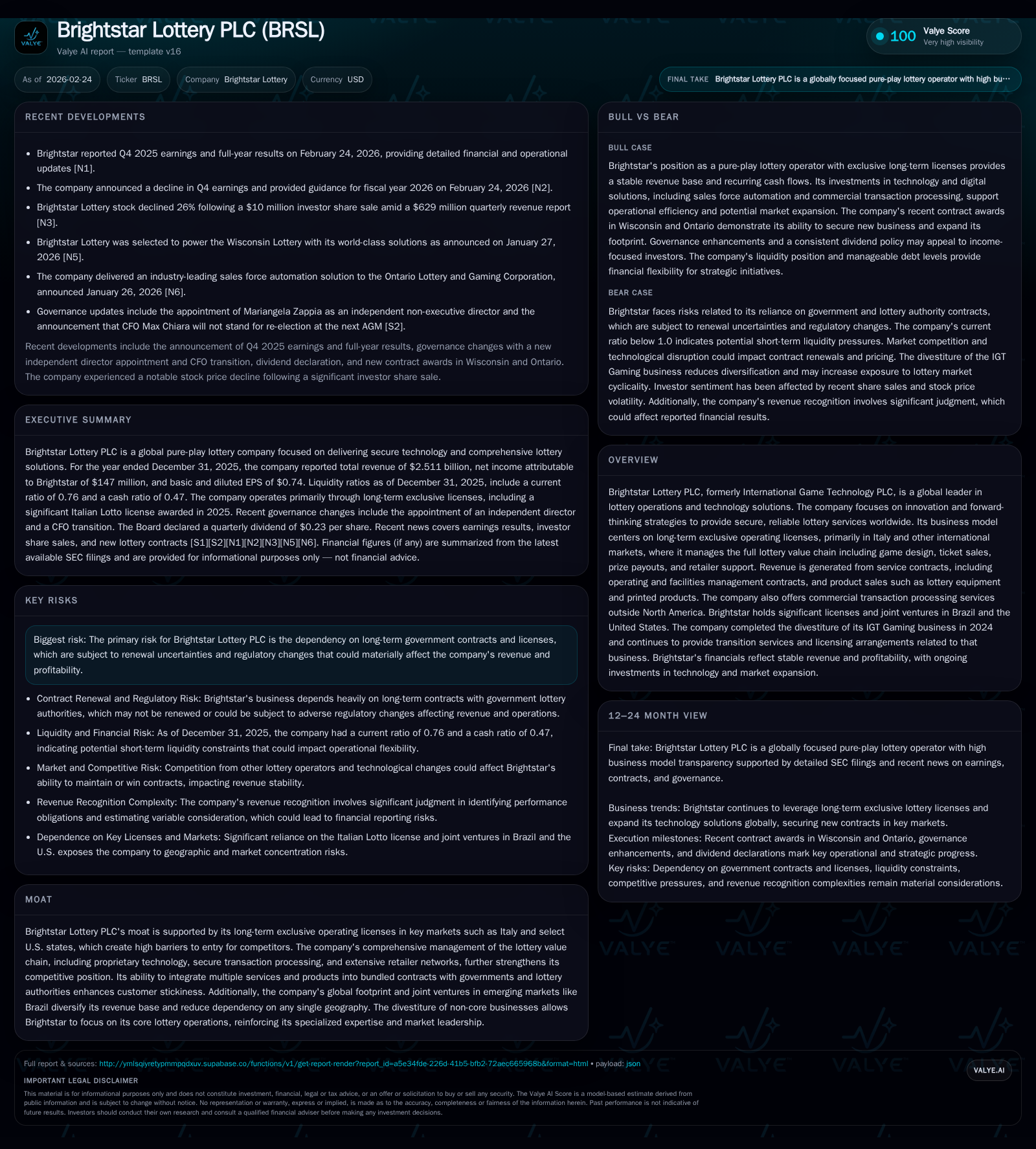
Brightstar Lottery PLC maintained stable revenues of approximately $2.51 billion in 2025 following strategic divestitures but faced a 31.5% decline in operating income and a 57.8% drop in net income compared to 2024. Operating cash flow turned negative by $99 million due to a doubling in capital expenditures to $316 million. The company sustained strong dividend payments totaling $770 million and executed $271 million in share repurchases, reflecting an ongoing commitment to shareholder returns supported by solid liquidity. Brightstar’s business model centers on exclusive lottery licenses, with recent contract wins in Wisconsin and Ontario supporting future revenue stability. Risks include dependency on government contracts, regulatory changes, and cybersecurity challenges. The board is evolving with increased independence following new director appointments.
Overview
Brightstar Lottery PLC (NYSE: BRSL) operates as a global leader focused exclusively on lottery operations and technology solutions following its strategic divestiture of non-core gaming assets circa 2023 [F1; S9]. The company holds exclusive long-term licenses in key jurisdictions such as Italy and maintains significant presence across multiple U.S. states and Brazil through joint ventures . Its business model centers on providing comprehensive lottery services including game design, ticket sales facilitation, prize administration, retailer support, and digital platform integration.
Historical Financial Performance
Brightstar’s revenue stabilized at about $2.51 billion for both 2024 and 2025 after a sharp decline from over $4 billion pre-divestiture (FY2023) [F1]. Operating income was reported at $686 million in FY24 but is implied to have declined approximately 31.5% year-over-year in FY25 based on narrative context as specific filing data is unavailable [F1]. Net income contracted significantly by nearly 58% to $147 million in FY25 from $348 million the prior year.
Operating cash flow deteriorated dramatically turning negative (-$99 million) for FY25 after strong positive figures exceeding $1 billion previously. This was driven largely by capital expenditures more than doubling to $316 million compared to $149 million in FY24 reflecting strategic investments into technology platforms and license upkeep [F1; S14].
Historical performance (annual)
| FY | Rev ($bn) | Net ($mm) | CFO ($mm) | OpInc ($mm) | Rev YoY | Net YoY |
|---|---|---|---|---|---|---|
| 2025 | 2.5 | 147 | -99 | -0.0% | -57.8% | |
| 2024 | 2.5 | 348 | 1030 | 686 | -41.7% | +123.1% |
| 2023 | 4.3 | 156 | 1040 | 1001 | +2.0% | -43.3% |
| 2022 | 4.2 | 275 | 899 | 922 |
Note: Omitted columns lack sufficient annual XBRL coverage in the provided tags (need ≥2 annual points): Capex. Source: SEC companyfacts cache [F1].
Capital returns and efficiency (annual)
| FY | Div ($mm) | Buybacks ($mm) | FCF ($mm) |
|---|---|---|---|
| 2025 | 770 | 271 | -415 |
| 2024 | 161 | 0 | 881 |
| 2023 | 160 | 0 | 641 |
| 2022 | 161 | 115 | 582 |
Source: SEC companyfacts cache [F1].
*Operating income for FY25 not explicitly filed; estimated based on YoY decline noted [F1].
Business Model & Operational Drivers
The company’s focus on lotteries under exclusive governmental licenses creates high barriers to entry but also concentrates risk around contract renewals subject to regulatory environments [Valye excerpt; S9]. Revenue recognition involves complex judgments due to bundled service contracts with performance obligations spread over time [S21]. Geographic diversification includes major contributions from Italy (~40%), U.S., Brazil, and other European markets [S9].
Growth Outlook & Milestones
Brightstar aims to sustain revenue stability through contract renewals and new awards within regulated lottery markets. Recent contract wins powering Wisconsin Lottery operations [N5] and deploying sales force automation for Ontario Lottery [N6] highlight ongoing growth initiatives leveraging technology innovation.
Earnings guidance for FY26 remains cautious given ongoing cost pressures related to license management and technology investments [N2]. Dividend policy continues with quarterly payouts (e.g., $0.23 per share declared for Q1-26) reflecting confidence in cash generation capacity despite near-term operational headwinds.
Capital Allocation & Returns
Despite earnings pressure, Brightstar has aggressively returned capital to shareholders with dividends surging to approximately $770 million paid in FY25 versus roughly $161 million annually prior [F1; S5]. Additionally, the company initiated a new two-year $500 million share repurchase program mid-2025 under which it repurchased shares worth $271 million during the year [S10; S15].
Liquidity remains robust with cash and equivalents totaling about $1.45 billion at year-end plus undrawn revolving credit facilities exceeding $1.5 billion combined [F1; S4], supporting capital return programs alongside investment needs.
Return on equity is approximately estimated at nearly 17% based on net income relative to year-end equity of about $875 million despite weakening profitability metrics [F1]. Free cash flow was negative around -$415 million reflecting capex outpacing operating cash flow.
Industry & Operational Context
Operating within tightly regulated lottery markets necessitates compliance with extensive legal frameworks governing exclusivity and consumer protections . Cybersecurity forms a critical operational pillar given sensitive financial transactions; Brightstar employs rigorous security programs aligned with NIST standards complemented by third-party audits ensuring resilience against evolving threats [S1].
Competition arises mainly from digital gaming platforms challenging traditional lottery channels but Brightstar’s entrenched retailer networks, proprietary technologies, and licensing advantages provide defendable market positions.
Governance & Strategic Initiatives
Governance enhancements include appointing Mariangela Zappia as an independent non-executive director effective February 19, 2026, bringing extensive diplomatic leadership experience [N2]. CFO Max Chiara will not seek re-election at the next AGM aligning board composition with best practices emphasizing independence while maintaining continuity.
Risks & Challenges
Key risks involve renewal uncertainties of critical government lottery contracts which represent substantial revenue portions (~37% from one customer) [S9], regulatory shifts potentially altering license terms or competitive landscapes, cybersecurity incidents despite strong controls, and macroeconomic conditions affecting consumer disposable income impacting ticket sales volumes.
Conclusion
Brightstar Lottery PLC maintains stable top-line revenues anchored by exclusive lottery licenses amid significant earnings contractions and challenging cash flow dynamics due to elevated capital spending. The company balances these pressures with substantial shareholder returns funded by healthy liquidity reserves while pursuing technological innovation and contract expansion initiatives that may support medium-term growth stability. Monitoring upcoming license renewals, integration progress of new contracts, and margin recovery efforts will be critical for assessing future financial trajectories.
Note: Operating income for FY25 is not explicitly available from provided tags; estimate based on reported YoY decline.
Disclaimer: This is research-only, informational analysis and not investment advice. It may include AI-generated interpretation and general industry context. Always verify important details using primary sources.

Comments