
Transocean’s Financial Restructuring and Merger Strategy Amid Offshore Market Volatility
Transocean Ltd. faces profitability challenges while pursuing a major merger to consolidate its position in the offshore drilling sector.
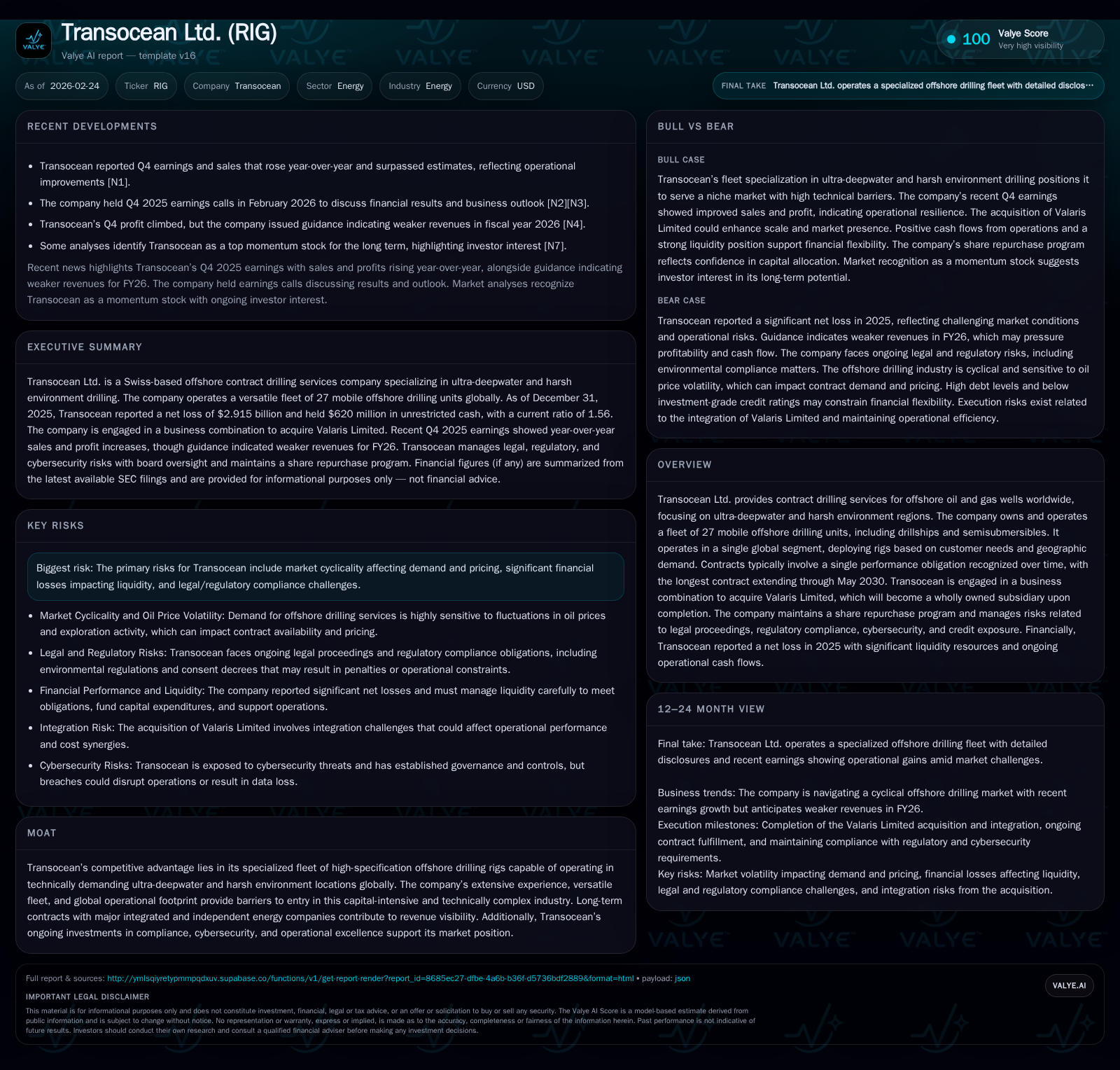
Transocean Ltd., a Swiss-based offshore drilling contractor specializing in ultra-deepwater and harsh environment rigs, reported a steep increase in net losses in 2025 driven by depressed market conditions and impairments. Despite improved cash flow from operations and controlled capital expenditures, the company’s operating income remains deeply negative. Transocean is currently executing a transformative merger with Valaris Limited, aiming to create scale and operational synergies amid an uncertain offshore drilling demand environment. The company maintains substantial liquidity supported by secured debt facilities but faces significant debt maturities over the next five years. Key investor focus will center on integration progress, contract backlog evolution, and capital allocation discipline.
Company Overview and Fleet Composition
Transocean Ltd. is positioned as a leading global offshore driller focused on providing contract drilling services for technically demanding ultra-deepwater and harsh environment locations worldwide. Its diversified fleet consists of 27 mobile offshore drilling units—20 ultra-deepwater drillships and 7 harsh environment semisubmersibles—offering versatility across multiple geographies including the U.S., Brazil, Norway, and other regions. This specialization creates structural barriers given the high capital intensity and technical expertise needed for these assets.
Contracts typically encompass performance obligations satisfied over the contract period, with the company's longest recorded drilling contract extending through May 2030, anchoring part of its revenue base.[S12][S26]
Historical Financial Performance
Over recent years, Transocean's financial results reflect both industry cyclicality and company-specific execution challenges. In FY2025, revenues declined substantially by approximately 35%, falling from around $6.14 billion (FY2024) to roughly $3.97 billion as upstream spending slowed and dayrates softened across offshore markets[F1]. This translated into severe operating losses amounting to about -$2.34 billion in FY2025 compared to -$417 million the previous year, indicating significant impairment charges or restructuring costs likely related to fleet optimization or underutilized assets.
Net income mirrored this pattern with losses deepening sharply from -$512 million in FY2024 to near -$2.92 billion in FY2025, eroding shareholders' equity returns and pushing ROE down to an estimated -36% based on net income over equity[F1]. Despite operating losses, cash flows from operations rose commendably by nearly 68% to approximately $749 million due largely to working capital improvements and disciplined cost controls.
Capital expenditures were curtailed aggressively during this period as capex dropped from $254 million in FY2024 to just $123 million in FY2025—a little over half year-on-year—as management prioritized liquidity preservation during weak demand[F1].
Historical performance (annual)
| FY | Net ($bn) | CFO ($mm) | OpInc ($bn) | Capex ($mm) | Net YoY |
|---|---|---|---|---|---|
| 2025 | -2.9 | 749 | -2.3 | 123 | -469.3% |
| 2024 | -0.5 | 447 | -0.4 | 254 | +46.3% |
| 2023 | -1.0 | 164 | -0.3 | 427 | -53.6% |
| 2022 | -0.6 | 448 | -0.0 | 717 |
Note: Omitted columns lack sufficient annual XBRL coverage in the provided tags (need ≥2 annual points): Rev, Div, Buybacks. Source: SEC companyfacts cache [F1].
Capital returns and efficiency (annual)
| FY | FCF ($mm) | ROE% |
|---|---|---|
| 2025 | 626 | -36.0 |
| 2024 | 193 | -5.0 |
| 2023 | -263 | -9.2 |
| 2022 | -269 | -5.8 |
Source: SEC companyfacts cache [F1].
Note: Revenue exact annual amounts prior to FY2018 not provided; CFO/Capex data limited.
Strategic Merger with Valaris Limited
In early February 2026, Transocean announced a definitive agreement to acquire Valaris Limited via a stock-for-stock business combination that would make Valaris a wholly owned subsidiary upon completion[S15]. The deal offers an exchange ratio of approximately 15.235 Transocean shares per Valaris share[N9]. Both boards unanimously approved the merger which aims at consolidating market share in an oversupplied offshore rig market challenged by fluctuating oil prices.
The transaction is structured as a scheme of arrangement subject to Bermuda Supreme Court sanction and regulatory approvals before closing.
This strategic move reflects industry consolidation trends designed to optimize utilization rates, reduce fixed overheads, and enhance bidding power for new contracts amid cyclical demand fluctuations.
Capital Structure and Liquidity Position
As of year-end 2025, Transocean maintained significant liquidity resources including roughly $620 million in unrestricted cash along with $377 million restricted for debt service obligations[F1][S18]. It also holds access to a secured revolving credit facility with maximum borrowing capacity around $510 million maturing mid-2028[S10]. This credit line is secured primarily by liens on eight ultra-deepwater drillships and two harsh-environment semisubmersibles with an aggregate carrying amount exceeding $4 billion[S4].
Despite liquidity cushions, Transocean carries substantial debt obligations totaling approximately $5.69 billion principal amount owed across multiple note series[S5]. The company faces meaningful near- and medium-term maturities: about $458 million scheduled within calendar year 2026 followed by rising annual repayments peaking at over $1.2 billion due in some years before tapering off after 2030[S5]. Such concentrations necessitate active capital management including potential refinancing or asset monetization initiatives.
Senior secured notes include covenants restricting dividend payments or share repurchases tied directly to earnings generated by collateralized rigs[S22], limiting free cash flow deployment flexibility.
Capital Allocation: Dividends and Buybacks
No dividends paid information is available from the provided XBRL tags; therefore, dividend history cannot be confirmed from current data[F1]. No recent share repurchases occurred according to disclosed figures but an authorized share repurchase program approved since May 2009 allows buybacks up to CHF3.24 billion (~$4.09 billion)[S7][S8]. This program remains dormant amid ongoing balance sheet repairs but could be reactivated subject to board decisions aligned with liquidity needs and market conditions.
Any repurchased shares would primarily be canceled unless held in treasury for employee incentive plans or future capital transactions.
Operating Environment and Risks
Market cyclicality remains the primary risk driver for Transocean given the capital-intensive nature of offshore rig deployment which depends heavily on oil exploration investment decisions tied closely to commodity price dynamics[S11]. Dayrate volatility challenges margins especially on older or less specialized rigs increasing contractual pressure.
Legal risks exist from environmental matters such as asbestos-related claims tied historically to legacy equipment manufacturing subsidiaries; while management expects these exposures not material on balance sheet valuations, uncertainties persist given litigation progressions[S20].
Cybersecurity constitutes another operational risk vector addressed actively through governance frameworks involving board oversight and executive accountability for program implementation[S1].
Financially, Transocean’s below investment grade credit rating raises borrowing costs on existing secured facilities[S21], potentially constraining future access under adverse conditions.
Growth Outlook
Explicit forward-looking guidance or growth outlook metrics are not available from provided SEC filings or company disclosures within the supplied evidence sets[S26][N11]. The company did issue commentary acknowledging weak revenue expectations for fiscal year 2026 amid challenging market conditions[N11], signaling subdued near-term growth prospects.
Investors should monitor updates on backlog development, contract awards particularly for ultra-deepwater rigs which command premium rates, as well as integration progress post-Valaris merger for clearer growth trajectory signals.
What To Watch: Key Future Milestones
- Completion timing and integration success of the Valaris merger given its impact on fleet composition, cost synergies, and market positioning[S15][N9].
- Contract backlog development including new awards especially for ultra-deepwater rigs which provide higher margins.
- Management’s ability to moderate capex while pursuing selective fleet upgrades balancing competitiveness against cash conservation.
- Debt refinancing strategies addressing large maturities commencing imminently in late-stage 2026[S5].
- Regulatory developments particularly environmental liability exposure resolution benchmarks.
- Cash flow generation sustainability enabling eventual return of capital initiatives such as dividends or buybacks if conditions improve.
This analysis relies solely on disclosed SEC filings as of February 23, 2026 [F1] alongside corroborative news reports from Nasdaq . No forward-looking statements beyond stated corporate guidance are provided herein; readers should consider macroeconomic factors impacting offshore energy markets when contextualizing this assessment.
Disclaimer: This is research-only, informational analysis and not investment advice. It may include AI-generated interpretation and general industry context. Always verify important details using primary sources.

Comments