
ManpowerGroup Inc. Confronts Profit Pressure While Leveraging Global Workforce Networks
The global staffing giant faces significant operating income contraction yet relies on its expansive service portfolio and geographic footprint for growth.
ManpowerGroup Inc. has experienced a steep decline in operating income over the last two years, reflecting the economic sensitivity inherent to global workforce solutions. Despite this profit pressure and a notable drop in operating cash flow turning negative in 2025, ManpowerGroup’s extensive network across over 70 countries and diversified services—including staffing under Manpower, IT resourcing via Experis, and integrated talent solutions through Talent Solutions—support its efforts to sustain market leadership. Future growth hinges on technology-enabled offerings such as AI-driven assessments and upskilling platforms, while regulatory complexity and competitive pressures pose ongoing challenges. The company maintains dividend payments above a 5% yield but has curtailed share repurchases amid cash flow constraints. Monitoring quarterly operating metrics and client contract renewals will be critical to gauge recovery momentum.
Historical Earnings Volatility: Unpacking Two Years of Profit Compression
ManpowerGroup’s financial trajectory over the past several years reveals pronounced earnings volatility culminating in a critical profit squeeze by FY2025. Operating income plummeted from $581.7 million in FY2022 to $150.1 million in FY2025, marking a steep 50.9% decrease year-over-year despite relatively stable net income data available only through FY2019 [F1]. This disproportionate decline reflects cost pressures, pricing competition, and economic headwinds affecting global employment demand.
The free cash flow outlook deteriorated sharply as well; operating cash flow (CFO) swung from healthy positive inflows ($423.3 million in FY2022 to $309.2 million in FY2024) into a negative position of -$104.1 million by FY2025 [F1]. Capital expenditures grew moderately from $51.1 million to $57.3 million during the same period, further straining liquidity [F1]. These cash dynamics foreshadowed the company’s recent conservative stance on buybacks.
Historical performance (annual)
| FY | CFO ($mm) | OpInc ($mm) | Capex ($mm) |
|---|---|---|---|
| 2025 | -104 | 150 | 57 |
| 2024 | 309 | 306 | 51 |
| 2023 | 348 | 256 | 78 |
| 2022 | 423 | 582 | 76 |
Note: Omitted columns lack sufficient annual XBRL coverage in the provided tags (need ≥2 annual points): Rev, Net, ROE%. Source: SEC companyfacts cache [F1].
Capital returns and efficiency (annual)
| FY | Div ($mm) | Buybacks ($mm) | FCF ($mm) |
|---|---|---|---|
| 2025 | 67 | 38 | -161 |
| 2024 | 146 | 140 | 258 |
| 2023 | 144 | 180 | 270 |
| 2022 | 140 | 270 | 348 |
Source: SEC companyfacts cache [F1].
Note: Net income data unavailable beyond FY2019 per provided tags; revenue figures not disclosed.
Services and Sector Mix: Drivers Behind Past Revenue Trends
ManpowerGroup operates through its three primary brands—Manpower for contingent staffing and permanent recruitment; Experis focusing on IT professional resourcing; and Talent Solutions offering integrated workforce programs like Recruitment Process Outsourcing (RPO), Managed Service Provider (MSP), and career management services [S1]. Its portfolio spans permanent hiring, contract staffing, outcome-based engagements, training, and consulting.
Staffing/interim services consistently generate the bulk of revenues (84%-91% depending on region), underscoring the traditional dominance of contingent workforce management within the business model [S4][S6]. However, emerging segments such as outcome-based solutions (driving about 2%-12% regionally) reflect strategic moves towards longer-term client partnerships involving risk-sharing models [S4]. Permanent recruitment remains a smaller portion but offers value through higher-margin roles.
This mix reflects industry trends favoring workforce flexibility driven by client demand for agile labor solutions amidst uncertainty—embracing RPO/MSP capabilities where process efficiency gains and data analytics improve matching precision [S5]. Technologies embedded within ManpowerGroup’s PowerSuite platform serve as differentiators by incorporating AI-enabled candidate assessments that improve retention rates and speed hiring cycles [S1].
Geographic Performance: Regional Contributions and Challenges
ManpowerGroup’s geographic segmentation comprises Americas; Southern Europe; Northern Europe; Asia Pacific Middle East (APME) [S4][S6]. Americas dominates with approximately 553 branch and franchise offices (415 branches +138 franchises), especially concentrated in the U.S., accounting for ~63% of Americas revenue with extensive onsite client deployments [S5].
Southern Europe is dense with over 1,179 offices primarily across France (53% segment rev.) and Italy (22%), where industrial temporary recruitment commands high volume but exposes margin sensitivity due to local regulation [S14][S18]. Northern Europe includes operations in the UK—the largest within that segment—alongside Germany and Nordics across roughly 239 offices supporting diversified client segments [S18].
APME operates around 118 locations focused mainly in Japan and India, with a heavier weighting towards staffing/interim services but also expanding consulting solutions [S4]. The firm faces varying regulatory regimes impacting temporary worker utilization rules, pay parity mandates, licensing costs, and collective bargaining agreements which complicate pricing power particularly in Europe [S6]. This diverse landscape calls for nuanced local labor market expertise—a notable moat enhancing customer retention despite competitive fragmentation.
Growth Outlook Anchored in Technology-Enabled Workforce Solutions
Looking forward, ManpowerGroup aims to capitalize on secular shifts toward digital transformation across human capital management via AI-driven talent assessment tools integrated through PowerSuite [N9][S1]. The company emphasizes rapid upskilling/reskilling offerings addressing gaps exacerbated by fast-evolving technology stacks especially within Experis’ IT workforce resourcing vertical [N9][N13].
Talent Solutions stands out as a growth lever through expanded RPO/MSP contracts where end-to-end permanent recruitment outsourcing facilitates scale efficiencies and deeper client integration with outcome-based pricing models lowering client risk exposure [N1][N2][S1]. Upskilling initiatives packaged alongside contingent hires support clients' evolving skill adjacencies helping reduce attrition risk while enabling workforce agility.
Despite these catalysts, macroeconomic headwinds including potential recessionary pressures or slower corporate hiring temper near-term optimism [N6]. Demand cyclicality remains a core risk given the dependency on economic conditions influencing corporate budgets for both flexible labor procurement and training investments.
Near-Term Market Guidance and Investor Expectations Post Q4 Results
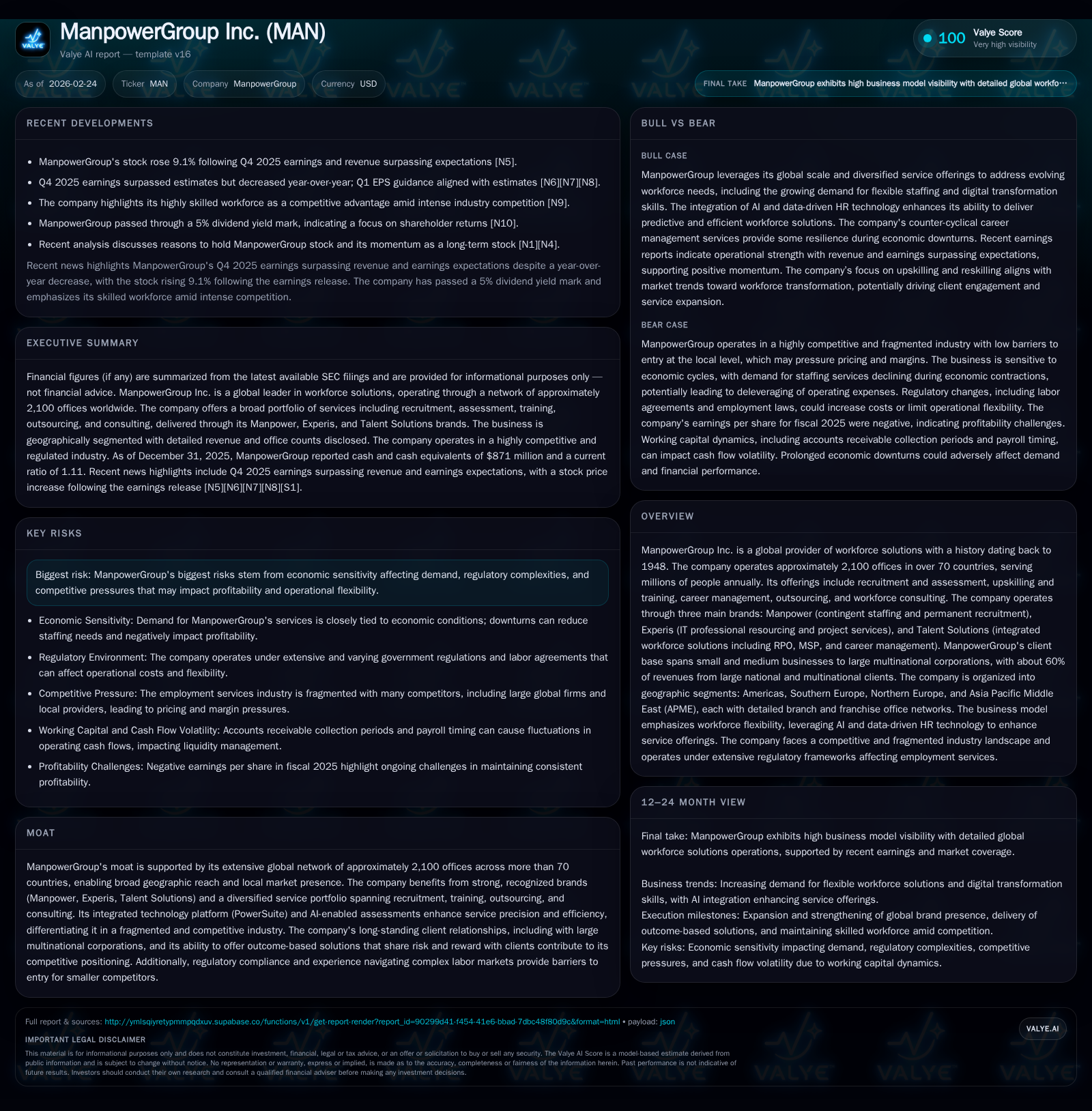
ManpowerGroup reported Q4 earnings that exceeded analyst estimates albeit registering lower year-on-year profitability—a signal of ongoing margin compression balanced by revenue resilience [N2][N5]. This elicited positive investor response reflected in a stock price increase of approximately +9% post-release [N1]. Management guided Q1 EPS inline with consensus expectations without providing aggressive forward commentary highlighting cautious optimism amid prevailing economic uncertainties [N11][N12].
The market will closely monitor execution on technology-driven service expansions alongside any early signs of stabilization or rebound in operating margins given the recent challenging backdrop.
Capital Allocation Amid Pressures: Dividends, Buybacks and Cash Flow Dynamics
Despite shrinking operating income and negative free cash flow (-$161 million estimated for FY2025), ManpowerGroup maintained dividend payments around $66.7 million translating into a dividend yield surpassing 5%, appealing amidst low-yield market conditions [F1][N10]. The firm demonstrated capital discipline by significantly reducing share repurchase activity—from $140 million in FY2024 down to $38 million in FY2025—reflecting constrained liquidity linked to deteriorating operating cash flows [F1].
Latest equity at approximately $2 billion versus net income approximations suggests a healthy return on equity near an approximate rate of 27%, though this relies on aged net income figures due to data limitations post-2019 [F1]. The sustainable balance between shareholder returns and reinvestment remains sensitive to improving operational cash generation.
Competitive Environment in Global Staffing Services
The employment services industry is both vast and fragmented with thousands of competitors ranging from multinational giants like Adecco group, Randstad to regional players such as Recruit Holdings or Kelly Services competing at local levels [S6]. ManpowerGroup leverages its scale advantage (roughly 2100 offices globally) alongside strong brand recognition across Manpower, Experis, Talent Solutions brands that command trust especially among multi-national clients who represent ~60% of revenues [S6][S14].
However, low barriers for small local firms combined with increasing consolidation among clients demands continuous innovation particularly on service model integration leveraging digital platforms with AI-based candidate matching capabilities—a key battleground where ManpowerGroup aims to stay ahead.[S6]
Regulatory Complexity as an Operational and Strategic Barrier
Labor regulations remain complex across countries impacting temporary staffing models via employer/employee relationship laws, licensing requirements, mandated pay parity rules, social benefits provisioning, as well as union-led collective bargaining frameworks affecting pricing flexibility [S6][N13]. For example, stringent French employment law governs temporary recruitment intensely especially for industrial sector roles impacting profitability profiles regionally.
While presenting challenges operationally—requiring ongoing compliance investments—the regulatory environment acts as a moat reducing newcomer threat since scale combined with legal expertise allows ManpowerGroup to better navigate these complexities than smaller firms relying heavily on localized knowledge.[S6]
What to Watch: Metrics and Milestones Signaling Recovery or Further Risks
Future monitoring should prioritize quarterly operating income trends indicating margin stabilization post recent sharp contraction alongside improvements in operating cash flow signaling better working capital management or cost control efforts.[N11]
Additionally, tracking expansion success within outcome-based workforce engagements along with governance around client contract renewals especially among large national or multinational organizations could presage volume recovery.[N2][N12]
The pace at which ManpowerGroup can scale its AI-powered assessments plus reskilling offerings within existing accounts—leveraging broad talent insights—will be key milestones defining growth trajectory amid competitive forces.[N9]
Overall investor focus ought toward operational agility underscored by disciplined capital allocation balancing shareholder returns against investment needs within technology enhancement-oriented growth avenues.
This analysis synthesizes publicly available SEC filings ([S#]), recent news reports ([N#]), and company facts financial data ([F1]) without incorporating speculative forecasts or investment recommendations.
Disclaimer: This is research-only, informational analysis and not investment advice. It may include AI-generated interpretation and general industry context. Always verify important details using primary sources.

Comments