
How Metropolitan Bank Holding Cultivates Niche Lending to Drive Financial Resilience
Metropolitan Bank Holding Corp. leverages focused middle-market lending and diversified deposits in the competitive New York metro banking landscape.
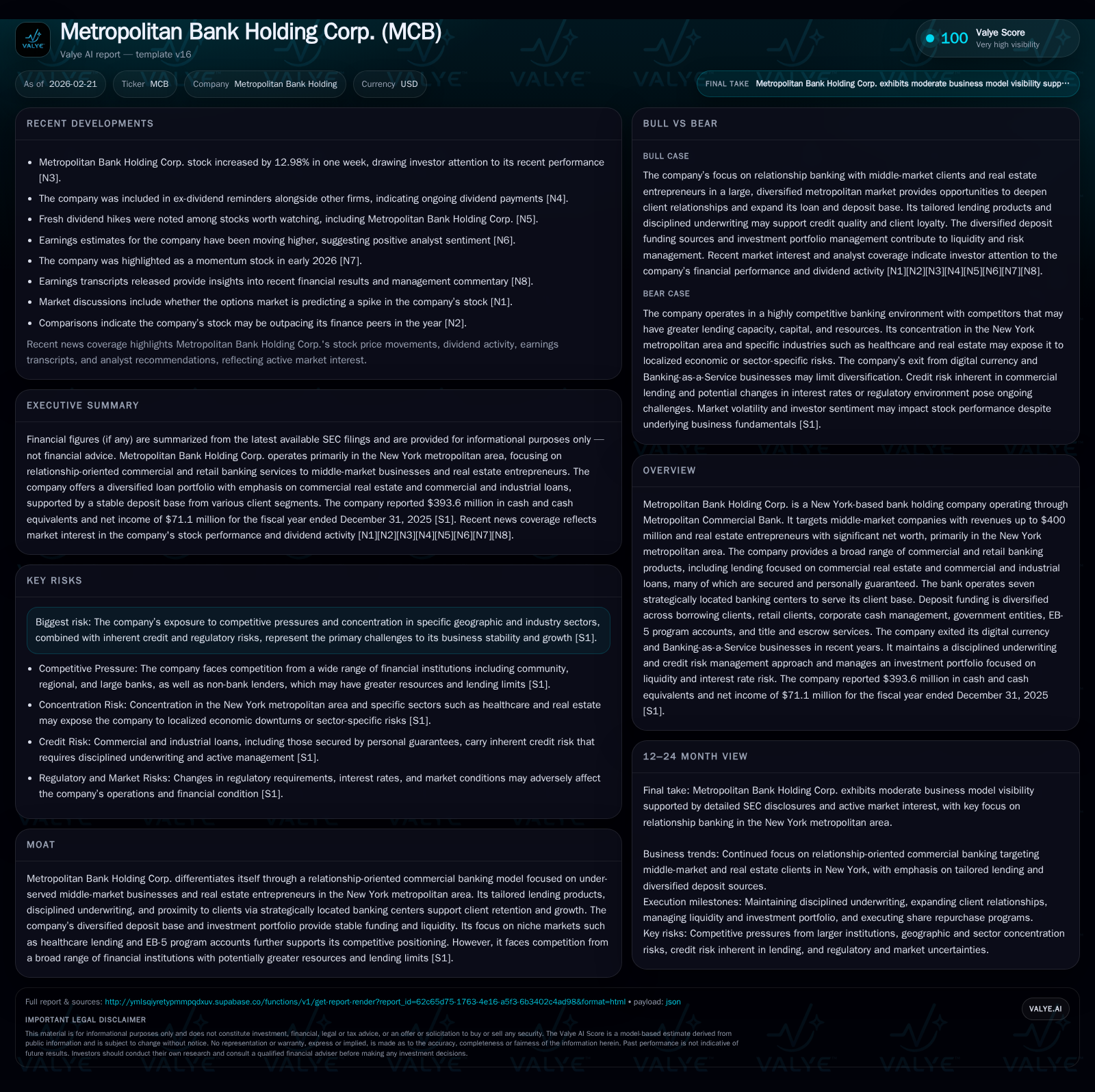
Metropolitan Bank Holding Corp. has demonstrated a notable rebound in net income following a loss in 2022, supported by its disciplined underwriting in commercial real estate (CRE) and commercial & industrial (C&I) lending concentrated in the New York metropolitan area. The bank’s niche approach targets middle-market companies and real estate entrepreneurs, relying heavily on personal guarantees and sector expertise—particularly in healthcare lending—to mitigate risk. Deposit funding is drawn from diverse sources including borrowing clients, government entities, and EB-5 program accounts, sustaining stable liquidity. Capital allocation balances modest dividends with significant share repurchases, while profitability metrics such as a ~9.6% return on equity and consistent free cash flow underline financial resilience. Key monitoring points include evolving credit quality amid concentrated exposures and competitive pressures from larger banks.
Earnings Progression and Underlying Drivers: From Rebound to Moderation
Metropolitan Bank Holding Corp. experienced a sharp reversal in earnings following a substantial loss of $7.74 million in fiscal year 2022. Since that trough, net income climbed steadily to $77.3 million in 2023 before moderating slightly to $66.7 million in 2024 and expanding again by 6.6% to $71.1 million in 2025 [F1]. This trajectory reflects effective management of credit risk alongside revenue growth stemming primarily from the bank’s disciplined lending approach.
Key contributors to this earnings momentum include a loan portfolio focused on commercial real estate (CRE) and commercial & industrial (C&I) loans that are largely secured and often personally guaranteed by business principals. The company’s underwriting rigor is evident from conservative loan-to-value ratios (maximum LTVs between 50%-75%), debt service coverage minimums (notably above 1.20x), and mandatory Phase I Environmental Assessments for new CRE loans particularly when properties are under renovation or lease-up stage [S1][S24]. The targeted borrower profile consists predominantly of middle-market firms—a segment historically underserved by larger regional banks—which provides both revenue opportunities and sustainable credit performance.
Historical performance (annual)
| FY | Net ($mm) | CFO ($mm) | Net YoY |
|---|---|---|---|
| 2025 | 71 | 89 | +6.6% |
| 2024 | 67 | 148 | -13.7% |
| 2023 | 77 | 42 | +1098.3% |
| 2022 | -8 | 86 |
Note: Omitted columns lack sufficient annual XBRL coverage in the provided tags (need ≥2 annual points): Rev, OpInc, Capex, Div, Buybacks, FCF. Source: SEC companyfacts cache [F1].
Capital returns and efficiency (annual)
| FY | ROE% |
|---|---|
| 2025 | 9.6 |
| 2024 | 9.1 |
| 2023 | 11.7 |
| 2022 | -1.3 |
Source: SEC companyfacts cache [F1].
Capex data is unavailable in provided filings; net income YoY calculated from latest reports.
Targeted Middle-Market Commercial Lending as Growth Foundation
Metropolitan Bank’s core strategy orbits around serving middle-market enterprises with revenues up to $400 million primarily located within the New York metropolitan vicinity [S1][S7]. This niche is inhabited by borrowers typically excluded or underserved by large-scale regional banking entities due to their relatively moderate size or specialized financing needs.
CRE loans form a critical storefront of this strategy—covering acquisition, refinancing, renovation, owner-occupied buildings, and construction loans across property sectors such as multi-family residential, healthcare facilities (notably skilled nursing homes), office buildings, hospitality venues, retail outlets, and warehouses [S1][S24]. The company prudently requires personal guarantees more frequently for loans on properties undergoing transition phases like renovations or lease-ups where collateral income streams may be less stable [S24]. For C&I loans, typical offerings include working capital lines secured by business assets, self-liquidating term loans calibrated for equipment purchases or asset acquisitions, trade finance solutions, and letters of credit—most backed with personal guarantees underscoring credit discipline [S7].
Sector-specific expertise supports underwriting efficacy: for example, over one-third (roughly $303 million) of the C&I portfolio relates to healthcare facilities where the bank’s lenders possess deep operational knowledge of skilled nursing operators managing thousands of beds [S7]. These bespoke insights optimize risk assessment and borrower relationship management.
Geographic and Industry Concentrations: Strengths and Vulnerabilities
Concentration risks emanate naturally from Metropolitan Bank’s deliberate geographic focus on the New York metropolitan area—a vibrant market encompassing Manhattan borough centers like Park Avenue where affluent entrepreneurs reside alongside midsize commercial hubs such as Brooklyn's Boro Park neighborhood where client density is high [S15][S8]. This footprint comprises seven strategically situated banking centers plus an active loan production office based out of Miami with plans underway to open a Florida banking center in Q2 2026 [S8][S15].
Industry-wise, concentrations notably cluster around healthcare lending—43% of the real estate book links back to healthcare-related properties; similarly heavy exposure flows into rent-regulated multi-family housing which carries regulatory headwinds due to NYC policies restricting rent increases [S16][S24]. These sector concentrations bear scrutiny since downturns could amplify credit strains.
Competitive dynamics compound these inherent risks: Metropolitan faces challengers ranging from large national banks boasting heftier capital bases/lending capacities to nimble fintech entrants offering alternative credit products—all vying for overlapping client segments but often lacking Metropolitan’s relationship intimacy or specialized knowledge that underpins its underwriting edge [S8][S1].
Deposit Diversification Fuels Stable Funding Sources
A salient strength lies in the bank's diversified deposit base which mitigates reliance on any single source thereby stabilizing liquidity metrics amid volatile market conditions [S4][S5][S6]. Deposits are harvested across multiple verticals:
- Borrowing clients converted into full retail customers creating sticky deposit relationships bolstered by remote deposit capture technologies and personalized banker interactions.
- Non-borrowing retail clientele primarily rooted locally requiring efficient digital banking interfaces intertwined with community presence.
- Corporate cash management flows sourced notably from property managers, title companies, bankruptcy trustees leveraging comprehensive solutions.
- Government entities including municipalities and charter schools tapping customized financial arrangements facilitating strategic objectives.
- EB-5 program escrow accounts catering to foreign investors seeking immigration-compliant investment channels add unique deposits less correlated with traditional consumer behaviors.
- Title & Escrow services enabling tax-deferred transactions like Section 1031 exchanges underpin specialized transactional deposit inflows.
Together these heterogeneous streams cushion interest expense pressures while providing operational flexibility contrasting with branch-heavy peers reliant on narrower retail deposits.
Capital Allocation Priorities: Share Repurchases, Dividends, and Expansion Investments
Capital policy reveals an assertive stance towards shareholder returns dominated by buybacks which totaled approximately $73.5 million during fiscal year 2025 supported by board authorizations aggregating $100 million since early 2025 initiation dates [F1][S2]. Dividend payouts remain modest at around $3.12 million reflecting retained earnings priorities alongside cautious balancing against regulatory capital targets.
Capital expenditures remain low as fitting for a commercial bank emphasizing operational efficiency over growth capex—consistent investing focused on technology enhancements rather than physical infrastructure expansion given the limited branch network philosophy depicted by seven key banking centers strategically placed near client clusters rather than broad footprint proliferation [F1][S4].
This allocation blend conveys confidence in current business momentum complemented by prudent reinvestment while rewarding shareholders through elevated repurchase activity without compromising risk-based capital buffers.
Profitability Metrics and Returns Analysis: ROE and Cash Flows Spotlight
The bank delivers a reasonable profitability profile with an approximate return on equity near 9.6% as computed from latest net income ($71.1M) divided by equity ($743M) at December 31, 2025 [F1]. Operating cash flows exhibited a YOY decline of roughly -40%, dropping from $148M in FY24 down to $88.7M in FY25—likely reflecting timing shifts or changes in working capital—but remained comfortably positive generating about $86.7M free cash flow after estimated capex deductions (capex not separately reported but likely limited given industry norms) [F1].
This pattern indicates stable core profitability augmented by efficient capital use albeit susceptible to balance sheet rotation effects inherent in specialized lending portfolios requiring attentive liquidity management.
What to Monitor Next: Earnings Forecasts, Credit Trends, and Competitive Pressures
Market consensus has begun trending upward on earnings forecasts bolstered by recent quarterly results exceeding expectations per earnings transcripts highlighting margin stability despite competitive challenges [N1][N2]. Investors should track developments closely around loan loss provisions particularly tied to rent-controlled multifamily units amid regulatory shifts as well as skilled nursing loan performance given demographic changes plus political sensitivities surrounding healthcare funding programs.
Competitive pressure evolution merits attention: larger banks may intensify pursuit of lucrative New York middle-market credits potentially pressuring pricing or shortening decision timelines but lacking Metropolitan’s entrenched relationships may limit threat level short term.[^Analysis] The upcoming Florida expansion will be an important testbed for scaling relationship banking outside its primary hub while maintaining underwriting discipline.
Additional monitoring includes regulatory updates impacting capital requirements affecting dividend/buyback policy flexibility.
Conclusions: Assessing Sustainability of Growth Amid Market Realities
Metropolitan Bank Holding Corp.’s targeted approach toward under-served middle-market businesses anchored in the New York metro area embodies a differentiated model yielding stable albeit modest growth alongside resilient profitability augmented via disciplined underwriting practices heavily supported by personal guarantees within CRE and C&I portfolios.
Its diversified deposit structure provides reliable funding diverse enough to sustain operations independent of branch density while capital return initiatives through aggressive buybacks demonstrate confidence balanced by conservative dividend distributions compatible with prudent capital management requirements.
Nonetheless, inherent concentrations—both geographic and sectoral—coupled with intense competition necessitate vigilant credit oversight enhanced through ongoing portfolio reviews ensuring early identification/resolution of emerging risks.
Given these dynamics, Metropolitan stands as a noteworthy player cultivating niche dominance delivering financial resilience through thoughtful strategy execution attuned closely to evolving market conditions.
Disclaimer: This analysis is based solely on publicly available information as of February 2026 without any forward-looking investment recommendations or advice regarding buying or selling securities.
Disclaimer: This is research-only, informational analysis and not investment advice. It may include AI-generated interpretation and general industry context. Always verify important details using primary sources.

Comments