
Western Union's Earnings and Strategy Shift Highlight Challenges in Global Payments
Western Union balances cost-saving initiatives and regulatory demands while navigating digital disruption and macroeconomic sensitivities.
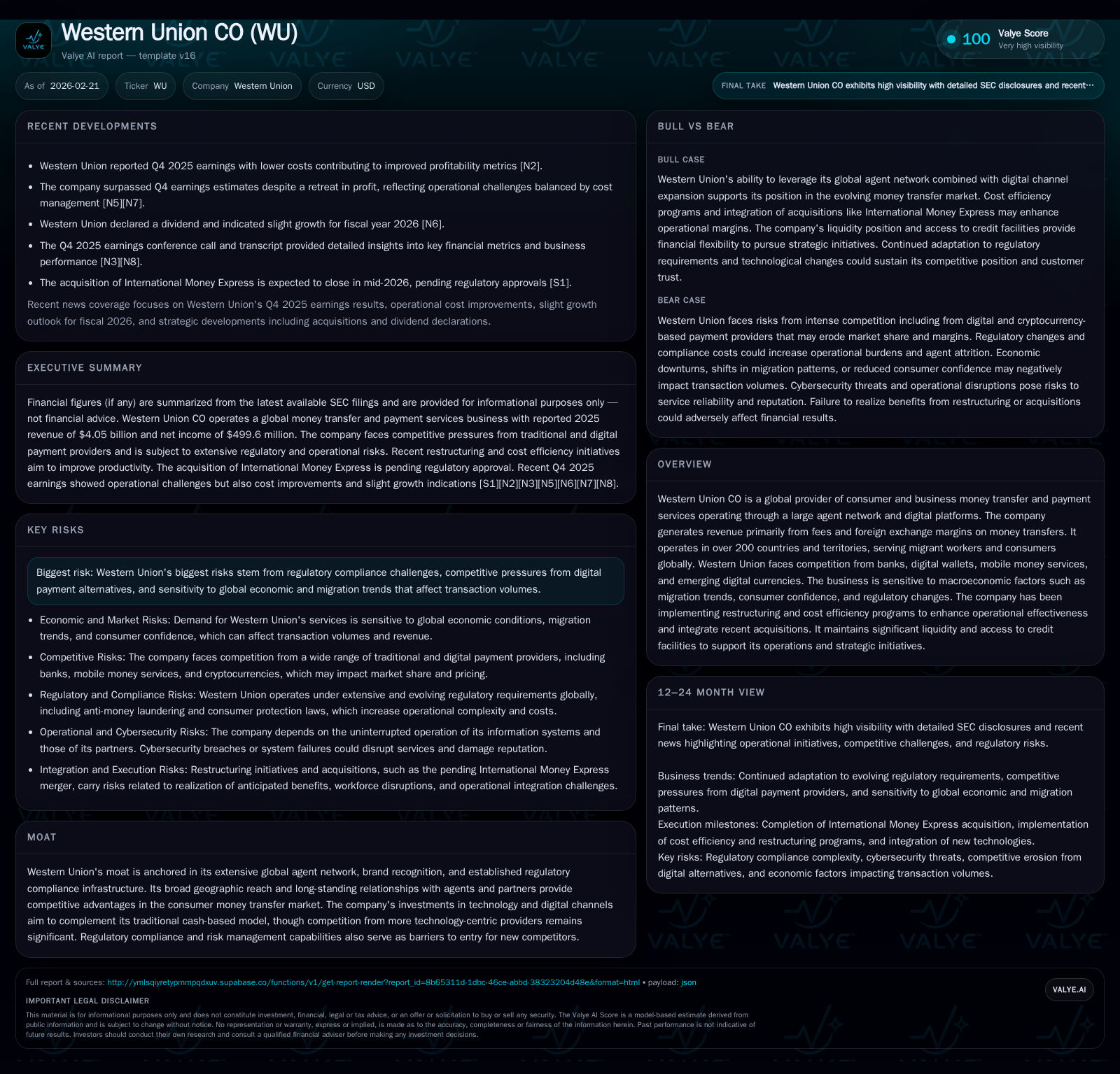
Western Union CO reported a 3.8% revenue decline in FY2025 alongside a modest 4.3% increase in operating income driven by restructuring and efficiency gains. Net income fell sharply, reflecting margin pressures amid costs associated with compliance and investment in technology. The company faces mounting regulatory scrutiny from multiple jurisdictions that impacts operating flexibility and costs, alongside stiff competition from digital payment providers challenging its legacy agent-based model. Western Union’s capital allocation favors dividends and share repurchases, supported by positive free cash flow, while growth outlook hinges on integrating acquisitions and further digital innovation amid evolving migration patterns and economic uncertainty.
Historical Financial Trends Highlight Margin Pressures Despite Revenue Contraction
Western Union CO’s financial trajectory over the recent four years shows declining revenues paired with a rebound in operating margins overshadowed by steep net income contraction. Revenues fell steadily from $4.48 billion in FY2022 to $4.05 billion in FY2025, a cumulative decline of nearly 9.5%. This trend underscores persistent pressures from competitive pricing, regulatory headwinds, and macroeconomic factors such as lower migration-driven remittance volumes. Yet, operating income improved from $725.8 million in FY2024 to $757.3 million in FY2025 (+4.3%), signaling successful cost containment and restructuring initiatives.
However, net income declined sharply by 46.5% year-over-year to just under $500 million in FY2025 after a prior peak of over $900 million in FY2024. This disparity between operating income improvement and net earnings suggests higher non-operating costs including potentially elevated tax expenses, interest costs related to debt refinancing or one-time restructuring charges not explicitly detailed here.
Historical performance (annual)
| FY | Rev ($bn) | Net ($mm) | CFO ($mm) | OpInc ($mm) | Rev YoY | Net YoY |
|---|---|---|---|---|---|---|
| 2025 | 4.1 | 500 | 544 | 757 | -3.8% | -46.5% |
| 2024 | 4.2 | 934 | 406 | 726 | -3.4% | +49.2% |
| 2023 | 4.4 | 626 | 783 | 818 | -2.6% | -31.3% |
| 2022 | 4.5 | 911 | 582 | 885 |
Note: Omitted columns lack sufficient annual XBRL coverage in the provided tags (need ≥2 annual points): Capex, ROE%. Source: SEC companyfacts cache [F1].
Capital returns and efficiency (annual)
| FY | Div ($mm) | Buybacks ($mm) | FCF ($mm) |
|---|---|---|---|
| 2025 | 309 | 235 | 505 |
| 2024 | 322 | 186 | 369 |
| 2023 | 349 | 308 | 760 |
| 2022 | 364 | 370 | 550 |
Source: SEC companyfacts cache [F1].
Table Note: Operating Cash Flow, Capex, Dividends, Buybacks data are addressed separately below.
Western Union’s ability to improve operating margins despite revenue contraction mainly reflects disciplined expense management targeting call center productivity, digitization benefits reducing payout costs, and rationalization of legacy technology platforms [N2][N3][S14]. The high dependence on its vast global agent network—which involves significant fixed costs—limits leverage potential despite these efforts.
Cost Efficiency Programs and Restructuring Bolster Operating Income
Management's November 2025 announcements detailed new cost efficiency initiatives intended to yield savings through automation of account payouts, reducing fraud-related expense volatility, consolidating technology infrastructure, optimizing back-office functions, and realizing synergies from the Intermex acquisition integration [N3][S14]. Transcript excerpts indicated stronger-than-anticipated expense controls contributed materially to the Q4 operating profit beat versus estimates [N2][N5].
Such restructuring measures are customary for legacy players adapting to digital transformation pressures that demand leaner cost structures while simultaneously investing in growth channels.
Sector analysts note that agent onboarding and retention constitute major line items exacerbated by rising commissions due to increased compliance burdens placed on agents for AML/KYC adherence or anti-fraud measures—a dynamic Western Union faces given its decentralized distribution model [S25][S27]. Controlling these indirect channel costs without impairing network breadth is an ongoing challenge requiring fine balance.
Navigating Intense Regulatory Environment and Compliance Commitments
Western Union endures rigorous scrutiny under multiple overlapping regulatory regimes worldwide encompassing anti-money laundering (AML), consumer protection laws regulated by bodies like the US Federal Trade Commission (FTC), Consumer Financial Protection Bureau (CFPB), state attorneys general offices,[...]and international financial regulators .
The company remains under continuing obligations stemming from Deferred Prosecution Agreements (DPAs) entered into with US authorities concerning anti-money laundering program lapses dating back over a decade ago [S6][S8]. These agreements impose strict ongoing reporting duties through January 2028 as per the FTC Consent Order.
Compliance requires substantial investment into enhanced agent oversight programs covering customer due diligence training, monitoring suspicious activity reports (SARs), stricter recordkeeping mandates, consumer fraud disclosures enforcement, periodic agent suspensions or terminations when warranted—all adding operational complexity [S24]. Moreover, regulatory developments such as the EU’s Payment Services Directive PSD2/PSD3 frameworks tighten supervision over European entities’ agents increasing compliance workloads further [S12][S24].
Banks’ hesitancy toward Money Service Businesses (MSBs)—a category covering Western Union's operations—due to perceived high-risk profiles complicates maintenance of bank relationships critical for liquidity management [S26][S25]. Additionally, enhanced geographic targeting orders (GTOs) issued by FinCEN require collection of more granular customer data impacting transaction throughput efficiency since early 2025 [S25].
This layered regulatory environment elevates both direct compliance expenditures plus indirect costs via agent attrition risk when agents resist onerous rules or taxes imposed at local levels [S21]. Hence regulatory compliance represents an ongoing trade-off between operational cost management versus reputational risk mitigation.
Digital Innovation Versus Legacy Agent Network: Competing Business Models
While Western Union’s extensive global agent network is a powerful moat anchored in brand recognition and entrenched local presence, the company faces significant competitive pressure from digital-native payment providers leveraging mobile wallets, internet money transfer services like PayPal or Wise,[...]as well as emerging cryptocurrencies ushering decentralized alternatives that bypass intermediaries.
This tension manifests in strategic channel diversification efforts aiming for omnichannel integration where physical outlets coexist but increasingly interface with app-based services allowing consumers lower friction transfer options.
In payments vernacular: Western Union’s transition strategy attempts to offset shrinking cash-based remittance margins with digital wallet penetration efforts complemented by AI-powered fraud detection enhancements aimed at improving payout cost ratios while safeguarding compliance quality standards [N3][S7]. Such hybridization is crucial given average transfer ticket size declines coincide with shifting consumer preferences towards faster electronic settlement mechanisms.
However, technological catch-up is costly—and competing fintech firms often benefit from lighter legacy infrastructure absence—placing Western Union at risk of margin compression unless its tech investments translate rapidly into meaningful volume growth or better unit economics.
Consumer Migration Dynamics and Macroeconomic Sensitivities Impact Volumes
International remittances are deeply intertwined with global migration flows influenced by geopolitical events, labor market conditions,[...]and international relations affecting cross-border worker mobility patterns [S1].
Economic factors such as inflation levels affecting disposable incomes abroad modulate consumer confidence impacting propensity to send remittances. For example, currency fluctuations where dollar appreciation reduces value received overseas impact demand elasticity.
These dynamics create cyclicality—abrupt policy shifts limiting migration corridors or prolonged economic downturns translate into immediate volume declines adversely affecting Western Union's fee-based revenues negatively skewing growth prospects without offsetting price hikes which face competitive resistance.[S29]
Thus operational planning must carefully monitor macro variables including foreign exchange rates alongside micro trends like urbanization rates affecting agent density economics which vary significantly across emerging market corridors posing complex forecasting challenges.
Capital Allocation Prioritizes Dividends and Share Repurchases Amid Cash Flow Variability
In FY2025 Western Union returned approximately $309 million through dividends and repurchased shares totaling around $235 million[~$234m],[F1], demonstrating commitment to shareholder distributions despite top-line pressures.
Operating cash flow strengthened notably by nearly one-third year-over-year reaching approximately $544 million driven by improved working capital management,[F1] enabling positive free cash flow estimated close to $505 million after subtracting modest capex outlays near $38 million representing less than 1% of revenue.[F1]
The capital expenditure profile remains conservative indicative of mature firm status focusing on digital platform upgrades rather than heavy physical infrastructure buildouts typical of core agent locations.[F1]
Reported return on equity skews elevated (~438%) relative to historical equity base due largely to book equity shrinkage —highly affected by share repurchases rather than operational leverage gains alone.[F1]
Maintaining steady distributions amidst earnings variability portrays conservative capital strategy balancing investor expectations with prudent liquidity buffers given ongoing regulatory uncertainties impacting future cash flows.[F1][S17]
Analyzing Earnings Guidance and Key Metrics from Q4 2025 Reports
While explicit formal full-year guidance remains generalized noting "slight growth" expectations for fiscal 2026,[N13] recent quarterly releases emphasized favorable operating margin trends attributable primarily to scaled efficiencies realized post Intermex acquisition integration plus lower fraud loss ratios enabled through new AI tools deployed late last year[N2][N3].[N10]
Key performance indicators emphasize transaction volume stabilization despite lingering competitive challenges augmented by successful cost structure streamlining underpinning earnings beats relative to consensus estimates during Q4[N2][N4][N5].
Investor focus should center on metrics indicating sustained margin expansions combined with rolling innovations adoption rates within both developed markets supporting premium fees along with emerging regions offering expansion runway but accompanied by heightened compliance risk profiles[N13][N10].
Risks Pertaining to Litigation and Changing Regulatory Frameworks
Ongoing legal exposure includes class action suits alleging consumer protection violations,[...]enforcement actions relating historically inadequate compliance programs prior DPA periods,[...]and regulator-led investigations encompassing anti-money laundering program adequacy underscoring intrinsic risks embedded deeply within operational frameworks.[S4],[S6],[S8]
High litigation expense coupled with uncertain timing/outcome elevates contingent liability concerns though management continues fortifying defenses including enhanced monitoring software deployment plus executive oversight committees tasked specifically with compliance governance[S12],[S14],[S21].[...]
Compounding this are dynamic shifts across jurisdictions embracing new laws—increasingly stringent data privacy mandates post-GDPR enactment householding additional operational overheads imposing greater compliance layers subjecting agents inadvertently resistant or unable-to-comply putting entire transaction blocks at risk[S19],[...]making geographic coverage uneven[S22],[...]and exposing brand reputation especially given agent-subagent contractor legal exposures inherent in the franchise-like payment model.
Future Growth Levers: Acquisition Integration, Technology Investments, and Market Expansion
Management highlights several forward-looking levers including tighter integration of acquired entities like Intermex promising cross-selling opportunities alongside realized back-office synergies that collectively aim at margin enhancement[N3],[S7].
Incremental technology investments focused on digital remittance platforms leveraging machine learning models forecasted not only detect fraud earlier reducing losses but also improve customer engagement with personalized service offerings potentially expanding wallet share within key corridors[N3].
Strategic market expansion targets include underserved regions constrained previously by limited brick-and-mortar presence now addressable via fintech routes combined with partnerships emphasizing white-labeled services under partner brands enhancing reach without proportional direct investment[S7].[...]
However navigating evolving regulatory environments will require agile compliance frameworks anticipating PSD3-related requirements effective near-term especially across EU zones along with adaptations responding proactively to emerging consumer protection regimes globally posing material implementation costs that could temper near-term incremental profit capture spikes[S24].[...]
Disclaimer: This report provides an analytical overview based solely on disclosed financial information, public statements from Western Union CO filings ([F1]), news reports ([N#]), SEC filings ([S#]), and Valye News domain expertise context without offering investment recommendations or price targets.
Disclaimer: This is research-only, informational analysis and not investment advice. It may include AI-generated interpretation and general industry context. Always verify important details using primary sources.

Comments