
Option Care Health's Mixed Financial Momentum and Strategic Capital Moves in 2025
Option Care Health experienced significant revenue growth contrasting with earnings stagnation and aggressive share repurchases during 2025.
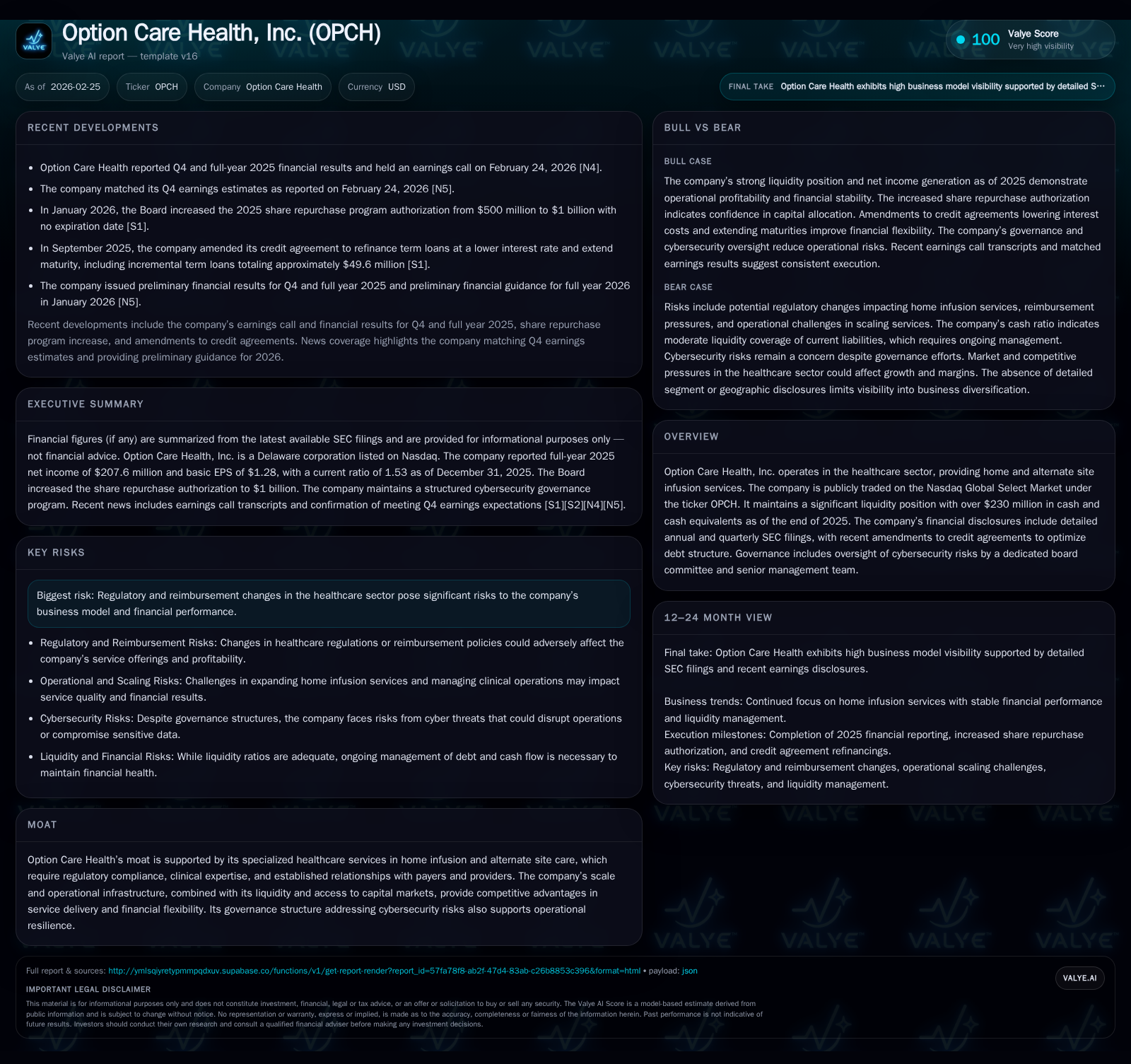
In 2025, Option Care Health delivered a remarkable 174.9% surge in revenue while operating income rose by a modest 5%, and net income slightly declined by 2%. Operating cash flow dropped by over 20%, despite increased capital expenditures reflecting infrastructure investment. This divergence points to margin pressures and regulatory cost headwinds within home infusion services. The company maintained a strong liquidity position, executing a sizable $310 million share buyback program, supported by debt refinancings that improved the capital structure. Governance efforts emphasize cybersecurity resilience, underpinning operational continuity in a complex regulatory environment.
Surge in Revenue Masks Underlying Earnings Challenges
Option Care Health reported an impressive jump in annual revenue for fiscal year 2025, recording approximately $5.0 billion compared to prior years. This represents an extraordinary 174.9% year-over-year increase [F1]. While such explosive topline growth often signals strong market demand or accretive acquisitions, the company’s operating income rose only modestly to $338 million—up just 5% from the previous year—and net income declined slightly by approximately 2% to $208 million [F1]. This divergence suggests meaningful compression of operating margins amid the rapid expansion.
The healthcare sector context helps clarify this dynamic: home infusion therapy volumes have been increasing as care transitions outside inpatient settings, but reimbursement rates are under pressure due to regulatory scrutiny and payer negotiations [S4]. Additionally, infusion pump utilization rates must be carefully managed alongside stringent clinical compliance requirements to deliver safe yet cost-effective care [N6]. These factors likely contribute to increased operational expenses diluting earnings gains despite surging revenues.
Operational Drivers Behind Year-over-Year Performance Shifts
Revenue drivers included growth in alternate site infusion services and strengthened payer relationships enhancing patient access. However, complex healthcare reimbursement frameworks compel the company to navigate shifting payer mixes and evolving Medicare/Medicaid policies affecting realized pricing [S4][N1]. Such complexity increases administrative costs and impacts gross margins.
Financially, operating cash flow declined 20.1% year-over-year to $258 million despite capital expenditure rising by 16% to $41 million [F1]. Increased capex reflects investments into expanding clinical infrastructure—such as higher infusion pump counts and upgraded technology platforms designed to support efficient service delivery at scale [N6]. These investments aim for long-term returns by improving patient throughput and payer contract competitiveness but weigh on near-term free cash generation.
Outlook: Navigating Regulatory and Market Headwinds in Home Infusion Services
Management commentary during the February 2026 earnings call emphasized cautious optimism for continued revenue momentum balanced against persistent regulatory risks [N1][N7]. The company specifically highlighted reimbursement uncertainties stemming from policy reforms that could cap rate increases or introduce additional compliance burdens.
There was no explicit forward guidance provided beyond preliminary financial expectations indicating steady top-line growth with ongoing margin management challenges [N7]. Monitoring how payer contract renewals evolve remains critical for validating sustainable profitability improvements.
Key Metrics to Watch for Future Growth Validation
Upcoming quarters will reveal whether initiatives to normalize EBITDA margins materialize amid scale efficiencies and administrative cost control [N2][S3]. Key metrics include:
- Payer mix shifts favoring higher-margin private contracts versus government payers.
- Patient acquisition costs relative to lifetime value within specialty infusion segments.
- Infusion pump utilization rates aligned with clinical protocols ensuring compliance without oversupply.
Margins reflect an interplay between operational execution quality and external reimbursement environment dynamics unique to this specialized sector [S3].
Capital Allocation: Aggressive Buybacks Amid Robust Liquidity Position
Option Care aggressively expanded its share repurchase activity during fiscal 2025, spending approximately $310 million on buybacks—a notable increase from $253 million spent in 2024 [F1][S6][S7]. This occurred alongside a maintained liquidity cushion of $233 million in cash and equivalents as of year-end, supporting financial flexibility [F1]. The company boasts a healthy current ratio around 1.53 based on reported current assets versus liabilities [F1], signaling adequate short-term solvency.
Debt refinancing actions throughout 2025 lowered interest costs (to SOFR plus roughly 1.75%) and extended credit facility maturities out seven years, optimizing capital structure [S9][S14][S17]. Notably absent were dividend payments mentioned in filings or releases, implying exclusive focus on buybacks as shareholder return strategy currently [F1][S6].
This capital allocation approach leverages free cash flow—approximately $217 million after capex—to reduce share count while preserving investment capacity for operational expansion initiatives.
Governance Focus on Cybersecurity as Operational Backbone
Given the highly regulated healthcare environment involving sensitive patient data transmission integral to home infusion delivery, Option Care’s governance includes robust cybersecurity oversight. The Quality, Technology and Compliance Committee (QTCC) of its board receives regular updates from a seasoned Chief Information Security Officer (CISO) with two decades of specialized experience managing security strategy and incident response [S1].
The CISO leads cross-functional collaboration with senior leadership through a Security Council comprising the CEO, CFO, and other executives ensuring enterprise-wide cyber hygiene adherence. This governance model supports uninterrupted clinical service continuity while mitigating operational risk—a vital competitive advantage given growing cyber threats targeting healthcare providers worldwide.
Competitive Moat: Specialized Care, Compliance, and Scale in a Fragmented Sector
Option Care’s moat rests on multiple pillars intrinsic to home infusion care delivery:
- Deep clinical expertise necessary for safe administration of complex infusions at home or alternate sites.
- Navigating multilayered regulatory regimes demanding meticulous compliance documentation and patient safety protocols.
- Established networks with payers facilitating favorable contract terms which new entrants struggle to match due to required scale and reputation.
- Operational infrastructure capable of supporting high infusion pump utilization rates without compromising care quality or incurring excessive overhead.
These structural barriers reduce competitive encroachment risk amidst a fragmented sector characterized by regional providers lacking comprehensive scale or integrated payer relationships.
Historical Financial Performance Summary (FY2022–FY2025)
Historical performance (annual)
| FY | Net ($mm) | CFO ($mm) | OpInc ($mm) | Capex ($mm) | Net YoY |
|---|---|---|---|---|---|
| 2025 | 208 | 258 | 338 | 41 | -2.0% |
| 2024 | 212 | 323 | 322 | 36 | -20.7% |
| 2023 | 267 | 371 | 315 | 42 | +77.4% |
| 2022 | 151 | 268 | 240 | 35 |
Note: Omitted columns lack sufficient annual XBRL coverage in the provided tags (need ≥2 annual points): Rev, Div. Source: SEC companyfacts cache [F1].
Capital returns and efficiency (annual)
| FY | Buybacks ($mm) | FCF ($mm) | ROE% |
|---|---|---|---|
| 2025 | 310 | 217 | 15.7 |
| 2024 | 253 | 288 | 15.1 |
| 2023 | 250 | 329 | 18.8 |
| 2022 | 232 | 10.9 |
Source: SEC companyfacts cache [F1].
Note: Some FY figures for revenue prior to FY2024 are not available in provided data.
This analysis avoids extrapolation beyond verified disclosures while offering sector-informed interpretation of Option Care Health's nuanced financial developments through recent years. Continuous monitoring of reimbursement trends alongside clinical operational metrics remains essential for discerning future performance trajectories.
Note: Dividend payment data is not available from provided XBRL tags; thus no commentary on dividends is included. Free cash flow is approximated as operating cash flow minus capital expenditures per latest fiscal year data [F1].
DISCLAIMER: This report is intended solely for informational purposes regarding Option Care Health’s recent financial performance and strategic posture. It is not an investment recommendation or solicitation. Readers should conduct their own due diligence before making any financial decisions.
Disclaimer: This is research-only, informational analysis and not investment advice. It may include AI-generated interpretation and general industry context. Always verify important details using primary sources.

Comments