
Day One Biopharmaceuticals’ Growth Fueled by Pediatric Oncology Focus and Commercial Launch Execution
Operational strides with OJEMDA™ and pipeline investments define Day One’s path amid commercialization and regulatory challenges.
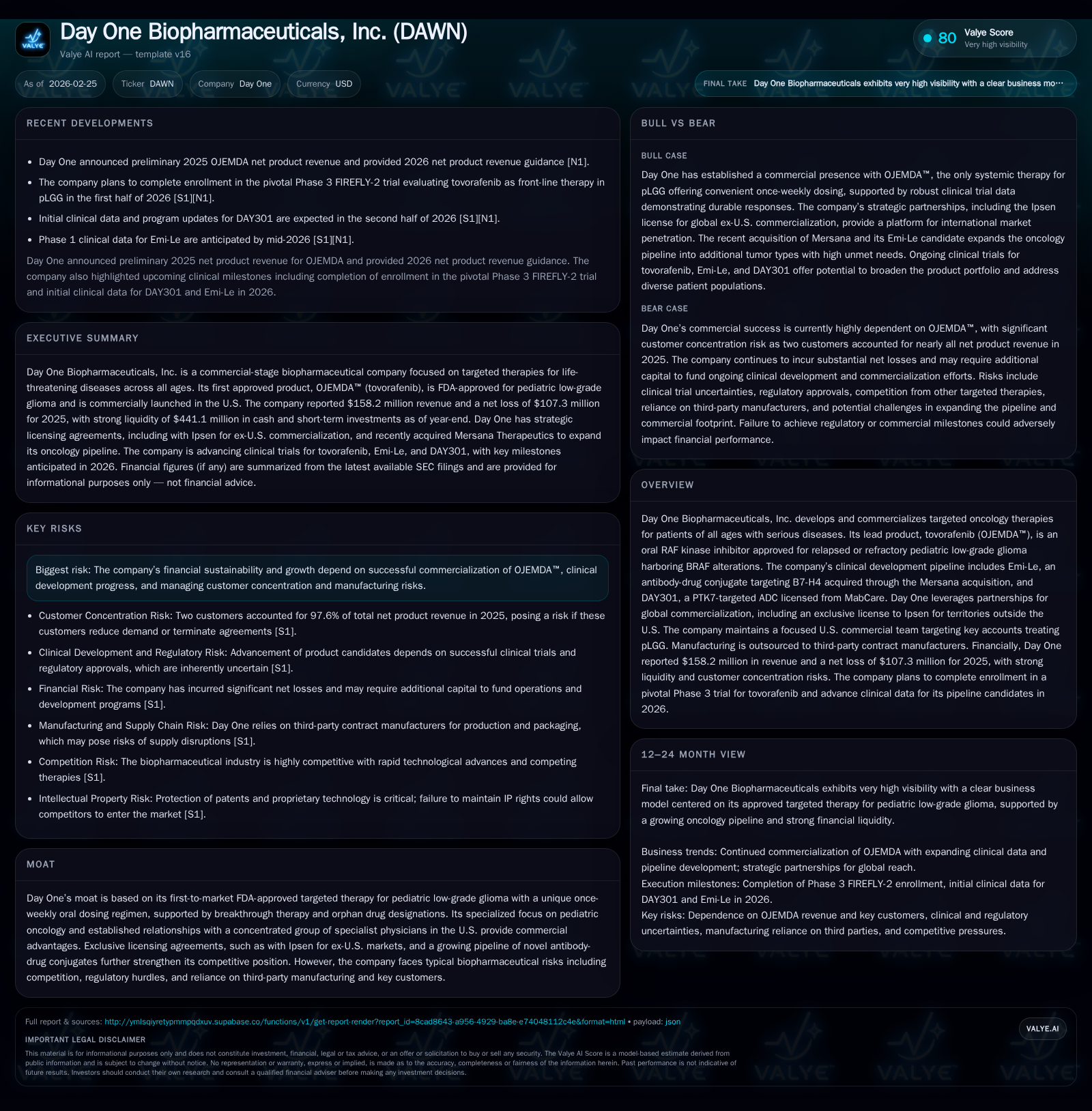
Day One Biopharmaceuticals, Inc. has transitioned into a commercial stage entity primarily through the FDA approval and launch of OJEMDA™, an oral RAF kinase inhibitor for pediatric low-grade glioma patients. The company’s revenue surpassed $158 million in 2025, representing over 20% year-over-year growth driven by initial commercial traction. Losses narrowed compared to prior years, reflecting operational leverage despite ongoing investment in clinical development of novel therapies such as Emi-Le and DAY301 antibody-drug conjugates. Key risks remain around the pace of market adoption, regulatory approvals for pipeline assets, supply chain dependencies, and capital raising needs. The firm’s unique first-in-class product niche combined with its specialized pediatric oncology commercial footprint underpin its competitive moat. Current returns metrics reflect ongoing investment with negative ROE and cash flow, while no dividends or buybacks are reported.
Company Overview and Strategic Positioning
Day One Biopharmaceuticals, Inc. has progressed into a commercial-stage biopharma company following FDA accelerated approval of OJEMDA™ (tovorafenib), an oral RAF kinase inhibitor targeting relapsed or refractory pediatric low-grade glioma (pLGG) with specific BRAF alterations. This first-in-class therapy offers a differentiated once-weekly oral dosing regimen addressing a significant unmet need in pediatric neuro-oncology.[N1][S1]
The company’s strategic emphasis on pediatric oncology distinguishes it within a niche marked by limited approved options but substantial clinical demand. Orphan drug designation and breakthrough therapy status underpin intellectual property protection and regulatory exclusivity.[S1]
Day One has partnered globally by licensing exclusive rights for OJEMDA outside the United States to Ipsen, enabling broader geographic reach without direct operational expansion abroad. The U.S. commercial team remains focused on specialized accounts treating pediatric brain tumors.[N1][S1]
Pipeline expansion efforts include antibody-drug conjugates Emi-Le (targeting B7-H4) acquired through Mersana Therapeutics, and DAY301 (PTK7-targeted ADC) licensed from MabCare, adding modality diversity beyond small molecules.[S1]
Manufacturing is outsourced to contract manufacturing organizations (CMOs), maintaining a capital-light asset base but exposing the company to third-party supply chain risks.[S1]
Historical Financial Performance
Day One's financial results illustrate progression from research & development toward commercial operations:
Historical performance (annual)
| FY | Rev ($mm) | Net ($mm) | CFO ($mm) | OpInc ($mm) | Rev YoY | Net YoY |
|---|---|---|---|---|---|---|
| 2025 | 158 | -107 | -104 | -128 | +20.6% | -12.4% |
| 2024 | 131 | -95 | -78 | -217 | ||
| 2023 | -147 | -206 | ||||
| 2022 | -41 | -110 | -147 | 0.0% |
Note: Omitted columns lack sufficient annual XBRL coverage in the provided tags (need ≥2 annual points): Capex, Div, Buybacks. Source: SEC companyfacts cache [F1].
Capital returns and efficiency (annual)
| FY | FCF ($mm) | ROE% |
|---|---|---|
| 2025 | -104 | -24.3 |
| 2024 | -80 | -19.0 |
| 2023 | -147 | |
| 2022 | -110 | -12.2 |
Source: SEC companyfacts cache [F1].
Revenue growth of approximately 20% year-over-year reflects initial commercial uptake of OJEMDA post-launch activities starting late-2023.[F1][N1]
Operating losses have improved significantly by over 40%, evidencing operational leverage from increased sales partially offsetting continued R&D investments and SG&A expenses related to commercialization efforts.[F1]
Net losses increased slightly (~12%), likely influenced by non-operating costs or tax effects despite improved operating results.[F1]
Operating cash flows remain negative due to ongoing expenditures associated with late-stage clinical trials, regulatory compliance, sales force deployment, and general corporate costs during commercialization transition.[F1] Capital expenditures remain minimal consistent with an outsourced manufacturing strategy.[F1]
Equity decreased relative to prior year reflecting cumulative net losses but remains substantial providing liquidity for near-term obligations and growth funding.[F1]
Growth Drivers and Catalysts
Key drivers shaping Day One’s growth trajectory include:
- Commercial adoption of OJEMDA as the sole approved systemic oral therapy offering convenience advantages addressing unmet needs in pLGG patients harboring BRAF mutations.[N1][S1]
- Potential label expansions or new indications pending successful clinical trials could broaden patient populations.
- Advancement of pipeline candidates Emi-Le and DAY301 through clinical development may diversify future revenue streams beyond OJEMDA’s lifecycle.[S1]
- Leverage of Ipsen partnership for ex-U.S commercialization expedites international market penetration while limiting direct operational complexity for Day One.[N1][S1]
- Favorable reimbursement policies influence access levels amidst evolving healthcare payer scrutiny.[S6][S18]
- Manufacturing continuity via CMOs is critical to avoid supply disruptions impacting sales momentum.
Constraints include regulatory uncertainties delaying approvals, competition from alternative therapies, pricing pressures from healthcare reforms domestically and abroad, reliance on specialist prescribers creating concentration risk, and capital requirements potentially diluting shareholders or limiting flexibility if unfavorable terms arise.[S26]
Forecasts and Milestones
While detailed numeric guidance is not explicitly provided beyond preliminary projections,[N1] important milestones to track include:
- Quarterly revenue trends reflecting OJEMDA penetration into specialist centers.
- Clinical trial readouts for Emi-Le assessing safety and efficacy in B7-H4 expressing solid tumors.
- Progression of DAY301 clinical programs evaluating PTK7-targeted ADC therapeutic potential.
- Regulatory filings outside the U.S., leveraging Ipsen’s licensing rights indicating global expansion feasibility.[N1]
- Updates on payer coverage negotiations influencing formulary inclusion impacting U.S. adoption rates.[S6][S27]
These milestones will be pivotal in validating sustained growth prospects.
Returns and Capital Allocation Analysis
Return metrics highlight typical early-stage biopharma challenges balancing costly clinical development with nascent commercialization:
- Approximate Return on Equity (ROE) is negative ~24%, consistent with net losses amid reinvestment rather than profitability generation currently.[F1]
- Operating cash flow remains negative at about $104 million free cash burn after nominal capex outlays, underscoring dependence on external capital to fund ongoing R&D, sales expansion, and regulatory activities.[F1]
- No dividends or share repurchases are recorded in available filings indicating capital allocation prioritizes growth investments over shareholder distributions at this stage.[F1][S26]
- The strong current ratio above 8x signals robust liquidity to meet short-term liabilities supporting continued operations without immediate solvency concerns.[F1]
Industry Context & Sector Nuances (Analysis)
Pediatric oncology represents a niche yet underserved oncology segment characterized by smaller patient populations but incentivized by orphan drug designations facilitating accelerated approvals and exclusivity periods vital for innovators like Day One. Antibody-drug conjugates are among biopharma’s rapidly advancing modalities delivering targeted cytotoxic payloads; Day One’s focus on ADCs via Emi-Le and DAY301 positions it strategically within this dynamic therapeutic area where differentiation stems from target specificity and linker-payload innovations.
Pricing pressures globally contrast with orphan drug premiums domestic markets enjoy; consequently robust efficacy data underpinning payer acceptance is critical for sustaining favorable reimbursement amid intensifying government scrutiny over specialty drug costs.
Outsourced manufacturing reduces fixed asset burdens but heightens reliance on contract manufacturers’ capacity planning—a logistical element requiring close coordination between clinical teams and CMOs.
Risks Summary Synthesized from SEC Disclosures
Principal risks include:
- Heavy dependence on single approved product OJEMDA for majority revenues exposes vulnerability if market penetration slows or competitors emerge swiftly.[S4][S27]
- Clinical development uncertainties persist for investigational ADC candidates where safety/efficacy outcomes remain unconfirmed until later phases.[S4]
- Supply chain risks tied to third-party manufacturers could disrupt timely drug availability affecting revenue streams adversely.[S4][S26]
- Regulatory complexities including post-market commitments or REMS requirements may impose additional costs or restrictions impairing scalability.[S10][S17]
- Intellectual property litigation risks common in biopharma could divert resources or impact exclusivity durations crucial for competitive positioning.[S16][S22]
- Capital raising needs present dilution risk or debt burdens depending on market conditions potentially constraining operational independence.[S26]
- Compliance obligations under evolving healthcare laws governing pricing transparency, anti-kickback statutes, false claims exposures carry financial penalties or reputational damage if breached.
Conclusion
Day One Biopharmaceuticals has successfully initiated commercialization marked by solid initial growth driven by a first-to-market targeted therapy addressing significant unmet need in pediatric low-grade glioma patients bearing BRAF mutations. The product's oral dosing regimen supports differentiated value aiding clinician uptake supported by regulatory designations enhancing pathway advantages.
Pipeline diversification into novel ADC candidates mitigates single-product dependence risk but requires successful clinical validation to contribute materially going forward.
The company faces typical early-commercialization risks alongside sector-specific challenges including regulatory hurdles, intellectual property landscape complexities, pricing environment uncertainties, and high cash burn necessitating adept capital management.
Financial trends indicate progress toward operating leverage though sustained net losses underscore continued external funding needs balanced against strong liquidity enabling ongoing clinical activities coupled with global rollout supported through licensing partnerships.
This analysis presents factual information drawn solely from publicly available documents without offering investment advice or recommendations.
Disclaimer: This is research-only, informational analysis and not investment advice. It may include AI-generated interpretation and general industry context. Always verify important details using primary sources.

Comments