
Procore Technologies Balances Revenue Growth with Ongoing Profitability Challenges
Procore continues to expand its construction management platform reach while managing losses and regulatory risks.
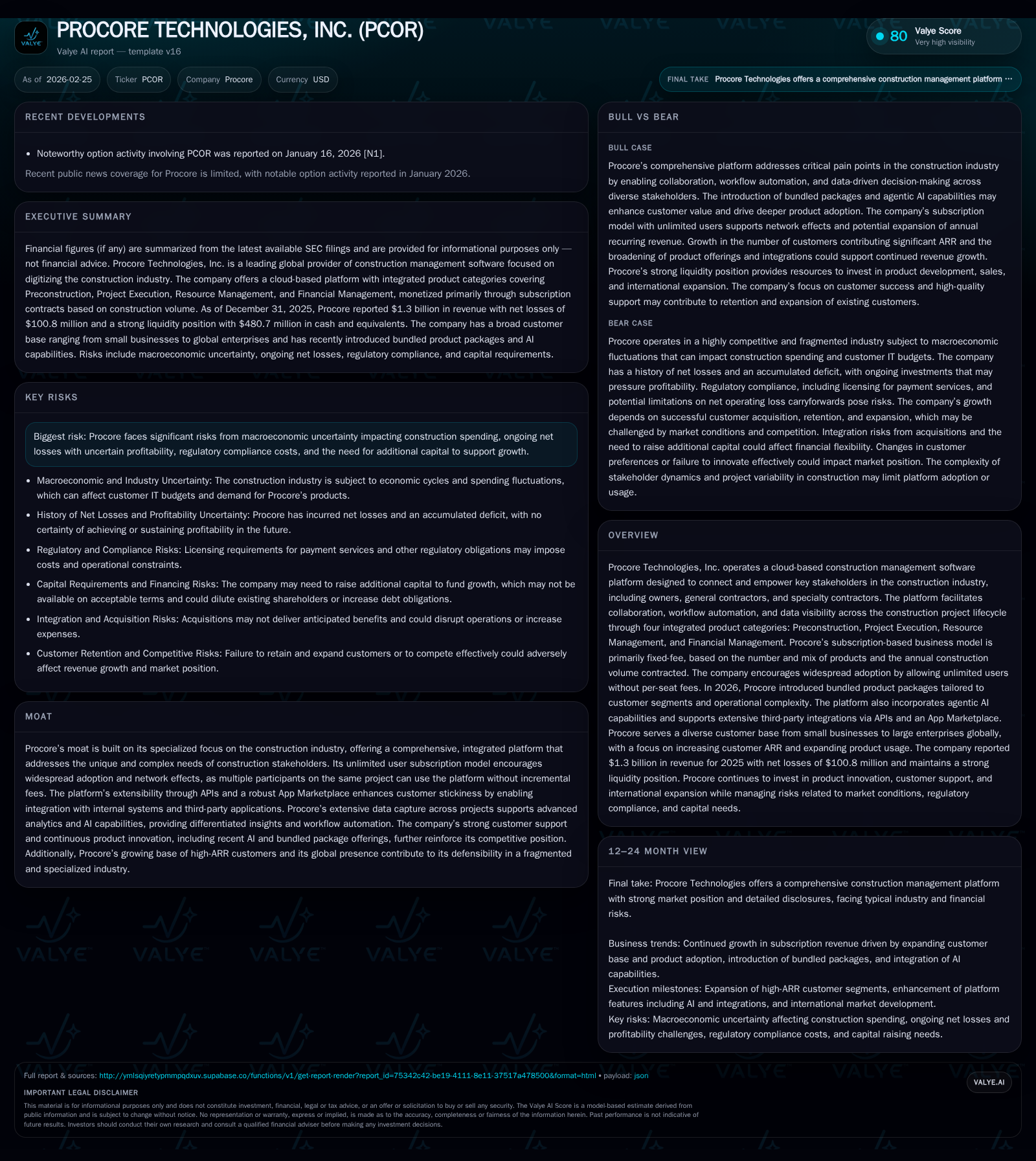
Procore Technologies, Inc. operates a leading cloud-based construction management software platform tailored for owners, general contractors, and specialty contractors. The company has demonstrated steady revenue growth over recent years through its subscription-based model that encourages widespread adoption via unlimited user access and integrated product bundles introduced in 2026. However, persistent net losses and evolving macroeconomic headwinds in the construction industry continue to pressure profitability. Procore’s growth strategy hinges on product innovation, ecosystem expansion through acquisitions, and deepening customer engagement internationally. Capital allocation includes opportunistic share repurchases but no dividends, awaiting clearer paths to sustained profitability.
Company Overview
Procore Technologies, Inc., headquartered in Carpinteria, California, is a dominant player in the construction management software space offering a comprehensive cloud-based platform designed around the unique workflows of the fragmented construction ecosystem [S1][S4]. Its platform connects owners, general contractors, specialty contractors, architects, and engineers through four integrated solutions: Preconstruction, Project Execution, Resource Management, and Financial Management [S4][S15][S17].
The company emphasizes easy adoption with an unlimited user subscription model that removes per-seat charges, encouraging broad project team collaboration and network effects [S8][S20]. Users benefit from real-time data visibility, workflow automation powered by agentic AI technologies (exemplified by recent acquisitions), and integration with internal systems via APIs and an extensive App Marketplace [S4][S17][S20].
Historical Performance and Growth Drivers
Procore’s revenue growth trajectory has been robust but decelerating: $1.0 billion (2023), $1.2 billion (2024), and $1.3 billion (2025), representing annual growth rates of approximately 21% in 2024 and 15% in 2025 [N1][S1][S10]. This expansion reflects both new customer acquisition—particularly among larger customers contributing more than $100k ARR—and increased penetration within existing accounts as customers subscribe to additional products or scale their contracted annual construction volume [S7][S10]. The number of customers generating above $100k ARR rose by about 16% annually through 2025.
Despite top-line gains, Procore has yet to reach profitability. Net losses have improved significantly from -$189.7 million in 2023 to -$100.8 million in 2025 with operating losses showing a similar trajectory from -$215.7 million to -$124.3 million during this period [F1]. The reduction in operating loss reflects operational efficiencies alongside strategic investments.
Operating cash flows more than tripled from $92 million in 2023 to over $300 million in 2025—but capex has remained modest relative to cash flow ($18 million in 2025)—resulting in solid free cash flow generation (approximately $282 million) which supports ongoing investment and share repurchases [F1].
Historical performance (annual)
| FY | Net ($mm) | CFO ($mm) | OpInc ($mm) | Capex ($mm) | Net YoY |
|---|---|---|---|---|---|
| 2025 | -101 | 300 | -124 | 18 | +4.9% |
| 2024 | -106 | 196 | -136 | 19 | +44.1% |
| 2023 | -190 | 92 | -216 | 10 | +33.9% |
| 2022 | -287 | 13 | -290 | 16 |
Note: Omitted columns lack sufficient annual XBRL coverage in the provided tags (need ≥2 annual points): Rev, Div, Buybacks. Source: SEC companyfacts cache [F1].
Capital returns and efficiency (annual)
| FY | FCF ($mm) | ROE% |
|---|---|---|
| 2025 | 282 | -8.0 |
| 2024 | 177 | -8.2 |
| 2023 | 82 | -16.4 |
| 2022 | -3 | -25.7 |
Source: SEC companyfacts cache [F1].
Note: Revenue figures are derived from SEC narrative disclosures as they were not available via tagged XBRL data[F1][S1][S10]
Future Growth Prospects
Procore’s long-term growth strategy centers on three core elements:
- Technological leadership: Continuing investment in R&D to enhance product depth and AI-empowered workflow automation.
- Ecosystem expansion: Augmenting the App Marketplace and pursuing tuck-in acquisitions that accelerate roadmap delivery (e.g., Datagrid for AI solutions acquired early in 2026) [S4].
- Sales model evolution: Transitioning towards a general manager sales approach aligned regionally by size and type of customer for deeper market penetration [S14].
The introduction of four main bundled packages early in 2026—Project Execution, Cost Management, Resource Management, and Project Lifecycle Management—with tiered offerings aims to streamline customer choice while driving higher ARPU through integrated solutions suited to varying operational complexities [S17].
However, Procore acknowledges headwinds from uncertain macroeconomic conditions impacting overall construction spending patterns; these unpredictable shifts could dampen new bookings or expansion within its customer base [S1][S9]. Moreover, adoption rates could be influenced by IT budget constraints across the industry.
Forecasts and Milestones To Watch
While Procore has not provided explicit forward guidance for revenue or profitability milestones beyond general commentary [N1][S3], key indicators warrant monitoring:
- Adoption rate trends among customers with >$100k ARR—the company prioritizes this cohort over total user counts as a performance metric [S7].
- Success of bundled package uptake versus à la carte subscriptions.
- Efficacy of recent GTM changes toward general manager sales teams measured by new customer wins and expansion rates.
- Integration progress of recent acquisitions into the broader platform enhancing AI capabilities or specialty workflows.
- Macroeconomic indicators influencing construction expenditure trajectories globally.
Returns / Capital Allocation
Procore has yet to deliver positive net income or operating income; approximate Return on Equity stands near -8% based on latest annual net losses against equity base exceeding $1.26 billion at end-2025 [F1]. Despite this, operating cash flow generation remains robust with prudent capital expenditure levels enabling substantial free cash flow production.
Capital allocation focuses on selective share repurchases—authorized for up to $300 million with approximately $129 million executed in FY25—and no dividends issued to date reflecting the company's growth stage focus [S6][F1]. These buybacks demonstrate confidence in long-term value creation but face the complication of excise taxes imposed by legislation such as the US IRA tax on stock repurchases [S6]. The company's liquidity position remains strong with cash & equivalents around $480 million as of late 2025 [F1].
Dividends paid information is not available from provided tags or disclosures.
Industry Context and Moat Analysis
The global construction sector is traditionally fragmented with custom projects requiring multifaceted coordination among geographically dispersed stakeholders operating onsite versus office settings [S10]. This labor mobility necessitates cloud-enabled mobile workflows ensuring real-time access to current planning documents—a critical gap Procore addresses effectively.
Procore’s moat derives principally from its:
- Comprehensive platform integration spanning project lifecycle phases tailored explicitly for construction’s complexities.
- Unlimited user subscription approach fostering expansive network participation without per-seat license fees incentivizing platform stickiness.
- Rich data accumulation across projects fueling advanced analytics and enabling AI-driven risk assessment automation—a rare capability delivering differentiated client insights.
- Robust developer ecosystem via App Marketplace supporting extensibility through third-party integrations maintaining competitive edge.
- Strong support infrastructure offering high-touch customer service inclusive for all users that increases satisfaction and retention.
Risks Summary
Key risks outlined include:
- Macroeconomic volatility: Construction budget fluctuations can depress demand for SaaS subscriptions tied to contracted annual volumes [S1].
- Continued net losses: The path to sustainable profitability is uncertain amid necessary growth investments [S1].
- Regulatory landscape: Data privacy laws globally (GDPR etc.), payments regulation impacting Procore Pay solution licenses, unauthorized practice of law claims tied to lien management services present legal cost risks [S9][S22][S26].
- Litigation exposure: Ongoing lawsuits including trade secret allegations add uncertainty [S11][S16].
- Capital allocation constraints: Regulatory excise taxes on repurchases may raise costs impacting available liquidity deployed elsewhere [S6][F1].
Conclusion
Procore Technologies represents a sector-focused SaaS leader steadily expanding its footprint within the digitizing construction industry by addressing critical pain points through integrated cloud workflows supported by modern AI enhancements. Its unique unlimited user subscription model is a potent driver of network effects amplifying competitive advantage alongside an extensive App Marketplace ecosystem bolstered through tactical acquisitions.
Financially, Procore exhibits solid revenue scaling though profitability remains elusive amid active reinvestment cycles and external economic challenges affecting underlying construction activity levels globally. While free cash flow generation is improving markedly allowing disciplined share repurchases that underscore confidence from capital deployment strategies, investors should remain attentive to margin improvement timelines alongside execution against evolving GTM strategies and regulatory developments impacting operations worldwide.
This analysis is based solely on publicly available information as of February 2026 including SEC filings and does not constitute investment advice.
Disclaimer: This is research-only, informational analysis and not investment advice. It may include AI-generated interpretation and general industry context. Always verify important details using primary sources.

Comments