
CoinShares Bitcoin ETF Faces Volatility and Regulatory Headwinds in Recent Performance
CoinShares Bitcoin ETF’s financials highlight the challenges of navigating bitcoin price volatility and evolving regulatory landscapes for digital asset trusts.
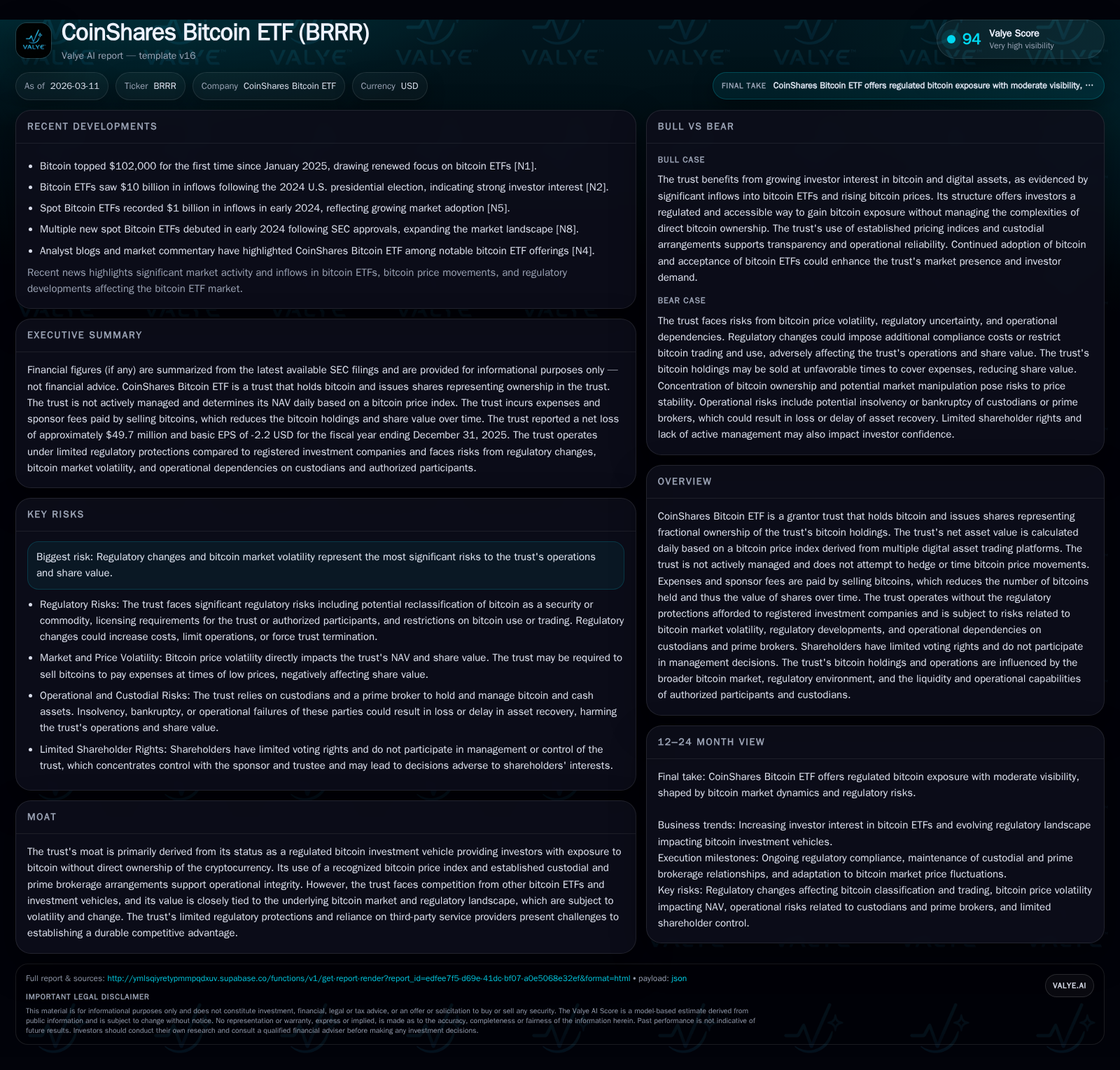
CoinShares Bitcoin ETF reported strong net income in FY2024 driven by bitcoin price appreciation, followed by a reversal to significant operating and net losses in FY2025 amid market volatility and regulatory uncertainty. The trust’s passive structure, with expenses paid via bitcoin sales, reduces underlying holdings over time. Regulatory risks including potential reclassification of bitcoin and increased compliance demands add complexity. Despite profitability challenges, buybacks increased notably in FY2025, reflecting management’s capital allocation approach. Monitoring regulatory developments and bitcoin market dynamics remains key to assessing the trust’s outlook.
Historical Performance Overview
CoinShares Bitcoin ETF's financial results reflect its passive exposure to bitcoin without active management or hedging. The trust reported no operating or net income through FY2023 ([F1]). In FY2024, net income rose sharply to about $307 million despite a modest operating loss of approximately $1.11 million ([F1]). This gain largely stemmed from appreciating bitcoin prices rather than operational improvements.
By the end of FY2024, equity was approximately $826 million, evidencing value accumulation aligned with bitcoin market performance ([F1]).
Historical performance (annual)
| FY | Net ($mm) | OpInc ($) | Net YoY |
|---|---|---|---|
| 2025 | -50 | -1618079 | -116.2% |
| 2024 | 307 | -1112971 | |
| 2023 | 0 | 0 |
Source: SEC companyfacts cache [F1].
Capital returns and efficiency (annual)
| FY | Buybacks ($mm) | ROE% |
|---|---|---|
| 2025 | 384 | -9.8 |
| 2024 | 113 | 37.2 |
| 2023 | 0 |
Source: SEC companyfacts cache [F1].
Note: Year-over-year changes and ROE calculated from [F1] data.
Recent Financial Trends
In FY2025, the trust experienced a significant downturn with operating income declining by 45% to a loss of $1.62 million and net income falling into a $49.7 million loss ([F1]). This shift correlates with bitcoin’s heightened volatility and associated valuation declines rather than changes in fund management.
Equity contracted by roughly 39% to about $505 million by year-end FY2025 ([F1]), reflecting asset depreciation and ongoing expenses funded through bitcoin sales. Despite these headwinds, buybacks increased substantially to $384 million in FY2025 from $113 million the prior year ([F1]), indicating an active capital return policy amid challenging fundamentals.
Regulatory Landscape
The trust operates amid evolving regulatory scrutiny that could materially affect its business model and investor returns ([S1], [S3], [S4], [S6], [S7], [S9]). The SEC has highlighted concerns around insufficient oversight of bitcoin markets and potential manipulative practices. Should bitcoin be reclassified as a security under U.S. federal laws, the trust would face additional registration and compliance burdens under the Investment Company Act—potentially increasing costs significantly ([S4], [S6]).
Alternatively, CFTC treats bitcoin as a commodity but currently does not regulate spot markets fully; shifts in this stance could impact derivatives linked to the trust ([S9], [S10]). International regulation remains fragmented with some jurisdictions imposing mining bans or trading restrictions that may impact liquidity and acceptance ([S14], [S19], [S28]).
Enforcement actions against exchanges and crypto businesses increase systemic risks impacting custody arrangements critical for trust operations ([S23], [S24]). Enhanced anti-money laundering requirements further elevate operational complexity ([S22], [S25]). Regulatory changes could also force termination or liquidation at unfavorable times if compliance becomes prohibitive ([S7], [S14], [S27]).
Market Volatility Impact
Bitcoin’s price volatility is intensified through momentum pricing dynamics which amplify fluctuations beyond fundamental demand shifts ([S1], [S6]). The trust holds bitcoins passively without hedges; thus its NAV reflects spot price movements less gradual dilution from expense-funded coin sales.
Unique operational risks include irreversible loss of private keys and dependence on internet infrastructure for transaction processing ([S1]). These factors contribute to valuation instability making the trust less suitable for investors seeking stable value preservation.
Capital Allocation: Buybacks Amid Losses
The notable increase in buybacks during FY2025 despite negative returns suggests management aims to support per-share metrics or signal confidence amidst declining equity ([F1]). With no cash reserves for dividends or distributions—the trust relies entirely on NAV appreciation for shareholder returns.
ROE was approximately -9.8% in FY2025 reflecting impaired profitability relative to equity base ([F1]). Shareholder influence over buyback decisions is limited given the trust’s structure and governance framework.
Operational Structure and Growth Considerations
As a grantor trust holding direct interests in bitcoins without active portfolio management or hedging abilities, CoinShares Bitcoin ETF is fully exposed to market risks without mitigation tools. Shareholders have minimal governance rights compared to registered investment companies.
Operational dependencies on custodians and prime brokers introduce additional risk layers; any disruption—regulatory or technical—could impair fund functioning. Competition includes other passive funds as well as actively managed products employing derivatives strategies.
Outlook: Navigating Uncertainty
Absent explicit forward-looking guidance from filings or sponsor communications, future prospects hinge largely on macro trends including institutional adoption levels and regulatory clarity ([S1] et al.). Potential growth depends on improved regulatory frameworks enabling stable operation without excessive compliance burdens.
Technological advances may both enhance network utility and raise new regulatory challenges due to privacy features reducing transparency ([S11]). Strategic adaptations might involve revisiting fee structures or partnerships to manage shrinking asset bases caused by ongoing expense-funded coin sales.
Investors should monitor:
- Regulatory developments regarding bitcoin’s classification;
- Legislative initiatives affecting digital asset markets;
- Legal precedents influencing fund registration requirements;
- Jurisdictional policy shifts impacting cross-border operations;
- Technological risks affecting asset security.
Summary Table of Key Financials
| Metric | FY2023 | FY2024 | FY2025 |
|---|---|---|---|
| Operating Income USD | $0 | -$1.11M | -$1.62M |
| Net Income USD | $0 | $306.96M | -$49.71M |
| Equity USD | $0 | $826.12M | $505.38M |
| Buybacks USD | $0 | $112.94M | $383.66M |
| ROE % | N/A | N/A | -9.8% |
This analysis is based strictly on official filings ([F1], [S1]-[S28]) without speculative assumptions or invented data points.
Disclaimer: This is research-only, informational analysis and not investment advice. It may include AI-generated interpretation and general industry context. Always verify important details using primary sources.

Comments