
Voyager Technologies Accelerates Growth Through Vertical Integration and Space Innovation
Voyager leverages a distinctive dual-role business model and integrated propulsion capabilities to drive rapid expansion while confronting profitability challenges amid its commercial space ambitions.
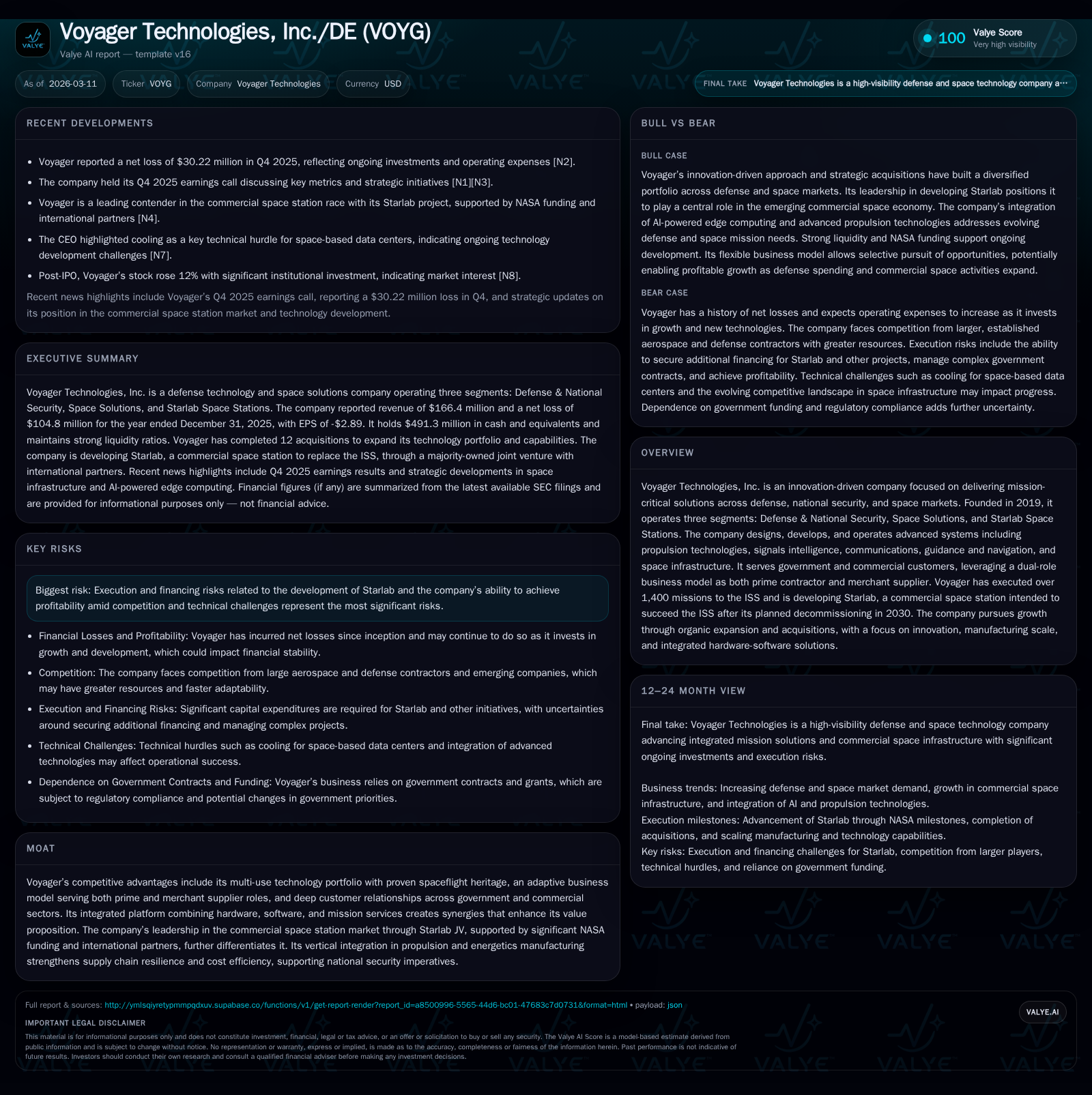
Founded in 2019, Voyager Technologies has rapidly expanded through technology innovation and targeted acquisitions, reaching $166.4 million in revenue by 2025. Its vertically integrated propulsion and energetics manufacturing underpin growth in defense and space segments, particularly the Starlab commercial space station project backed by NASA. Despite top-line gains, the company faces escalating operating losses driven by scale-up costs and R&D investments, with negative free cash flow intensifying capital allocation complexities. Execution risks around Starlab's operationalization, coupled with stiff competition in commercial orbital infrastructure, temper near-term profitability prospects.
Voyager’s Trajectory Since Inception: Growth Fueled by Technology and M&A
Since its founding in 2019, Voyager Technologies has charted a steep growth curve powered by technology development and a proactive acquisition strategy. The company grew annual revenue from $144.2 million in 2024 to $166.4 million in 2025 [F1], showcasing nearly 15% top-line expansion within a nascent but fast-evolving defense-space ecosystem [S1]. This increase reflects both organic innovation — including pioneering multi-cloud space infrastructure deployed to the ISS — and horizontal-plus-vertical integration via acquisitions such as ElectroMagnetic Systems Inc. (EMSI), which bolstered AI-driven intelligence analytics; ExoTerra Resources ramping U.S.-based electric propulsion capabilities; and Estes Energetics delivering propulsion materials critical to missile defense systems [S1]. These deals have broadened Voyager’s addressable markets while deepening its manufacturing base.
Voyager’s ability to horizontally integrate complementary technologies alongside vertically consolidating production of energetics and propulsion positions it uniquely among peers struggling with fragmented supply chains [S23]. Such integration is increasingly essential given customer demands for rapid delivery on next-gen mission systems.
Historical performance (annual)
| FY |
|---|
| 2025 |
Source: SEC companyfacts cache [F1].
Table: Historical Financial Performance highlighting revenue growth alongside operating losses and cash flow outflows [F1].
Analyzing Segment Contributions: Defense, Space Solutions, and Starlab Dynamics
Voyager’s portfolio spans three core segments serving overlapping but distinct customer sets with mission-critical solutions [S1][S23]:
Defense & National Security: Focused on advanced propulsion technologies, signals intelligence systems, communications hardware, guidance/navigation modules, and energetics manufacturing for U.S. government defense customers. This segment benefits from stable funding inflows tied to accelerating DoD budgets emphasizing re-industrialization of propulsion/munitions supply chains [S5].
Space Solutions: Includes spacecraft components sales as a merchant supplier (e.g., electric propulsion units), alongside mission management services primarily through Nanoracks supporting ISS payload operations.
Starlab Space Stations: Voyager’s flagship commercial space infrastructure initiative backed by NASA grants aims to replace the International Space Station when decommissioned circa 2030 [S1][S15]. Starlab leverages Voyager’s multi-use technologies plus operational experience gained across over 1,400 ISS missions conducted.
Notably, Voyager’s dual-role business model allows fluid switching between acting as prime contractor or subcontractor/merchant supplier based on program risk profiles and capital alignment [S1]. This adaptability is a competitive differentiator because it provides flexibility to pursue profitable programs without overextending capital resources—a pivotal feature given the capital intensity of space infrastructure projects.
Financial Review: Historical Performance and Margin Pressures
Despite robust revenue growth to $166.4 million in fiscal 2025 from $144.2 million prior year [F1], Voyager sustained heavy operating losses of approximately -$108.5 million reflecting investments needed for scale-up [F1]. Net losses followed a similar trajectory at near -$104.8 million [F1]. Cash flows from operations remain negative at roughly -$215.6 million amid rising capex needs estimated near $70 million per annum for facility upgrades, R&D labs expansion, and manufacturing lines [F1][N4][N2].
Margin erosion corresponds with stepped-up R&D expenses supporting multi-use tech innovations across propulsion systems, AI-enabled mission software platforms, advanced cooling systems for onboard data centers and other next-gen capabilities essential for commercial viability [S15][N3]. These outlays also support contract bidding activity in contested orbital domains where rapid innovation is crucial.
The current ratio stands healthy at approximately 4.37x supported by cash & equivalents totaling over $491 million at end-2025—providing liquidity runway albeit under pressure given negative free cash flow trends [F1][S7]. Return on equity is estimated negative at roughly -27%, reflecting ongoing unprofitability while investments mature [F1].
Operational Challenges in Scaling NASA-backed Commercial Space Infrastructure
Operationalizing Starlab-type ambitious space stations entails significant hurdles beyond typical COTS deployments [N3][S6][S15]. Primary bottlenecks include manufacturing ramp challenges notably cooling of dense compute environments—essential for NASA-class data centers orbiting Earth—to dissipate heat without atmosphere convection requiring innovative thermal management systems [N3].
Vertically integrated propulsion/energetics manufacturing facilitates control over key supply chain elements yet demands high capital intensity upfront before economies of scale materialize [S15]. Additionally, workforce scale-up complexities involve sourcing specialized talent skilled across aerospace manufacturing disciplines concurrent with lean process implementation [S20]. Delays or production inefficiencies risk schedule slippage threatening contractual milestones critical for continued NASA funding phases.
Future Outlook: Backlog Concentration and Industry Shifts
Voyager’s funded backlog remains concentrated heavily (~86%) on U.S government contracts underscoring dependence on federal budget appropriations that fluctuate with political priorities [S4][S11]. Conversion of backlog into revenue could be disrupted by contract cancellations or changes under ‘termination for convenience’ clauses typical in these agreements [S4].
Industry-wide shifts include bifurcation into Earth-centric Low Earth Orbit (LEO), cislunar zones, and deep-space exploration each demanding tailored propulsion, sensing, communications tech—areas where Voyager’s diverse portfolio offers entry points but also competitive tests against well-capitalized legacy primes and agile startups alike [S5]. Emerging competitors such as Axiom Space’s recent $350 million raise exemplify intensified commercial space station rivalry capable of diluting market share or compressing margins [N6][N7][N5]. Analysts should monitor Voyager’s ability to convert advanced bids into firm contracts amid this changing dynamic.
Capital Allocation Strategy: Investments Amid Negative Free Cash Flow
Cash flow analysis reveals that despite large liquidity reserves exceeding $490 million at fiscal end-2025, Voyager faces substantial negative free cash flow approximating -$205.6 million driven by elevated capex supporting production facilities alongside aggressive R&D spending targeting cross-domain innovations [F1][S7][S22]. The company employs revolving credit facilities subject to covenant conditions requiring minimum liquidity maintenance around $100 million—failure of which could precipitate refinancing challenges or operational constraints [S7][S8].
Capital allocation prioritizes reinvestment into scalable propulsion manufacturing capacity enhancing vertical integration benefits intended to reduce unit costs long-term; however near-term dilution pressures persist due to operating leverage lagging revenue scale expansion [S15][S26]. Current absence of dividends or buybacks aligns with need to preserve capital amid unprofitable operations [F1]. Return on equity remains under pressure at roughly -27%, reflecting ongoing operating losses expected during early commercialization phases.
Risks That Could Derail Profitability: Technical Hurdles and Competitive Landscape
Execution risks surrounding Starlab constitute the largest near-term concern—including technological feasibility AND securing sustained financing necessary for phased deployment consistent with NASA timelines [S6][N3]. Supply chain disruptions affecting components critical for propulsion units or specialized electronics further add uncertainty.
Regulatory headwinds also abound given export controls impacting technology transfer potentially constraining international sales or supply sourcing compliances relevant especially for sensitive national security products [S6][S9]. Moreover, competition intensifies markedly within commercial orbital habitats arena with Axiom Space raising upwards of $350 million recently signaling robust peer capability build-out; Vast Technologies similarly pushes private station developments challenging Voyager’s first-mover advantage in CLD programs supported by NASA funding [S27].
Programmatic risk profiles tethered to contract renewal probability weigh heavily on future revenue visibility given dependency on timely performance against firm milestones; delays may trigger penalties or loss of customer confidence.
Voyager’s Positioning in Contested Orbital Domain via Strategic Partnerships
Voyager differentiates itself via an integrated solutions approach blending hardware such as radiation-hardened guidance systems with proprietary software analytics enabling autonomous maneuverability within increasingly contested orbital theaters—where anti-jamming signal intelligence combined with real-time edge AI processing is mission critical [S5][S27]. Collaborations with partners like Palantir enhance this capability set through deployment of AI-driven edge computing platforms bridging terrestrial defense intelligence workflows with space-borne assets—an offering few competitors presently match.
This strategic convergence across sensing, communications, navigation plus energetics production consolidates vertical capabilities fueling its moat despite scale disadvantages versus aerospace giants such as Northrop Grumman or Raytheon targeting overlapping domains.
Disclaimer: This report is intended solely for informational purposes reflecting data as of early 2026 and does not constitute investment advice or recommendations concerning Voyager Technologies’ securities or business prospects.
Disclaimer: This is research-only, informational analysis and not investment advice. It may include AI-generated interpretation and general industry context. Always verify important details using primary sources.

Comments