
UNITED NATURAL FOODS INC: Rebounding from Challenges with Operational Discipline and Innovation
UNFI has reversed recent profitability losses by strengthening operational controls amid ongoing compliance and cybersecurity risks intrinsic to natural food distribution.
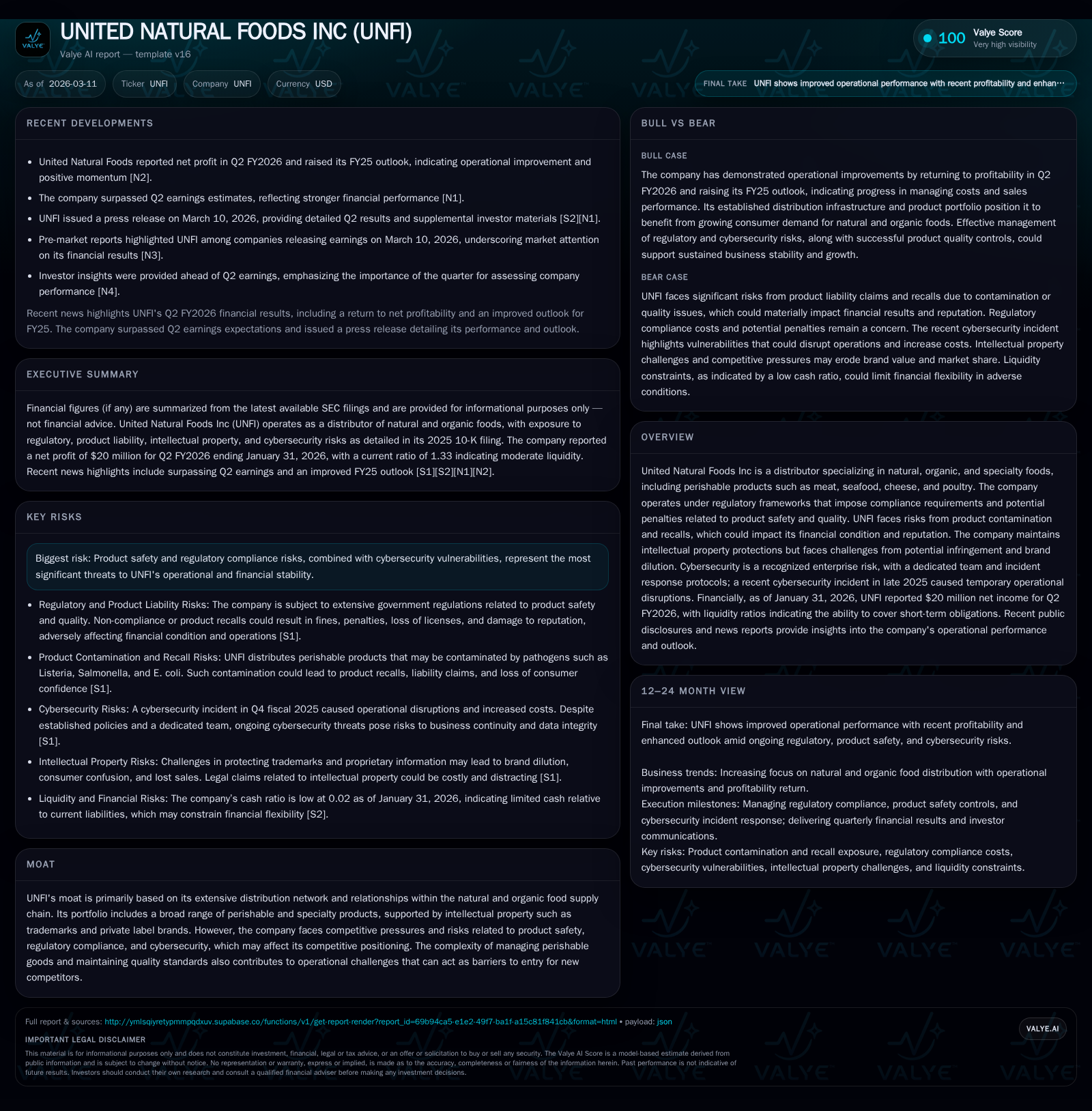
United Natural Foods Inc (UNFI) experienced a sharp financial downturn transitioning from significant profits in FY2023 to operating losses and net deficits by FY2025, driven by heightened product safety challenges and a disruptive cybersecurity incident. The company’s extensive distribution network and private label portfolio underpin its competitive moat, but regulatory scrutiny over perishable goods and contamination risks remain persistent operational hurdles. UNFI’s recent Q2 FY2026 net income turnaround reflects disciplined cost management and recovery efforts. Capital allocation remains cautious with an emphasis on deleveraging before resuming share repurchases while balancing cash flow generation. Investors should monitor upcoming earnings and regulatory updates for evidence of sustained operational resilience.
From Profitability to Losses and Back: UNFI's Financial Trajectory Over Recent Years
United Natural Foods Inc demonstrated a dramatic shift in its financial performance through the recent fiscal years. Following a substantial $120 million operating income recorded in FY2023, the company faced an operating loss of $31 million by FY2025 along with deepening net income losses moving from a positive $24 million to a negative $118 million over the same period [F1]. This contraction illustrates the significant headwinds that emerged post-FY2023. Despite this negative trajectory on the income statement, UNFI’s operational cash flow rose impressively, reaching $470 million in FY2025 compared to $253 million two years prior — underscoring robust cash generation amid tighter margin pressures. Capital expenditures contracted sharply as well, by about one-third, reflecting scaling back or optimization in investment spending [F1].
Historical performance (annual)
| FY | Net ($mm) | CFO ($mm) | OpInc ($mm) | Capex ($mm) | Net YoY |
|---|---|---|---|---|---|
| 2025 | -118 | 470 | -31 | 231 | -5.4% |
| 2024 | -112 | 253 | 8 | 345 | -566.7% |
| 2023 | 24 | 624 | 120 | 323 | -90.3% |
| 2022 | 248 | 331 | 423 | 251 |
Source: SEC companyfacts cache [F1].
Capital returns and efficiency (annual)
| FY | Buybacks ($mm) | FCF ($mm) | ROE% |
|---|---|---|---|
| 2025 | 0 | 239 | -7.6 |
| 2024 | 0 | -92 | -6.8 |
| 2023 | 62 | 301 | 1.4 |
| 2022 | 80 | 13.8 |
Source: SEC companyfacts cache [F1].
Table shows key annual headline figures highlighting deterioration then partial recovery phases.
The recent Q2 FY2026 quarterly results marked a positive inflection point as UNFI reported net income of approximately $20 million for the period ending January 31, 2026 — signaling potential stabilization following years of decline [N13][S23]. Liquidity indicators reinforce financial health resilience; the current ratio stands at about 1.33 supported by current assets exceeding liabilities [$3.25B vs $2.44B] [F1].
Core Drivers Behind Past Growth and the Impact of Disruptive Events
Historically UNFI capitalized on its extensive distribution footprint specializing in natural and organic perishable foods including meat and seafood — product categories that present complexity barriers deterring new entrants due to supply chain sensitivity and quality control demands [S1]. Combined with an expansive private label brand portfolio that adds proprietary product depth versus commoditized alternatives,[S5] these drivers underpinned revenue growth stability.
Nonetheless, adverse events severely disrupted this trajectory. Product contamination risks represent a central vulnerability given exposure to pathogens like Listeria monocytogenes and Salmonella particularly prevalent in poultry and meat goods distributed by UNFI [S6]. The risk extends beyond manufacturing into post-shipment handling over which UNFI lacks full control yet bears reputational consequences if incidents escalate into recalls or legal claims.
Additionally, a significant cybersecurity incident detected late in fiscal year 2025 temporarily impaired order fulfillment capabilities resulting in reduced sales volume and increased operational costs during that quarter [S9]. These combined operational setbacks impaired financial results but concurrently prompted reinforcement of control systems across risk dimensions.
Product Safety and Regulatory Compliance: Persistent Operational Challenges
UNFI operates within stringent federal and state regulatory frameworks pertaining to food safety which impose compliance costs alongside exposure to potentially severe administrative penalties for violations including forced recalls or license revocations [S4][S5]. These frameworks govern critical aspects such as labeling accuracy or microbial contaminants presence particularly salient given UNFI’s perishable inventory segments — meat, cheese, seafood, and poultry products susceptible to spoilage or pathogen contamination.
While adherence to good manufacturing practices mitigates some risks through finished product testing regimes,[S6] residual vulnerability persists especially tied to downstream handling outside direct supervision.[S4] Liability insurance coverage exists but is not guaranteed at reasonable premiums indefinitely and indemnification rights against suppliers depend on their creditworthiness placing some exposure on UNFI itself.
Regulatory scrutiny therefore acts as both a protective barrier supporting competitive differentiation — ensuring consistent quality deters less compliant entrants — but also exacts ongoing vigilance demands siphoning managerial attention[S5].
Cybersecurity Incident Impact and Strengthening Defense Mechanisms
UNFI manages cyber risk through a governance framework aligned with NIST cybersecurity principles underscored by dedicated leadership from a Chief Information Security Officer headed team responsible for policy formation, vulnerability management, and incident response.[S8][S9] The presence of robust processes including periodic third-party assessments along with tabletop exercises illustrates maturity consistent with enterprise-wide critical supply chain safety.
Notwithstanding preventive controls,[S9] the aforementioned cybersecurity breach causing unauthorized activity compelled proactive containment actions such as taking core systems offline temporarily disrupting customer order flows.[S9] Embedded insurance coverage mitigates certain financial consequences but cannot offset operational disruptions affecting revenue recognition periods.
This incident marks a salient reminder of evolving digital threats confronting supply-centric companies handling complex logistics networks where information system integrity directly correlates with service reliability hence brand trust.
Future Growth Prospects within Natural and Organic Food Distribution
Sector tailwinds are favorable given persistent consumer shifts towards health-and-wellness oriented products coupled with rising natural food adoption trends documented across industry reports.[N14] UNFI’s established relationships across retailers seeking specialty perishables position it well to capitalize on this macro environment.[N13]
Prospective growth may derive from leveraging expanded private label offerings combining quality perception gains supported by innovations unveiled during late-2025 investor communications.[N13] However,the dual pressures imposed by intensified regulatory oversight around food safety as well as rising cybersecurity risk vectors constitute growth ceilings unless continuously managed.[N14]
Capital Allocation Strategy: Balancing Cash Flow Generation and Shareholder Returns
Despite operating losses persisting through FY2025,[F1] UNFI produced substantial free cash flow around $239 million reflecting disciplined working capital management relative to capital expenditures capped at $231 million down one-third year-over-year [F1].
The board authorized a $200 million share repurchase program starting September 2022 but has suspended buybacks since Q4 FY2023 due primarily to leverage covenant limitations restricting repurchases until net leverage falls below prescribed thresholds.[S7][S11]
Dividend payments have continued signaling commitment towards returning capital yet ROE remains at approximately -7.6%, underscoring inefficiency converting equity into profits presently.[F1]
Management anticipates resuming opportunistic buybacks as deleveraging progresses aligned with capital allocation priorities focusing first on debt reduction then incremental returns.[S7]
Investor Watchpoints: Upcoming Milestones and Financial Metrics to Monitor
With explicit forward guidance limited,[N3] investors should vigilantly observe subsequent quarterly earnings releases for evidence sustaining profitability recovery beyond Q2 FY26 initial gains.[N13]
Equally important will be management disclosures regarding resolution or continuation of regulatory compliance issues alongside detailed updates on cybersecurity defensive enhancements recorded post-incident.[S12]
Given UNFI’s exposure profile,integration sustainability metrics coupled with qualitative assessments related to operational resilience form important heuristics complementing headline financial metrics monitoring ongoing enterprise health.
This analysis relies solely on publicly available filings including SEC reports up to March 10th, 2026,[F1][S#],and relevant recent news items[N#], aiming for factual accuracy without prescriptive investment guidance.
Disclaimer: This is research-only, informational analysis and not investment advice. It may include AI-generated interpretation and general industry context. Always verify important details using primary sources.

Comments