
ConnectOne Bancorp's Profit Surge and Cybersecurity Command in 2025
A near doubling of net income in 2025 juxtaposes sharply against ongoing wire transfer litigation, underscoring operational resilience bolstered by a stringent cybersecurity governance framework.
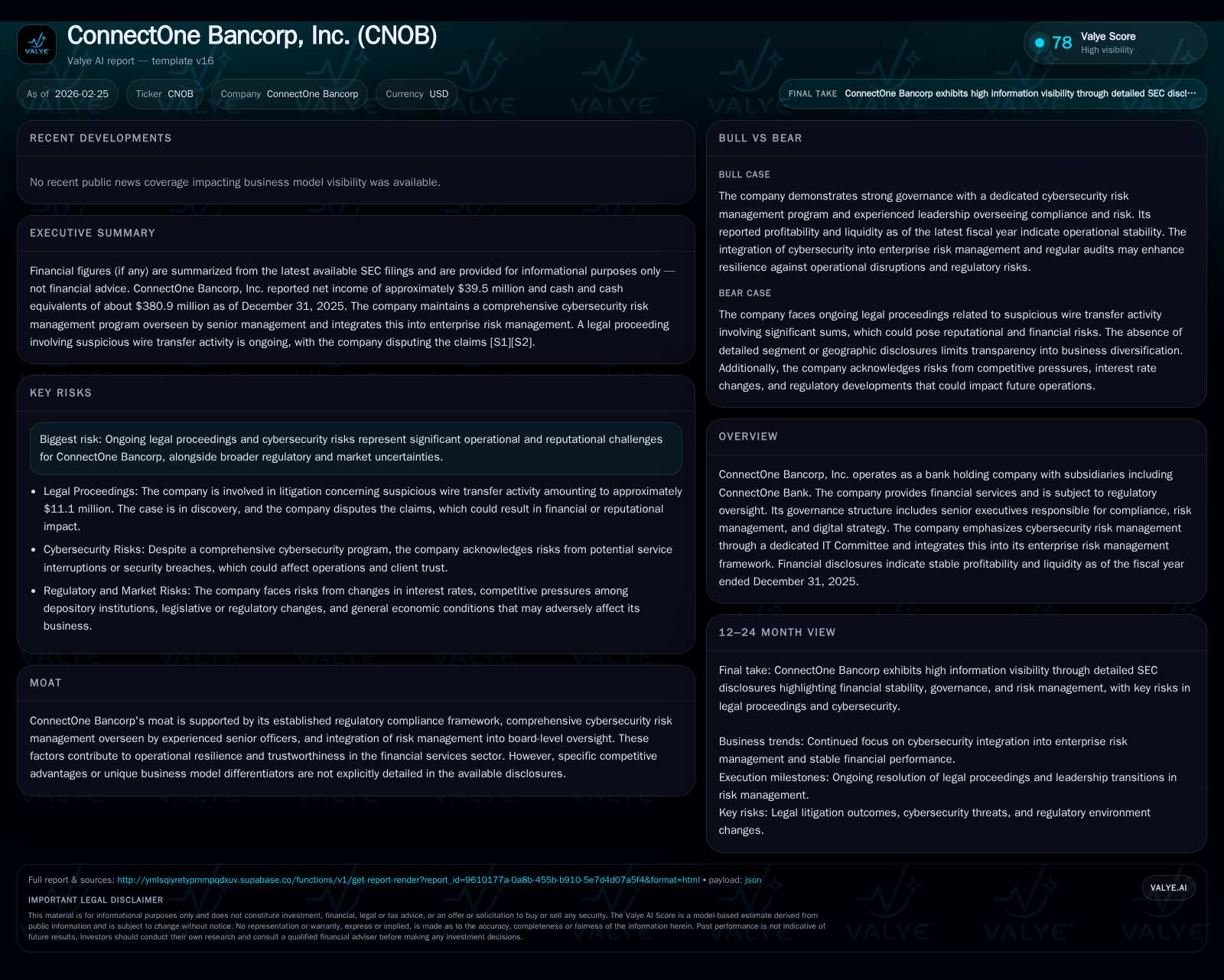
ConnectOne Bancorp, Inc. posted an impressive 94% increase in net income in fiscal year 2025, reaching $39.5 million despite the cloud of an $11.1 million wire transfer lawsuit originating from legacy entities. This financial strength was underpinned by a 75% jump in operating cash flow, reflecting disciplined operational execution and portfolio management. Simultaneously, ConnectOne's advanced cybersecurity governance - anchored by a dedicated IT Committee featuring senior executives - integrates tightly with enterprise risk management and board oversight, fortifying the bank’s operational trustworthiness amid heightened digital risks. The company’s capital allocation strategy favored dividend growth alongside suspension of share repurchases, reflecting a conservative stance amid legal uncertainties. Looking forward, interest margin pressures and competitive dynamics weigh on prospects even as continued investment in digital risk controls remains a strategic priority.
The stark contrast between ConnectOne Bancorp's near-doubling of net income in fiscal 2025 and its ongoing exposure to a multi-million-dollar wire transfer lawsuit encapsulates the company's resilience and disciplined risk governance.
Robust Earnings Trajectory and Growth Drivers Through 2025
ConnectOne reported net income of approximately $39.5 million for fiscal year 2025, up an aggressive 94% from $20.4 million in 2024 [F1]. This surge was accompanied by a pronounced rise in operating cash flow (CFO), which climbed roughly 75% to $106 million, highlighting robust cash earnings quality amidst moderate capex outlays [F1]. While revenues and operating income figures are not disclosed explicitly in provided filings, this combination suggests improvements in portfolio asset quality or more efficient operating cost management potentially buffering macro-financial headwinds—an increasingly critical factor for banks facing volatile interest rate environments.
Capital expenditures rose about 42% year-over-year to nearly $5.4 million as the bank invested notably into technological infrastructure aligned with its digital strategy and cybersecurity programs—a necessary outlay given evolving enterprise technology demands [F1].
Despite surging profitability and cash flows, ConnectOne's return on equity stood at an estimated modest 2.5% for 2025 due to significant equity base expansion from $1.24 billion at end-2024 to $1.57 billion by year-end 2025—a sign of conservative capital management possibly influenced by unresolved legal risks [F1].
Historical performance (annual)
| FY | Net ($mm) | CFO ($mm) | Capex ($mm) | Net YoY |
|---|---|---|---|---|
| 2025 | 40 | 106 | 5 | +94.0% |
| 2024 | 20 | 61 | 4 | +5.7% |
| 2023 | 19 | 93 | 7 | -40.8% |
| 2022 | 33 | 177 | 3 |
Note: Omitted columns lack sufficient annual XBRL coverage in the provided tags (need ≥2 annual points): Rev, OpInc. Source: SEC companyfacts cache [F1].
Capital returns and efficiency (annual)
| FY | Div ($mm) | Buybacks ($mm) | FCF ($mm) |
|---|---|---|---|
| 2025 | 32 | 0 | 101 |
| 2024 | 27 | 6 | 57 |
| 2023 | 26 | 17 | 85 |
| 2022 | 23 | 13 | 173 |
Source: SEC companyfacts cache [F1].
Note: Revenue and operating income not available from tags.
Advanced Cybersecurity Governance as a Pillar of Operational Resilience
ConnectOne's enterprise cybersecurity program is tightly woven into its corporate governance architecture—a noteworthy differentiator given heightened industry cyber threat vectors [S1],[S9]. The IT Committee (ITC), tasked with direct oversight of cyber risk management efforts, is co-chaired by Chief Compliance Officer Laura Criscione—an industry veteran with over three decades’ financial services compliance experience—and Chief Data & Development Officer Sharif Alexandre who brings cross-sector technology leadership.
Additional ITC members include roles pivotal to systemic controls such as the Information Security Officer, IT Manager, Chief Risk Officer Mark Pappas (appointed December 2025), Chief Digital Officer Ali Mattera—who steers digital innovation—and CEO Frank Sorrentino III [S1]. This composition ensures cyber risk is continually assessed through multiple expert lenses.
The ITC operates under rigorous protocols: regular monthly vulnerability scanning conducted by internal IT teams; an annual comprehensive risk assessment benchmarked against the National Institute of Standards and Technology (NIST) Cybersecurity Framework; acquisition of third-party System Organization Controls (SOC) reports for vendors rated “high-risk” within internal vendor management; annual external penetration testing feeding into ITC deliberations; plus an internal Incident Response Plan with associated drills through yearly table-top exercises designed to test crisis readiness [S1],[S9]. This layered approach feeds upward into the Enterprise Risk Management Committee (ERMC), which incorporates senior executives from various disciplines including risk management and legal counsel—a structure that ultimately reports quarterly to the Board Risk Committee.
This sophisticated governance provides board-level visibility into cyber risk posture alongside operational measures that combine proactive detection and rapid response capabilities.
Unpacking Pending Litigation’s Role in Risk and Reputation Management
The company remains embroiled in litigation stemming from suspicious wire transfers that surfaced at FLIC’s subsidiary FNBLI—a predecessor institution later merged into ConnectOne—in July of 2024 [S4],[S6]. The case involves alleged unauthorized access causing approximately $11.1 million in disputed funds movement affecting a client’s bank accounts.
A forensic investigation concluded no evidence of unauthorized network penetrations on the bank’s side; however, the client filed suit seeking damages equal to the net affected amount after initial recalled wires were returned [S4]. ConnectOne has publicly rejected these claims and is vigorously defending its position while acknowledging that this ongoing lawsuit represents both operational headwinds and reputational risk that may weigh on customer confidence or expose the company to regulatory scrutiny until resolved.
The lawsuit remains in active discovery stages without forecastable outcomes or expected settlements disclosed as yet.
Capital Allocation Dynamics: Dividends, Buybacks, and Equity Expansion
ConnectOne has consistently prioritized shareholder returns through dividend payments which rose steadily from $23.4 million in FY22 up to nearly $32 million in FY25—demonstrating commitment to yield stability despite external headwinds [F1]. This upward trend reflects confidence supported by improving net earnings trajectories.
Concurrently, share repurchase activity has diminished markedly—from over $13 million annually in early periods falling sharply to nil repurchases executed in FY25—highlighting a nuanced shift towards preserving capital amidst litigation uncertainties and balance sheet strengthening strategies [F1]. The bank expanded its shareholders’ equity base substantially from around $1.18 billion at end-2022 up to $1.57 billion by December last year with no indication of dilution events documented but likely driven primarily by retained earnings accumulation reflecting disciplined profit retention policy.
These capital actions suggest a prudent approach balancing stable dividend distribution alongside cautious stewardship of capital resources during periods of external uncertainty.
Future Outlook: Balancing Competitive Pressures with Technological Investments
While explicit forward-looking quantitative guidance remains absent explicitly from recent filings, identified risk factors impinge heavily on ConnectOne's horizon prospects [S1],[S7]. Rising competitive pressures amid depository institution consolidation trends could compress net interest margins (NIM), challenging revenue growth unless offset by scale efficiencies or pricing power shifts.
Additionally, continuing regulatory evolution necessitates adaptable compliance frameworks; cyber threat volatility similarly mandates sustained investment in technology infrastructure—both potential cost centers requiring ongoing capital funding prioritization.
The company's proactive embedding of digital strategy leadership within ERMC governance signals recognition that technological agility is integral not only for offense but also defense across compliance, customer experience enhancement, and operational continuity.
Key Financial Milestones and Cash Flow Assessment
A striking metric underpinning ConnectOne’s robust fiscal positioning is free cash flow generation approximating $101 million for FY25—the difference between operating cash flow ($106 million) less capex spend (~$5 million)—marking an improvement from prior years where large fluctuations occurred driven mainly by working capital cycles or adjusted provisioning levels [F1].
This positive cash conversion cycle supports ongoing dividends while providing flexibility for incremental investments or contingencies amid unpredictable macroeconomic factors.
This capital efficiency speaks well of management’s ability to sustain liquidity buffers (notably over $380 million in cash equivalents year-end) alongside measured reinvestment consistent with strategic priorities focused on digital transformation imperatives.
Digital Strategy Leadership in Enterprise Risk Framework
A salient point reinforcing ConnectOne’s moat is the presence of the Chief Digital Officer within not only the IT Committee but also as an active participant reporting directly through ERMC processes up to board-level scrutiny at each meeting cycle [S1].
Ali Mattera's leadership role exemplifies an embedment of IT governance deeply into enterprise risk workflows beyond traditional silos—facilitating comprehensive cyber risk escalation processes combined with data analytics oversight and innovative service delivery models.
Such structural integration ensures technology-driven risk identification aligns seamlessly with overall corporate objectives maintaining stakeholder trust amid rapidly shifting threat landscapes.
This analysis rests strictly on reported financials and SEC disclosures through February 25th, 2026 without projecting unsupported forecasts or investment recommendations. Financial metrics employ company-reported figures supplemented by standardized banking sector terminology for interpretative clarity.
Disclaimer: This is research-only, informational analysis and not investment advice. It may include AI-generated interpretation and general industry context. Always verify important details using primary sources.

Comments