
EverQuote's Growth, Profitability Surge, and Debt-Linked Capital Allocation Tradeoffs
EverQuote accelerated revenue and earnings growth in 2025, supported by insurance segment expansion and liquidity strength, alongside active share repurchases constrained by revolving credit covenants.
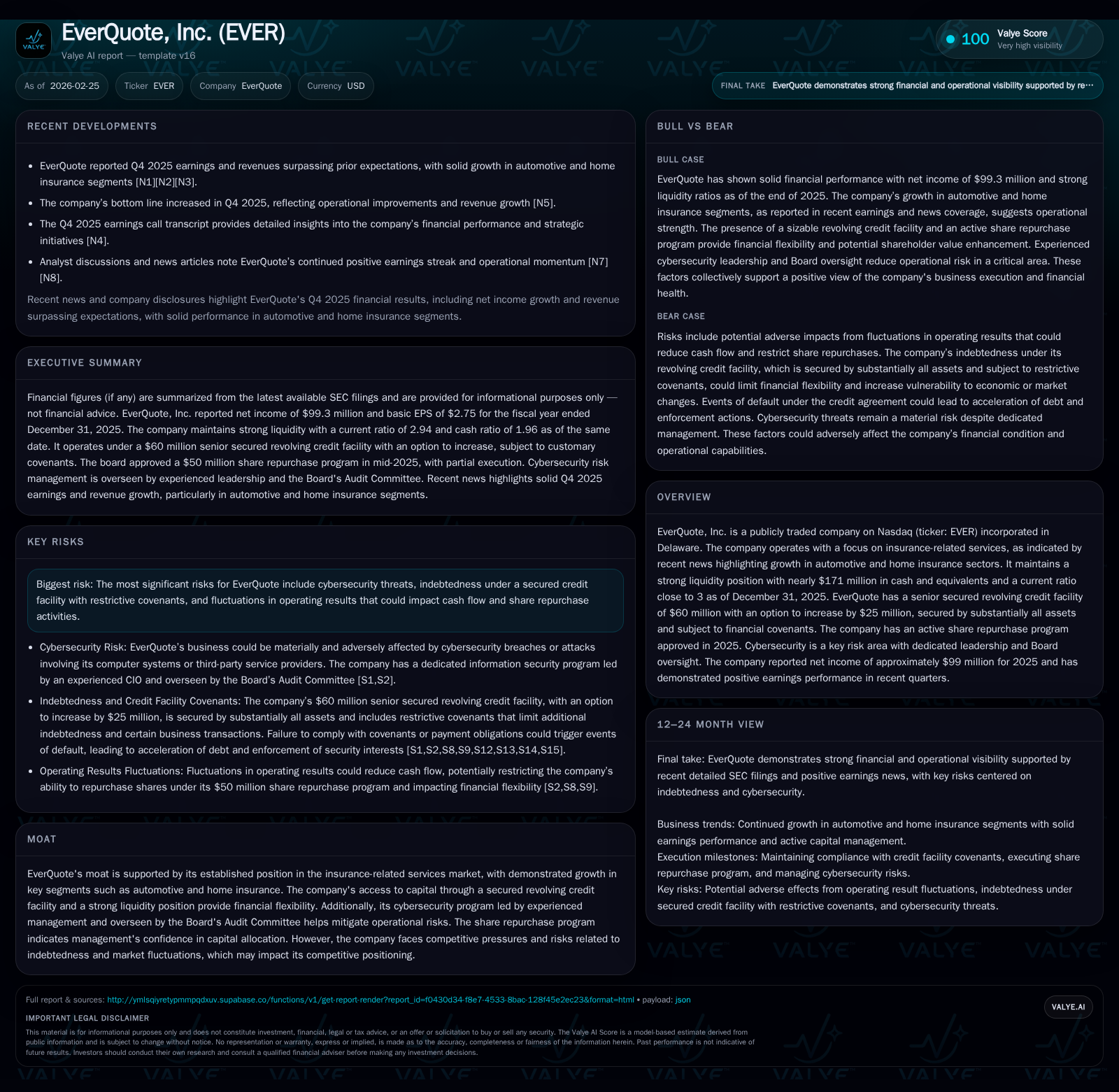
EverQuote, Inc. delivered a significant turnaround with a robust 31.8% revenue increase to $97.3 million in 2025 and a net income rebound to $99.3 million from prior losses. This performance was fueled by growth in automotive and home insurance verticals underpinned by the company’s effective platform strategy and capitalized marketing. Operating cash flow improved dramatically alongside margin expansion. However, the company’s senior secured $60 million revolving credit facility imposes leverage-related covenants that may restrict the timing and scale of its ongoing $50 million share repurchase program. Cybersecurity risk remains a board-level focus amid digital reliance.
Company Overview and Historical Performance
EverQuote operates as a provider of insurance-related services, primarily targeting the automotive and home insurance markets. Incorporated in Delaware and listed on Nasdaq (ticker: EVER), it positions itself as an established platform connecting consumers with insurance providers through targeted marketing technology.
Historical financial trends exhibit EverQuote's transformation from unprofitable operations in early years toward sustainable profitability in recent periods. Revenue increased from approximately $39.8 million in 2018 to $73.8 million in 2019, then surged to $97.3 million by 2020 [F1].
Operating income shows an even more distinct inflection: negative operating results during 2022 (-$24.8 million) and 2023 (-$51.9 million) gave way to positive operating income of $31.7 million in 2024 and further expanded to $58.3 million in 2025 [F1]. Net income followed a similar path – after posting losses of -$24.4 million (2022) and -$51.3 million (2023), the company returned to solid net income of $32.2 million in 2024 and nearly tripled that figure to $99.3 million for the full year ending December 31, 2025 [F1].
These gains reflect successful monetization efforts within core insurance verticals supported by efficiency gains that enhanced margins across sales and general administration expenses.
Historical performance (annual)
| FY | Net ($mm) | CFO ($mm) | OpInc ($mm) | Capex ($mm) | Net YoY |
|---|---|---|---|---|---|
| 2025 | 99 | 95 | 58 | 5 | +208.7% |
| 2024 | 32 | 67 | 32 | 4 | +162.7% |
| 2023 | -51 | -3 | -52 | 4 | -110.1% |
| 2022 | -24 | -16 | -25 | 4 |
Note: Omitted columns lack sufficient annual XBRL coverage in the provided tags (need ≥2 annual points): Rev, Div, Buybacks. Source: SEC companyfacts cache [F1].
Capital returns and efficiency (annual)
| FY | FCF ($mm) | ROE% |
|---|---|---|
| 2025 | 90 | 41.7 |
| 2024 | 62 | 23.8 |
| 2023 | -7 | -63.4 |
| 2022 | -20 | -22.7 |
Source: SEC companyfacts cache [F1].
Note: Some prior year revenue data not fully available for direct FY comparison; YoY % computed based on latest available data points [F1].
Drivers Behind Past Growth
The company's acceleration is chiefly attributed to solid growth in its automotive and home insurance products — sectors where EverQuote has gained traction through digital lead-generation solutions enhancing consumer engagement with insurers [N8]. The ability to effectively leverage data analytics for marketing optimization has been a key competitive edge.
Operational improvements included streamlined cost structures and automation initiatives leading to expanded operating margins visible since the profitable inflection starting in late-2023 [S1][N1]. Cash flows correspondingly improved from negative territory into strong positive operating cash flow exceeding $95 million by end-2025 [F1].
Future Growth Prospects
EverQuote's growth prospects pivot on continuing expansion within insurance verticals where digital transformation remains underpenetrated, including further consolidation of automotive insurance leads and upselling into adjacent homeowners’ policies [N8]. Investments into platform enhancements supporting better conversion rates constitute another growth lever.
However, company-specific guidance on explicit future revenue targets or EBITDA margins is not publicly disclosed as per recent filings [N3][S1]. Market factors such as competitive pricing by insurance aggregators or changes in advertising spend budgets could cap growth potential.
A notable consideration is EverQuote's liquidity management; maintaining sufficient unrestricted cash while adhering to credit facility covenants will be critical for sustaining both organic investments and shareholder returns [S9][S13].
Capital Structure and Returns
As of December 31, 2025, EverQuote maintains a robust liquidity position with approximately $171 million in cash and equivalents alongside current assets totaling about $256 million against current liabilities near $87 million—a current ratio near three times indicates strong short-term financial health [F1].
The company operates with a senior secured revolving credit facility aggregating $60 million available, extendable incrementally by another $25 million subject to lender approval, secured against substantially all assets [S14][S25]. The facility carries variable interest rates tied to Term SOFR or prime rate benchmarks plus spreads around ~2%, imposing customary affirmative/negative covenants restricting further indebtedness and major structural changes [S11][S14].
Restriction under credit terms may limit discretionary share repurchases which are otherwise underway: authorized up to $50 million over one year since July 22, 2025 with about $21 million executed as of late-2025—demonstrating management’s commitment to efficient capital allocation amid ongoing earnings improvement [S9][S13][F1].
Return on equity was estimated at approximately 41.7% for fiscal year ending December 31, reflecting strong profitability relative to equity base [$99M net income / ~$238M equity] [F1]. This elevated ROE signals effective capital deployment though partially offset by leverage considerations.
Capex levels remain modest near ~$5 million annually primarily geared toward product development infrastructure rather than heavy physical asset accumulation—suggesting innovation-focused capital expenditure discipline supporting scalable growth dynamics [F1].
Operational Risks: Cybersecurity Focus
A key operational risk area under scrutiny is cybersecurity given EverQuote’s reliance on digital platforms aggregating sensitive customer data [S8][S16]. The company has instituted an information security organization led by a CIO with over three decades’ industry expertise who oversees comprehensive risk assessments and mitigation strategies.
The Board’s Audit Committee closely monitors cybersecurity exposures with regular reporting channels established ensuring oversight of incidents, threat landscapes, regulatory compliance, and emerging risks—reflecting mature governance consistent with technology-enabled service providers [S16]. Despite safeguards, breaches or failures could materially disrupt operations or erode trust impacting revenues adversely.
What To Watch Going Forward (Analysis)
- Monitor changes or expansions in the secured revolving credit facility terms that could affect debt capacity or covenants restricting share buybacks or M&A activity.
- Observe quarterly performance trends within automotive versus home insurance segments to track momentum sustainability amid competitive pressures.
- Evaluate developments on cybersecurity front via disclosures or incident-related announcements that may influence risk profile.
- Keep an eye on operating margins evolution as scale benefits mature balanced against incremental marketing investment.
- Assess insider share repurchase activity pacing signaling confidence or cash flow flexibility shifts.
- An updated guidance release would clarify medium-term revenue goals which remain undisclosed currently.
Summary Table: EverQuote Annual Financial Highlights (USD millions)
| FY | Rev | OpInc | Net Inc | CFO | Capex | Buybacks |
|---|---|---|---|---|---|---|
| 2018* | 39.8 | N/A | N/A | N/A | N/A | N/A |
| 2019* | 73.8 | N/A | N/A | N/A | N/A | N/A |
| 2020* | 97.3 | N/A | N/A | N/A | N/A | N/A |
| 2022* | N/A | -24.9 | -24.4 | -15.8 | 4.3 | N/A |
| 2023* | N/A | -51.9 | -51.3 | -2.8 | 3.8 | - |
| 2024* | N/A | 31.7 | 32.2 | 66.6 | 4.1 | - |
| 2025 * | N/A 58.3 99.3 95.4 5.1 21 | |||||
| *Partial data used; some categories omitted due lack of multi-year availability. |
EverQuote’s trajectory from losses toward profitability coupled with strategic share repurchases reflects executive confidence grounded in core market strength within digital insurance media services despite debt covenant limitations restraining rapid capital return expansions.
The company's disciplined capex approach alongside cybersecurity governance advances supports sustained platform reliability integral for customer retention amidst intensifying competition.
Investors should continue monitoring financial covenant compliance signals embedded within liquidity disclosures given their potential impact on share buyback flexibility—a vital element of capital allocation philosophy demonstrated most recently.
Disclaimer: This analysis is for informational purposes only and does not constitute investment advice or recommendations regarding securities transactions.
Disclaimer: This is research-only, informational analysis and not investment advice. It may include AI-generated interpretation and general industry context. Always verify important details using primary sources.

Comments