
AstraZeneca's Revenue and Innovation Surge Propels Its Competitive Edge
AstraZeneca’s robust financial growth and innovation pipeline reinforce its resilient global pharmaceutical leadership.
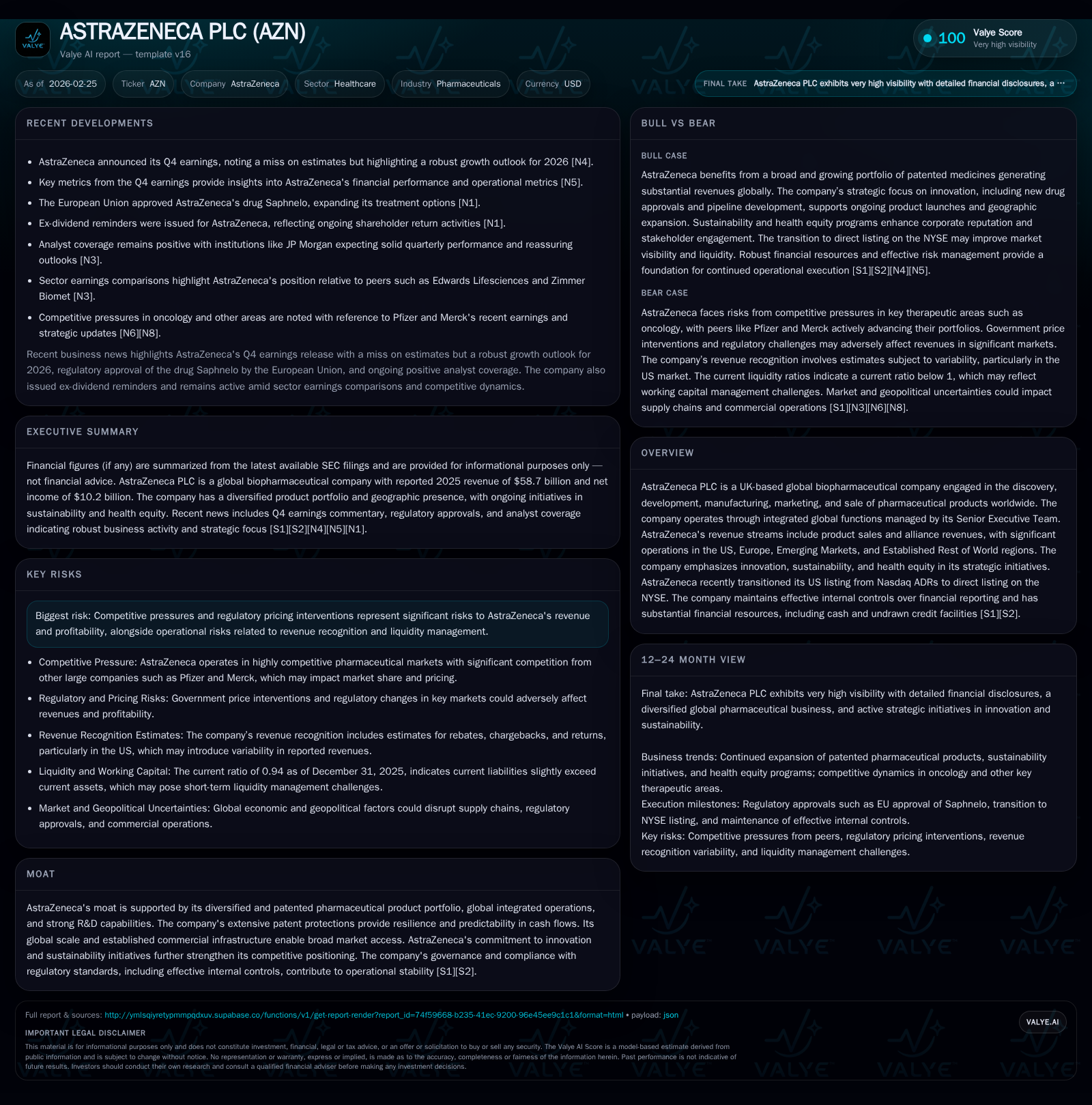
Between 2022 and 2025, AstraZeneca experienced strong revenue expansion coupled with accelerated net income growth, underpinned by strategic innovation investments and patent protection. The company’s well-diversified geographic footprint and solid R&D pipeline bolster its prospects despite ongoing regulatory and competitive challenges. AstraZeneca maintains disciplined capital allocation focused on sustaining R&D while ensuring stable shareholder returns, with a return on equity near 21%. Investors should monitor upcoming pipeline readouts, patent expirations, and guidance updates for directional insights.
Robust Historical Growth Fueled by Strategic Innovation
AstraZeneca demonstrated compelling financial acceleration between fiscal years 2022 and 2025. Revenue grew from $44.4 billion in FY2022 to nearly $58.7 billion by FY2025 [F1], representing an annualized increase of roughly 8.6% from the prior year alone. This top-line strength was supported primarily by expansion across key patented product lines and geographic diversification.
More notable was the bottom-line performance: net income surged from $3.3 billion in FY2022 to over $10.2 billion in FY2025 [F1], posting an impressive year-over-year increase of about 45.3% at the latest fiscal year end. This gap between revenue and profit growth signals meaningful operating leverage improvements, influenced by economies of scale, enhanced gross margins on high-value products, and tighter cost management strategies reported in corporate disclosures [S1][S8].
Research and Development expenditures stood as a pillar underpinning these outcomes. AstraZeneca allocated significant resources towards R&D as part of its strategic emphasis on innovation-led growth. Intangible asset investment related to product development is substantial but selectively deployed toward promising candidates—resulting in both capitalized milestones for successful compounds as well as impairment charges where portfolio reprioritization occurred [S8][S14][S18]. The balance suggests a disciplined approach to managing the pipeline’s technical risk while preserving long-term growth engines.
Historical performance (annual)
| FY | Rev ($bn) | Net ($bn) | Rev YoY | Net YoY |
|---|---|---|---|---|
| 2025 | 58.7 | 10.2 | +8.6% | +45.3% |
| 2024 | 54.1 | 7.0 | +18.0% | +18.1% |
| 2023 | 45.8 | 6.0 | +3.3% | +81.0% |
| 2022 | 44.4 | 3.3 |
Note: Omitted columns lack sufficient annual XBRL coverage in the provided tags (need ≥2 annual points): CFO, OpInc, Capex, Div, Buybacks, FCF. Source: SEC companyfacts cache [F1].
Capital returns and efficiency (annual)
| FY | ROE% |
|---|---|
| 2025 | 21.0 |
| 2024 | 17.2 |
| 2023 | 15.2 |
| 2022 | 8.9 |
Source: SEC companyfacts cache [F1].
Note: Operating income, cash flow metrics, dividends or buybacks unavailable in provided XBRL data [F1]. ROE calculated as Net Income divided by Equity times hundred.
Pipeline Strength and Market Expansion Shape Future Growth Prospects
AstraZeneca maintains a broad pipeline with ongoing clinical developments concentrated in oncology — its traditional core strength — alongside expanding efforts in respiratory diseases, cardiovascular health, and rare diseases [S1][S2]. Recent acquisitions have supplemented this pipeline with advanced-stage assets such as Koselugo (neurofibromatosis treatment) and platform technologies like Engineered NanoBody Lentiviral platforms, reinforcing innovation breadth [S16].
Geographically, the company benefits from strong positions across the US (largest revenue contributor), Europe (including emerging economies), and the Established Rest of World markets such as Japan — each having shown positive sales trends attributable to differentiated new products [S5][S9]. Emerging Markets represent a vital vector for future gains given rising healthcare access and AstraZeneca’s targeted expansion strategies [N9].
Innovation is also linked tightly with sustainability ambitions—investing in healthcare equity initiatives that may facilitate market access improvements globally [S1]. Competitive pressures persist especially within oncology where peer firms pursue similar pathways; however, AstraZeneca’s patent estate confers a temporal moat enabling predictable cash flows before generic competition emerges.
Key Financial Milestones To Monitor In Upcoming Quarters
While explicit full-year guidance figures for revenues or margins are not detailed publicly as per filings [S1][N3], market participants should observe several indicators:
- Quarterly earnings results capturing margin sustainability amid pricing challenges.
- Progress reports on pivotal late-stage trial readouts influencing potential regulatory approvals.
- Updates regarding patent expiries affecting flagship drugs, notably within oncology segments.
- Commentary on effects from continued pricing reforms particularly in major markets like the US. These factors serve as essential checkpoints for anticipating shifts in financial momentum throughout the current fiscal cycle [N3][N4].
Capital Allocation: Balancing R&D Investment with Shareholder Returns
AstraZeneca demonstrates prudent capital discipline aligned with its growth mission; it sustains robust R&D spending aimed at fueling long-term innovation pipelines while managing liquidity conservatively [S10][S14]. As of December 31, 2025, cash and cash equivalents stood at approximately $5.7 billion complemented by undrawn committed credit facilities of $4.9 billion extending through April 2030 — indicative of strong financial flexibility [F1][S10][S11].
Although data on dividends or share repurchases are not included within tagged disclosures [F1], narrative sections emphasize consistent dividend policies combined with strategic share buyback activities aligned to market conditions [S1]. Return on equity has progressively improved from sub-9% in FY2022 to ~21% in FY2025 demonstrating effective capital employment despite elevated intangible asset balances stemming from R&D capitalization and acquisitions [F1][S8].
Navigating Regulatory Risks and Competitive Dynamics
The biopharmaceutical industry remains heavily regulated with AstraZeneca facing several inherent risks including governmental price control initiatives especially in the US market which could dampen revenue growth trajectories over time [S4][S6]. The company manages these risks through proactive compliance programs supported by rigorous internal controls around revenue recognition—a vital aspect giving credibility to reported financials amid complexity surrounding rebate accruals and chargebacks primarily applicable to US pharmaceuticals sales [S6][S7].
Legal provision amounts totaled $376 million as of end-2025 covering litigation typical for large pharma entities such as product liability claims or IP disputes [S4][S19]. Impairments related to portfolio reprioritization further reflect dynamic responses to competitive shifts where non-core or lower-priority assets are written down prudently reducing balance sheet risk exposure [S14][S18].
Global Footprint Supports Resilient Revenue Streams
AstraZeneca’s geographical diversification constitutes a critical competitive advantage mitigating exposure to idiosyncratic country-specific regulatory or macroeconomic shocks [S5][S9]. The US represents the largest market with intricate rebate mechanisms affecting net realizations but balanced by volume scale; Europe continues steady growth while Emerging Markets provide sizable upside due to demographic trends.
Established Rest of World regions including Japan demonstrate solid double-digit growth rates for select products like Strensiq and Koselugo owing to both sustained demand and geographic expansion initiatives [S9]. Integrated global commercial infrastructure supporting sales operations facilitates efficient go-to-market execution across these diverse segments enhancing overall resilience against volatility.
This analysis incorporates publicly filed U.S. Securities and Exchange Commission documents including Form 20-F filings dated February 24, 2026 ([S1]-[S29]), company-provided financial disclosures ([F1]), along with relevant third-party news reports ([N#]). While historic financial figures are precise per XBRL data parsing, forward-looking commentary is interpreted strictly within context of disclosed company statements without extrapolation beyond stated facts.
This document is intended solely for informational purposes without offering investment advice or recommendations concerning AstraZeneca PLC securities.
Disclaimer: This is research-only, informational analysis and not investment advice. It may include AI-generated interpretation and general industry context. Always verify important details using primary sources.

Comments