
RLI Corp's Specialty Insurance Growth Anchored by Niche Expertise and Robust Capital Allocation
RLI Corp leverages its specialty underwriting expertise and disciplined capital strategy to deliver steady growth and strong returns.
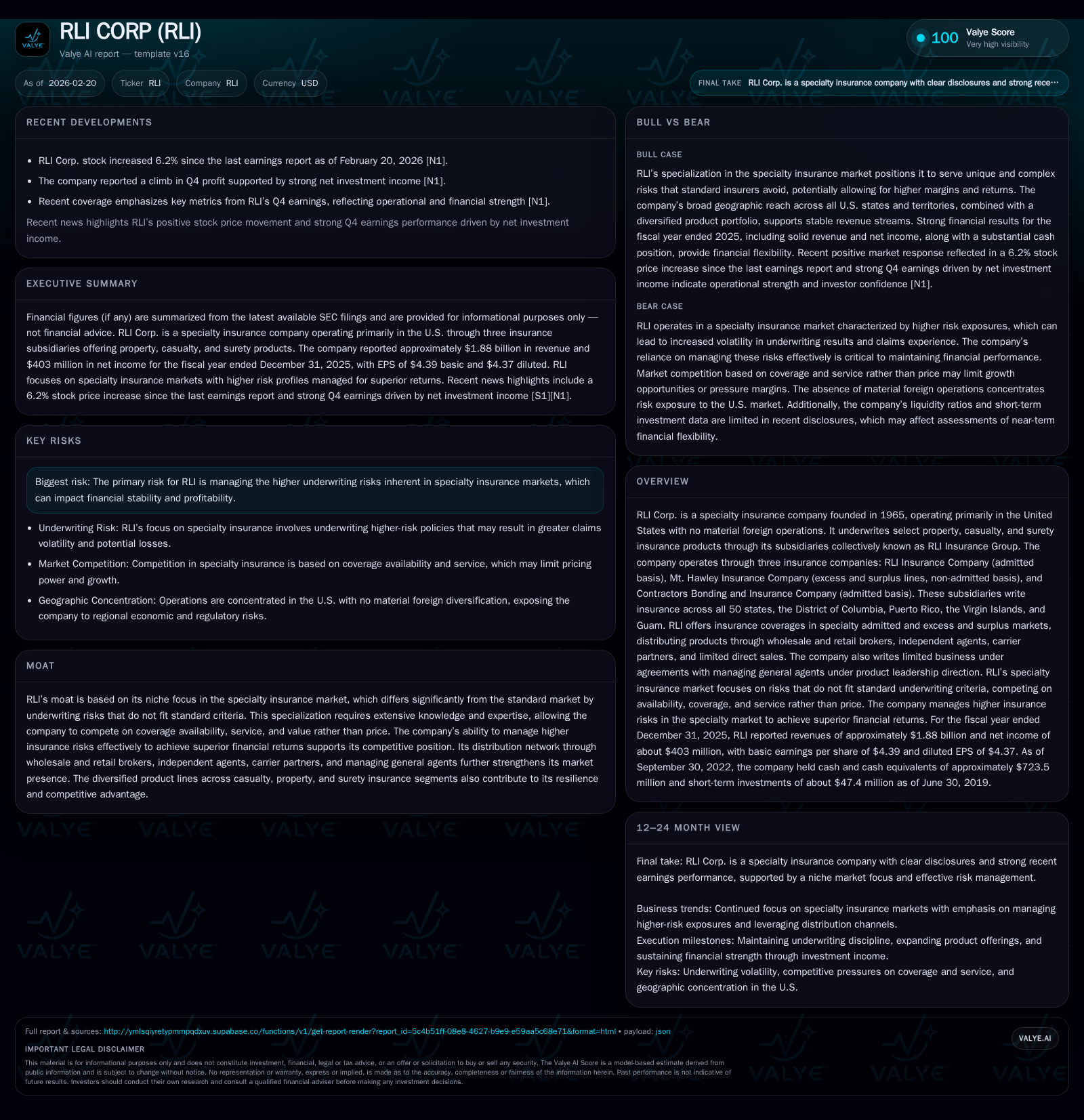
Founded in 1965, RLI Corp operates exclusively in the U.S. specialty insurance market through three main subsidiaries, writing niche property, casualty, and surety products. Over recent years, RLI has achieved consistent revenue and earnings growth driven by its expertise in underwriting complex risks not served by standard carriers. The company maintains a strong capital base, generating robust operating cash flow and returning capital to shareholders through dividends. Key future growth hinges on continued risk management capabilities and expanding specialty product offerings while navigating inherent underwriting volatility.
Company Overview and Business Model
RLI Corp is a specialized insurer founded in 1965 focusing on the U.S. market without material international exposure [S1][S4]. The company operates via three main insurance entities — RLI Insurance Company (admitted), Mt. Hawley Insurance Company (excess and surplus lines), and Contractors Bonding and Insurance Company (admitted) — providing property, casualty, and surety coverages across all states plus territories such as Puerto Rico and Guam [S4][S7].
Distinct from standard insurance markets where products are largely commoditized and compete primarily on price, RLI’s specialty insurance segment underwrites complex risks that fall outside typical underwriting guidelines [S4]. This niche approach builds a moat anchored on underwriting expertise, offering coverage options unavailable elsewhere, which drives competitive advantage based on coverage availability, service quality, and tailored value rather than pricing.
Distribution is diversified among wholesale/retail brokers, independent agents, carrier partners, limited direct sales, and managing general agents aligning with product leadership strategies [S4]. This multi-channel distribution enhances market penetration while allowing granular risk selection.
Historical Performance
From a financial perspective, RLI has demonstrated stable topline expansion marked by compound annual growth rate (CAGR) potential exceeding low double digits over recent years excluding a volatile investment environment affecting net income in 2022 [F1]. Revenue expanded from approximately $1.51 billion in FY2023 to $1.88 billion in FY2025 — a roughly 6.3% increase year-over-year between 2024 and 2025 reflecting steady organic growth within its specialty segments.
Net income followed an upward trajectory post-2022 troughs driven by underwriting performance normalization coupled with strong net investment income [F1][N11]. 2025 net income of roughly $403 million (up 16.6% YoY) contrasts with a peak of $583 million in 2022 likely influenced by extraordinary items rather than core insurance operations.
Operating cash flows have grown concurrently with revenue gains reaching over $614 million for FY2025 indicating a healthy conversion of earnings into liquidity supportive of operational agility [F1]. Capital expenditures remain restrained around $5–6 million annually, appropriate for an asset-light insurer predominantly focused on underwriting rather than physical asset investment.
Historical performance (annual)
| FY | Rev ($mm) | Net ($mm) | CFO ($mm) | Capex ($mm) | Rev YoY | Net YoY |
|---|---|---|---|---|---|---|
| 2025 | 1882 | 403 | 614 | 6 | +6.3% | +16.6% |
| 2024 | 1770 | 346 | 560 | 5 | +17.1% | +13.5% |
| 2023 | 1512 | 305 | 464 | 6 | -11.0% | -47.8% |
| 2022 | 1698 | 583 | 250 | 6 |
Note: Omitted columns lack sufficient annual XBRL coverage in the provided tags (need ≥2 annual points): OpInc, Buybacks. Source: SEC companyfacts cache [F1].
Capital returns and efficiency (annual)
| FY | Div ($mm) | FCF ($mm) | ROE% |
|---|---|---|---|
| 2025 | 242 | 609 | 22.7 |
| 2024 | 236 | 556 | 22.7 |
| 2023 | 140 | 458 | 21.5 |
| 2022 | 365 | 245 | 49.6 |
Source: SEC companyfacts cache [F1].
¹ Declines reflect volatile investment results impacting bottom line in FY2022 prior to resumption of core growth.
ROE approximates a robust ~22.7% for FY2025 calculated as net income divided by shareholders’ equity near $1.78 billion demonstrating efficient equity usage given the inherent risk profile [F1].
Industry Context and Competitive Positioning
The U.S specialty insurance sector serves complex risks often excluded from traditional coverage due to loss volatility or non-standard exposures — including unique commercial liability niches or challenging surety bonds [S4]. These markets tend toward less commoditization enabling players like RLI to differentiate via underwriting skill sets rather than competing solely on premiums.
Given the greater uncertainty around claim frequencies/severity compared to admitted standard lines insurers, managing loss ratios prudently is critical for sustainable profitability [S4][S5]. RLI’s proven focus on select lines mitigates this risk concentration while enabling pricing power supported by coverage innovation and customer service excellence.
Strong reinsurance partnerships diversify catastrophe exposures limiting earnings surprises from extreme events [S6][S12][S20]. Additionally, RLI holds satisfactory AM Best and S&P ratings reflecting solid capital adequacy consistent with specialty insurer norms [S9][S16].
Future Growth Prospects
Looking ahead, RLI’s growth opportunity rests chiefly on deepening penetration within existing specialty lines and innovating new products responsive to emerging market gaps often created by regulatory shifts or evolving commercial risks [N11][N13]. Deep domain knowledge across admitted vs excess & surplus lines affords flexibility to adapt offerings selectively across markets nationwide.
Incremental growth may also stem from expanding managing general agent agreements leveraging local expertise under centralized product leadership [S4], optimizing distribution networks without substantial fixed-cost increases.
However, sizable growth ceilings exist due to the limited scale of specialty segments relative to broad P&C insurance markets along with unavoidable exposure to underwriting volatility inherent in non-standard risks which could pressure margins during adverse claim cycles [S5]. External macroeconomic factors influencing commercial activity levels can also impact premium volumes indirectly.
Returns and Capital Allocation Strategy
RLI’s capital allocation prioritizes sustaining financial strength while rewarding shareholders through dividends which have increased steadily: the company paid out $242 million in dividends during FY2025 versus $236 million the prior year demonstrating commitment to shareholder returns balanced with growth funding [F1][S10][N11].
Share repurchases have been minimal or nil recently indicating preference for dividend returns alongside reinvestment in underwriting capabilities rather than stock buybacks [F1]. Operating cash flows comfortably cover fixed investments which stay small relative to cash generation marking an asset-light model advantageous for free cash flow consistency.
Strong liquidity reserves including substantial fixed income holdings reinforce resilience against short-term market disruptions or claim surges — vital for maintaining operational continuity given elevated risk tolerance required for specialty underwriting [S6][S15].
What to Watch Next (Analysis)
While no specific forward guidance is provided explicitly in filings or news releases [N11][S1], key metrics worth monitoring include:
- Underwriting profit trends indicated by combined ratio movements reflecting claims environment stability.
- Net investment income trajectory given its meaningful contribution historically to net results.
- Organic premium growth pace particularly across Mt. Hawley’s excess & surplus lines segment as pricing cycles evolve post-pandemic distortions.
- Dividend declarations signaling ongoing confidence in free cash flow sustainability.
- Risk management execution amid potential extremity shifts driven by natural catastrophes or emerging liabilities affecting specialty businesses.
- Distribution diversification impact from managing general agent partnerships enhancing access without diluting returns.
Sector-wide commentary notes that growing sophistication among brokers and insureds increasingly values customized solutions over commodity pricing especially on casualty exposures where frequency/severity patterns remain complicated amidst inflationary cost pressures (analysis).
Summary
RLI Corp exemplifies a specialty insurer that has carved out enduring competitive advantage through focus on complex niche risks underserved by standard market participants coupled with disciplined capital stewardship yielding attractive returns on equity nearing mid-twenties percentages [F1][S4][S9].
Its recent financial results underscore successful navigation of loss volatility inherent to specialty lines supplemented by strong investment performance supporting overall profitability recovery following transient headwinds earlier this decade.
Strategic emphasis on broad yet selective U.S geographical footprint supported by multi-channel distribution models including MGAs fosters tailored market access while preserving prudent risk selection discipline crucial for long-term operational success.
While challenges persist from higher underwriting variability characterizing the specialty segment arena alongside macroeconomic factors impacting premium demand elasticity (analysis), the company’s demonstrated ability to deploy expertise effectively within these constraints signals sustained value creation potential contingent upon continued excellence in core competencies.
Disclaimer: This analysis is for informational purposes only. It does not constitute investment advice or recommendations regarding any securities or companies mentioned herein.
Disclaimer: This is research-only, informational analysis and not investment advice. It may include AI-generated interpretation and general industry context. Always verify important details using primary sources.

Comments