
Liberty Global’s Turnaround Road Amid European Market Shifts
A comprehensive analysis of Liberty Global’s financial evolution and strategic maneuvering amid mounting regulatory and competitive pressures.
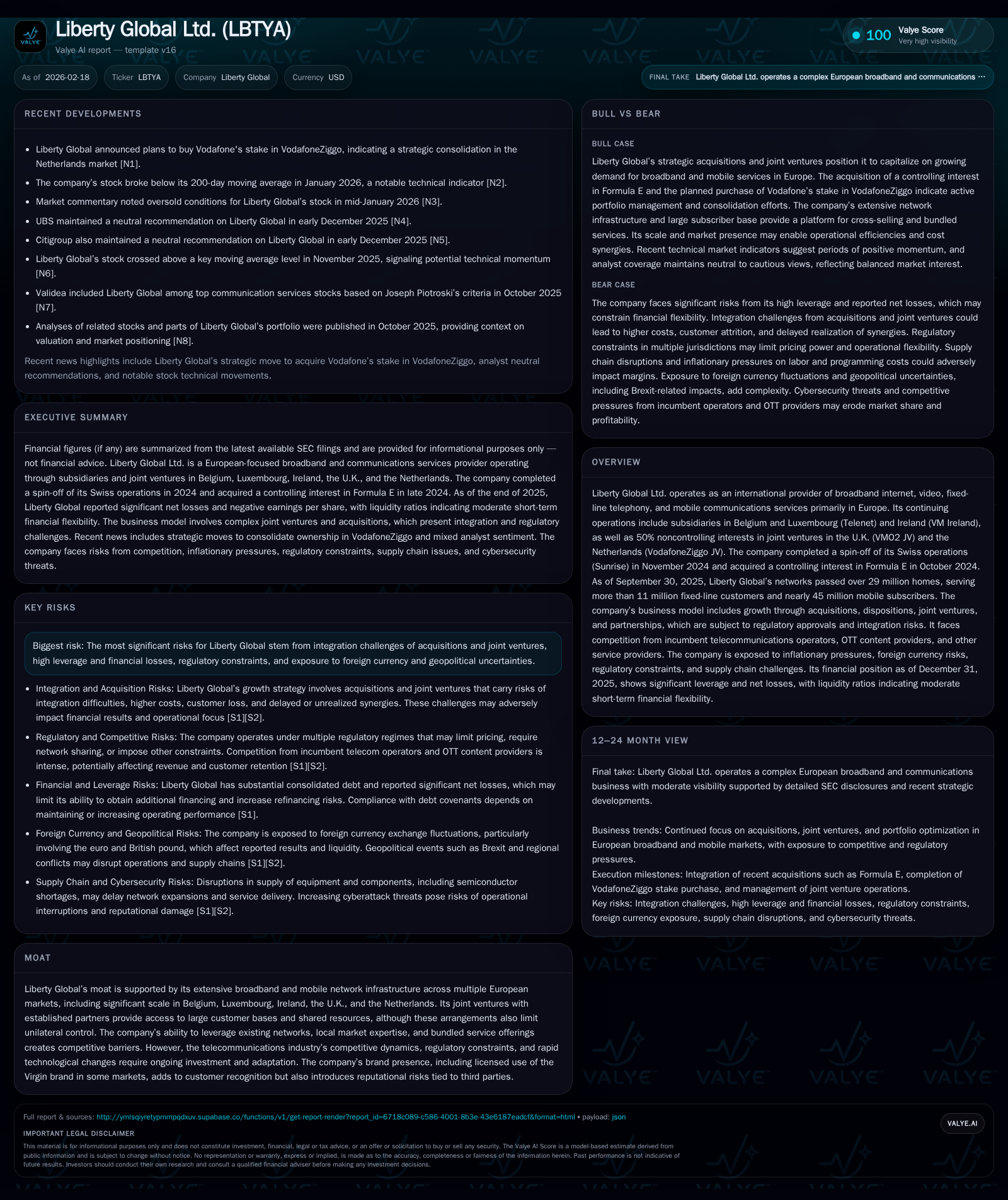
Liberty Global Ltd. has expanded its network footprint across key European markets through acquisitions, joint ventures, and divestitures, reaching over 29 million home passes. Despite this scale, the company reported significant net losses in FY2025 alongside increased capital expenditures reflecting continued network investments. Future growth hinges on completing strategic transactions like acquiring Vodafone’s stake in VodafoneZiggo and the Substantial Group deal, tempered by regulatory scrutiny and integration complexities. Capital structure constraints from high leverage and credit covenants limit operational flexibility, while declining buybacks signal prioritization of balance sheet repair over shareholder returns. Dividends data is not available in the provided disclosures.
Expanding Footprint Through Deals: The Past Growth Trajectory
Liberty Global has pursued growth via acquisitions, disposals, joint ventures, and partnerships shaping its presence across key European telecom markets. By late 2025, its networks passed over 29 million homes with a subscriber base exceeding 11 million fixed-line customers and nearly 45 million mobile users [S19][F1]. Landmark transactions include the October 2023 Telenet takeover bid enhancing Belgian market scale, the November 2024 spin-off of Swiss operations (Sunrise) streamlining focus [S1], and the October 2024 acquisition of controlling interest in Formula E expanding brand exposure beyond core telecom operations [S1].
Joint ventures such as VMO2 JV (U.K.) and VodafoneZiggo JV (Netherlands) provide Liberty access to substantial customer bases without full consolidation control [S19]. The strategy leverages copper and fiber-optic infrastructure alongside FTTx deployments to compete against DSL incumbents while expanding mobile offerings through MVNO arrangements like VM Ireland.
Financial Performance in FY2025: Losses during Revenue Shifts
Recent filings show continued challenges converting scale into profitability. Revenue data beyond FY2019 ($11.54 billion) is unavailable; however, operating income improved slightly to a negative $23.3 million from a $48.2 million loss in FY2024 [F1][N2]. Operating cash flow remained positive at $1.21 billion despite these losses, indicating core business cash generation [F1]. Net income plunged to a loss of $7.14 billion in FY2025 from a profit of $2.24 billion the prior year, likely reflecting non-recurring charges or impairments [F1][N2].
Capital expenditures surged by nearly 48% year-over-year to $1.34 billion as Liberty intensified investment in broadband infrastructure upgrades consistent with industry-wide FTTx migration trends [F1]. This contrasted with constrained earnings resulted in negative free cash flow of approximately -$132 million [F1], highlighting liquidity pressures during ongoing capital needs.
Historical performance (annual)
| FY | Net ($bn) | CFO ($bn) | OpInc ($mm) | Capex ($mm) | Net YoY |
|---|---|---|---|---|---|
| 2025 | -7.1 | 1.2 | -23 | 1343 | -418.1% |
| 2024 | 2.2 | 2.0 | -48 | 909 | +155.4% |
| 2023 | -4.1 | 2.2 | -244 | 1386 | -375.0% |
| 2022 | 1.5 | 2.8 | 147 | 1303 |
Note: Omitted columns lack sufficient annual XBRL coverage in the provided tags (need ≥2 annual points): Rev, Div. Source: SEC companyfacts cache [F1].
Capital returns and efficiency (annual)
| FY | Buybacks ($mm) | FCF ($mm) | ROE% |
|---|---|---|---|
| 2025 | 192 | -132 | -73.3 |
| 2024 | 690 | 1124 | 18.1 |
| 2023 | 1495 | 780 | -21.3 |
| 2022 | 1703 | 1535 | 6.6 |
Source: SEC companyfacts cache [F1].
Note: Revenue data beyond FY2019 is not available; table focuses on profitability and cash flow metrics per provided data [F1].
Strategic Acquisitions and Divestitures Driving Future Growth
Liberty Global aims to strengthen its market position through transformative deals amid regulatory complexities [N1][N3][S1][S5]. The collaboration with InfraVia Partners and Telefónica to acquire the £2 billion Substantial Group targets wholesale infrastructure expansion complementing retail footprints [N1]. Concurrently, acquiring Vodafone's stake in VodafoneZiggo would enable full consolidation benefits pending regulatory approval but introduces integration risks [N3].
These transactions face rigorous regulatory review including EU competition authorities and national foreign investment screenings designed to safeguard critical telecommunications infrastructure ownership [S5]. Such oversight may delay closings or impose conditions affecting expected synergies.
Competitive and Regulatory Challenges
Liberty Global operates within highly competitive telecom markets facing incumbent telcos with extensive networks plus OTT video platforms disrupting traditional revenue streams [S1][S29]. SMP designations impose open-access obligations enabling competitors regulated access to Liberty’s network assets which limits proprietary bandwidth availability impacting ARPU.
Technological advances intensify pressure; DSL providers upgrade with vectoring technologies while standalone 5G wireless solutions offer alternative broadband choices challenging fixed-line customer retention [S1]. Government-backed public-private partnerships deploying FTTx infrastructure add competition from entities less focused on commercial returns [S1], collectively compressing margins and requiring continual capital expenditure just to maintain competitiveness.
Liquidity, Debt Maturities and Capital Structure Constraints
Liberty Global’s consolidated debt stands at approximately $8.6 billion with about $0.8 billion maturing within one year [F1][S4][S6]. Debt agreements impose restrictive covenants limiting dividend upstreaming from subsidiaries, additional borrowing capacity, asset sales, or distributions constraining liquidity management flexibility [S4]. Amid geopolitical volatility and tight credit markets during recent years, no attractive refinancing has been completed increasing exposure risk around clustered maturities later this decade [S6][S13].
Interest rate fluctuations tied to EURIBOR, SOFR variants or SONIA challenge hedging effectiveness adding uncertainty on future financing costs [S11]. Consequently, Liberty faces limited capacity for opportunistic capital deployment beyond essential operations.
Capital Allocation: Buybacks Versus Investments
Capital allocation reflects conservative discipline given liquidity constraints amid losses [F1]. Share repurchases fell sharply to $192 million in FY2025 from $1.7 billion in FY2022 showing reduced emphasis on share price support activities [F1]. Meanwhile capex spending rose materially (+47.8%), reaffirming commitment toward sustaining network competitiveness amid evolving technology risks.
No dividend payments are disclosed within available financial data tags; thus dividend policy or payouts remain unspecified but likely restrained given financial headwinds [F1]. Negative free cash flow (-$132 million) further supports prioritization of balance sheet stability over discretionary shareholder returns.
What to Watch: Upcoming Milestones and Market Signals
Investors should monitor progress on regulatory approvals related to the Substantial Group acquisition and VodafoneZiggo stake purchase as these will materially influence future cash flows and operating scale [N1][N3]. Refinancing outcomes for debt maturing later this decade are pivotal especially if credit conditions improve after geopolitical disruptions.
Regulatory reviews on SMP status across Europe may reshape open-access obligations impacting margin sustainability [S5][S29]. Operational metrics such as ARPU trends amid IPTV & OTT competitive pressures plus integration success post-acquisitions will indicate effectiveness of Liberty's strategic repositioning.
Technical indicators include recent breaches below key moving averages ([N4]) alongside oversold RSI conditions ([N5]) reflecting short-term investor sentiment though macroeconomic uncertainties persist.
Disclaimer: This analysis is based solely on publicly available information as of February 18, 2026 from SEC filings and news sources cited herewithin without extrapolating missing metrics or inventing forecasts.
Disclaimer: This is research-only, informational analysis and not investment advice. It may include AI-generated interpretation and general industry context. Always verify important details using primary sources.

Comments