
Hershey’s Earnings Surge Tempered by Cost Pressures and Shareholder Returns
Hershey maintained revenue growth in 2025 but faced significant margin pressures alongside shifts in capital allocation.
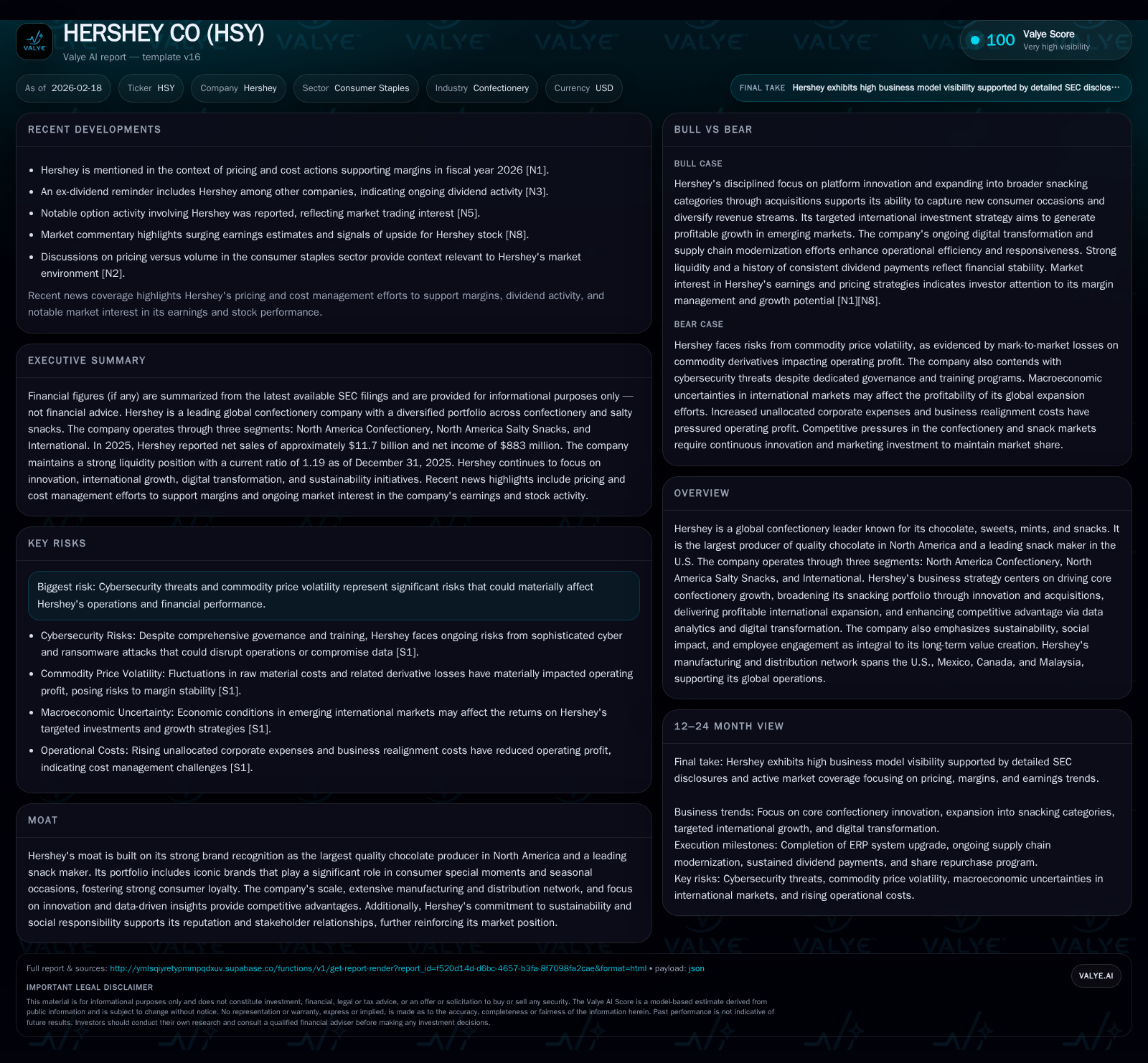
The Hershey Company leverages its dominant North American chocolate brand while expanding its snack portfolio and international footprint. In 2025, revenues grew 5.7% driven by pricing initiatives and acquisitions, yet operating income and net income more than halved due to commodity inflation, higher costs, and promotional spend. Capital allocation reflects a stable dividend policy but a pause on share repurchases, signaling cautious cash deployment amid margin pressures. Digital transformation and product innovation efforts position Hershey to sustain engagement in a competitive snacking landscape, though international expansion remains a work in progress. Cybersecurity vigilance and commodity volatility pose ongoing operational risks.
Historic Momentum Fueled by Market Leadership and Expanding Portfolio
Hershey's consistent revenue growth over recent years is anchored by its position as North America's largest quality chocolate producer and an expanding presence in salty snacks. From fiscal year (FY) 2018 through FY 2020 (latest available revenue data), annual revenues increased from approximately $1.99 billion (reported in billions scale per source context) to $2.19 billion as of December 31, 2020 [F1]. For the most recent fiscal year ending December 31, 2025, reported revenues reached approximately $11.69 billion reflecting a year-over-year increase of about 5.7% from $11.20 billion in FY24 [F1].
The majority of sales emanate from the North America Confectionery segment—which accounted for approximately 81% of revenues in FY2025—highlighting the centrality of its core chocolate products [S12]. The segment's expansion results primarily from pricing actions initiated mid-2025 (6% price realization), partially offsetting a modest decline (2%) in volume due to consumer price sensitivity across everyday core confection brands [S12]. Additionally, recent acquisitions have diversified Hershey's portfolio particularly within salty snacks (which grew steadily but remains under 11% of total sales) and the international segment that contributes roughly 8%, albeit with recent profitability challenges [S13][S18].
Despite top-line momentum, operating income displays marked volatility tied to cost dynamics discussed below. Segment income margins within North America Confectionery narrowed materially in 2025 amidst rising commodity prices and supply chain costs [F1][S12]. Concentration risk remains notable with key distributors such as McLane Company accounting for approximately 27% of consolidated net sales exposure [S7], underscoring distribution channel dependencies.
2025 Results Reflect Margin Compression Despite Topline Revenue Gains
While Hershey posted revenue growth from $11.20 billion in FY24 to $11.69 billion in FY25 (+5.7%), operating profitability suffered significantly—operating income plummeted nearly 50%, from approximately $2.9 billion to about $1.44 billion—a reflection of acute margin compression during FY25 [F1][S3][S12].
Several macroeconomic forces weighed heavily: commodity inflation impacted the cost base markedly given Hershey’s reliance on cocoa, sugar, dairy inputs, and packaging materials; tariff adjustments further exacerbated costs; logistical overheads rose amid persistently high transport rates; promotional investments increased as competitive intensity escalated; all culminating in an unfavorable mix effect that trimmed margins sharply despite pricing efforts [N7][S3]. This dynamic particularly affected the North America Confectionery segment where segment income declined approximately 15% year-over-year even as revenues climbed [S12].
Promotional strategies aimed at protecting brand loyalty sometimes softened pricing power resulting in volume decreases compounded by consumer price elasticity especially within staple confection categories—typical pressure points across packaged food sectors during inflationary periods.
Net income's drop exceeded operating income decline percentages (-60%) due to increased interest expenses related to incremental debt issuances totaling approximately $2 billion in long-term notes during early-to-mid-2025 matured partially by mid-year repayments along with elevated tax provisioning impacting bottom-line results [F1][S21][S23]. Interest expense netted about $190 million for FY25 versus $165 million prior year [S23].
Driving Future Growth Through Product Innovation and Digital Transformation
Hershey’s strategic thrust centers on bolstering core confectionary leadership while transforming into a broader snacking powerhouse with agility derived from innovation and digital capabilities. Recent acquisitions such as LesserEvil (2025) reflect intent to scale healthier snack options complementing familiar indulgent brands [S1]. Product innovations target capturing multi-channel retail trends spanning convenience stores, mass merchandisers, food service outlets, leveraging new product varieties including protein bars, spreads, snack bites amidst evolving consumer preferences.
Digital transformation underpins these growth efforts: Hershey has invested substantially in enterprise IT modernization focused on data analytics platforms enabling nuanced consumer segmentation, inventory optimization, predictive demand planning via AI-powered supply chain simulation led by its CTO office [S1]. The completion of a new ERP system upgrade in late FY24 has laid groundwork enabling more agile operations management though it temporarily increased non-cash expenses around amortization [F1][S14][S17].
Advertising spend remained robust (~$612 million in FY25), emphasizing both traditional brand equity maintenance and innovative marketing aimed at younger demographics plus diverse snacking occasions beyond chocolate-centric consumption patterns [S8]. These investments are critical for sustaining relevance amid intense competition.
Navigating International Expansion and Competitive Snacking Markets
Hershey’s international business faced challenges during FY25 reflected by segment income erosion from over $111 million in FY24 down near break-even at $3 million in FY25 mainly due to foreign currency fluctuations coupled with structural competitiveness issues within certain geographies [F1][S13]. Despite this setback, international markets represent essential long-term drivers beyond saturated North American core regions.
Efforts include leveraging iconic brand associations globally while localizing product offerings tailored to regional taste profiles thereby deploying data-driven consumer insights gathered via enhanced analytics capabilities. Operational complexity includes managing cross-border tariffs, diverse regulatory environments, supply chain synchronization across several plants including Malaysia besides North America facilities plus emerging market channels requiring innovation mindful of price sensitivity.
Competitive pressures escalate particularly within salty snack category segments where private label growth penetrates mass channels prompting Hershey’s need for sustained category innovation combined with efficient go-to-market strategies leveraging consolidated distribution partnerships primarily through McLane Company among others [S7].
Capital Allocation Focus: Dividends Stability vs Evolving Buyback Execution
Hershey’s capital deployment displays prudent balance between shareholder returns and financial flexibility amid earnings volatility. Dividends exhibited strong stability with total payments exceeding $1.08 billion annually across FY24-FY25 maintaining per share payouts at consistent levels (~$5.48 common stock dividends) evidencing commitment to reliable income return trajectory [F1][S6].
Share repurchase activity ceased entirely during FY25 following substantial executions ($494 million buybacks) completed mostly during FY24 under board-authorized programs totaling up to $500 million periodically refreshed with about $470 million remaining unused post-FY25 ready for opportunistic use should valuation or market conditions align favorably [F1][S4][S10].
Debt financing was proactively managed including recent issuance of four tranches totaling about $2 billion notes at coupon rates near mid-4%s maturing between 2028-2035 offsetting maturities ensuring liquidity adequacy without compromising creditworthiness; revolving credit lines remain healthy providing additional flexibility with available capacity approximating $1.875 billion at year end [S16].
Return on equity calculation approximates ~19% for FY25 reflecting reasonable capital efficiency despite compressed earnings highlighting solid asset utilization backed by strong brand equity foundation paired with operational efficiency efforts underway albeit challenged currently by cost escalations [F1].
Capital expenditures decreased by about 25% from approximately $606 million in FY24 to around $455 million in FY25 following major ERP system upgrades completed prior year; future capex expected near historical ranges supporting manufacturing capacity expansion and technology investments [F1][S14].
Operational Risks: Cybersecurity and Commodity Volatility in Focus
As detailed extensively in its latest SEC disclosures, Hershey faces material operational risk factors primarily involving cybersecurity threats amplified by increasingly sophisticated ransomware attacks globally impacting supply chain continuity and information integrity [S1].
Governance structures assign oversight responsibilities clearly involving the Board’s Finance & Risk Management Committee supported by an experienced Chief Information Security Officer (CISO) reporting directly to the CTO who leads integration of comprehensive cyber defense layers including regular workforce trainings, phishing simulations, incident response drills ensuring preparedness against evolving vulnerabilities [S1].
Parallelly commodity price volatility continues posing perennial risk influencing input cost baselines prompting Hershey's active use of futures/options contracts hedging programs over horizons typically ranging from three months up to two years designed to moderate raw material cost swings albeit unhedged mark-to-market impacts introduce earnings noise recognized outside segment performance measures until actual inventory sale occurs per GAAP treatment applied for derivative instruments used [S13][S15].
Key Metrics Snapshot: Financial Trends and What to Monitor Ahead
Historical performance (annual)
| FY | Net ($bn) | CFO ($bn) | OpInc ($bn) | Capex ($mm) | Net YoY |
|---|---|---|---|---|---|
| 2025 | 0.9 | 2.3 | 1.4 | 455 | -60.2% |
| 2024 | 2.2 | 2.5 | 2.9 | 606 | +19.3% |
| 2023 | 1.9 | 2.3 | 2.6 | 771 | +13.2% |
| 2022 | 1.6 | 2.3 | 2.3 | 519 |
Note: Omitted columns lack sufficient annual XBRL coverage in the provided tags (need ≥2 annual points): Rev. Source: SEC companyfacts cache [F1].
Capital returns and efficiency (annual)
| FY | Div ($mm) | Buybacks ($mm) | FCF ($mm) |
|---|---|---|---|
| 2025 | 1085 | 0 | 1823 |
| 2024 | 1085 | 494 | 1926 |
| 2023 | 889 | 265 | 1552 |
| 2022 | 775 | 389 | 1808 |
Source: SEC companyfacts cache [F1]. | Prior years not shown due to limited data availability
Investors should monitor metrics such as margin recovery potential following easing inflation or further pricing actions; pace and effectiveness of share repurchase utilization subject to corporate discretion; momentum behind product pipeline refreshment particularly within salty snacks category; progress reports on international profitability improvement; impacts stemming from ongoing digital transformation enhancements as well as any elevated cybersecurity incident disclosures or unexpected commodity cost shocks ([N7]).
This report is intended solely for informational purposes based on publicly available documents and reported data without offering investment advice or recommendations.
Disclaimer: This is research-only, informational analysis and not investment advice. It may include AI-generated interpretation and general industry context. Always verify important details using primary sources.

Comments