
How PennyMac Financial Navigates Interest Rates and Servicing Operations for Growth
PennyMac Financial Services balances surging earnings with complex interest rate risks and capital strategies in mortgage finance.
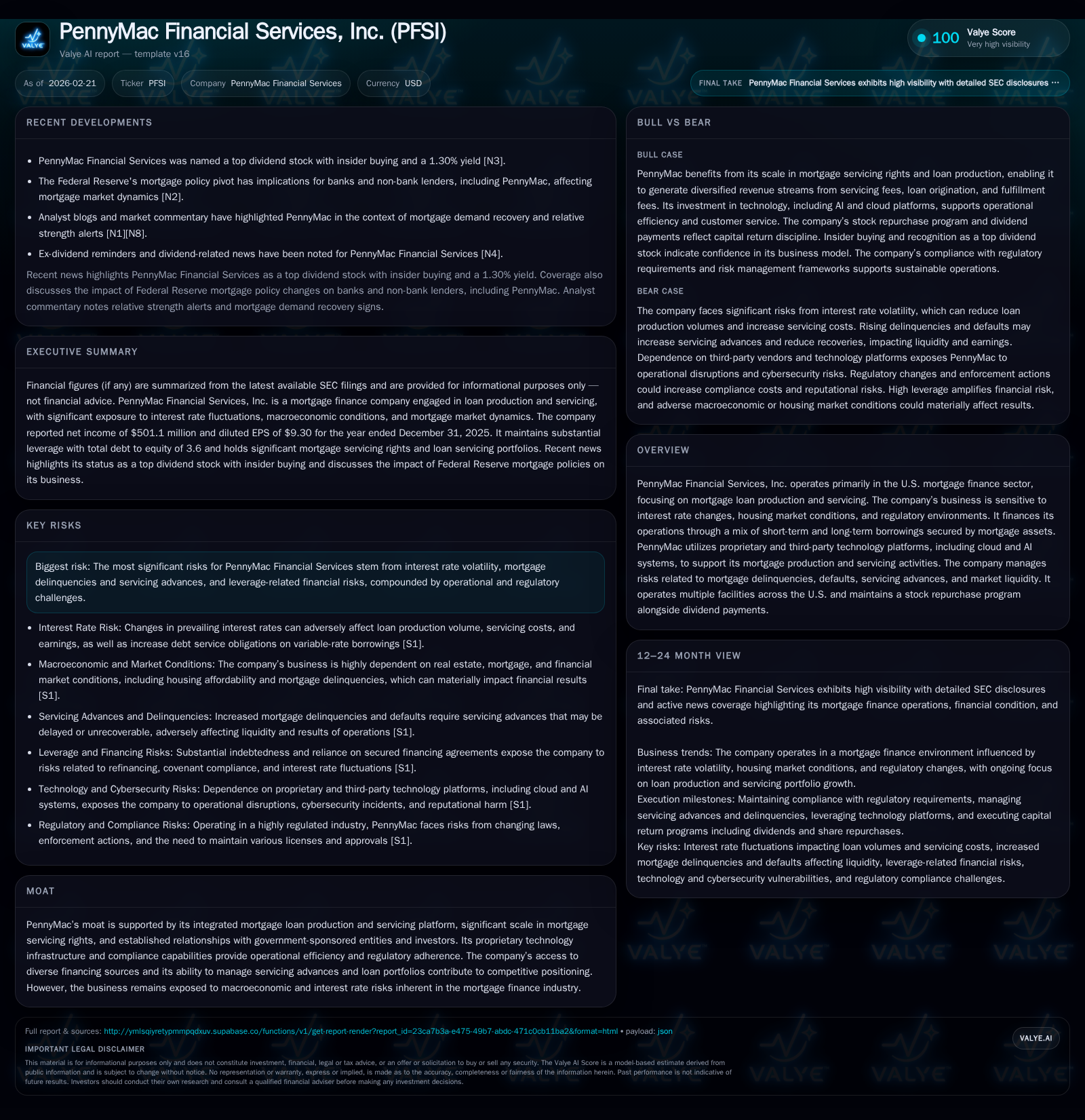
PennyMac Financial Services, Inc. reported a robust 60.9% year-over-year net income growth in fiscal 2025, driven by strategic loan production and servicing operations expansion amid a volatile interest rate environment. Despite negative operating cash flows influenced by inventory growth and servicing advances, the company invested heavily in capital expenditures to enhance proprietary technology and manage risk. PennyMac faces significant refinancing risk due to reliance on short-term repurchase agreements but maintains compliance with restrictive covenants while pursuing disciplined shareholder returns through steady dividends and limited buybacks. The recent acquisition of Cenlar’s subservicing business and technological investments position PennyMac for operational scaling, though ongoing regulatory and macroeconomic risks remain key monitoring points.
Historic Performance and Earnings Drivers in Fiscal 2025
PennyMac Financial closed fiscal year 2025 with notable financial contrasts underscoring the complexities of mortgage finance operations. The company reported net income of approximately $501 million, a substantial 60.9% increase over $311 million in 2024 [F1]. This growth reflects improved profitability driven by expanding mortgage production and servicing fee income despite challenging macroeconomic conditions.
Operating cash flow remained deeply negative at -$1.65 billion in 2025, though improved from -$4.53 billion in 2024, highlighting intense working capital demands primarily due to elevated inventories of loans held for sale and servicing advances to cover delinquent borrower payments before reimbursement [F1,S1].
Capital expenditures rose sharply nearly sixfold from approximately $1.7 million in 2024 to $11.9 million in 2025, reflecting investments to enhance cloud-native platforms and integrate artificial intelligence for underwriting automation, risk analytics, and servicing efficiency—key components of PennyMac's competitive advantage [F1,N8,N13].
Historical performance (annual)
| FY | Net ($mm) | CFO ($bn) | Capex ($mm) | Net YoY |
|---|---|---|---|---|
| 2025 | 501 | -1.7 | 12 | +60.9% |
| 2024 | 311 | -4.5 | 2 | +115.3% |
| 2023 | 145 | -1.6 | 1 | -69.6% |
| 2022 | 476 | 6.0 | 7 |
Note: Omitted columns lack sufficient annual XBRL coverage in the provided tags (need ≥2 annual points): Rev, OpInc, ROE%. Source: SEC companyfacts cache [F1].
Capital returns and efficiency (annual)
| FY | Div ($mm) | Buybacks ($mm) | FCF ($bn) |
|---|---|---|---|
| 2025 | 63 | 5 | -1.7 |
| 2024 | 52 | 71 | -4.5 |
| 2023 | 41 | 71 | -1.6 |
| 2022 | 55 | 406 | 6.0 |
Source: SEC companyfacts cache [F1].
Note: Revenue is not available in the provided data tags; operating income is also unavailable.
This snapshot highlights a key challenge: strong earnings growth driven by scale does not immediately translate into positive cash flows due to financing cycles tied up in loan production inventories and servicing advances.
Interest Rate Sensitivity and Operational Risk Landscape
PennyMac's business is highly sensitive to interest rate movements impacting mortgage refinancing activity, default probabilities, and MSR valuations [S1,S14]. Ownership of Mortgage Servicing Rights exposes the firm to prepayment risk where accelerated refinancings reduce expected servicing fee streams, causing revenue volatility.
Servicing advances—payments made upfront when borrowers miss payments—pose credit risk heightened by delinquency trends amid rising homeownership costs [S24]. The company manages these risks via diversified financing sources including repurchase agreements, secured term notes, and unsecured senior notes that carry restrictive covenants limiting dividends, equity repurchases, incurrence of additional debt, asset sales, and affiliate transactions to protect creditor interests but constrain operational flexibility during stress periods [S4,S6,S9,S13].
The debt structure includes margin call provisions requiring rapid collateral replenishment if asset valuations decline—a liquidity risk during mortgage-backed securities market disruptions [S17,S22]. Hedging strategies employing derivatives mitigate interest rate exposure on MSRs and loan commitments but add complexity including potential mark-to-market losses.
Recent Federal Reserve policy shifts affect non-bank lenders like PennyMac unevenly given the cyclical nature of refinance pipelines combined with regulatory compliance tightening the operational risk profile [N5].
Growth Outlook Anchored by Strategic Acquisition and Technology
PennyMac pursues growth via organic expansion complemented by acquisitions; notably its February 2026 definitive agreement to acquire Cenlar Capital Corporation's subservicing business aims at increasing economies of scale within its servicing portfolio enhancing fee revenue potential tied to fixed-percentage MSRs [S3].
The company's investments in proprietary cloud infrastructure coupled with AI applications improve workflow automation reducing unit servicing costs while enhancing credit decision quality over time—a critical differentiator addressing industry-wide challenges such as borrower complexity, compliance costs, cybersecurity risks, and fraud detection highlighted in regulatory filings [N8,N13,S14,S19].
While lending volumes are exposed to macroeconomic headwinds, PennyMac anticipates stabilizing refinance demand given recent mortgage rate declines reported among peers [N8]. Successful integration of acquired subservicing assets will be essential for realizing cost synergies.
Capital Structure, Liquidity Position, and Financing Covenants
PennyMac's balance sheet reflects a financing mix heavily reliant on short-term repurchase agreements secured by loans held for sale and MSRs backed by Agency programs (Fannie Mae/Freddie Mac/Ginnie Mae), alongside longer-term unsecured corporate notes maturing between near-term (2026) and mid-2030s [S6,S9,S10]. As of December 31, 2025, borrowings under repurchase agreements amounted to several billion dollars spread across major financial institutions including Bank of America and JP Morgan Chase .
Restrictive covenants embedded within unsecured senior notes limit dividends, equity repurchases (notably reduced from $71 million in prior years to $4.7 million in 2025), asset sales or mergers without lender consent—constraints that temper discretionary capital allocation despite strong earnings performance [F1,S8,S13].
Liquidity buffers comply with minimum regulatory thresholds mandated by FHFA/Ginnie Mae essential for agency seller/servicer status continuity securing access to financing facilities; however refinancing short-duration warehouse lines remains an inherent refinancing risk characteristic of mortgage warehousing models [S6,S14,S15]. Covenant requirements include maintaining minimum unrestricted cash (~$100 million) and tangible net worth thresholds.
Returns to Shareholders: Dividends and Buyback Activities
Dividend payments grew to approximately $62.6 million in fiscal year 2025 from $52.2 million a year earlier reflecting board confidence anchored on earnings strength yet tempered by liquidity prudence amid financing constraints [F1,S8]. Conversely share repurchases contracted sharply evidencing caution given increased leverage exposure despite robust net income growth [F1].
Insider buying activity combined with a modest ~1.3% dividend yield has attracted yield-focused investors indicating perceived sustainable payout supported by recurring servicing fee streams despite macro uncertainties [N6]. This approach balances capital allocation priorities favoring financial resilience over aggressive buybacks amidst ongoing credit market sensitivities.
Key Industry Relationships and Regulatory Compliance
PennyMac's relationships with government-sponsored entities such as Fannie Mae and Freddie Mac under FHFA supervision along with Ginnie Mae represent strategic moats providing channel access for securitization markets fundamental to its funding model stability [S14,S6]. Maintaining agency seller/servicer designations requires adherence to capital adequacy standards alongside regulatory obligations governing loan origination quality controls.
Regulatory complexity intensifies with changes under CFPB enforcement affecting consumer financial protection compliance for servicers like PennyMac; evolving rules may increase administrative costs though possibly reduce certain federal scrutiny temporarily [S26,S20]. Concurrent deployment of artificial intelligence heightens compliance challenges due to potential biases or legal risks linked to algorithmic decision-making used in underwriting or customer service platforms [S19].
Metrics to Monitor: What Investors Should Watch Next
Key performance indicators warranting close observation include:
- Loan origination volumes reflecting mortgage demand momentum impacting inventory size and revenue base [N1,N2]
- Delinquency ratios on servicing advances indicating credit risk stress potentially leading to increased loss provisions or liquidity demands [N4]
- Frequency and magnitude of margin calls under financing agreements signaling liquidity strain amid fluctuating collateral valuations [N11]
- Integration progress post-Cenlar acquisition capturing cost synergy realization crucial for scalable expense management trajectories.
- Movements in macro interest rates influencing prepayment speeds directly affecting MSR fair values driving earnings volatility. These metrics align with company disclosures supplemented by broader secondary mortgage-backed securities sector trends influencing PennyMac’s risk-reward dynamics.
DISCLAIMER: This analysis is based solely on publicly available data from regulatory filings ([S#]) and news sources ([N#]) as cited; it does not constitute investment advice or recommendations regarding ownership or trading decisions involving PennyMac Financial Services, Inc.
Disclaimer: This is research-only, informational analysis and not investment advice. It may include AI-generated interpretation and general industry context. Always verify important details using primary sources.

Comments