
Akamai Technologies Strengthens Edge Leadership Through AI-Driven Security and Cloud Expansion
Akamai leverages its expansive edge network and AI innovations to sustain growth while navigating competitive and macroeconomic headwinds.
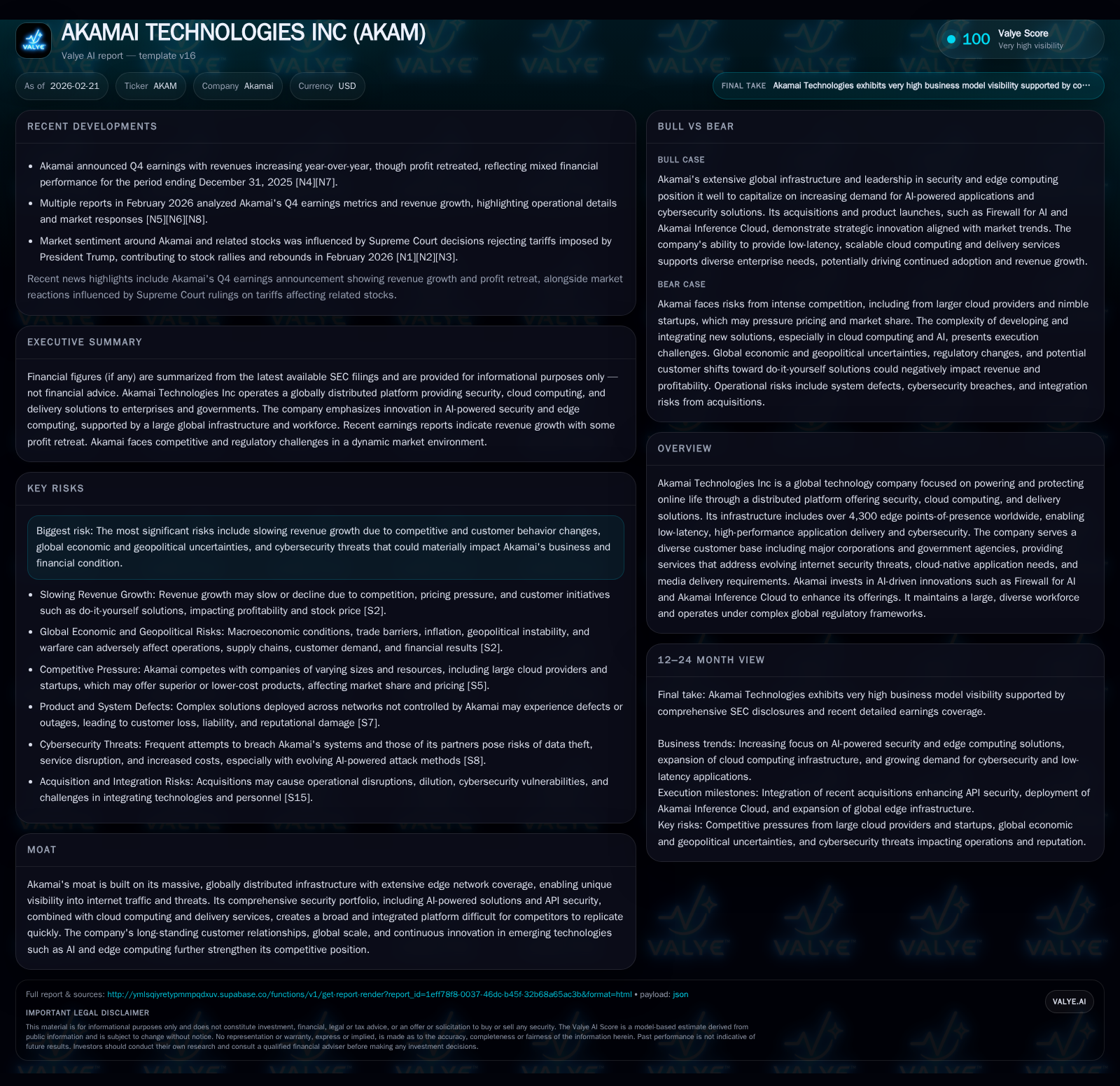
Akamai Technologies maintains a formidable position in content delivery, security, and cloud computing by capitalizing on its globally distributed edge infrastructure enriched with AI capabilities. Despite facing delivery revenue pressures from pricing competition and customer 'do-it-yourself' trends, the company’s security solutions—now the largest revenue driver—and emerging cloud computing services underpin recent growth. Enhanced by AI-powered cybersecurity tools and cloud-native platforms, Akamai is investing heavily in capacity expansion and innovation, supported by strong operating cash flow and significant share repurchases. Ongoing macroeconomic uncertainties, geopolitical risks, regulatory compliance costs, and intensifying competition from hyperscale cloud providers remain critical factors to monitor.
Foundation of Growth: Analyzing Akamai’s Historical Revenue and Profit Trends
Akamai Technologies exhibits steady revenue growth driven by diversification across security, delivery, and cloud computing segments. The company reported approximately $6.69 billion in revenue for FY2025, marking a 7.7% increase year-over-year [F1]. Operating income rose by a more modest 6.3% to about $567 million in FY2025 after declines from previous years since the peak in FY2022. Net income contracted by roughly 10.5% compared with FY2024 to $452 million, partly reflecting increased investments and cost pressures [F1]. Operating cash flow has been robust, stable around $1.52 billion across FY2024-25.
Capital expenditures surged notably by 30%, reaching nearly $508 million in FY2025 as Akamai prioritized infrastructure expansion—its capital intensity rising to support greater edge capacity amid evolving application demands [F1]. The company's shareholders' equity also grew steadily to nearly $5 billion.
Historical performance (annual)
| FY | Net ($mm) | CFO ($mm) | OpInc ($mm) | Capex ($mm) | Net YoY |
|---|---|---|---|---|---|
| 2025 | 452 | 1519 | 567 | 508 | -10.5% |
| 2024 | 505 | 1519 | 533 | 390 | -7.8% |
| 2023 | 548 | 1348 | 637 | 458 | +325.3% |
| 2022 | 129 | 1275 | 676 | 241 |
Note: Omitted columns lack sufficient annual XBRL coverage in the provided tags (need ≥2 annual points): Rev, Div. Source: SEC companyfacts cache [F1].
Capital returns and efficiency (annual)
| FY | Buybacks ($mm) | FCF ($mm) | ROE% |
|---|---|---|---|
| 2025 | 800 | 1011 | 9.1 |
| 2024 | 557 | 1129 | 10.4 |
| 2023 | 654 | 891 | 11.9 |
| 2022 | 608 | 1033 | 3.0 |
Source: SEC companyfacts cache [F1].
Note: Data includes most relevant annual figures from FY2024-FY2025 due to availability; earlier years omitted to focus analysis.
The slight deceleration in net income growth despite revenue gains highlights margin pressures that have settled after sharper contractions prior to FY2024. Strong cash flow supports both reinvestment and capital return programs.
Structural Drivers Behind Revenue Dynamics: Security, Delivery, and Cloud Solutions
Akamai's offerings fall mainly into three pillars: security solutions, content delivery services, and cloud computing platforms [S6][S21]. Security revenues lead the portfolio accounting for the largest fraction due to persistent demand for web application firewalls (WAF), bot management systems, distributed denial-of-service (DDoS) protection, API security features, and domain name system (DNS) security products [S6][S21]. These services leverage real-time adaptive AI to continuously defend against evolving cyber threats including prompt injection attacks—a tactic increasingly used against generative AI systems.
Conversely, delivery solutions—which encompass web/mobile performance acceleration and media distribution such as video streaming or game downloads—face ongoing pricing pressure and fluctuations caused by shifts in customer content popularity as well as traffic optimization efforts internalized through DIY initiatives or multi-provider sourcing models [S1][S2][S6]. This segment's marginal declines reflect broader sector dynamics where volumetric traffic growth does not translate neatly into top-line growth.
Cloud computing is the fastest-growing segment within Akamai’s ecosystem. Its compute platform enables hybrid-cloud distributed workloads at the edge with minimal latency [S6][S25]. This platform supports customers developing AI-powered applications needing massive data throughput close to data origination points. Cloud-native architectures poised for rapid scalability attract clientele transitioning away from traditional hyperscaler clouds seeking lower latency or enhanced data sovereignty [S6].
Response to Competitive Pressures and DIY Customer Initiatives
One of Akamai’s paramount operational challenges is counteracting customer migration towards self-managed traffic routing or partial displacement by hyperscale providers bundling delivery with expansive security suites [S4][S9]. Several enterprise clients adopt internal equipment/software stacks either to control costs or customize their architecture which historically reduces traffic directed through Akamai's global edge network negatively impacting volume-based revenue models.
Moreover, hyperscale cloud titans have ventured aggressively into API protection, zero trust network access (ZTNA), bot mitigation tools, often leveraging their immense scale advantages to bundle these offers with broader cloud services on preferential terms [S19]. Akamai competes primarily through differentiated features such as ease of integration within complex hybrid environments; extensive geographic distribution allowing traffic proximity benefits; superior real-time analytics; and broad partner ecosystem access.
However, these competitive dynamics impose margin pressure forcing continuous innovation cycles alongside pricing discipline. Customer contract negotiations frequently trigger downward price adjustments especially on renewals where AWS, Microsoft Azure or Google Cloud alternatives provide attractive counterproposals [S1][S4]. The ‘DIY’ trend among higher-spend clients increases risk further by fragmenting workload volumes.
AI Integration and Platform Innovation as Catalysts for Future Momentum
Akamai is proactively embedding AI into its core product suite to extend differentiation amid intensifying competition [N2][N3][S6]. The launch of Firewall for AI exemplifies adaptive machine learning models designed to detect novel attack patterns exploiting generative language models’ vulnerabilities—such as prompt injections attempting data exfiltration or generation of unsafe content.
Generative AI accelerates threat investigation workflows improving detection speed and reducing human analyst workloads through enhanced automation [N2]. Parallel investments expand Akamai Inference Cloud capabilities placing GPU-accelerated inferencing close to users worldwide via its unprecedented distribution of edge POPs.
These developments not only solidify defense mechanisms but enable new use cases where customer-facing applications can leverage edge-based full-stack compute coupled with uninterrupted low latency critical for real-time inference or compliance-relevant processing geographically constrained due to data sovereignty laws [S6]. Such rapidly implemented innovations reinforce switching costs hardening Akamai’s moat beyond mere IP protection toward operational indispensability.
Capital Deployment Strategy: Buybacks, Investments, and Balance Sheet Strength
From a capital allocation perspective Akamai balances aggressive buybacks with sizable reinvestment in infrastructure [F1][S5]. The company repurchased approximately $800 million of common stock in FY2025 up from $557 million the prior year, reflecting strong confidence in underlying free cash flow generation calculated at roughly $1 billion annually by deducting capex from operating cash flows.
Capex climbed sharply (+30%) reaching about $508 million as Akamai advanced upgrades of data centers and expanded edge presence necessary for scaling compute-intensive services tied to AI workloads. Maintaining a current ratio above 2.3 alongside no drawn revolver balance underscores prudent liquidity management despite substantial debt issuance tied to convertible note obligations maturing years out [F1][S5].
Returns on equity remain moderate near 9.1%, consistent with investment requirements inherent in capital-intensive tech infrastructure businesses yet bolstered over time by steady profitability improvements [F1]. Dividend payments are not available in provided tags; however, buybacks indicate active shareholder return policy.
Navigating Global Economic and Regulatory Environment Risks
Operating globally exposes Akamai to multifaceted risks including inflationary cost pressures, foreign exchange volatility, geopolitical instability affecting cross-border contracts or supply chains as evidenced during trade tensions involving U.S., China and others [S13][S29]. Current economic uncertainty incentivizes client caution manifesting as extended procurement cycles or shifting towards lower-cost DIY frameworks reducing contracted volumes.
Regulatory complexity escalates especially around data privacy laws (GDPR/CCPA), digital sovereignty policies limiting international data flows, content liability regimes potentially amplifying exposure tied to user-generated content on their networks—and emerging AI legislation imposing operational compliance burdens requiring transparency and governance controls [S14][S16]. Failure or delays in adaptation risk fines or reputational damage affecting customer trust.
Cybersecurity threats also intensify during geopolitical crises escalating attempted intrusions targeting infrastructure providers like Akamai thereby raising defensive expenditure burdens while magnifying potential service interruption consequences.
As a mitigating factor Akamai emphasizes geographic diversification distributing risk across >700 cities worldwide combined with advanced adaptive security protocols hardening resilience despite external shocks.
Performance Benchmarks: What to Watch Moving Forward
Upcoming quarters will test the sustainability of reported revenue beats amid evolving product mix shifts highlighted during Q4 earnings releases showing positive trajectory versus estimates [N2][N3]. Critical metrics include new multi-year contract signings particularly within security/cloud segments which indicate client commitment levels amidst alternative vendor pressures.
Innovation pipeline execution remains key — focused on rolling out expanded generative AI protections faster than competitors while scaling edge compute resources economically without inflating overhead excessively.
Conversion rates from marketing campaigns aimed at promoting Akamai App Platform’s ability to streamline Kubernetes cluster deployments using pre-built templates will also offer insights into acceptance dynamics within developer communities adapting hybrid/multi-cloud infrastructures [S25].
Cost efficiencies matter given interaction between fixed cost base of maintaining distributed facilities balanced against fluctuating subscription revenue stemming from usage variances related to customer digital initiative priorities.
Ultimately monitoring quarterly guidance updates on capex spend trajectories aligned with strategic milestones will signal whether planned investments continue apace or face retrenchment under global economic uncertainties.
Disclaimer: This analysis is based exclusively on publicly available information as of February 2026. It does not constitute investment advice or recommendations but aims to provide an informed overview of Akamai Technologies Inc’s financial performance, strategy execution, industry positioning, risks and opportunities.
Disclaimer: This is research-only, informational analysis and not investment advice. It may include AI-generated interpretation and general industry context. Always verify important details using primary sources.

Comments