
Kforce Inc Faces Revenue Pressure and Margin Challenges While Maintaining Shareholder Returns
Kforce Inc's 2025 results reveal revenue declines driven by macroeconomic uncertainty and technology shifts, with operational adjustments impacting margins amid strong capital returns.
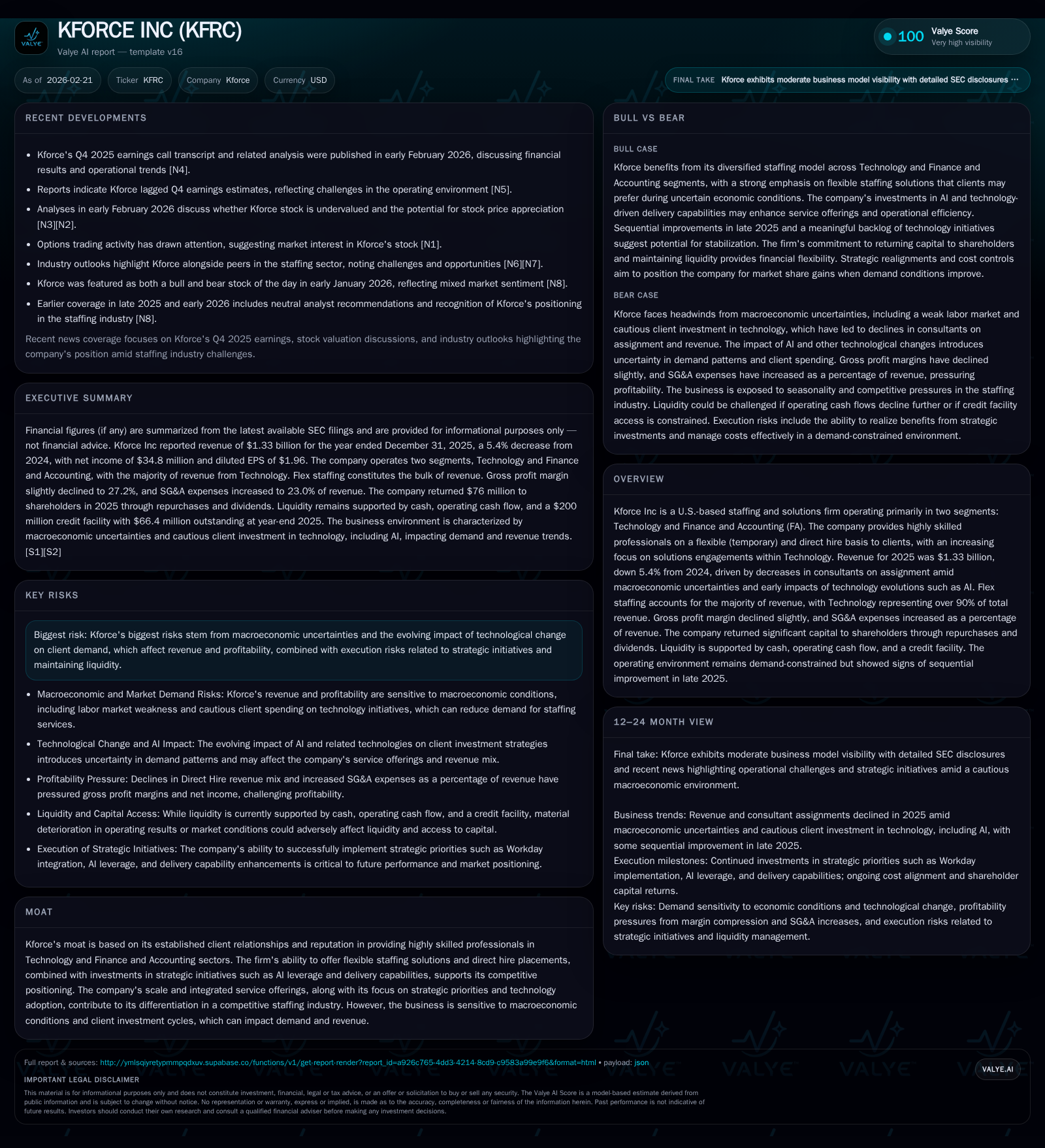
In 2025, Kforce Inc experienced a 5.4% revenue decline to $1.33 billion largely from decreased consultants on assignment in both Technology and Finance & Accounting segments. Gross profit margins contracted slightly, and SG&A expenses rose as a percentage of revenue. Despite top-line pressures exacerbated by early AI adoption impacts, Kforce improved sequential performance in its Finance & Accounting flex staffing during Q4 and sustained significant capital returns through dividends and share buybacks. Operating cash flow fell nearly 30%, while capital expenditures doubled, reflecting investments in technology infrastructure. The company’s credit facility remains well-funded with ample liquidity to support operations and strategic initiatives, though future growth depends on macroeconomic improvement and client technology investment confidence.
Overview of Kforce’s Business Model and Market Position
Kforce Inc operates primarily as a staffing firm providing highly skilled professionals predominantly in two segments: Technology and Finance & Accounting (FA). Its service offerings include flexible (temporary) staffing engagements as well as direct hires, with an increasing emphasis on solutions-oriented engagements within Technology [S1]. The majority of revenue derives from flex staffing contracts, where factors such as utilization rates, bill rates, pay rates, and talent availability interact closely with macroeconomic cycles [S13].
Historical Financial Performance
The latest audited data for fiscal year-end 2025 reveal notable headwinds for Kforce’s topline growth alongside margin pressures stemming from mix shifts and operating cost dynamics.
Historical performance (annual)
| FY | Net ($mm) | CFO ($mm) | OpInc ($mm) | Capex ($mm) | Net YoY |
|---|---|---|---|---|---|
| 2025 | 35 | 62 | 50 | 15 | -30.9% |
| 2024 | 50 | 87 | 70 | 8 | -17.5% |
| 2023 | 61 | 91 | 87 | 8 | -19.0% |
| 2022 | 75 | 91 | 117 | 8 |
Note: Omitted columns lack sufficient annual XBRL coverage in the provided tags (need ≥2 annual points): Rev. Source: SEC companyfacts cache [F1].
Capital returns and efficiency (annual)
| FY | Div ($mm) | Buybacks ($mm) | FCF ($mm) |
|---|---|---|---|
| 2025 | 27 | 51 | 47 |
| 2024 | 28 | 42 | 79 |
| 2023 | 28 | 75 | 84 |
| 2022 | 24 | 75 | 83 |
Source: SEC companyfacts cache [F1].
Note: Revenue figures are not available from provided tags; trends are derived from SEC narrative citations.
Operating income declined approximately 28% year-over-year from about $69.7 million in FY2024 to roughly $50 million in FY2025 [F1]. Net income fell nearly 31% to $34.8 million for FY2025 [F1], driven by fewer consultants on assignment attributed primarily to cautious corporate investment amid macroeconomic uncertainty and technological shifts including AI adoption effects on staffing demand [S1].
Gross profit margins narrowed modestly by roughly 20 basis points to approximately 27.2%, mainly due to declines in higher-margin Direct Hire revenues that dropped over 11%, alongside slight margin compression particularly within the FA segment’s flex business [S1][S17]. Flex gross profit margin held steady near ~25.8%, with Technology flex margins improving late in Q4 while FA margins declined notably.
SG&A expenses rose as a percentage of revenue to about 23%, up from around 22%, reflecting both lower revenues and one-time organizational restructuring costs of $3.4 million recognized in Q4 impacting EPS by approximately $0.13 [S1].
Segment Performance Dynamics
Technology accounts for over 90% of total revenue at Kforce [S1], highlighting its dominant role within IT staffing:
- Technology Segment: Revenue decreased about 4.8% year-over-year on a billing day adjusted basis; Tech Flex revenues showed relative sequential stability or slight improvement (+0.2%) into Q4 after adjusting for billing days [S12].
- Finance & Accounting Segment: FA revenues declined more sharply over the year (-12%), but sequential quarterly improvements were noted over the last three quarters following strategic realignment efforts initiated early in the year designed to enhance sales intensity and client focus within this segment [S1][S12].
The chief operating decision-maker monitors leading indicators such as job order trends, pipeline quality for solutions engagements (especially relevant amid growing AI-enabled services), and consultant headcounts when allocating capital and resources across segments [S13].
Growth Outlook and Strategic Considerations
Future growth hinges on multiple factors:
- Macroeconomic Environment: Greater clarity around economic conditions post-COVID disruptions should influence clients’ willingness to invest further in technology staffing [N1][S2].
- AI Impact: While AI may reduce demand for some roles, Kforce is investing strategically to leverage AI capabilities internally which could mitigate adverse effects over time [N1][S2].
- Segment Realignment: Early signs of sequential improvement in FA Flex indicate benefits from recent structural changes.
- Solutions Expansion: Growth potential exists through expanding solutions-oriented engagements beyond traditional staffing within Technology.
However, uncertainties persist regarding timing of client tech spend rebounds, competitive pressures, margin sustainability, and execution risks related to strategic initiatives.
Capital Allocation and Shareholder Returns
Kforce maintained a shareholder-friendly capital allocation approach despite earnings pressure:
- Dividends: Paid approximately $27.5 million during FY2025 consistent with prior years; increased dividend per share again early in calendar year 2026 marking seven consecutive annual increases [F1][S8][S26].
- Share Repurchases: Executed open market buybacks totaling about $48.5 million purchasing roughly 1.2 million shares during FY2025 extending prior activity levels [F1][S7][S26].
- Cash Flow Generation: Operating cash flow decreased nearly one-third but remained positive at about $61.6 million; capex nearly doubled compared to prior years reaching approximately $14.8 million reflecting investments including capitalized software development supporting delivery enhancements [F1][S12][S20]. Free cash flow was robust at around $46.8 million enabling continued capital return flexibility.
- Return on Equity: Approximate ROE stands near ~28%, indicating reasonable profitability relative to equity base reduced by ongoing buybacks [F1].
Liquidity Profile and Debt Structure
In November 2025, Kforce entered into a new senior secured credit facility providing up to $200 million borrowing capacity secured against substantially all tangible and intangible assets [S7][S10]:
- Outstanding borrowings stood at approximately $66 million at December year-end.
- Available borrowing capacity exceeded $130 million net of letters of credit outstanding.
- Interest rates vary based on Term SOFR plus applicable margin dependent on leverage ratios.
- Financial covenants require maintaining total leverage below defined thresholds (≤3.50x) and fixed charge coverage ratio ≥1.25x; Kforce was compliant at year-end [S7][F1].
Contractual lease obligations total about $18 million expiring through the early 2030s supporting operational footprint including recruitment facilities [S7][S20].
Summary and Monitoring Points
Kforce’s FY2025 results highlight challenges from external macroeconomic volatility combined with evolving technology-driven shifts such as AI impacting client hiring strategies; however, sequential gains within Finance & Accounting Flex staffing suggest adaptive management actions are taking hold [N1][N2][N4].
Investors should monitor:
- Quarterly trends in consultant headcount across segments.
- Gross profit margin fluctuations especially within Technology flex staffing.
- Effectiveness of solution-led offerings development within Technology segment.
- SG&A efficiency excluding nonrecurring charges.
- Credit covenant compliance alongside borrowing activity signaling balance sheet strength.
- Capital deployment pace relative to earnings stability.
Overall, Kforce balances legacy staffing demands amid evolving tech landscapes requiring tactical operational adjustments alongside strategic investments while sustaining disciplined capital return policies aimed at preserving shareholder value amidst uncertainty.
This analysis is based on information available as of February 21, 2026 from public filings and news sources provided without offering investment advice or recommendations.
Disclaimer: This is research-only, informational analysis and not investment advice. It may include AI-generated interpretation and general industry context. Always verify important details using primary sources.

Comments