
Quaker Chemical's Earnings Slip Signals Industry Cyclicity Challenges
The company’s latest profit downturn highlights demand sensitivity in heavy industry process fluids amid competitive and raw material pressures.
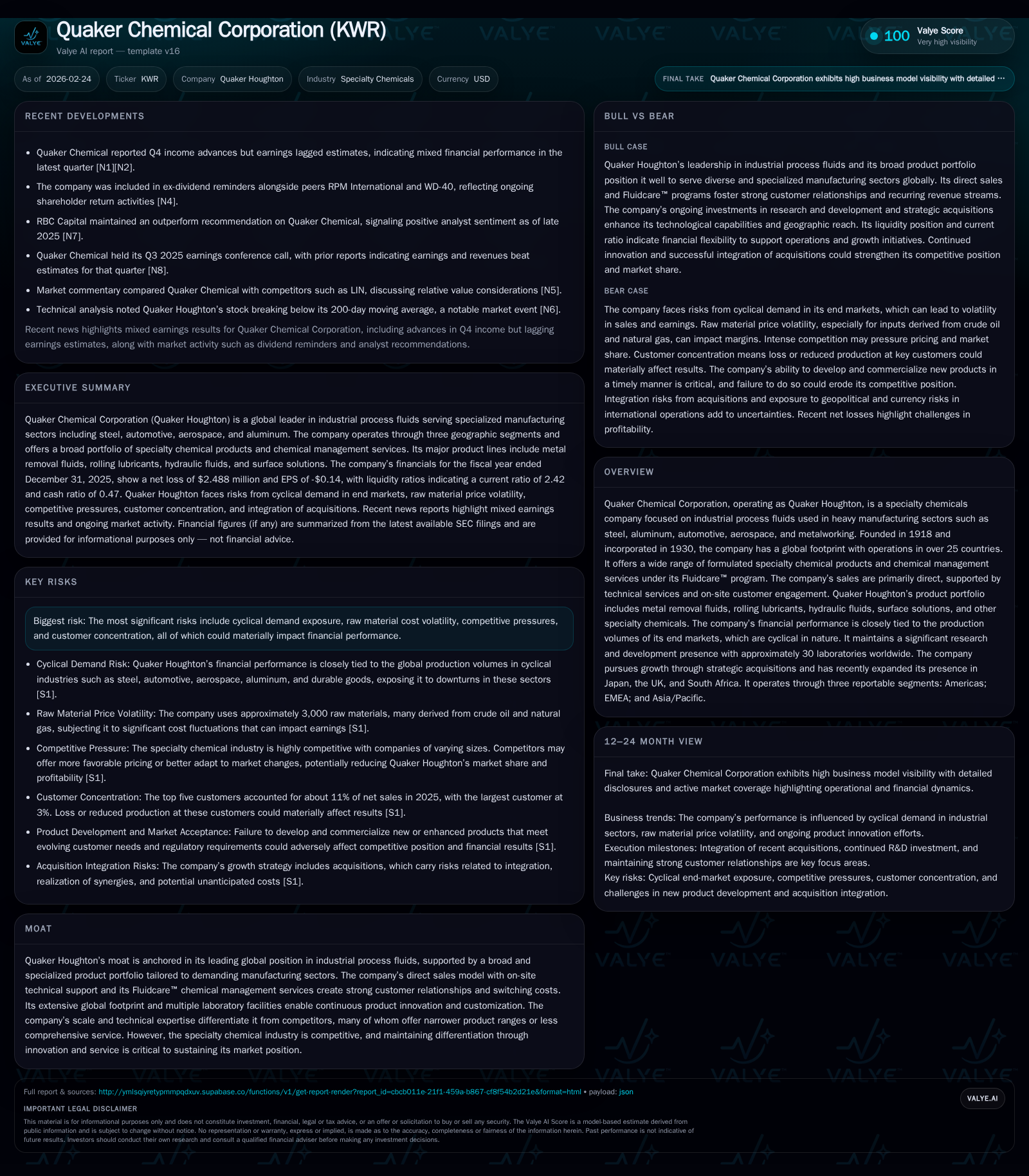
Quaker Chemical Corporation reported a sharp decline in operating income and net income in fiscal 2025, reflecting pronounced cyclicality tied to its industrial customer base. Despite this earnings weakness, robust operating cash flow and ongoing share repurchases underscore disciplined capital management. The company’s broad product portfolio and Fluidcare™ chemical management services provide differentiation, yet exposure to cyclical end markets, raw material cost fluctuations, and competitive pricing pressures constrain near-term growth. Upcoming quarters will be critical for order book trends and margin stabilization, with innovation and geographic diversification pivotal in offsetting headwinds.
Historical Financial Performance Highlights and Year-Over-Year Dynamics
In fiscal 2025, Quaker Chemical experienced a pronounced earnings contraction reflective of the volatile cyclicality endemic to the specialty chemicals serving industrial process fluids markets. Operating income collapsed roughly 73% from $195 million in FY2024 to just under $53 million [F1]. Net income followed suit, turning negative with a small loss of $2.5 million compared to a strong profit of over $116 million the previous year [F1]. This volatility aligns with significant operating leverage inherent in Quaker’s manufacturing chemical business model where volume sensitivity drives amplified profit swings.
Despite earnings pressure, operating cash flow remained solid at $136 million though down by one-third from FY2024’s elevated level [F1]. Capital expenditures accelerated by over 33% to $56 million as the company maintained investments across manufacturing facilities and lab capabilities [F1]. These investment increases reflect ongoing commitment to innovation and capacity expansion amidst tougher market conditions.
Historical performance (annual)
| FY | Net ($mm) | CFO ($mm) | OpInc ($mm) | Capex ($mm) | Net YoY |
|---|---|---|---|---|---|
| 2025 | -2 | 136 | 53 | 56 | -102.1% |
| 2024 | 117 | 205 | 195 | 42 | +3.5% |
| 2023 | 113 | 279 | 214 | 39 | +807.7% |
| 2022 | -16 | 42 | 52 | 29 |
Note: Omitted columns lack sufficient annual XBRL coverage in the provided tags (need ≥2 annual points): Rev, Div. Source: SEC companyfacts cache [F1].
Capital returns and efficiency (annual)
| FY | Buybacks ($mm) | FCF ($mm) | ROE% |
|---|---|---|---|
| 2025 | 42 | 81 | -0.2 |
| 2024 | 49 | 163 | 8.6 |
| 2023 | 240 | 8.1 | |
| 2022 | 13 | -1.2 |
Source: SEC companyfacts cache [F1].
Note: Revenue data not available from provided tags; table omits metrics with insufficient data.
Drivers Behind Recent Operating Income Volatility
Quaker Chemical’s earnings volatility closely tracks demand fluctuations within its core heavy-industrial end markets such as steel production, automotive manufacturing, aerospace components fabrication, and aluminum extraction [S1][S10]. These sectors are inherently cyclical with broad exposure to global economic shifts impacting production volumes and capital expenditure cycles by customers.
Raw material input cost variability emerged as a critical margin headwind during FY2025; significant exposure to crude oil derivatives used as base stocks for many formulations meant that spikes or rapid swings in petrochemical feedstocks pressured product profitability [S1]. Concurrently, increased competitive intensity has pressured pricing flexibility as peers seek market share amid subdued demand conditions [N1][S1].
Crucially, Quaker Chemical’s operating model — emphasizing direct sales with embedded on-site technical support — provides some insulation by differentiating on service rather than price alone [S5][S7]. This technical service footprint fosters customer switching costs contributing defensibility even during downturns.
Product Mix and End-Market Dependency Shaping Growth Patterns
The company derives substantial revenue from metal removal fluids (19%), rolling lubricants (18%), hydraulic fluids (12%), and surface solutions which notably increased to near 11% in FY2025 from about 5% previously [S1][S4]. This product portfolio reflects complexity common within industrial process fluids where diverse applications require tailored chemical formulations.
However, shifts in these product line contributions directly map onto fluctuations across the major industrial sectors served — for example reduced automotive manufacturing lines or steel mill output lead directly to volume contractions impacting Quaker’s top-line growth potential [S4][S24]. Additionally, customer concentration is moderate but remains a risk factor; top five customers accounted for approximately 11% of net sales implying dependency on key accounts whose production changes can disproportionately affect demand [S10].
Emerging Growth Opportunities Balanced Against Market Constraints
Growth avenues include expansion of the proprietary Fluidcare™ chemical management service platform which allows customers operational efficiencies through inventory management and usage optimization [N2][S1]. Geographic diversification through recent acquisitions—including Dipsol Chemicals (Japan), focusing on surface treatment chemicals aligned with automotive applications globally—provides cross-selling potential while broadening regional end-market exposure [S16][S26].
Yet the upside is tempered by systemic challenges: persistent raw material price swings dampen margin visibility; macroeconomic uncertainty restrains capex cycles among customers; environmental regulations heighten compliance costs; and competition from better capitalized or more specialized rivals tightens pricing power [S1][S8][N2].
Competitive Landscape and Innovation as Differentiators
Within specialty chemicals for industrial process fluids, Quaker Houghton stands out due to its extensive R&D infrastructure—maintaining approximately 30 laboratories worldwide geared towards applied technology development—and its integrated technical service delivery model that couples product sales with process optimization [S23][S7]. This approach elevates switching costs making substitution by competitors more challenging.
Nonetheless, competition is fierce from both large diversified chemical producers offering broad lubricant portfolios as well as niche specialists providing targeted chemistries [S5]. Consolidation trends may intensify competitive pressures potentially compressing margins further unless Quaker leverages its innovation pipeline effectively.
Capital Allocation Strategies: Readiness Amid Profit Downturns
Despite the sharp decline in profitability during FY2025, Quaker Chemical maintained strategic capital allocation discipline evidenced by active share repurchase programs totaling approximately $41.5 million mirroring prior year levels and continuing steady dividend payouts without interruption [F1][S19]. This speaks to management confidence in underlying free cash flow generation capability despite volatile earnings.
Leverage ratios remain moderate supported by a strong current ratio of approximately 2.4 indicating ample liquidity headroom even under stressed scenarios [F1][S6]. Exposure to interest rate risk linked to variable debt costs underscores sensitivity to broader macroeconomic factors impacting debt servicing expenses going forward but no specific numerical ROE figures beyond approximate calculation are available from provided tags.
Cash Flow Generation, Dividends, and Share Repurchase Trends
Free cash flow resilience was notable as operating cash flow of $136 million exceeded capital spending of about $56 million resulting in positive free cash flow near $81 million during FY2025 even as profits slumped deeply negative at the net income level [F1]. Such cash conversion efficiency is a hallmark feature enabling shareholder returns continuity against an uneven profit backdrop.
Share buybacks have been opportunistic under the refreshed $150 million authorization initiated in February 2024 facilitating ongoing reduction of outstanding shares thereby improving per-share metrics when market conditions permit [S19][N5]. Dividend payments continue at levels consistent with historical practice reinforcing stable capital return policy despite earnings pressure.
Key Forecast Metrics and Strategic Milestones to Watch
While explicit company guidance for upcoming periods is not available from provided evidence, several indicators warrant monitoring: order backlog status reflective of underlying demand momentum; trajectory of raw material input costs that impact margin recovery; renewal or expansion of key customer supply agreements signaling confidence; progress integrating recent acquisitions for synergistic gains; and pace of Fluidcare™ program adoption across geographic segments [N2][N4].
Margin improvement would hinge on stabilizing raw material prices alongside better capacity utilization correlated with industrial production normalization. New product introductions aligned with sustainability-driven reformulations oriented towards emissions reductions may also serve as longer-term growth catalysts.
Disclaimer: This analysis is intended solely for informational purposes based on publicly available data as of February 2026 and does not constitute investment advice or recommendations.
Disclaimer: This is research-only, informational analysis and not investment advice. It may include AI-generated interpretation and general industry context. Always verify important details using primary sources.

Comments