
Erie Indemnity’s Earnings Retreat and Dividend Strength: Balancing Growth and Leadership Transition
Erie Indemnity reports Q4 2025 earnings slip alongside sustained dividend growth amid CEO retirement announcement.
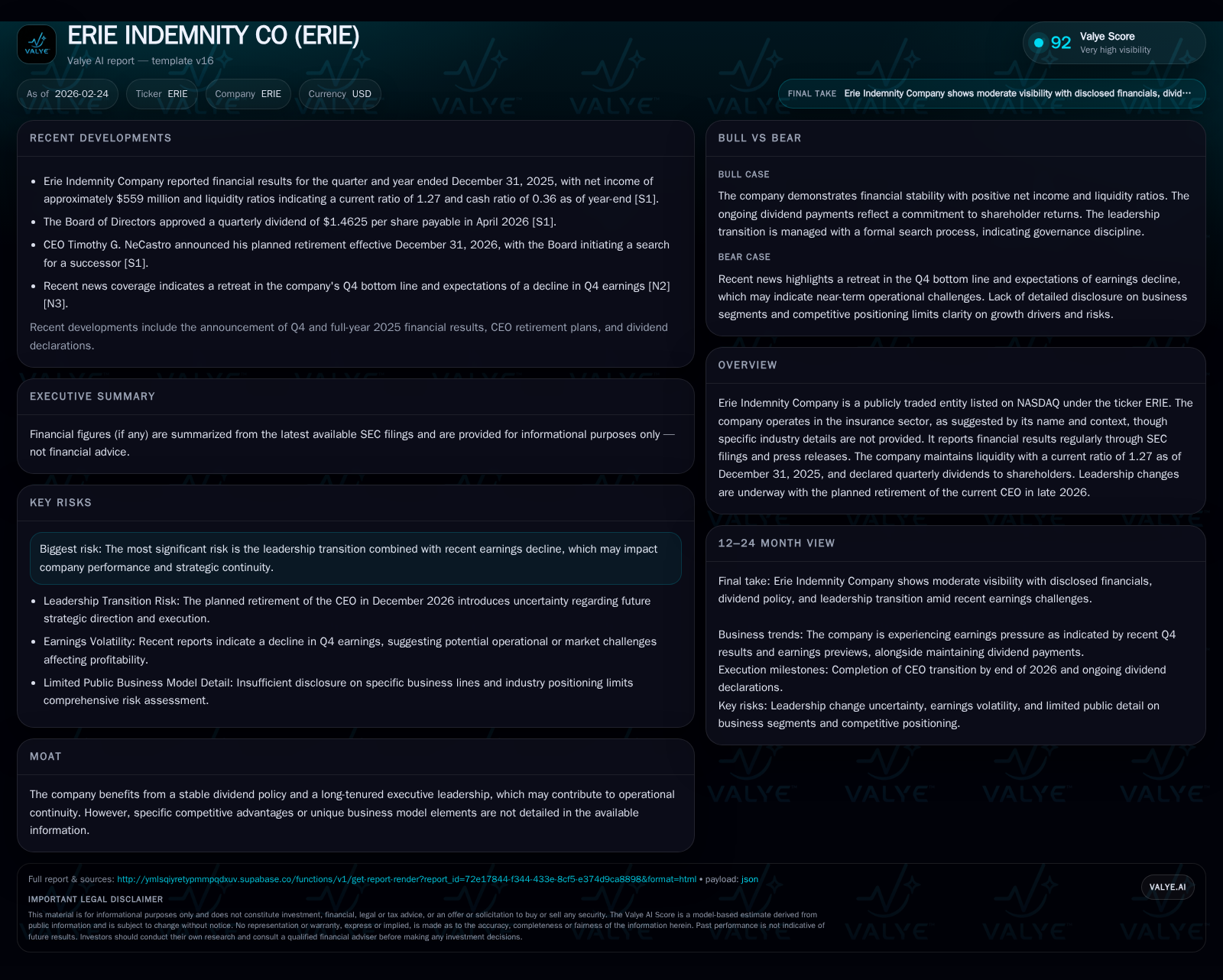
Erie Indemnity Company has demonstrated consistent revenue and operating income growth over recent years, yet its net income declined in the fourth quarter of 2025. The company maintains a strong dividend policy supported by robust operating cash flows even as it faces the imminent retirement of its long-tenured CEO. Liquidity metrics remain solid, while capital allocation continues to favor dividends over buybacks. Investors should watch premium growth, underwriting results, and management succession execution for signs of sustained stability.
Revenue Expansion and Profitability Trends Over Recent Years
Erie Indemnity Company has demonstrated a solid upward trajectory in its top-line financials in the past few years. For fiscal year 2025, revenues climbed to approximately $717 million, representing a 5.7% year-over-year increase from $676 million in 2024 [F1]. This growth has been supported by favorable underwriting profitability alongside recurring investment income streams typical of insurers managing reserves prudently. Operating income expanded by about 6%, matching top-line momentum with improved efficiency or underwriting success contributing positively to the bottom line.
However, net income painted a more nuanced picture with a decline of roughly 6.8% to $559 million in FY2025 compared to $600 million the prior year [F1]. Despite rising operating profits, this fall in net income suggests non-operating factors or one-time charges impacted performance especially near year-end.
Additionally, operating cash flow (CFO) posted robust gains climbing 12.3% to nearly $687 million in FY2025 from $611 million previously. This increase signals strong operational leverage where cash generation outpaces accounting profits indicating effective working capital management or timing differences inherent to insurance claim cycles.
Historical performance (annual)
| FY | Net ($mm) | CFO ($mm) | OpInc ($mm) | Capex ($mm) | Net YoY |
|---|---|---|---|---|---|
| 2025 | 559 | 687 | 717 | 116 | -6.8% |
| 2024 | 600 | 611 | 676 | 125 | +34.6% |
| 2023 | 446 | 381 | 520 | 93 | +49.4% |
| 2022 | 299 | 366 | 376 | 67 |
Note: Omitted columns lack sufficient annual XBRL coverage in the provided tags (need ≥2 annual points): Rev, Buybacks. Source: SEC companyfacts cache [F1].
Capital returns and efficiency (annual)
| FY | Div ($mm) | FCF ($mm) | ROE% |
|---|---|---|---|
| 2025 | 254 | 571 | 24.5 |
| 2024 | 238 | 486 | 30.2 |
| 2023 | 222 | 289 | 26.8 |
| 2022 | 207 | 299 | 20.6 |
Source: SEC companyfacts cache [F1].
Note: Revenue for earlier years not comparable due to entity-specific reporting categorizations; omitted certain metrics unavailable across periods.
Drivers Behind Earnings Decline in Late 2025
Despite an overall positive annual performance, Erie’s fourth-quarter earnings retreated notably as flagged in the company's February 23, 2026 press release [N6], [S3]. The downturn stems mainly from higher loss ratios—claims costs increased relative to earned premiums—and elevated expense ratios driven partly by inflationary pressures on administrative costs or IT investments.
From available SEC MD&A disclosures, no extraordinary litigation charges or regulatory fines were reported that could singularly explain the dip, indicating that underwriting cycles and competitive pricing dynamics likely caused margin compression during Q4 [S1], [S3]. The company’s risk management remains vigilant but these fluctuations underscore the volatility insurable events can introduce quarter-to-quarter.
Impacts and Implications of the CEO Transition
An important corporate governance development occurred with CEO Timothy G. NeCastro announcing his intent to retire at the end of calendar year 2026 after serving as Chief Executive since 2016 and dedicating three decades to Erie Indemnity Company overall [S18]. This impending leadership change introduces uncertainty around strategic continuity given NeCastro’s deep institutional knowledge and longstanding relationships within underwriting teams and broker networks.
Insurance is a relationship-driven business where executive tenure contributes materially to maintaining underwriting discipline and market trust—both vital components of Erie’s implicit moat according to internal assessments . The board's search for a successor is ongoing; meanwhile operational steadiness depends on retaining middle management layers that support daily underwriting decision frameworks and client distribution channels.
Capital Allocation Strategy: Dividends, Buybacks, and Cash Flow Efficiency
Capital deployment reveals Erie prioritizes returning capital consistently through dividends over aggressive buybacks or acquisitions currently. Annual dividend payments increased steadily from approximately $206 million in FY2022 to around $254 million for FY2025, illustrating commitment amid fluctuating net income metrics [F1], [S10–S18]. The latest declared quarterly dividend amounts to $1.4625 per share payable April 21, 2026, reinforcing shareholder yield stability.
Meanwhile, share repurchases have been minimal or absent since at least FY2016 aligning with management's focus on organic growth and prudent balance sheet stewardship rather than opportunistic buybacks.
Operating cash flow comfortably covers dividends with free cash flow—operating cash flow minus capital expenditures—estimated near $571 million for FY2025 [F1]. Moderate capex reductions (-7.3%) reflect cautious reinvestment calibrated towards platform maintenance rather than expansion-heavy initiatives typically seen in sectors requiring rapid technological upgrades.
Of note within recurrent revenues is the management fee rate charged by Erie Indemnity Company to its affiliate Erie Insurance Exchange which impacts fee income streams and ultimately shareholder earnings stability; adjustments here have been approved recently but specifics are company-confidential [S10–S18].
Financial Health: Liquidity, Capital Structure, and Return on Equity
Financially Erie Indemnity maintains solidity characteristic of well-managed insurance entities balancing claim reserves with liquid assets adequately. The current ratio calculated at fiscal year-end stands at roughly 1.27 reflecting sufficient short-term assets against liabilities—a critical measure given insurers’ reserve requirements for claims payments on relatively short notice [F1].
Equity grew strongly from $1.45 billion in FY2022 to over $2.28 billion by FY2025 driven by retained earnings accumulation despite dividend payouts, underscoring capitalization strength supportive of underwriting risks and regulatory capital adequacy frameworks common across U.S insurance law jurisdictions.
Approximate return on equity (ROE) calculates near a robust ~24.5% based on trailing net income versus equity figures—a signal that capital is being deployed effectively even though recent earnings softness tempers optimism somewhat [F1]. No significant debt issuance has been reported indicating reliance predominantly on equity funding consistent with sector norms.
Forward-Looking Considerations: What to Monitor for Growth and Stability
Although explicit earnings guidance is absent from recent disclosures ([N2], [S3]), important metrics merit attention for future assessment:
- Premium growth rates signaling new business acquisition or retention trends impacting revenue inflows.
- Combined ratio developments delineating underwriting profitability including loss adjustment expenses shifts.
- Sustainability of operating cash flows which underpin dividend payout capacity without eroding core capital.
- Smoothness of CEO succession impacting insurer-client relations and internal culture preservation.
Sector-native risks such as regulatory changes or emergent litigation are flagged minimally currently but remain areas warranting vigilance per risk factor sections of recent filings ([S4], [S5]).
Conclusion: Managing Stability Amid Change
Erie Indemnity Company exhibits a compelling balance between resilient financial footing—reflected in sustained revenue increases, strong operating cash flows, stable dividends—and emerging challenges posed by earnings softness late last year coupled with executive turnover looming. This combination frames an opportunity-cost tradeoff familiar within insurance sector paradigms where leadership continuity significantly shapes underwriter discipline and long-term profitability.
For stakeholders tracking Erie’s trajectory, monitoring key operational metrics alongside leadership transition outcomes will be crucial markers shaping future stability prospects while reaffirming dividend strength remains a cornerstone of shareholder returns through this period.
Disclaimer: This is research-only, informational analysis and not investment advice. It may include AI-generated interpretation and general industry context. Always verify important details using primary sources.

Comments