
Soren Acquisition Corp.’s Debut: IPO Proceeds and the Road to Business Combination
Examining Soren Acquisition Corp.’s January 2026 IPO execution, financial footing, and regulatory structure setting the stage for its forthcoming business combination.
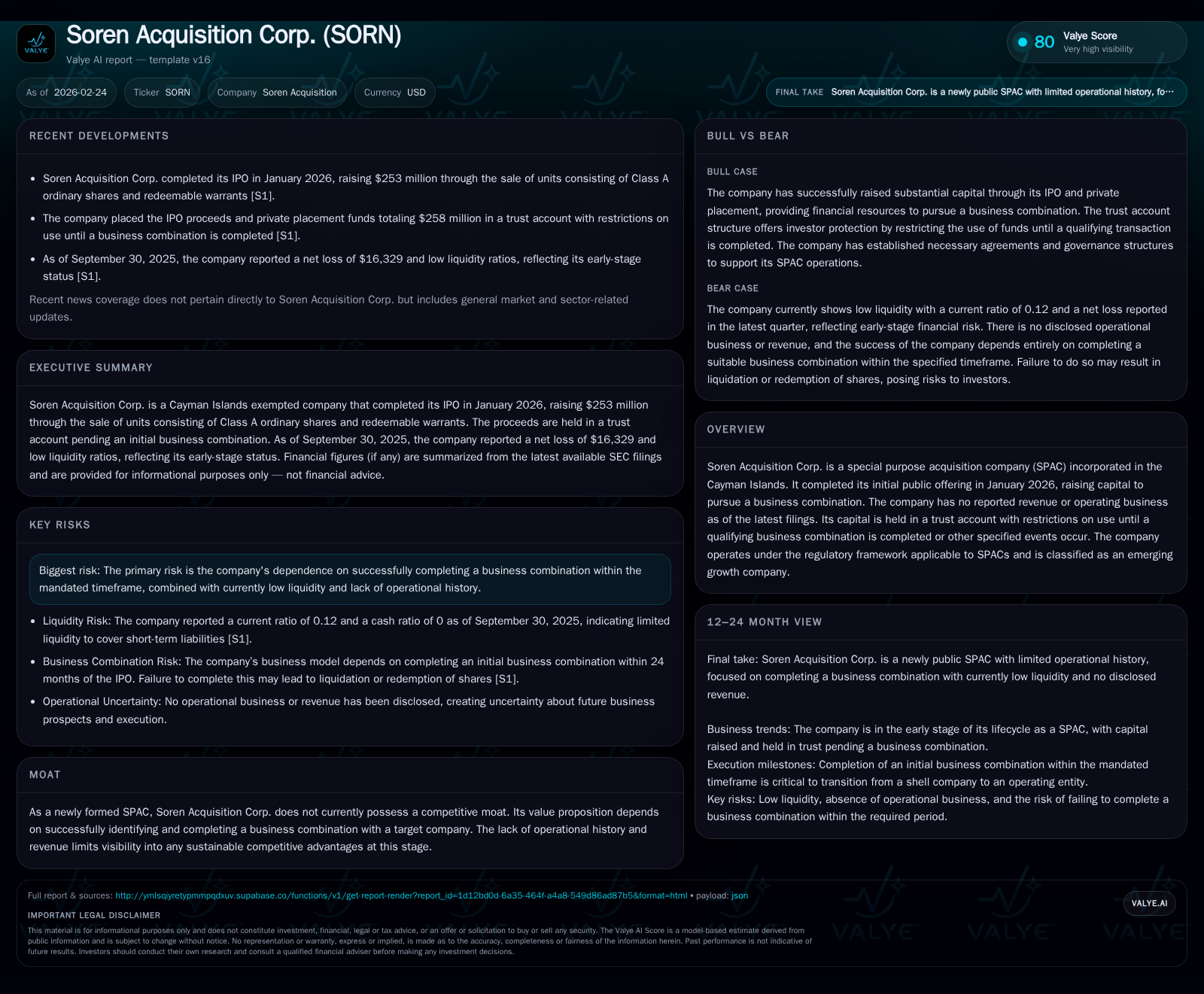
Soren Acquisition Corp., a Cayman Islands-based SPAC, raised $253 million in its January 2026 initial public offering through the issuance of units comprising Class A ordinary shares and fractional warrants. The capital sits in a trust account with strict restrictions on use prior to a qualifying business combination, limiting liquidity and operational activity for the newly formed entity. Early financial results reflect start-up costs without revenue generation, while governance and sponsor arrangements align incentives for completing a deal within the mandated timeframe. Investors face typical SPAC risks including dilution from warrant exercises and redemption rights but should monitor announcements relating to target acquisition progress carefully.
IPO Completion and Cash Position Establishing Launchpad
Soren Acquisition Corp. launched its public market journey with an initial public offering completed on January 8, 2026. The offering generated gross proceeds totaling approximately $253 million through the sale of 25.3 million units priced at exactly $10 per unit [S3][S5][F1]. Each unit comprised one Class A ordinary share with nominal par value ($0.0001 per share) alongside one-third of a redeemable warrant. This fractional warrant structure means that three units confer entitlement to purchase one additional Class A share at an exercise price set at $11.50 per share, establishing clear terms for potential dilution post-business combination [S3][S6].
In tandem with the public offering, the sponsor—Soren Holdings LLC—acquired five million private placement warrants at $1 each, raising a further $5 million in capital that aligns incentives between public shareholders and founders via "warrant economics." These private placement warrants mirror the rights of publicly issued warrants but were sold directly to the sponsor without underwriting fees [S6][S9].
Crucially, all net proceeds from the IPO plus private placement (inclusive of approximately $10.12 million allocated towards business combination marketing fees payable to BTIG, LLC) were deposited into a U.S.-based trust account maintained by Continental Stock Transfer & Trust Company acting as trustee. This trust arrangement imposes stringent restrictions on fund deployment: monies cannot be released except for qualifying uses delineated by SEC regulations governing SPACs—primarily the consummation of a business combination or orderly wind-down scenarios triggered by timing constraints or shareholder redemption requests [S9][S15]. This locked cash base provides both security and constraint—it underpins any future transaction financing yet inhibits flexibility ahead of a successful combination.
Historical Overview: Initial Financial Footprint without Operating History
Given Soren Acquisition Corp.’s formation immediately preceding its IPO, its financial footprint is minimal and entirely shaped by start-up outlays rather than operational metrics. As of September 30, 2025 (latest quarter filing), the company reported zero revenue or operating income consistent with pre-combination status; these metrics are not available in the provided XBRL tags [F1]. The small net loss recorded (-$16,329) stems entirely from administrative expenses incurred during formation activities and regulatory compliance processes.
Balance sheet presentation reveals current assets totaling roughly $25,000 contrasted against current liabilities approximating $206,677—yielding an underscored current ratio of just 0.12 indicative not of operational distress but of limited transactional volume and timing differences inherent in newly constituted entities designed solely for merger purposes [F1]. The relative size of stockholders’ equity remains modest ($8,671) given no accumulated earnings but fully reflects nominal paid-in capital less residual losses.
The consequent annualized return on equity figure hits -188%, a product of low equity denominator magnified by non-recurring startup costs absent any revenue production—which encapsulates typical early-stage SPAC financial dynamics prior to deal execution [F1]. There are no dividends declared nor share repurchases undertaken due to infancy stage focus on capital preservation for anticipated acquisition funding.
Historical performance (annual)
| FY |
|---|
| 2025 |
Note: Omitted columns lack sufficient annual XBRL coverage in the provided tags (need ≥2 annual points): Rev, Net, CFO, OpInc, Capex, Div, Buybacks, FCF, ROE%. Source: SEC companyfacts cache [F1].
Note: Revenue, operating income, operating cash flow (CFO), capital expenditures (Capex), dividends paid, and buybacks/repurchases are not available from provided tags.
SPAC Structural Framework and Regulatory Environment
Structured as an exempted company under Cayman Islands law yet fully listed on Nasdaq with ticker symbols SORN (Class A shares), SORNU (units), and SORNW (warrants), Soren Acquisition operates within the SEC’s regulatory regime applicable to special purpose acquisition companies. It qualifies as an "emerging growth company" under applicable definitions providing transitional accounting reliefs but remains subject to robust disclosure requirements [S2][S4].
Governance instruments include an amended and restated memorandum and articles of association that define corporate rights such as redemption privileges allowing investors who disapprove of proposed combinations to redeem shares at a fixed benchmark price—a fundamental risk mitigant embedded in SPAC structures [S11]. Disclosure requirements mandate detailed risk factor articulation emphasizing uncertainties surrounding timing deadlines (24-month window extendable only via shareholder vote), reliance on external deal sourcing capabilities, litigation exposures from merger disputes, and regulatory compliance considerations.
The trust account custodianship fulfills crucial regulatory mandates preserving investor deposits until definitive merger conditions are met or alternative liquidation events compel return of funds—a built-in safeguard integral to SPACs’ legal framework designed to isolate pre-transaction capital from operating liabilities [S4][S15].
Capital Allocation Strategy and Sponsor Warrants
Sponsor economics center around private placement warrants acquired simultaneously with IPO closing at $1 per warrant entitling conversion into one Class A ordinary share at an exercise price of $11.50—premium pricing intended to preserve value for public investors while incentivizing sponsor commitment toward consummating a high-quality transaction [S6][S9].
Underwriting agreements executed with BTIG, LLC include standard fee arrangements as well as business combination marketing agreements that articulate performance incentives tied to deal completion [S7][S11]. BTIG also received "representative shares" totaling approximately 1.1 million Class A ordinary shares that carry transfer restrictions for a minimum six-month lockup period barring sales or hedging strategies until after initial business combination closes—measures aimed at reducing pre-deal market volatility related to underwriter inventory positions [S10][S12].
In addition, shareholders' transfer restrictions vis-à-vis sponsor shares prior to business combination preserve orderly equity stability while administrative services agreements align operational back-office support through designated service providers under contractual terms ensuring continuity throughout pre-transaction lifecycle phases [S13].
Risks and Constraints Influencing SORN’s Near-Term Trajectory
The principal risk vector centers on successfully identifying and completing a qualifying business combination within the mandated timeframe—for Soren this deadline falls around early 2028 unless extended by shareholder action—and failure triggers mandatory liquidation returning trust funds minus permitted expenses; this event would materially impair shareholder value expectations absent mitigating scenarios [S2][S4].
Additional constraints stem from absence of operational revenues or cash flow generating assets meaning liquidity relies exclusively on trust account holdings which are legally restricted from use except under narrow circumstances defined by governing agreements. This precludes executing independent investments or initiatives unrelated to merger activity.
Dilution risk also emerges from pro forma capital structure alterations once warrants become exercisable following a successful merger announcement; these securities introduce potential overhang increasing float size while imposing exercise price premiums above original Unit pricing that could impact secondary market prices negatively if perceived deal valuation lacks sufficient margin [S2][S6].
Legal/compliance risks inherit typical exposures associated with SPAC frameworks subject to evolving regulatory scrutiny concerning disclosure adequacy around target identification process as well as market fairness considerations relevant to retail investors’ protection policies outlined by SEC enforcement priorities.
What Investors Should Monitor Ahead of Business Combination Announcement
Although Soren Acquisition has not provided explicit forward-looking guidance or target timelines beyond statutory deadlines (analysis), investors ought to closely monitor press releases or SEC filings signaling progress milestones such as:
- Receipt or announcement of letters of intent or definitive agreements outlining proposed de-SPAC transactions;
- Timeline indications regarding shareholder meetings convened for voting on proposed mergers;
- Updates on redemptions rates exercised by public shareholders reflecting sentiment polarity around proposed deals;
- Disclosures addressing material changes in sponsorship or advisor agreements impacting marketing efforts;
- Market commentary from investment bankers engaged in deal sourcing potentially influencing competitive transaction dynamics.
Active scrutiny will help contextualize valuation implications given highly binary nature of SPAC outcomes wherein either positive de-SPAC transactions catalyze share price appreciation or unsuccessful timelines lead toward wind-down discounting.
Investor Returns Expectations: Dilution, Warrants, and Redemption Rights
Currently exhibiting negative returns owing primarily to early stage operating losses incurred before any acquired operational asset backing exists (-188% ROE annualized), Soren Acquisition’s capital structure post-combination stands poised for notable transformation centered around warrant exercise mechanics priced markedly above initial Unit cost ($11.50 vs. $10 unit price) [F1][S5][S7].
This creates a dilution tradeoff where new equity inflows via exercised warrants increase total share count but also introduce fresh capital supporting merged entity operations; however, excessive exercise coupled with high shareholder redemptions triggered by merger disagreements can substantially alter ownership percentages reducing existing holders’ effective participation.
SPAC standard redemption rights afford investors means to tender their shares back at near-offering values if they reject proposed acquisitions—a protective feature that simultaneously introduces uncertainty whether sufficient ownership remains committed post-merger leading potentially to constrained trading liquidity immediately after initial combination closure.
Absence currently exists around dividend distributions or share repurchases reflecting strategic focus remaining strictly on deal execution rather than capital returns optimization; these are typically dormant until stable cash flow generation emerges from merged businesses enabling disciplined allocation decisions over time horizon beyond initial public listing phase.
Conclusion & Disclaimer
In sum, Soren Acquisition Corp.’s launch via its substantial IPO underscores foundational capital readiness underpinning planned business combination pursuits customary in contemporary SPAC markets. The structural safeguards embedded through trust accounts alongside sponsor-aligned warrant instruments configure classical incentive frameworks integral for navigating merger complexities ahead. While operating history is non-existent reflecting entity infancy status accompanied by customary risks like transactional lethargy or liquidity constraints confined by regulatory strictures—the practical trajectory hinges heavily on forthcoming deal announcements catalyzing shifts in valuation paradigm central to stakeholders’ interest.
This report does not constitute investment advice or recommendations concerning any securities offerings or corporate actions related thereto but aims solely to present factual synthesis derived from available disclosures for institutional-grade reference.
Disclaimer: This is research-only, informational analysis and not investment advice. It may include AI-generated interpretation and general industry context. Always verify important details using primary sources.

Comments