
Kratos' Growth Balances Innovation Investment and Operational Cash Flow Pressures
The defense technology firm expands backlog and capital expenditures amid operating cash flow challenges.
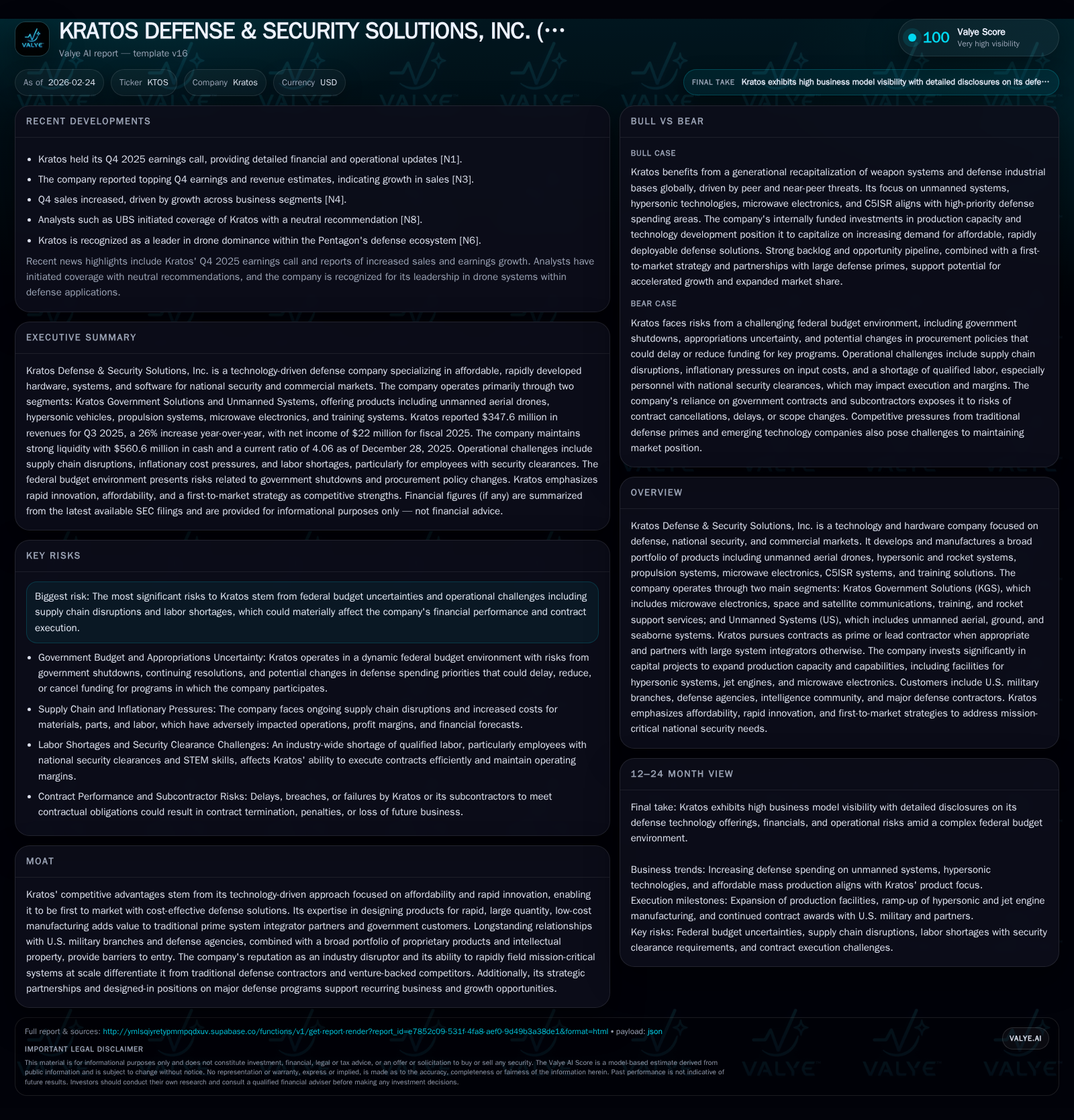
Kratos Defense & Security Solutions has experienced solid revenue growth driven by its dual segments focused on government contracts and unmanned systems, underscored by record backlog reaching over $1.5 billion. The company’s strategy to lead with cost-effective, rapidly deployable defense technologies—especially in unmanned aerial systems and hypersonics—positions it well within a generational defense recapitalization. However, despite growing revenues and profitability improvements, Kratos reported declining operating cash flows and negative free cash flow due to elevated capital investments for capacity expansion and supply chain mitigation. Monitoring future contract awards, margin trends, and working capital management will be critical to assess whether operational cash flows can align with Kratos’ expansive growth ambitions.
Company Overview
Kratos Defense & Security Solutions operates at the intersection of defense technology and national security hardware solutions. Its offerings span unmanned aerial drones, hypersonic propulsion systems, microwave electronics for missile defense and satellite communications, along with training and command-and-control systems. Kratos segments its business into two primary divisions: Kratos Government Solutions (KGS), covering microwave electronics, space communications, training systems, rocket support; and Unmanned Systems (US), which includes unmanned aerial vehicles (UAVs), ground and sea platforms.
A defining characteristic of Kratos’ approach is its mantra that "affordability is a technology." Rather than chasing unproven cutting-edge tech, the company focuses on mature but innovative methods that shorten schedules, reduce costs, and lower risk to expedite entry to market with cost-effective defense products [S1][S2]. This strategy has cultivated long-term relationships with major U.S. military agencies and prime contractors.
Historical Growth Performance
From a financial perspective, Kratos delivered $751.9 million in revenue in fiscal 2025—marking a 12.4% increase over the prior year [F1]. This growth was buoyed by expanded sales across both KGS and US segments, driven notably by higher production volumes of unmanned systems alongside sustained demand for microwave electronics and defense rocket support services [S5][S23]. Although operating income dipped slightly by 11.7% to $25.6 million primarily due to increased investment spending, net income improved significantly from prior-year losses to a positive $22 million [F1].
Cash flow trends reveal some tension between growth investment and operations: operating cash flow swung negative (-$42.1 million in FY2025) from a positive base in prior years [F1], reflecting increased working capital tied up in inventory accumulation, vendor prepayments for long-lead items (notably for hypersonic projects), and funding milestone-based billing terms typical in DoD contracting [S14][S22]. Capital expenditures climbed sharply (+63.7%) to $95.3 million as Kratos accelerated expansion of its Indiana-based hypersonic system fabrication plant, UAV production tooling including Valkyrie variants under development, as well as upgrades in cyber security infrastructure [S20][S28].
Historical performance (annual)
| FY | Net ($mm) | CFO ($mm) | OpInc ($mm) | Capex ($mm) | Net YoY |
|---|---|---|---|---|---|
| 2025 | 22 | -42 | 26 | 95 | +35.0% |
| 2024 | 16 | 50 | 29 | 58 | +283.1% |
| 2023 | -9 | 31 | 52 | +75.9% | |
| 2022 | -37 | -3 | 45 |
Note: Omitted columns lack sufficient annual XBRL coverage in the provided tags (need ≥2 annual points): Rev, Div, Buybacks, ROE%. Source: SEC companyfacts cache [F1].
Capital returns and efficiency (annual)
| FY | FCF ($mm) |
|---|---|
| 2025 | -137 |
| 2024 | -8 |
| 2023 | |
| 2022 |
Source: SEC companyfacts cache [F1].
Note: Operating cash flow data not fully available for all years; YoY % calculated where possible.
Future Growth Prospects
Kratos benefits from what it terms a "generational recapitalization" of defense modernization programs globally focused on countering peer threats from Russia, China, North Korea, and Iran [S1][S26]. Its internally funded R&D nurtures rapid development cycles aiming for "first-to-market" positions especially in hypersonics (Zeus solid rocket motors; Erinyes flight systems) and jet-powered UAVs (Valkyrie platform enhancements). The company’s recent backlog rose approximately 9% year-over-year to about $1.57 billion at fiscal year-end 2025—with about $1.23 billion funded—signaling abundant near-term revenue visibility [S26]. Roughly half this backlog is expected to convert into revenue within the next twelve months.
Strategic partnerships with traditional aerospace giants like Lockheed Martin, Northrop Grumman as well as emerging technology contractors broaden Kratos’ market reach while enabling it to serve both as prime contractor on select programs or subsystem supplier on others [S5][S8]. The company’s distinctive ability lies in product designs geared toward scalable low-cost mass manufacturing—a valuable edge amid DoD demands for affordable attritable unmanned capabilities.
That said, sustaining momentum depends on several factors: securing additional high-value contracts amidst intensifying competition from established primes and agile startups alike; managing supply chain stability including access to critical components; recruiting talent capable of sustaining complex manufacturing; adapting quickly to evolving customer priorities; and managing working capital pressures as order sizes grow [S8][S12].
Financial Forecasts & Milestones
While explicit forward guidance remains limited publicly, management commentary highlights continued capital deployments totaling upward of $35-$40 million annually dedicated mainly to unmanned tactical initiatives including UAV fleet expansions [S20]. Metrics to watch include backlog conversion pacing relative to revenue growth; gross margin stabilization given inflationary headwinds especially on labor/materials; operating cash flow trends vis-à-vis capex commitments; award announcements involving hypersonic propulsion or large-scale drone programs; plus contract performance on classified work supporting classified customers.
Industry context suggests procurement emphasis will remain laser-focused on agility, affordability, and speed-to-field — conditions favoring companies like Kratos that combine lean innovation with disciplined scale manufacturing capabilities.
Returns & Capital Allocation
Kratos’ approximate return on equity remains modest at around 1.1% based on latest fiscal net income against equity levels exceeding $1.99 billion [F1]. The persistent negative free cash flow (-$137 million defined as operating CFO minus capex for FY2025) underscores intensive reinvestment for growth expansion [F1]. The company has no data available publicly regarding dividend payments or share repurchases within recent periods.
Notably Kratos extinguished all outstanding term loan debt ($177.5M principal) mid-2025 using proceeds from a substantial equity raise exceeding $555 million—thereby deleveraging its balance sheet dramatically while maintaining a strong liquidity cushion above half a billion dollars in cash equivalents [S6][S7][S21][F1]. The undrawn revolving credit facility stands at $200 million providing additional optional liquidity.
Capital allocation clearly prioritizes internal reinvestment into production capacity enhancement and R&D rather than shareholder distributions or debt financing given industry cycle requirements for upfront investment.
Industry Positioning & Risks
The competitive landscape pits Kratos against major primes like Raytheon Technologies, Boeing Defense Systems alongside nimble specialized tech firms such as Anduril or Shield AI competing aggressively in areas like drone warfare or digital battlefield systems [S8][S16]. The firm's ethos centers on disruptive innovation through affordability combined with rapid fielding —a contrast against traditional high-cost prime contractor approaches.
Risks are prominent given reliance on government spending decisions vulnerable to budgetary uncertainty, operational risks linked to global supply chain fragility particularly on semiconductors/electronics components used in missiles/UAVs,[S14] workforce availability challenges affecting skilled manufacturing staffing,[S19] plus potential delays or cancellations inherent to government contracts subject to termination-at-will clauses [S24].
Effective navigation of these risks while leveraging increasing backlog-driven scale will define whether Kratos can translate current momentum into sustainable profitable growth.
Disclaimer: This report is prepared solely for informational purposes without any recommendation or solicitation regarding securities transactions involving Kratos Defense & Security Solutions Inc., nor should it be construed as investment advice or an endorsement of any particular financial strategy.
Disclaimer: This is research-only, informational analysis and not investment advice. It may include AI-generated interpretation and general industry context. Always verify important details using primary sources.

Comments