
Kinsale Capital’s Strategic Gains and Technology Edge in the E&S Market
Kinsale Capital leverages underwriting expertise and proprietary technology to deliver strong returns and disciplined capital management in specialty insurance.
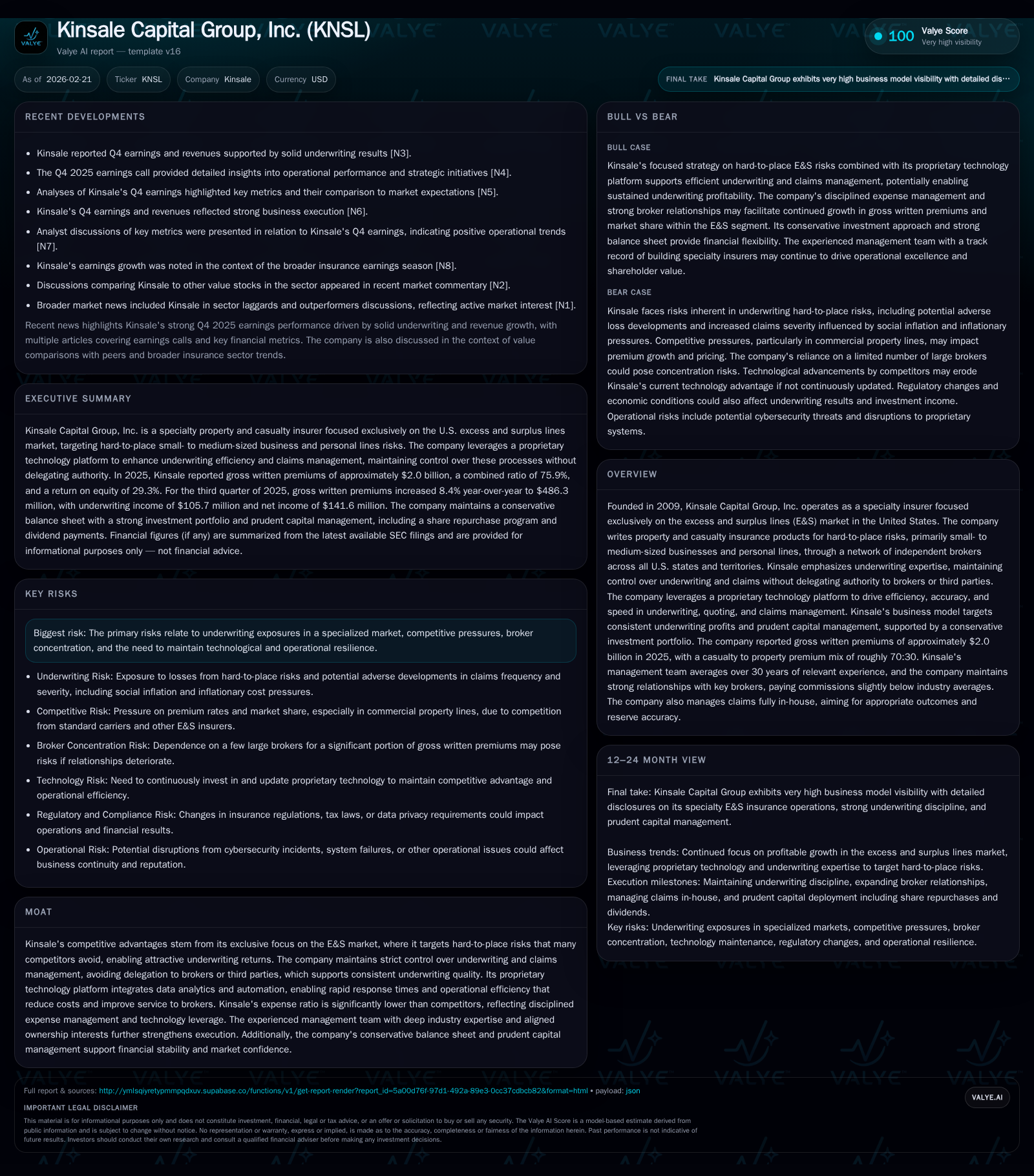
Since its 2016 IPO, Kinsale Capital Group has demonstrated impressive growth by focusing exclusively on the niche Excess & Surplus (E&S) lines market, serving hard-to-place risks with tight underwriting controls. The company’s proprietary technology platform enhances precision and efficiency, driving lower expense ratios relative to peers. In 2025, Kinsale sustained above-industry premium growth and strong net income expansion while maintaining disciplined capital allocation through dividends and substantial share repurchases. Key risks remain tied to reserving adequacy for complex occurrence policies and competitive pressures. Monitoring combined ratio trends, loss reserve developments, and technology investment returns will be critical for validating future growth prospects.
Impressive Historical Growth Underpinned by Focused E&S Expertise
Since its public offering in mid-2016 at $16 per share, Kinsale Capital Group has consistently outpaced market averages through a pure play on the Excess & Surplus (E&S) lines market [S1]. This focus on hard-to-place property and casualty risks among mainly small- to medium-sized commercial insureds has fueled robust revenue expansion paired with disciplined underwriting.
From $819 million in revenue in fiscal 2022, Kinsale increased top-line to nearly $1.87 billion by year-end 2025—a roughly 37% compounded annual growth rate over this period [F1]. The net income trajectory similarly accelerated from $159 million to over $503 million (21.4% YoY growth in 2025 alone), underlining not just volume gains but also margin enhancements through underwriting discipline [F1]. Equity grew significantly from $745 million at end-2022 to almost $2 billion at end-2025, reflecting retained earnings accumulation and capital injections aligned with growth [F1].
This historical success is anchored in targeting segments that standard markets avoid—illustrated by a stable casualty-to-property mix of approximately 70:30 weighted towards casualty risks as of end-2025 [S1]. Their strict centralized control over underwriting decisions and claims handling avoids delegation pitfalls common in E&S insurers, translating into consistent risk selection quality and attractive combined ratios near 75.9% recorded for the full year 2025 [S1].
Historical performance (annual)
| FY | Rev ($mm) | Net ($mm) | CFO ($mm) | Capex ($mm) | Rev YoY | Net YoY |
|---|---|---|---|---|---|---|
| 2025 | 1874 | 504 | 1044 | 54 | +18.0% | +21.4% |
| 2024 | 1588 | 415 | 976 | 24 | +29.7% | +34.6% |
| 2023 | 1224 | 308 | 860 | 7 | +49.5% | +93.6% |
| 2022 | 819 | 159 | 558 | 7 |
Note: Omitted columns lack sufficient annual XBRL coverage in the provided tags (need ≥2 annual points): OpInc. Source: SEC companyfacts cache [F1].
Capital returns and efficiency (annual)
| FY | Div ($mm) | Buybacks ($mm) | FCF ($mm) |
|---|---|---|---|
| 2025 | 16 | 90 | 990 |
| 2024 | 14 | 10 | 952 |
| 2023 | 13 | 853 | |
| 2022 | 12 | 551 |
Source: SEC companyfacts cache [F1].
*Latest values per fiscal year ended Dec'25; YoY % vs prior year [F1]
Omitted: operating income due to unavailability.
Leveraging Proprietary Technology for Underwriting Precision and Efficiency
Kinsale’s proprietary technology platform stands as a key differentiator within the fragmented E&S market [S1][N1]. Unlike many competitors that outsource or delegate underwriting authority to brokers or third parties—potentially diluting risk discipline—Kinsale maintains direct control over underwriting and claims processes. This ensures rapid decision-making backed by data-driven analytics.
Sector-specific terms such as policy acquisition cost are tightly managed via automation-enabled risk selection algorithms that enhance accuracy without sacrificing speed [S1]. The platform's integration facilitates real-time quote generation allowing brokers faster response times while maintaining stringent rates adequacy within accepted risk appetite boundaries.
Expense discipline is visible through materially lower expense ratios versus peers—a reflection of both technology leverage and operational focus on minimizing acquisition costs plus loss adjustment expenses while keeping policy servicing agile [N1]. The ongoing capex surge (+124% YoY in FY2025 reaching $53.7 million) primarily fuels further enhancements in digital infrastructure aimed at sustaining competitive moat [F1].
2025 Performance Recap: Revenue, Earnings, and Operational Highlights
In calendar year 2025, Kinsale reported gross written premiums of approximately $2 billion—up roughly +5.7% compared to prior year—highlighting sustained demand for their specialized coverages despite broader market challenges [S1][N1]. Net income advanced by about +21.4%, benefiting from underwriting profitability complemented by efficient cost control measures.
The combined ratio—measuring losses plus expenses relative to earned premiums—improved slightly to around the mid-75s percentage range (75.9% as reported), outperforming many segment peers who grapple with higher claims inflation and social inflation effects impacting loss severity [S1][N2]. Operating return on equity edged down modestly to ~26.4% due principally to equity base expansion from accumulated profits but remained indicative of strong capital utilization [S13].
Operating cash flows crossed the billion-dollar threshold ($1.04 billion), growing nearly +6.9%, underpinning the company’s capacity to fund working capital needs alongside strategic investments [F1]. Capital expenditures more than doubled from preceding years reflecting the accelerated iteration of their tech stack including automation upgrades and data analytics capabilities supporting underwriting accuracy [F1][S8].
Key Drivers Behind Premium Growth and Claims Management Dynamics
Growth drivers encompass multiple vectors: new business submissions increased owing to broadening broker relationships; conversion rates benefitted from streamlined quoting technologies; renewals remained stable due to high retention rates supported by service quality; and selective rate increases reflected improving market pricing environments in several commercial lines segments [S1][S2].
Claims management complexity is elevated given that approximately four-fifths of casualty reserves relate to occurrence policies where claims may surface years post-policy expiration, intensifying reserving uncertainty [S12][S17]. Increasing claims inflation driven by wage pressures, material costs escalation, legal environment shifts including growing social inflation factors such as litigation funding produce continual upward pressure on loss adjustment expenses [S1][S20].
The company's actuarial teams continuously monitor loss development patterns using stochastic modeling complemented by scenario testing against external judicial trends ensuring proactive reserve adequacy assessments remain current with evolving exposures [S12][S17].
Capital Allocation Discipline: Balancing Repurchases, Dividends, and Expansion
Kinsale exhibits conservative yet shareholder-friendly capital management within regulatory constraints governing insurance holding companies [S6][S14]. In October 2024 a $100 million share repurchase authorization was completed during calendar year 2025 accounting for roughly $90 million in buybacks—indicating significant opportunistic stock returns discipline amidst market conditions [S8][F1]. Subsequent authorization increased repurchase capacity fivefold for up to $250 million reflecting board confidence.
Dividends paid rose steadily reaching nearly $15.8 million aggregate payout in FY25 (~$0.68 per share total), underscoring a commitment to returning cash flow while retaining sufficient surplus for organic growth investments [F1][S11]. The regulatory framework caps dividend distributions based on insurer statutory surplus formulas necessitating ongoing dialogue with regulators regarding appropriate surplus thresholds [S14].
Equity base expanded by about one-third between FY24-FY25 reaching ~$2 billion end-December reflecting retained earnings generation outpacing buybacks thus preserving strong solvency margin aligned with A.M Best “A” financial strength ratings maintained consistently [S16][F1]. This balance supports both prudent surplus maintenance crucial for reinsurer confidence as well as tactical flexibility for bolt-on acquisitions or product expansion if pursued.
Assessing Loss Reserves and Risk Exposure in a Hard-to-Place Market
Reserve adequacy remains one of Kinsale’s most critical risk exposures given the incidence of long-tail occurrence policies accounting for roughly ~84.2% of net casualty reserves at end-2025 which heightens actuarial uncertainty given potential adverse development beyond initial estimates [S12][S17]. Regular updates stem from evolving claim severity patterns influenced by legal reforms, social inflation—including higher jury awards—and emerging claims litigation theories applied retroactively by courts posing reserving challenges uncommon outside specialty niches.
The company employs rigorous reserving methodologies leveraging iterative actuarial analyses incorporating multi-year loss development triangles stratified by business segments coupled with macroeconomic adjustments factoring wage inflation and material costs escalations [S12].[S20] Kinsale also monitors emerging litigatory trends that could enlarge ultimate liabilities.
Credit risk concentration exists moderately via reinsurance recoverables—with five reinsurers representing around ~60% of total recovery balances warranting close counterparty credit oversight though all reinsurers maintain at least A- AM Best ratings thus mitigating default risk substantially but not eliminating it altogether [S16].[S19].
Growth Outlook and Challenges Shaping Future Underwriting Opportunities
Management commentary signals confidence in continuing premium growth linked to expanding broker penetration paired with incremental product diversification targeting underserved segments within small-medium commercial spaces leveraging data-driven pricing models increasingly embedded into their proprietary tech platform aiding submission conversion rates improvement without diluting underwriting standards [N1][S1]. Explicit numeric guidance is not provided; investors should watch quarterly premium writings progression particularly new business vs renewal splits.
Constraints include persistent competitive pressures from larger diversified insurers seeking scale efficiencies potentially compressing rate adequacy margins alongside claim cost volatility inherent in casualty-heavy portfolios arising from social inflation dynamics noted earlier restricting upside profit leverage potential absent stringent expense control loops continuously needed.
Technological resilience will become pivotal as innovation cycles accelerate requiring sustained reinvestment evidenced by rising capex alongside integration of advanced analytics such as AI-enhanced exposure modeling anticipated but not explicitly disclosed yet signaling management intent towards maintaining digital leadership hence competitive moat preservation.
Investor Watchpoints: Metrics and Milestones for Validation
Stakeholders monitoring Kinsale’s fundamental progress should prioritize several key metrics:
- Stability or improvement of combined ratios below industry medians indicating durable underwriting profitability amidst potential market cycles fluctuations.
- Sustainable operating return on equity remaining comfortably above mid-20%s validating efficient capital deployment aligned with conservative surplus buffers.
- Consistent positive operating cash flows converting into free cash flow post-capital expenditures confirming internal funding sufficiency even during heightened investment phases.
- Transparency around loss reserve development runs including detailed disclosures on occurrence policy reserve changes crucial given inherent estimation lags;
- Effectiveness of reinsurance renewals balancing retention levels against catastrophic loss protections shaping volatility envelope;
- Progress reports on technology investments translating into measurable cost reductions or enhanced submission throughput earmarked for quarterly/annual filings.
Such indicators will serve as foundational benchmarks discerning whether the firm sustains its current trajectory capitalizing on structural advantages unique within specialty E&S lines insurance.
Disclaimer: This is research-only, informational analysis and not investment advice. It may include AI-generated interpretation and general industry context. Always verify important details using primary sources.

Comments