
AdvanSix’s Capital Intensity and Regulatory Compliance Define Growth and Returns Trajectory
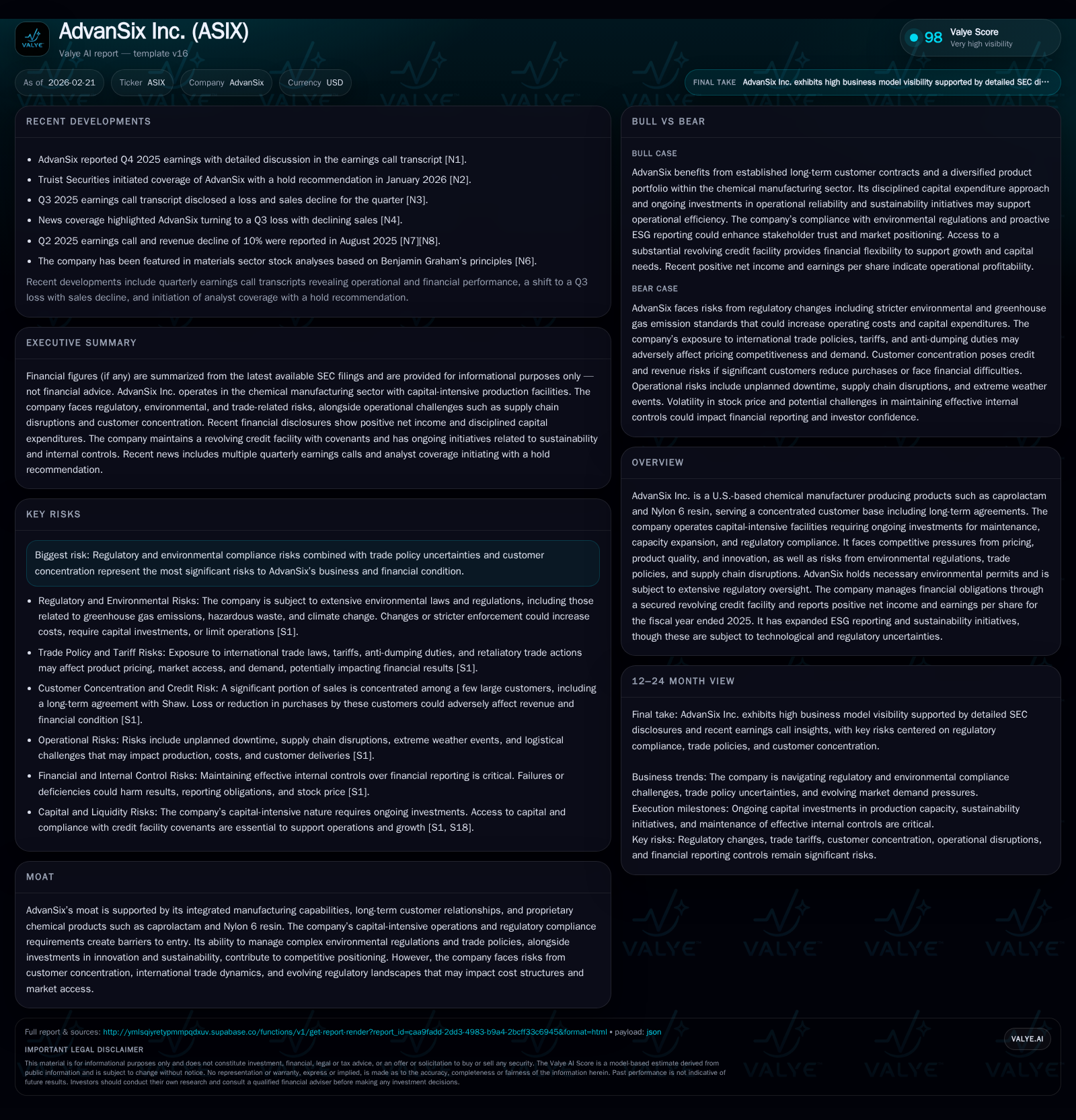
AdvanSix balances its integrated chemical manufacturing moat with capital investments and regulatory risks amid cyclical demand.
AdvanSix Inc., a U.S.-based chemical producer specializing in caprolactam and Nylon 6 resin, delivered modest net income growth of 11.6% in 2025 despite a challenging operating environment marked by cyclical industry pressures and regulatory compliance costs. The company's long-term customer contracts and integrated manufacturing facilities underpin a defensible moat but necessitate sustained capital expenditures averaging over $100 million annually. Going forward, maintaining margins amidst raw material cost volatility, environmental regulation tightening, and elevated capex needs will constrain returns, with approximately 6% ROE recorded in 2025. AdvanSix’s disciplined capital allocation includes moderate share buybacks and steady dividends, yet external factors such as trade policies and customer concentration remain material risks.
Historical Performance and Growth Drivers
AdvanSix Inc. operates as an integrated manufacturer of specialty chemicals such as caprolactam and Nylon 6 resin. This vertical integration along with long-term contracts with major customers like Shaw provide the company a competitive moat supported by barriers from capital-intensive manufacturing and regulatory compliance complexity [S7][S6].
Financially, net income declined sharply from its peak of $171.9 million in fiscal 2022 to roughly $44.1 million in 2024 before recovering to $49.3 million in fiscal year 2025 — a notable improvement reflecting some stabilization after cyclical downturns [F1]. However, the company’s net income trajectory remained below historic highs typical of peak demand periods demonstrating ongoing cyclicality characteristic of chemical commodity markets [S9].
Operating cash flows similarly mirrored earnings volatility but showed solid free cash flow generation once capital investments are considered; CFO amounted to $122.9 million in FY25 while capital expenditures were significant at $116.4 million — nearly matching operating cash generation and highlighting the high reinvestment rate required for maintenance, capacity augmentation, environmental compliance, and technological initiatives [F1][S17].
Historical performance (annual)
| FY | Net ($mm) | CFO ($mm) | Capex ($mm) | Net YoY |
|---|---|---|---|---|
| 2025 | 49 | 123 | 116 | +11.6% |
| 2024 | 44 | 135 | 134 | -19.2% |
| 2023 | 55 | 118 | 107 | -68.2% |
| 2022 | 172 | 274 | 89 |
Note: Omitted columns lack sufficient annual XBRL coverage in the provided tags (need ≥2 annual points): Rev, OpInc. Source: SEC companyfacts cache [F1].
Capital returns and efficiency (annual)
| FY | Div ($mm) | Buybacks ($mm) | FCF ($mm) |
|---|---|---|---|
| 2025 | 17 | 2 | 6 |
| 2024 | 17 | 10 | 2 |
| 2023 | 17 | 46 | 10 |
| 2022 | 15 | 34 | 184 |
Source: SEC companyfacts cache [F1].
Note: Revenue and operating income data are not available in the provided tags.
Operational Context: Cyclicality, Customer Concentration, and Regulation
The chemical industry’s inherent cyclicality deeply impacts AdvanSix’s financials through demand fluctuations affecting pricing for products like Nylon 6 resin [S9]. About 40% of sales derive from the top ten customers with long-term supply agreements anchored by Shaw, providing certain revenue stability but also exposing the company to concentration risk if purchasing patterns change or contracts are renegotiated [S7]. Competitive pressures arise from product quality expectations, global competitors’ pricing strategies, and innovation pace [S6].
Environmental regulations impose substantial compliance requirements ranging from air emissions management to stormwater discharge controls, necessitating ongoing capital investment alongside operational adaptations targeted at reducing greenhouse gas emissions under evolving rules [S9][S11][S14]. These mandates increase fixed operating costs while limiting flexibility.
Legal engagements include EPA-administered consent orders addressing self-reported violations at the Hopewell facility; management assesses no material adverse financial impact currently based on ongoing remediation efforts [S11]. However, future regulatory tightening remains a significant risk.
Trade-related risks include anti-dumping duties on products such as acetone that elevate costs or limit market access internationally versus competitors potentially benefiting from less stringent regulations or government supports abroad [S14][S24]. This creates competitive imbalances tied to regulatory environments.
Capital Structure and Liquidity Position
AdvanSix maintains liquidity supported by a senior secured revolving credit facility originally maturing October 2026 but extended through October 2027 following amendment for participating lenders covering up to $452 million of the $500 million commitment [S4][S5]. As of December 31, 2025, borrowings stood at approximately $215 million with about $284 million available credit capacity offering financial flexibility for working capital needs and debt servicing.
Financial covenants require maintaining an interest coverage ratio above three times and leverage below about 3.75 times; these were met comfortably as of fiscal year-end with all domestic tangible and intangible assets pledged as collateral securing obligations under the credit agreement [S8][S20].
Capital Allocation: Dividends and Share Repurchases
Free cash flow remains constrained due to high capital expenditure requirements despite solid operating cash flows; however, since initiating dividends in September 2021, AdvanSix has consistently distributed quarterly dividends around $0.16 per share totaling approximately $17 million annually reflecting shareholder return focus within liquidity constraints [F1][S19].
Share repurchases have decelerated markedly from over $46 million in FY23 to just $1.7 million in FY25 indicating management caution amid volatile market conditions though authorized programs remain active offering repurchase flexibility going forward [F1][S1].
Future Growth Prospects and Risks
Growth opportunities center on capacity expansions embedded within AdvanSix's sustainability-focused SUSTAIN program aimed at yield improvements, higher-margin specialty chemicals development, and enhanced environmental credentials demanded by regulators and customers alike [N1][S17].
Nonetheless, persistent cyclicality combined with volatility in raw material prices—particularly natural gas used as feedstock and energy—could constrain margin expansion despite operational gains [S9]. Escalating environmental regulations may further increase capital investment demands potentially limiting free cash flow generation.
Customer concentration remains a meaningful risk given reliance on a limited number of large buyers whose purchasing terms heavily influence volume stability; any loss or significant contract repricing could materially impact results [S7]. Trade policy uncertainties including tariffs or retaliatory measures present additional downside risks affecting international sales strategies [S24].
Monitoring quarterly updates on pricing trends, input cost developments, capital spending aligned with the company’s guidance range of roughly $75-$95 million for FY26 projects along with evolving regulatory landscapes will be important for assessing profitability margins and balance sheet strength going forward.
Summary
AdvanSix typifies a capital-intensive chemical manufacturer navigating cyclical commodity markets supported by structural moats including integrated manufacturing capabilities and enforceable long-term customer relationships amid complex regulatory environments.
Recent years show oscillating net income linked closely to sector dynamics; management’s disciplined investment approach toward compliance coupled with controlled capital expenditures has driven modest profitability recovery though free cash flow remains tight due to reinvestment needs.
Dividend payments demonstrate steady shareholder remuneration intent; however strict debt covenants combined with external headwinds related to trade policies and product pricing limit financial flexibility somewhat.
Strategic emphasis on sustainability programs alongside process innovations may offer growth pathways if successfully executed while balancing environmental stewardship — a critical challenge faced by mid-cycle maturity chemical producers today.
Disclosure: This analysis is based solely on information available from cited SEC filings and public news transcripts as of February 2026; it does not constitute investment advice.
Disclaimer: This is research-only, informational analysis and not investment advice. It may include AI-generated interpretation and general industry context. Always verify important details using primary sources.

Comments