
Essex Property Trust Advances Rental Power and Financial Flexibility in 2025
Essex Property Trust leverages geographic concentration, research-driven investment, and disciplined capital management to sustain growth in the constrained West Coast multifamily market.
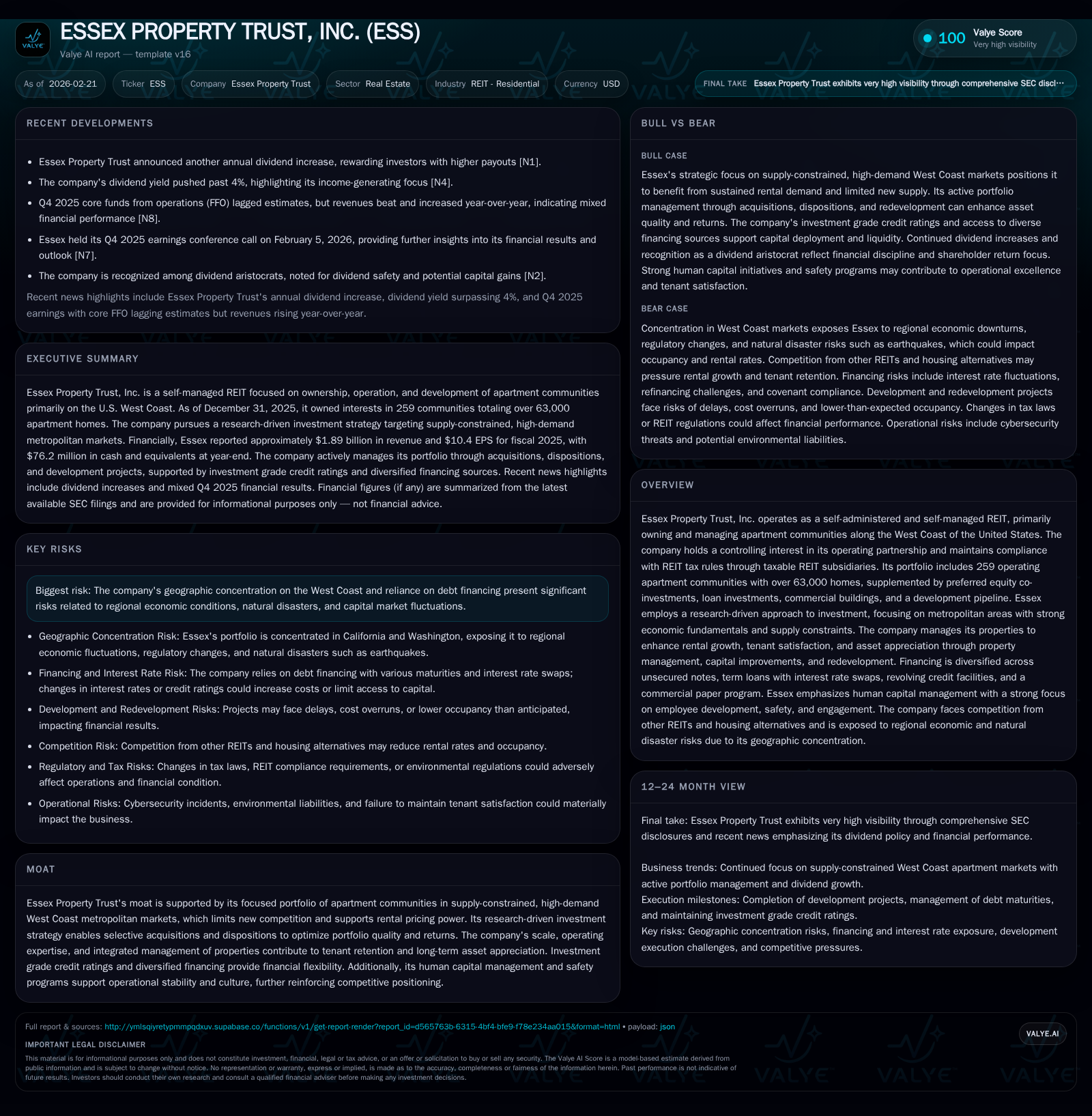
Essex Property Trust demonstrated solid revenue growth of 6.4% in 2025 driven by its focus on high-demand West Coast metros with supply constraints, supporting sustained rental pricing power. Operating income expanded by nearly 28%, reflecting operational leverage, while net income data post-2018 is unavailable but recent commentary suggests stable trends amid financing pressures. The company enhanced financial flexibility with a $1.5 billion revolver extension and new unsecured notes issuance, supporting selective acquisitions and development pipeline investments. Dividend increases were executed with no share repurchases in 2025, reflecting a cautious capital return approach amid evolving regulatory and regional risks.
Track Record of Revenue Growth and Operational Performance
Essex Property Trust recorded total revenues of approximately $1.89 billion for FY2025, representing a healthy 6.4% increase from $1.77 billion in FY2024 [F1]. This steady expansion reflects organic rental growth combined with selective acquisitions targeting supply-constrained high-demand West Coast metros. Operating income notably outpaced revenue growth with a strong jump of 27.9% from roughly $703 million to $899 million year-over-year [F1], indicating improving operational efficiency amidst inflationary pressures.
Net income figures subsequent to FY2018 are not publicly disclosed; however, recent quarterly commentary noted broadly flat net income performance contrasting with underlying operating momentum [N10]. Operating cash flow demonstrated resilience with marginal YoY growth of approximately 0.6%, reaching over $1.07 billion [F1], underscoring stable cash generation capacity essential for dividends and capital expenditures. Capital expenditure details were not available in provided disclosures limiting reinvestment analysis [F1].
Historical performance (annual)
| FY | Rev ($mm) | CFO ($mm) | OpInc ($mm) | Rev YoY |
|---|---|---|---|---|
| 2025 | 1887 | 1074 | 899 | +6.4% |
| 2024 | 1774 | 1068 | 703 | +6.3% |
| 2023 | 1669 | 980 | 584 | +3.9% |
| 2022 | 1607 | 976 | 595 |
Note: Omitted columns lack sufficient annual XBRL coverage in the provided tags (need ≥2 annual points): Net, Capex, Div, FCF, ROE%. Source: SEC companyfacts cache [F1].
Capital returns and efficiency (annual)
| FY | Buybacks ($mm) |
|---|---|
| 2025 | 0 |
| 2024 | 0 |
| 2023 | 96 |
| 2022 | 190 |
Source: SEC companyfacts cache [F1].
Note: Net income post-2018 not disclosed; Capex data unavailable.
Research-Driven Market Focus: Geographic Strengths and Supply Constraints
Essex’s portfolio spans approximately 259 apartment communities comprising over 63,000 homes predominantly located along the West Coast urban corridor from Southern California through Northern California to the Seattle metropolitan area [S1][S12]. The company’s investment thesis hinges on this geographic concentration benefiting from intrinsic supply constraints — including scarce developable land due to terrain or protected areas, stringent municipal growth controls like urban growth boundaries, and lengthy permitting cycles [S13]. These barriers restrict competitive new supply inflows enabling Essex to command sustainable rental pricing power across stabilized assets.
The company employs ongoing market intelligence assessing demographic shifts, proximate job growth metrics, median incomes, and housing affordability relative to ownership costs [S13]. This research-driven approach directs capital towards markets with strong economic prospects while maintaining discipline against inflated valuations or emerging regulatory challenges.
This strategy supports high occupancy levels driven by tenant demand anchored in quality location factors and limited alternative housing options — underpinning robust same-store NOI growth potential.
Insights from Recent Earnings: Revenue Beats Yet FFO Challenges
Q4 fiscal results showed revenues beating consensus estimates while core Funds From Operations (FFO), a critical REIT metric excluding non-cash items, lagged expectations [N10][N14]. Challenges included lease renewal impacts amid macroeconomic uncertainty alongside pressures from expanding rent control ordinances prevalent in California markets.
Expense inflation—especially labor wages for property management and maintenance supplies—compressed margins despite top-line strength [N10]. Sensitivity to eviction regulations and legal scrutiny over revenue management software also introduced volatility into cash flow predictability even as asset values appreciate due to supply tightness [S19].
2026 Outlook: Growth Prospects and Potential Headwinds
Essex’s development pipeline includes one consolidated project comprising roughly 543 units plus predevelopment sites totaling estimated costs near $358 million intended to add inventory within core markets demonstrating strong absorption fundamentals [S8]. Selective acquisitions focus on properties suitable for repositioning or located in submarkets with favorable demographics [S21].
Ongoing challenges include:
- Regional economic cyclicality linked to tech sector volatility impacting Seattle;
- Escalating regulatory risks from expanding rent control laws beyond major Californian cities;
- Natural disaster exposures like earthquakes requiring layered insurance coverage;
- Inflation-driven contractor cost increases potentially compressing redevelopment margins;
- Financing environment uncertainties affecting cost and availability of capital at scale [S24].
These factors necessitate calibrated capital deployment prioritizing portfolio enhancement while preserving liquidity buffers.
Capital Structure, Financing Flexibility, and Credit Profile
In 2025 Essex expanded its revolving credit facility from $1.2 billion to $1.5 billion with maturity extended to January 2030 plus two optional six-month extensions exercisable by the company; interest rates are SOFR plus approximately +0.775% based on credit rating tiers [S4][S5]. A commercial paper program allowing up to $750 million issuance backed by this revolver enhances short-term liquidity access without incurring long-term debt.
Long-term debt includes senior unsecured notes totaling $350 million due February 2036 bearing fixed coupons near 4.875%, issued primarily for refinancing April 2026 maturities and general corporate purposes including acquisitions [S5][S7]. Interest rate swaps hedge portions of variable rate term loans reducing cost volatility; Moody’s Baa1 and S&P BBB+ ratings confirm investment grade status supported by consistent EBITDA coverage ratios [S7][S9].
Covenant compliance remains strong across all unsecured facilities and bond indentures minimizing default risk while preserving capacity for opportunistic debt issuances funding accretive expansion.
Dividend Policy, Share Repurchase Activity, and Shareholder Returns
Consistent with REIT tax rules requiring substantial taxable income distribution, Essex increased its annual dividend pushing yield above four percent early in 2026 reflecting confidence in cash flow sustainability despite margin pressures [N3][N7]. Although authorized buyback plans permit up to $500 million repurchases since September 2022, no shares were repurchased during FY2025 leaving roughly $303 million available but unused as management prioritizes balance sheet strength amid regulatory uncertainties impacting multifamily economics [S6][N3].
This cautious capital return approach balances shareholder distributions with liquidity preservation given the evolving regulatory landscape.
Risks from Regional Concentration and Regulatory Environment
Concentration along the West Coast exposes Essex to localized economic risks tied especially to technology sector employment fluctuations around San Francisco Bay Area and Seattle metropolitan regions [S11][S15][S19]. Natural catastrophe risks primarily from earthquakes are mitigated partially through seismic insurance arranged via proprietary captive entities alongside standard policies; however residual uninsured loss risk remains material given potential impact magnitude [S18].
Expanding rent stabilization laws impose downward pressure on achievable rents restraining upside leasing spreads crucial for FFO growth trajectories; eviction moratoria may delay turnover increasing vacancy risks temporarily damping margins [S15][S28]. Legislative complexity also extends into compliance burdens related to tenant data privacy regulations amidst rising cybersecurity concerns managed via vendor partnerships but still posing vulnerabilities [S24][S26][S29].
Litigation risks related to fair housing practices or algorithmic pricing software may affect reputation or operational costs further heightening risk profile per SEC disclosures.
Disclaimer: This report is for informational purposes only; it does not constitute investment advice or recommendations regarding Essex Property Trust's securities or any other financial products or strategies.
Disclaimer: This is research-only, informational analysis and not investment advice. It may include AI-generated interpretation and general industry context. Always verify important details using primary sources.

Comments