
Helio Corp’s Quest for Scalable Space Hardware and Solar Power Innovation
Helio leverages its extensive space mission heritage to pursue a transition into space-based solar power amid fiscal and execution challenges.
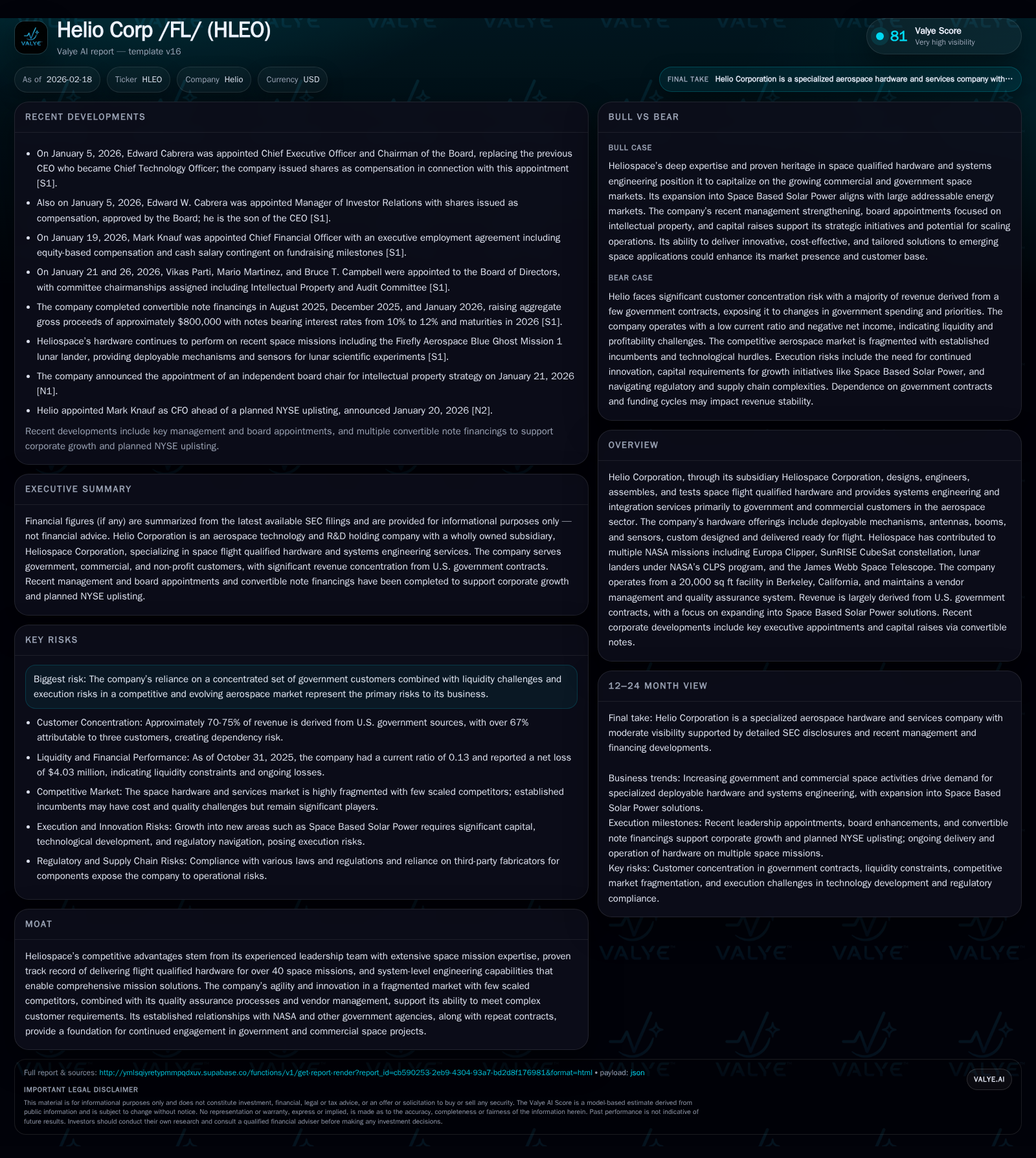
Helio Corporation, through its subsidiary Heliospace, has established a niche in designing and delivering flight-qualified hardware for over 40 space missions, predominantly under U.S. government contracts. Despite a strong technological foundation and deep systems engineering expertise, the company faces significant liquidity pressures and operating losses as it pivots towards space-based solar power (SBSP), a capital-intensive frontier. Growth hinges on successful SBSP demonstrations by 2030 and diversification beyond government clients, while risks from customer concentration and competitive dynamics persist.
Heliospace’s History of Contract Success and Product Excellence
Heliospace Corporation operates as Helio Corp’s wholly owned subsidiary focusing on aerospace hardware engineering for government and commercial markets [S1], [S7]. The company has contributed hardware to over 40 space flight missions including major NASA programs such as the James Webb Space Telescope (JWST), Hubble servicing missions, lunar landers under NASA's Commercial Lunar Payload Services (CLPS) program, the Europa Clipper mission, and SunRISE CubeSat constellation integration [S5], [S7].
Its leadership team brings decades of experience with system-level design expertise spanning structural, thermal, electromagnetic, optical modeling, integration & test services—forming a critical competitive moat [S5], [S10]. The company has received recognition including NASA JPL subcontractor awards linked to JWST contributions [S5]. Operating out of a 20,000 sq ft Berkeley facility with clean rooms and thermal vacuum chambers supports reliable production scaling [S20].
Project engagements vary widely in scale—from $100K up to $10M+—reflecting its ability to deliver custom end-to-end solutions integrating hardware design with mission architecture [S6].
Historical performance (annual)
| FY |
|---|
| 2025 |
Note: Omitted columns lack sufficient annual XBRL coverage in the provided tags (need ≥2 annual points): Rev, Net, CFO, OpInc, Capex, Div, Buybacks, FCF, ROE%. Source: SEC companyfacts cache [F1].
Note: Capital expenditure data is not available in provided tags.
Financial Performance: Scale Constraints Amid Operating Losses
For the fiscal year ended October 31, 2025, Helio reported revenues near $3.9 million alongside an operating loss of approximately $3.7 million and net loss exceeding $4 million [F1]. The negative operating cash flow of around $2.07 million underscores ongoing cash burn tied to R&D investments and operational expenses amid limited top-line growth [F1], [S29].
A current ratio of roughly 0.13 indicates acute short-term liquidity pressures given current liabilities near $4.5 million dwarfing current assets under $600K [F1], [S14]. This financial profile reflects challenges typical for emerging aerospace hardware firms transitioning toward capital-intensive innovation.
Absence of disclosed capex suggests investments may be expensed or minimal physical asset expansion is underway currently [F1]. Fixed costs related to quality assurance processes, skilled personnel for flight hardware assembly/testing, and R&D initiatives—especially SBSP-related—contribute materially to losses [S20].
Customer Concentration: Heavy Reliance on U.S. Government Contracts
Approximately 70-75% of Helio’s revenues derive directly or indirectly from U.S. government sources primarily NASA through IDIQ prime contracts or subcontracts [S4], [S6]. Three principal customers accounted for more than two-thirds of total revenue in FY2024-FY2025 periods; one major NASA prime contractor alone contributed about 31% in FY2025 [S6].
This concentration exposes Helio to political budget cycles affecting contract renewals and funding levels alongside pricing pressures due to government fee caps under FAR policies [S11]. Compliance audits mandated by U.S. government contracts increase overhead costs.
While Heliospace is gradually expanding commercial engagements such as Blue Origin lunar lander projects, pace remains constrained by long qualification timelines typical in aerospace sectors dominated by entrenched incumbents [S7], [S9].
Strategic Growth via Space-Based Solar Power (SBSP)
Helio aims to leverage its hardware expertise into the emerging space-based solar power market—a novel clean energy source offering baseload capacity beyond terrestrial renewables' limitations [S8], [S10]. SBSP involves collecting solar energy outside Earth's atmosphere using modular deployable photovoltaic arrays like the internally developed "HelioSat" system and transmitting power wirelessly back to Earth.
The global electricity market exceeds $2 trillion annually with accelerated demand driven by electrification trends notably in data centers; Helio targets delivering electricity at an estimated Levelized Cost Of Energy near $0.10/kWh over a 20-year lifespan—potentially capturing significant future demand if technological milestones are met [S8].
Milestones include demonstration flights planned by 2030 followed by larger capacity deployments later in the decade enabled by reduced launch costs and innovations in payload integration and wireless power transmission technologies [S8].
Competitive Landscape: Balancing Agility Against Scale Giants
The aerospace hardware sector remains fragmented with legacy incumbents often challenged by bureaucratic cost control issues alongside small boutique firms constrained by capacity limitations [S5].
Heliospace differentiates itself through integrated system-level engineering across entire mission chains combined with nimble custom hardware manufacturing capabilities—a hybrid approach uncommon among competitors focused solely on components or large-scale but inflexible production lines [S5], [S10].
This positions Heliospace well to serve emerging commercial applications requiring flexible turnkey solutions.
Capital Structure & Allocation: Cash Constraints Amid Financing Efforts
As of October 31, 2025, Helio held approximately $7K in cash against current liabilities near $4.5 million yielding a precarious current ratio (~0.13) highlighting solvency concerns in the near term [F1], [S14], [S29].
Recent convertible promissory notes totaling several hundred thousand dollars issued during late 2025/early 2026 provide working capital but bear interest rates between 10-12%, including default provisions that could escalate costs significantly if triggered ([S14],[S24],[S26]).
No dividends or share repurchases have been declared or paid; capital allocation focuses primarily on funding R&D activities essential for advancing SBSP development rather than shareholder returns at this stage ([F1],[S16],[S21],[S27]).
Reported shareholder equity was negative approximately -$4 million reflecting accumulated losses; thus conventional Return on Equity metrics are not meaningful currently but indicate financial strain ([F1]).
Upcoming Milestones & Management Initiatives Driving SBSP Progression
Key upcoming milestones include continued Phase II Small Business Innovation Research program developments around proprietary QuasiStatic Release Mechanism technology critical for reliable array deployment expected throughout calendar year 2026 ([N1],[S3]). The appointment of Oliver Fildes as Lead Systems Engineer aims to accelerate systems engineering efforts specific to SBSP initiatives ([N2]).
Commercial product pipeline expansions target mid-2026 advances beyond core deployables into radar/RF sensing payloads aligned with Earth observation applications broadening addressable markets outside traditional government clients ([N2],[S15]). Monitoring scheduled launch deliveries supporting demonstration validation remains important before larger-scale financing commitments can be secured ([N1]).
A potential uplisting from OTCID marketplace to NYSE would materially improve access to liquidity enabling broader investor engagement—a crucial factor given current trading volume constraints ([N1]).
Risk Factors: Government Dependence & Technological Execution Challenges
Significant risks include dependence on a narrow set of U.S. government agencies making revenues vulnerable to federal budget fluctuations compounded by shifting political priorities impacting NASA funding explicitly acknowledged in risk disclosures ([S11]). Regulatory compliance complexity under FAR plus export controls via ITAR/EAR frameworks impose ongoing overhead while noncompliance risks suspension or penalties ([S11],[S22]).
Technological risks inherent in scaling novel SBSP payloads encompass ensuring durability against micrometeoroid impacts/radiation exposure plus developing efficient wireless power transmission systems capable of safe terrestrial delivery—daunting challenges even for well-resourced incumbents ([S8]).
Competitive consolidation trends may intensify pricing pressure from larger aerospace firms while smaller niche providers could compress margins further ([S5]). Reduced disclosure obligations as a smaller reporting company limit public transparency into operational contingencies necessitating cautious appraisal amidst uncertainty ([S19]).
Disclaimer: This analysis is based solely on publicly available SEC filings and company disclosures as cited without provision of investment advice or stock recommendations.
Disclaimer: This is research-only, informational analysis and not investment advice. It may include AI-generated interpretation and general industry context. Always verify important details using primary sources.

Comments