
Insulet Corp Accelerates Innovation and Expands Market Share with Omnipod Platform
Omnipod’s proprietary tubeless insulin delivery and expanded manufacturing support robust revenue growth amid strategic capital deployment and supply risks.
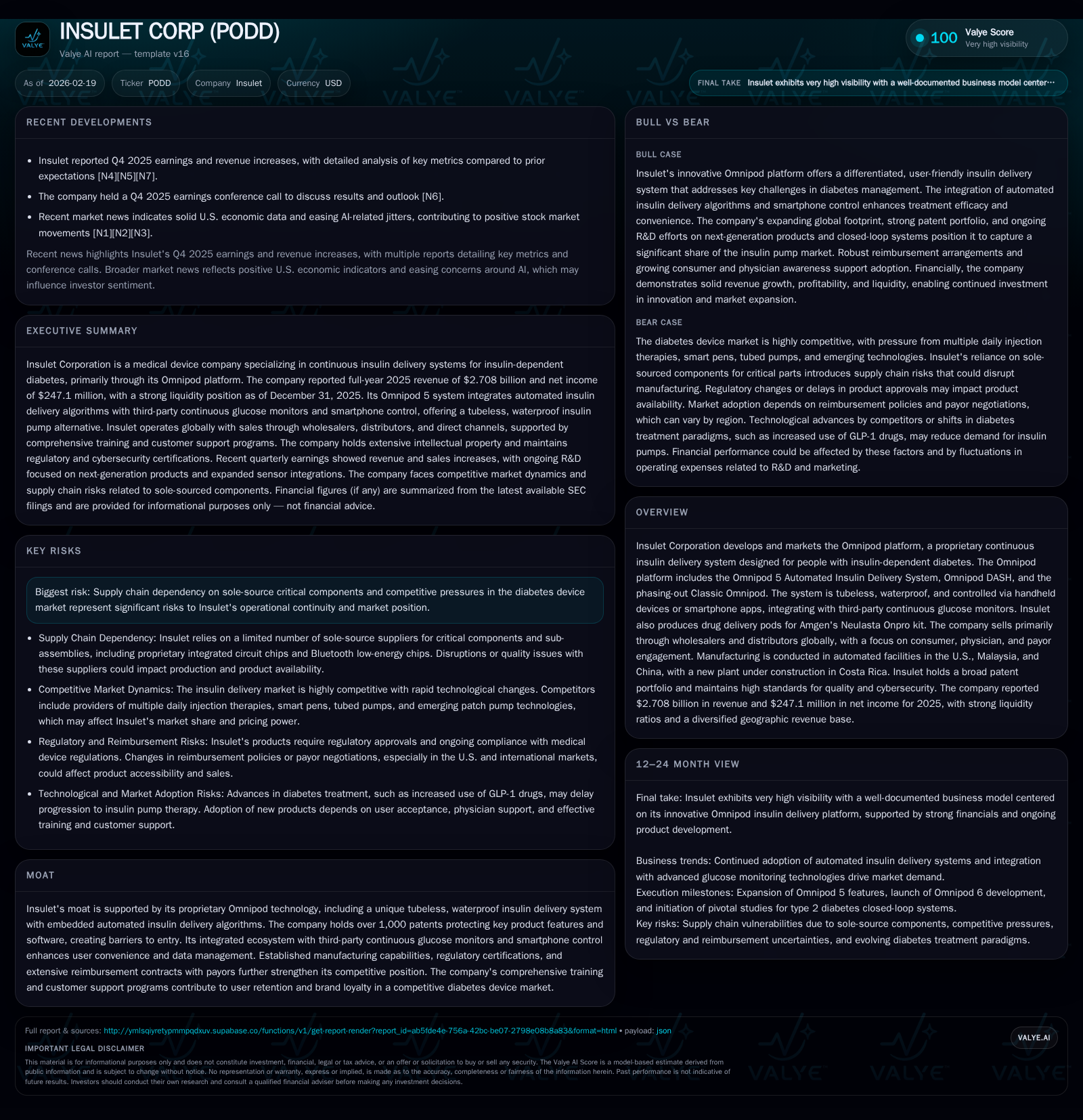
Insulet Corp demonstrated robust fiscal 2025 growth, with revenues up 30.7% to $2.71 billion driven by its Omnipod platform's expanding adoption domestically and internationally. Operating income surged 53.4% to $474 million, while net income declined 40.9% due to nonrecurring debt extinguishment costs. Strategic investments in automated manufacturing capacity, including a new Costa Rica facility, underpin long-term operational leverage. Capital structure optimization included debt refinancing and interest rate hedging, reducing leverage to a 39% debt-to-capital ratio. The company returned $59.6 million in share repurchases under an extended buyback program, maintaining a no-dividend policy. Risks involve sole-source component dependency and competitive pressures in diabetes care markets.
Innovative Legacy: Omnipod Platform Drives Years of Rapid Growth
Insulet Corporation’s evolution hinges on its pioneering Omnipod platform—a suite of tubeless, waterproof continuous insulin delivery devices acclaimed for their ease of use and integration within diabetic care ecosystems [S1][F1]. Comprising the flagship Omnipod 5 Automated Insulin Delivery System, the Omnipod DASH system, and phasing out the Classic Omnipod, this platform embodies breakthrough technology including embedded automated insulin delivery algorithms calibrated for real-time glycemic control.
Interoperability stands out as a core moat attribute: Omnipod devices seamlessly integrate with third-party continuous glucose monitors (CGMs) and smartphone apps—enhancing patient convenience and fostering adherence through data-driven insights [S1]. This interconnected system expands beyond diabetes care with drug delivery pods for Amgen’s Neulasta Onpro kit, underscoring Insulet’s platform adaptability.
Insulet’s patent portfolio is expansive—comprising over 1,000 granted patents—that shield critical innovations ranging from pod design features to software elements controlling insulin dosing algorithms. This intellectual property barrier limits competitor encroachment while supporting regulatory certifications vital for global sales [S1]. Concurrently, robust customer engagement initiatives including comprehensive training programs buttress retention rates amidst intensifying diabetes device market competition.
Financial Momentum: Revenue and Earnings Trends Through FY2025
The fiscal year 2025 manifested pronounced financial momentum for Insulet. Total revenues surged to $2.71 billion representing a robust 30.7% increase over $2.07 billion reported in 2024 [F1][N1][N2]. This acceleration reflects widespread adoption of the Omnipod 5 system domestically and internationally alongside steady demand for legacy products.
Operating income demonstrated even more pronounced leverage, climbing by 53.4% year-over-year to approximately $474 million (vs $309 million prior year). However, net income declined by nearly 41% to $247 million primarily due to a $124 million loss related to extinguishing convertible senior notes alongside nonrecurring expenses [F1][S6].
Operating cash flow exhibited healthy growth at $569 million (+32.3%), supporting continued investment capacity. Capital expenditures expanded sharply by 53.4% to $192 million in alignment with manufacturing scale-up objectives.
Historical performance (annual)
| FY | Rev ($bn) | Net ($mm) | CFO ($mm) | OpInc ($mm) | Rev YoY | Net YoY |
|---|---|---|---|---|---|---|
| 2025 | 2.7 | 247 | 569 | 474 | +30.7% | -40.9% |
| 2024 | 2.1 | 418 | 430 | 309 | +22.1% | +102.8% |
| 2023 | 1.7 | 206 | 146 | 220 | +30.0% | +4384.8% |
| 2022 | 1.3 | 5 | 119 | 38 |
Note: Omitted columns lack sufficient annual XBRL coverage in the provided tags (need ≥2 annual points): Capex, Div, Buybacks. Source: SEC companyfacts cache [F1].
Capital returns and efficiency (annual)
| FY | FCF ($mm) | ROE% |
|---|---|---|
| 2025 | 378 | 16.3 |
| 2024 | 305 | 34.5 |
| 2023 | 70 | 28.2 |
| 2022 | -4 | 1.0 |
Source: SEC companyfacts cache [F1].
Note: Prior years’ YoY percentages omitted due to incomplete data.
Strategic Investments: Manufacturing Expansion and R&D Focus
Capex commitments escalated sharply (+53.4%) driven by Insulet’s strategic investment in production capabilities—including construction of an advanced manufacturing facility in Costa Rica tailored for high automation levels [S18][S1]. This expansion aims to bolster operational leverage by reducing per-unit costs as volumes scale and mitigating supply chain concentration risk across domestically sourced plants in the U.S., Malaysia, and China.
R&D remains a key pillar fueling product pipeline advancement, focusing on refining algorithmic calibration tied to automated insulin delivery efficacy while enhancing embedded software security measures compliant with evolving cybersecurity standards [S18]. These activities empower technology differentiation essential amidst rapid innovation cycles.
Capital Structure Dynamics: Leverage, Liquidity, and Debt Management
Insulet has prudently managed capital structure dynamics throughout FY2025; total debt outstanding fell meaningfully from approximately $1.38 billion at end-2024 to around $949 million as of December ’25 [S4][S5][F1]. The company restructured debt instruments by issuing $450 million senior unsecured notes at a fixed coupon of 6.5%, concurrently repurchasing substantial portions of convertible notes at a premium—incurring recognized losses but reducing refinancing risk [S6].
Interest rate risk mitigation was enhanced via swaps converting $460 million of floating-rate term loan balances into fixed-rate obligations; this hedging strategy limits earnings volatility from SOFR fluctuations [S4]. The resultant debt-to-capital ratio improved to ~39%, coupled with a cash balance exceeding $700 million maintaining ample liquidity headroom [S4][F1].
Shareholder Returns: Executing Buybacks Without Dividends
In line with management’s capital allocation philosophy prioritizing reinvestment into growth while addressing shareholder dilution from stock-based compensation, Insulet executed share repurchases totaling approximately $59.6 million during FY2025 under an authorized program extended through end-2027 with an increased cap of up to $475 million [S9][F1].
Currently, the company does not pay dividends but retains earnings primarily for funding R&D and operational expansions—balancing between preserving financial flexibility and rewarding shareholders via equity buybacks designed to enhance per-share metrics [S9][F1].
Market Position and Competitive Moat: Patents, Integration, and Ecosystem
Insulet's holistic moat encompasses the combination of its unique pod design—tubeless, waterproof—and its sophisticated automated insulin delivery algorithm embedded within the Omnipod system software [S1]. The breadth of intellectual property protects both hardware innovation and software codebases governing insulin dosing decisions.
Seamless integration capability with multiple third-party continuous glucose monitors exemplifies strategic partner ecosystems crucial for device interoperability—a key barrier for new entrants lacking regulatory approvals or technological breadth [S1]. Payer contracting rigor also reinforces market access advantages as reimbursement landscapes tighten globally.
Risks Ahead: Supply Chain Dependencies and Margin Pressures
Critical risks center on reliance upon sole-sourced components fundamental to pod manufacturing that may lead to operational bottlenecks or production disruptions [S7]. Global semiconductor shortages or logistics disruptions could amplify these vulnerabilities.
Furthermore, pricing pressures arising from intensified competition among diabetes care device manufacturers persistently threaten gross margins; coupled with increasing investments into clinical education programs required for user onboarding compliance adds cost layers potentially compressing near-term profitability [S7][S10].
Outlook Signals: Upcoming Milestones and Key Performance Indicators to Monitor
While explicit forward guidance remains limited in public disclosures [N3][N6][N7], key performance indicators warrant close attention:
- Pace of ramp-up utilization at the Costa Rica plant – fundamental for meeting projected volume demand with improved cost efficiency.
- Adoption curves of next-generation Omnipod versions (e.g., updates beyond Omnipod DASH) which dictate future revenue streams.
- Regulatory developments impacting payer reimbursement frameworks that influence net selling prices.
- Operational metrics linked to supply chain stability addressing sole-source parts procurement effectiveness. Monitoring these metrics will provide clearer insight into whether operational scalability can sustain top-line growth without margin dilution amid evolving competitive dynamics.
This analysis consolidates publicly available SEC filings including the recent FY2025 Form 10-K/Q reports along with verified news sources as cited throughout ([F1],[N#],[S#]). It is intended strictly for informational purposes without constituting investment advice or recommendations.
Disclaimer: This is research-only, informational analysis and not investment advice. It may include AI-generated interpretation and general industry context. Always verify important details using primary sources.

Comments