
Wingstop’s Expansion and Brand Strength Power Record 2025 Performance
Wingstop’s fiscal 2025 growth reflects aggressive franchising, strong brand differentiation, and digital sales leadership amid franchisee traffic challenges.
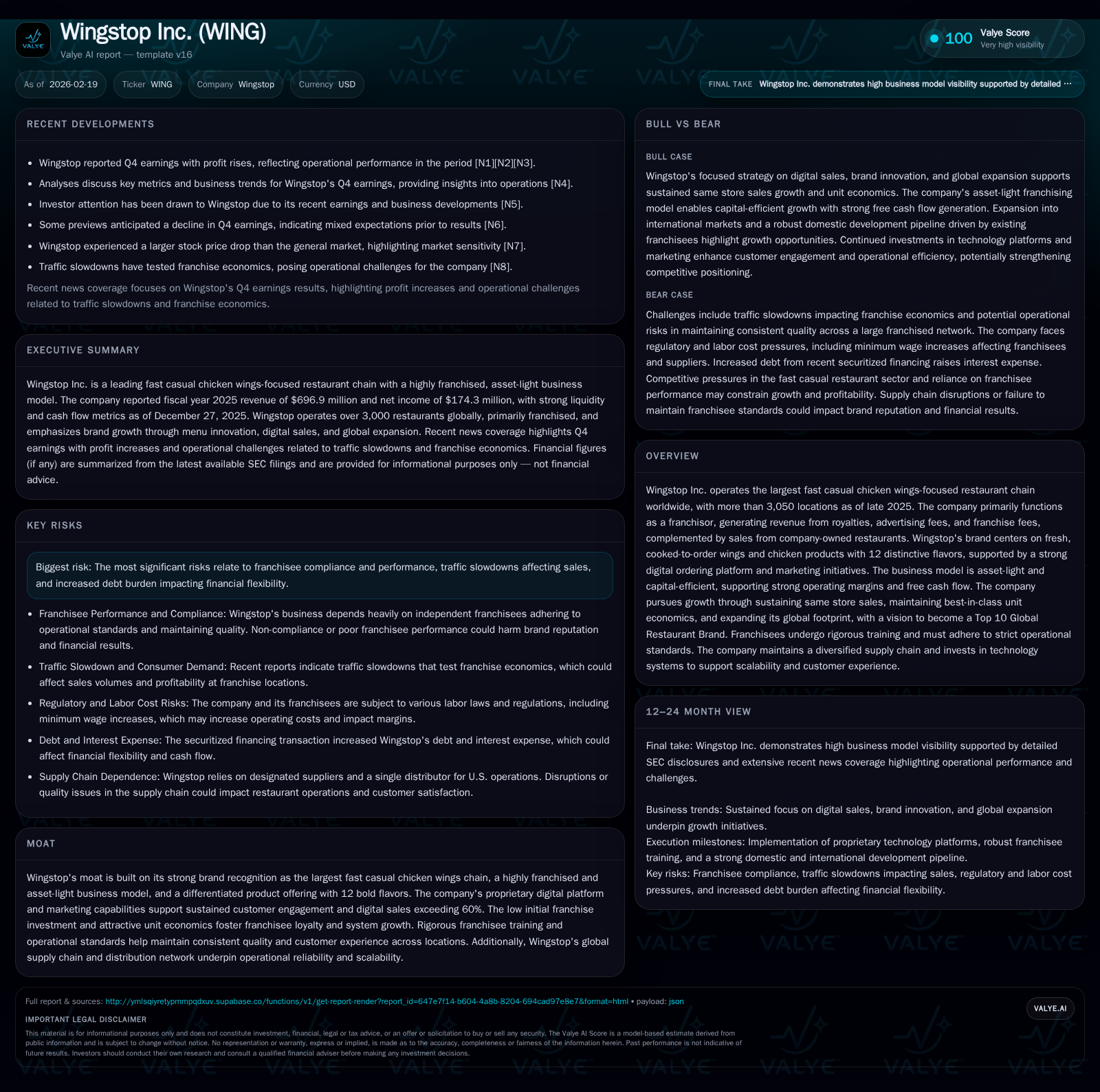
Wingstop Inc., the largest fast casual chicken wings chain globally, marked fiscal 2025 with a 19.2% increase in system-wide units and a 12.1% rise in system-wide sales, driven by its asset-light franchised model and expanding international footprint. Digital sales surged to over 73% of system-wide revenues, supported by Wingstop’s differentiated 12-flavor offering and proprietary marketing platform. Domestic franchise same-store sales declined slightly, offset by gains in company-owned locations, revealing nuanced operational dynamics. Despite heightened debt from recent securitized notes issuance and franchisee traffic pressures, Wingstop generated substantial free cash flow and returned significant capital through dividends and share repurchases. The company’s strategic focus on global expansion and sustaining best-in-class unit economics positions it to pursue its ambition to become a Top 10 Global Restaurant Brand.
Historic Surge in Unit Growth and System-Wide Sales: Tracking Wingstop’s Expansion
As of December 27, 2025, Wingstop operated a system of 3,056 restaurants worldwide — a robust increase of 19.2% from the prior year driven largely by franchisee expansion (493 net new unit openings) [S1][F1]. Of these locations, approximately 98% are franchised (2,999 restaurants), including a rapidly growing international base of 470 outlets across 18 countries and U.S. territories [S1][S7]. Company-owned units remain limited at just 57 locations domestically.
This asset-light franchised model underpins Wingstop's highly capital-efficient growth strategy: new units represent low initial investments (~$580K excluding real estate costs) which yield attractive unit economics — notably targeting unlevered cash-on-cash returns exceeding 70% as early as the second operational year [S9]. The domestic average unit volume (AUV) settled around $2.0 million for FY2025 [S1], reflecting strong per-unit sales performance notwithstanding macroeconomic pressures affecting traffic.
System-wide sales climbed sharply by 12.1% year-over-year to approximately $5.3 billion [S1], fueled primarily by the expanded footprint but also supported by steady same-store sale initiatives in select segments [F1]. This scaling translates directly into higher royalty revenue streams (which rose to $292 million), advertising fees ($248 million), and franchise fee income ($6.5 million) [S14]. The remarkable breadth of growth both domestically and internationally illustrates the scalability of Wingstop’s franchise-driven model.
Digital Sales Leadership and Product Differentiation as Growth Catalysts
Wingstop has spearheaded digital transformation within fast casual dining, with digital ordering comprising an impressive 73.2% of system-wide sales in FY2025 [S1], surpassing industry averages significantly — an important driver behind elevated digital AUV contribution metrics [N10]. Proprietary customer relationship management systems paired with rigorous digital marketing campaigns designed for granular audience targeting support this leadership position.
The brand's core product differentiation rests firmly on its portfolio of twelve bold wing flavors that consistently drive repeat visits across various dining occasions — from quick pick-up to family-sized orders [S20]. This flavor variety coupled with operational standardization facilitated through intensive franchisee training programs bolsters quality consistency across thousands of locations, reinforcing brand loyalty [S20][N10].
Additionally, enhancements in menu offerings and flexible ordering options (dine-in, carryout, delivery) engage multiple dayparts effectively.
Mixed Same-Store Sales Dynamics: Company-Owned vs. Franchised Stores
While overall system-wide sales grew swiftly due to expansion, domestic same-store sales faced headwinds with a reported decline of about -3.3% year-over-year for franchised outlets during fiscal year 2025 [S1][N9]. In contrast, company-operated stores witnessed a modest uptick (+2.6%) indicating operational agility in managed units.
The slump in franchisee store traffic highlights sector-wide concerns regarding consumer behavior shifts and localized market competition [N9]. This traffic slowdown exerts pressure on franchise economics since royalties and advertising fee revenues are percentage-based on gross sales—potentially constraining margins if prolonged.
Management attributes part of this downturn to macroeconomic factors impacting discretionary spending but emphasizes ongoing initiatives aimed at reinvigorating demand via targeted national advertising funded through the Wingstop Advertising Fund (Ad Fund), which commands contributions equalling roughly 5.5%+ of franchise gross sales [S26].
Exploring Challenges: Franchisee Traffic Slowdown and Operational Risks
Franchisee compliance remains critical for preserving brand standards amidst rapid scaling [S19]. The Company's franchisee training regimen mandates completion before openings alongside strict adherence to operational procedures — a necessary safeguard given the vast proportion (~98%) of franchised restaurants responsible for core revenue generation [S24].
Traffic slowdowns raise additional risks not only in margin compression but also in potential covenant constraints related to debt servicing amid increased leverage following the $500 million Class A-2 Senior Secured Notes issued in late 2024 [S4][S6][S8]. With total long-term debt around $1.21 billion—including prior notes from 2020 and 2022—the company remains below critical leverage thresholds (<5x) allowing suspension of principal payments aligned with debt agreement provisions [S10]. Nonetheless, careful liquidity management is imperative given these obligations alongside continued dividends and aggressive share repurchasing activity.
Capital Structure, Cash Flow Generation, and Shareholder Returns
Wingstop demonstrated healthy capital efficiency in FY2025 with net cash provided by operating activities totaling approximately $153 million despite a slight year-over-year decrease versus FY2024 ($157.6 million) attributed mainly to advertising fund payment timing differences [S4][F1]. Capital expenditures were controlled at roughly $47 million (-8.6%), primarily directed toward technology platforms supporting digital operations and some property investments [S12][F1]. Resultant free cash flow approximated $105.6 million — reinforcing capacity for capital returns.
On returns measures, while reported shareholders' equity is negative due to accumulated treasury stock from buybacks totaling approximately $222 million during FY2025 (and roughly $630 million cumulatively since program inception), net income surged by over +60% YoY reaching $174 million bolstering return metrics per share despite share reductions [F1][S15]. Dividends paid rose modestly totaling about $32 million for the year with quarterly payments increased midyear reflecting confidence in cash flows [S23].
Debt profile consists chiefly of fixed-rate senior secured notes with staggered maturities (notably March ‘29 for the ‘22 Notes and December ‘27 for the ‘20 Notes plus anticipated repayment dates stretching into early thirties for newer issues), structured through bankruptcy-remote subsidiaries optimizing financing costs but requiring vigilant covenant compliance monitoring [S8][S13][S17]. No borrowings were outstanding under revolving facilities at FY-end signaling conservative liquidity posture.
Strategic Outlook: Global Expansion Ambitions and Long-Term Growth Objectives
Wingstop frames its growth trajectory around becoming a Top-10 global restaurant brand — eyeing more than double the current store count domestically (from ~2,586 franchised U.S locations as of year-end) plus international growth beyond its existing footprint spanning nearly five hundred international franchised units across diverse markets [S20][S24].
The pipeline comprises virtually exclusive franchises from existing owners underpinning strong internal franchisor-franchisee relations essential for sustained rollout velocity [S24]. Continued menu innovations supported by data-driven marketing aim at sustaining long-term same-store sales improvement despite near-term promotional cadence shifts addressing traffic softness noted earlier.
Technological investments advancing enterprise resource planning (ERP), human capital management systems along with cloud migration enhance scalability positioning while global supply chain integration ensures consistency amid international rollouts—a critical enabler given chicken costs compose over half total operating purchases annually (~57%) necessitating tight vendor controls [S11][S21][F1].
Key Financial Metrics Overview: What Investors Should Watch
The table below distills Wingstop’s last three fiscal years' financial performance:
Historical performance (annual)
| FY | Rev ($mm) | Net ($mm) | CFO ($mm) | OpInc ($mm) | Rev YoY | Net YoY |
|---|---|---|---|---|---|---|
| 2025 | 697 | 174 | 153 | 179 | +11.4% | +60.3% |
| 2024 | 626 | 109 | 158 | 166 | +36.0% | +54.9% |
| 2023 | 460 | 70 | 122 | 113 | +28.7% | +32.5% |
| 2022 | 358 | 53 | 76 | 92 |
Note: Omitted columns lack sufficient annual XBRL coverage in the provided tags (need ≥2 annual points): Capex. Source: SEC companyfacts cache [F1].
Capital returns and efficiency (annual)
| FY | Div ($mm) | Buybacks ($mm) | FCF ($mm) |
|---|---|---|---|
| 2025 | 32 | 222 | 106 |
| 2024 | 29 | 315 | 106 |
| 2023 | 25 | 125 | 81 |
| 2022 | 141 | 52 |
Source: SEC companyfacts cache [F1].
Note: Operating income YoY calculated comparing consecutive years where data available; some variations due to rounding
Key near-term factors warranting close monitoring include sustained trajectory of domestic franchise same-store sales recovery amid competitive pressures; effective management of debt covenants given sizable long-term obligations; continuous enhancement of digital platform capabilities maintaining or growing >70% digital penetration; progress on international market penetrations aligned with margins expansion; and execution velocity against franchise recruitment targets without diluting operational quality standards.
Disclaimer: This analysis is prepared solely for informational purposes based on public disclosures as of February 19, 2026; it does not constitute investment advice or recommendations.
Disclaimer: This is research-only, informational analysis and not investment advice. It may include AI-generated interpretation and general industry context. Always verify important details using primary sources.

Comments