
Oshkosh Corp’s Revenue Growth Offset by Profitability Pressure and USPS NGDV Ramp Challenges
Oshkosh Corporation confronts cyclical end markets and production ramp risks while leveraging diversified segments and advanced tech integration.
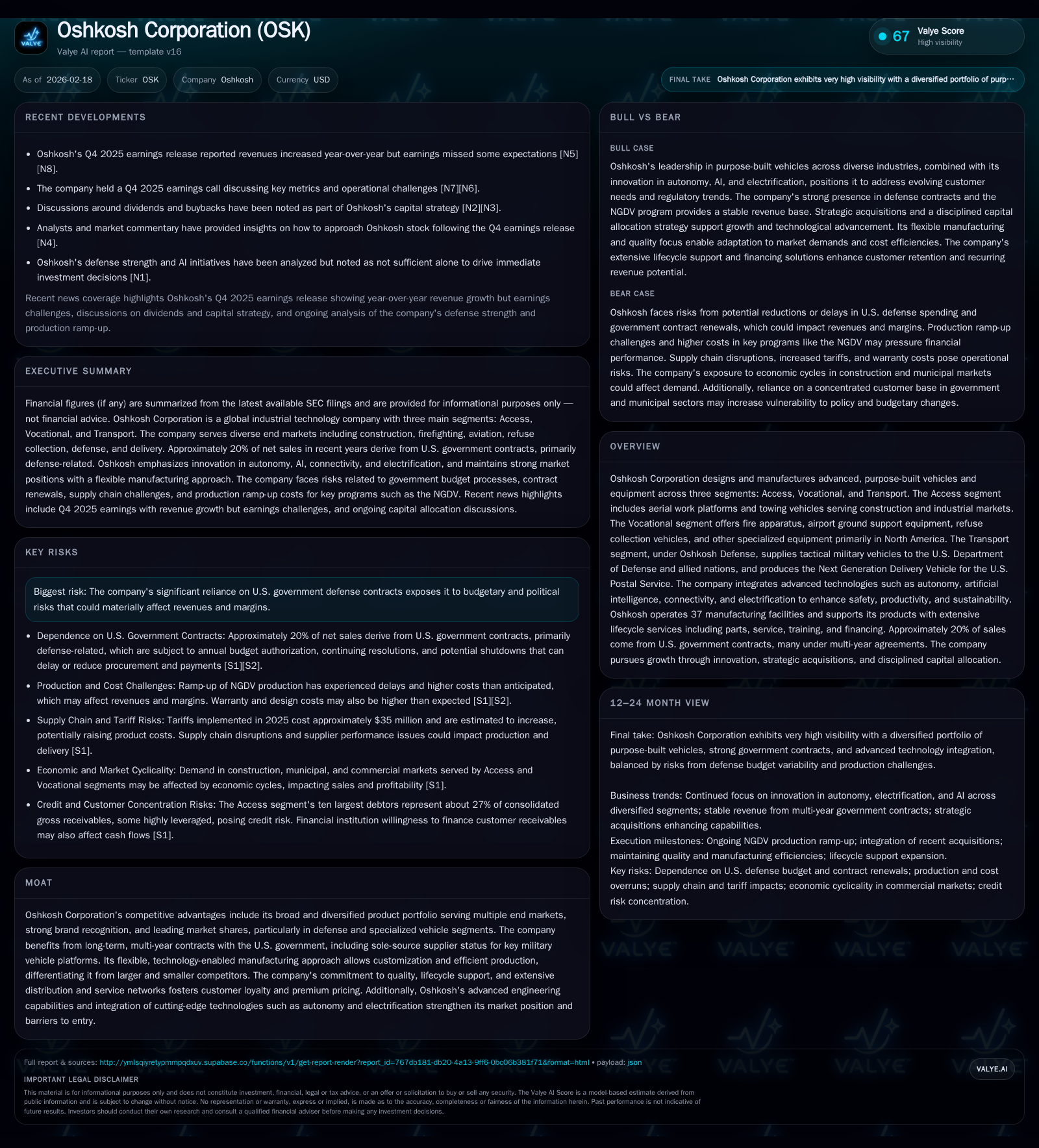
Oshkosh Corporation has delivered steady revenue growth over recent years supported by its diversified product portfolio encompassing Access, Vocational, and Defense Transport segments. Despite a solid operating income base, profitability faced a 7% decline in 2025 amid increased costs and complexities in scaling the Next Generation Delivery Vehicle (NGDV) for the U.S. Postal Service. The company's performance remains tethered to cyclical market factors and government contracts, while it invests heavily in electrification, autonomy, and AI to maintain competitive differentiation. Cash flow generation supports disciplined capital allocation including dividends and share buybacks, although future growth may hinge on USPS order volume and defense contract stability.
Overview
Oshkosh Corporation stands as a diversified industrial technology company focused on designing and manufacturing advanced purpose-built vehicles across three reportable segments: Access (aerial work platforms, towing vehicles), Vocational (fire apparatus, airport ground support, refuse collection), and Transport (defense tactical vehicles and the USPS NGDV). With over a century of engineering heritage, Oshkosh integrates technologies like autonomy, artificial intelligence (AI), connectivity, and electrification aimed at enhancing safety and operational efficiency for customers ranging from construction contractors to military clients [S1][S20].
Historical Financial Performance
Between FY2018 and FY2025, Oshkosh’s revenues have remained relatively stable with subtle fluctuations driven by segment-specific cyclicality. The company’s operating income advanced substantially from $147 million in 2022 to peak at approximately $1.01 billion in 2024 before retreating about 7% to $939 million in fiscal year-end 2025. This decline reflects margin pressures associated with cost inflation and operational challenges within its Transport segment primarily related to the NGDV program for USPS [F1].
Operating cash flows expanded sharply by +42% in 2025 to $783 million, while capital expenditures were pared back significantly (-41%) compared with prior years. This shift enabled an approximate free cash flow of $618 million supporting steady dividend growth—which increased from $97 million in 2022 to $130 million in 2025—and robust share repurchases that nearly doubled year-over-year reaching $278 million last fiscal year [F1]. The company’s equity base expanded consistent with earnings retention and net shareholder returns but its trailing ROE approximated a modest ~5.1%, pointing toward ongoing challenges in translating revenue into bottom-line profitability amidst operational headwinds.
Historical performance (annual)
| FY | CFO ($mm) | OpInc ($mm) | Capex ($mm) |
|---|---|---|---|
| 2025 | 783 | 940 | 165 |
| 2024 | 550 | 1011 | 281 |
| 2023 | 600 | 838 | 325 |
| 2022 | 601 | 147 | 270 |
Note: Omitted columns lack sufficient annual XBRL coverage in the provided tags (need ≥2 annual points): Rev, Net, ROE%. Source: SEC companyfacts cache [F1].
Capital returns and efficiency (annual)
| FY | Div ($mm) | Buybacks ($mm) | FCF ($mm) |
|---|---|---|---|
| 2025 | 130 | 278 | 618 |
| 2024 | 120 | 116 | 269 |
| 2023 | 107 | 23 | 274 |
| 2022 | 97 | 155 | 332 |
Source: SEC companyfacts cache [F1].
Note: Revenue YoY changes not computed due to limited year overlay data; net income data unavailable beyond FY2015.
Business Segments and Industry Positioning
Access Segment
Comprising about 43% of consolidated sales in recent years, this segment offers aerial work platforms under JLG brands for construction, industrial maintenance, agriculture, among others. Demand here closely tracks residential/non-residential construction spending cycles, rental companies’ equipment replacement rates, and broader economic activity—rendering it highly cyclical. Additional exposure arises from tariffs inflating component costs which likely compress margins given prevailing commodity price volatility [S13][S15]. The competitive arena includes major global players like Terex's Genie and XCMG; however Oshkosh's manufacturing flexibility, product reliability, and service network create tangible barriers versus both large OEMs and niche competitors [S16][S26].
Vocational Segment
At roughly one-third of total sales (36%), the Vocational business unit focuses on municipal fire apparatus (Pierce brand), airport ground support equipment (Oshkosh AeroTech), refuse collection vehicles (McNeilus), among other specialized products predominantly servicing North American municipal/commercial customers through robust dealer networks. This channel transformation towards dealership reliance introduces execution risk but also scale opportunity if managed well. Competition remains fragmented between global firms like Rosenbauer International versus regional bespoke manufacturers offering custom solutions. Oshkosh leverages advanced proprietary tech such as Command Zone vehicle diagnostics alongside integrated lifecycle support services comprising a meaningful competitive moat here [S21][S19][S26].
Transport Segment
Accounting for about one-fifth of sales (20%), this division centers on specialty military tactical wheeled vehicles assembled for the US Department of Defense plus allied nations along with the Next Generation Delivery Vehicle (NGDV) program under an indefinite delivery contract with the US Postal Service (USPS). The transport segment's defense portfolio enjoys sole-source supplier status for multiple DoD platforms supported by patented components like TAK-4 independent suspensions driving superior off-road mobility. However production scale-up for NGDV has encountered delays costing Oshkosh deferred contract assets nearing $135 million as USPS orders lag expectations at just over a third (~51,500 units) of guaranteed volumes through end-2025 out of possible up to ~165,000 units over ten years [S9][S13][S14]. This ramp timing mismatch directly weighed on revenues/margins during FY2025 despite growing cash flow realization.
Growth Prospects & Catalysts
Oshkosh’s future growth will critically hinge on several key vectors:
- USPS NGDV Orders: Increased volume commitments or acceleration in electric vehicle mix could unlock scale economies improving margins although receipt timing is uncertain.
- Defense Budgets: Multi-year DoD contracts underpin about one-fifth of revenues; shifts towards prioritizing speed-to-field via government executive directives may alter procurement criteria impacting contract structures or pricing dynamics [N6][S25].
- Electrification & Advanced Tech: Continued R&D investment exceeding thousands of engineering hours annually drives proprietary autonomy systems/machine learning applications integrated across product lines that enhance operational safety/productivity—a strategic imperative given competitors’ innovation pushes [S18][N10].
- Dealer Channel Evolution: Successful expansion/refinement of Vocational segment dealer relationships particularly for refuse vehicles post-transition could improve market penetration but carries execution risk especially due to state regulatory dealer protections potentially inhibiting terminations if performance falters [S19][S24].
- Input Cost Management: Escalating tariffs projected at ~$200 million annual impact by end-2026 require mitigation through sourcing diversification or manufacturing efficiencies lest pricing power erode across product segments [N2][S1].
Risks & Headwinds
The principal constraints include:
- Exposure to cyclical downturns particularly in construction-related end markets adversely affecting Access equipment demand.
- Concentration risk tied to U.S government contracts constituting roughly one-fifth of sales with political/budget uncertainty inherent.
- Supply chain complexity amplified due to dependence on specialized suppliers for critical components raising likelihood of parts discontinuations or design rework costs throughout product lifecycles.
- Competitive pricing pressures intensified by international OEMs leveraging subsidized imports targeting North American markets especially within Access boundaries.
- Potential litigation or regulatory compliance matters typical within complex manufacturing sectors though management regards current accrued liabilities as non-material relative to overall operations [S11][N5][N14].
Capital Allocation & Returns
Oshkosh demonstrates prudent capital deployment balancing reinvestment with shareholder returns. Operating cash flow generation surpassed capex consistently over recent years delivering strong free cash flow available for dividends—which grew steadily ($130M in FY25)—and sizable repurchases expanding materially to nearly $278M implemented during FY25 representing management’s confidence despite margin pressures [F1]. Return on equity hovers near mid-single digits (5%), reflecting ongoing profit conversion challenges constrained partly by non-cash deferred contract assets linked primarily to NGDV uncertainties [F1]. The firm maintains a healthy liquidity profile evidenced by a current ratio near two endorsing an ability to comfortably meet short-term obligations even amid working capital swings inherent in long-cycle contracts.
Market & Competitive Positioning Insights
In its core markets Oshkosh leverages brand strength—particularly within defense where it holds sole-source platforms—and vertically integrated manufacture enabling tailored customer solutions uncommon among larger mass producers dependent on purchased systems components. Proprietary technologies like Tak-4 independent suspensions provide unmatched mobility benefits appealing specifically within military vehicle domains reinforcing intangible barriers against competition along with extensive aftermarket service networks enhancing lifecycle economics critical for fleet operators. However competitors ranging from large multinational industrial players like Terex or Rosenbauer face-offs introduce constant price/service pressure requiring continuous innovation investments coupled with supply chain resilience strategies especially given evolving trade environments impacting cost bases globally [S15][S26][N10].
What To Watch Going Forward (Analysis)
Absent explicit guidance details beyond generic remarks there are several critical external referents investors should observe:
- USPS order cadence updates clarifying whether volume ramps accelerate or stall impacting revenue outlooks.
- Defense budget announcements clarifying scope/timing around tactical vehicle procurements including next-gen autonomous platform integrations.
- Tariff/trade policy developments potentially amplifying input cost burdens or forcing supply chain realignments.
- Dealer network evolution outcomes particularly for vocations following wholesale channel model shifts domestically.
- Margins trajectory recovery efforts as ramp issues ideally resolve combined with efficiency gains from leaner capex profiles influencing profitability sustainable thresholds.
Disclaimer
This analysis is based solely on publicly available information without offering any investment advice or recommendations. Readers should conduct their own due diligence before making any financial decisions related to Oshkosh Corporation.
Disclaimer: This is research-only, informational analysis and not investment advice. It may include AI-generated interpretation and general industry context. Always verify important details using primary sources.

Comments