
Analog Devices Inc’s Growth in Communications and Industrial Segments Balances Capital Allocation Challenges
Strong revenue growth and margin expansion juxtapose with strategic repositioning costs and capital deployment at Analog Devices.
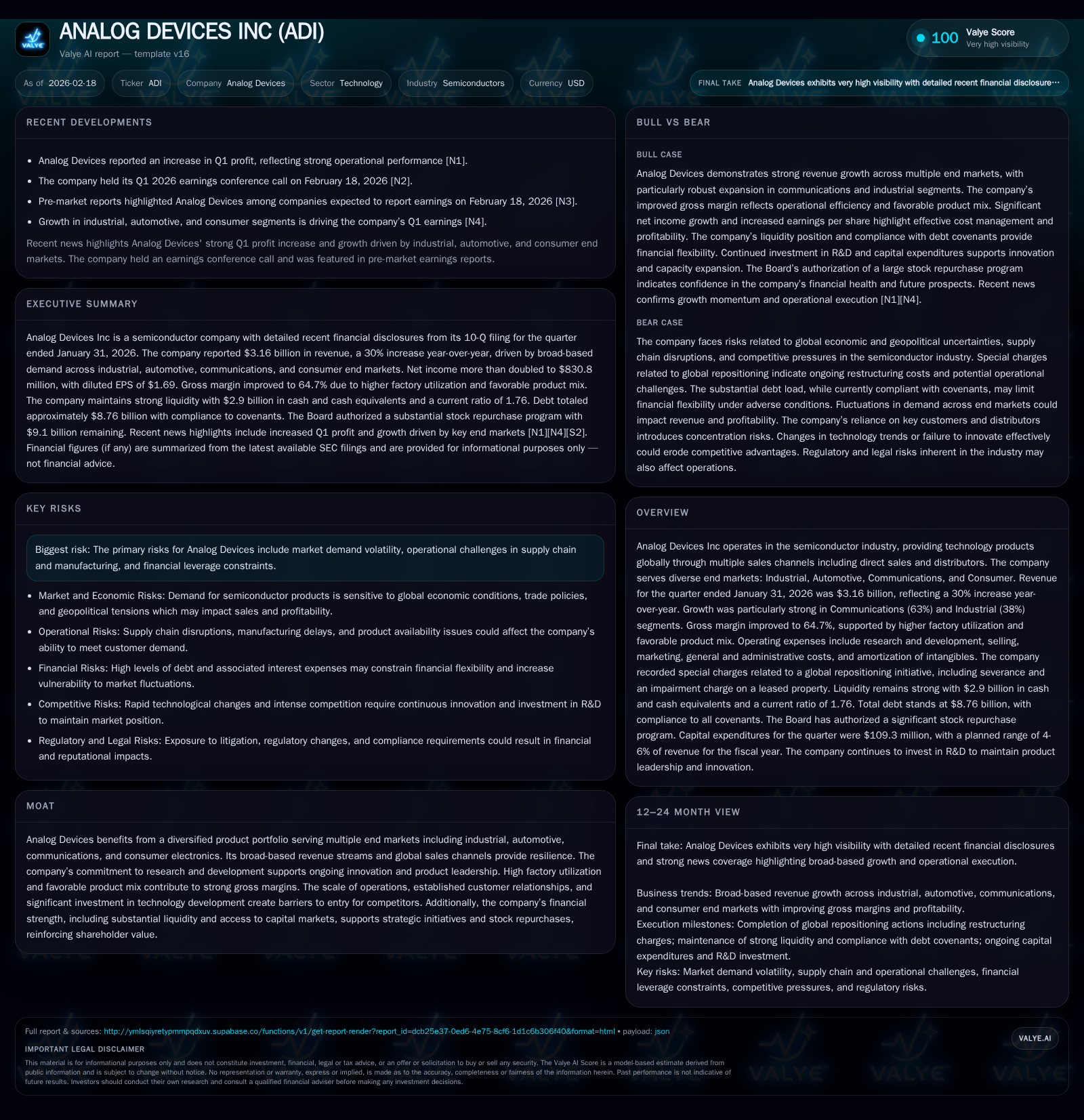
Analog Devices Inc (ADI) reported a robust 30% year-over-year revenue increase in Q1 fiscal 2026, highlighted by significant gains in its Communications (63%) and Industrial (38%) segments. Gross margin expanded notably to 64.7%, reflecting operational efficiencies like higher factory utilization and favorable product mix. The company navigated special charges linked to its global repositioning initiatives, impacting earnings somewhat but aligning with longer-term strategic plans. Capital allocation remains a focal point as ADI balances substantial dividends, accelerated share repurchases, and disciplined capital expenditures amid solid cash flow generation and a manageable debt profile.
Overview of Recent Performance
Analog Devices Inc (ADI), a major player in semiconductors specializing in analog, mixed-signal, and digital signal processing technologies, posted strong quarterly results for the three months ended January 31, 2026 [S2][N1]. Total revenue surged by an impressive 30% year-over-year to $3.16 billion [S4][F1], signaling broad-based demand recovery across all major end markets: Industrial (+38%), Automotive (+8%), Communications (+63%), and Consumer (+27%) [S4]. Communications segment outperformance was particularly notable due to robust wireline applications supporting data center infrastructure expansion.
Gross margin rose sharply by 570 basis points to 64.7%, reflecting improved factory utilization rates driven by elevated order volumes as well as a shift toward higher-margin products within its portfolio [S6]. This margin expansion underscores effective supply chain management and operational leverage during periods of scaling production.
Net income more than doubled compared to Q1 FY2025, reaching $831 million, propelled largely by operating income gains totaling a $505.7 million increase; however, this was partly offset by increased tax expenses associated with foreign profit repatriation under GILTI rules [S4][S19]. Diluted EPS nearly doubled to $1.69 versus $0.78 last year [S15][F1].
Historical Financial Snapshot
Historical performance (annual)
| FY | Net ($bn) | CFO ($bn) | OpInc ($bn) | Capex ($mm) | Net YoY |
|---|---|---|---|---|---|
| 2025 | 2.3 | 4.8 | 2.9 | 534 | +38.7% |
| 2024 | 1.6 | 3.9 | 2.0 | 730 | -50.7% |
| 2023 | 3.3 | 4.8 | 3.8 | 1261 | +20.6% |
| 2022 | 2.7 | 4.5 | 3.3 | 699 |
Note: Omitted columns lack sufficient annual XBRL coverage in the provided tags (need ≥2 annual points): Rev. Source: SEC companyfacts cache [F1].
Capital returns and efficiency (annual)
| FY | Div ($mm) | Buybacks ($bn) | FCF ($bn) |
|---|---|---|---|
| 2025 | 1924 | 2.2 | 4.3 |
| 2024 | 1795 | 0.6 | 3.1 |
| 2023 | 1679 | 3.0 | 3.6 |
| 2022 | 1545 | 2.6 | 3.8 |
Source: SEC companyfacts cache [F1].
Note: Annual revenue data is not available from the provided tags; operating income and net income year-over-year percentages are calculated for the latest two years based on [F1].
Growth Drivers and Segment Dynamics
The company's growth trajectory is anchored primarily in its diverse end-market exposure combined with technological innovation leadership. The Communications segment's substantial revenue jump (63%) in Q1 was largely related to demand for high-performance analog components supporting data center networking infrastructure—particularly wireline sub-markets critical for bandwidth scalability [S4]. Similarly, the Industrial segment's strong organic growth (+38%) reflects intensifying demand across test equipment applications and automation systems.
Automotive sales increased modestly by about +8%, which though slower than other sectors remains strategically essential given the rising content penetration of ADI's analog sensors and power management solutions in electric vehicles [S4][N3]. The Consumer segment’s growth (+27%), fueled by portable electronics adoption trends, also contributes steadily to revenue diversification.
Research & Development spending grew by +16% on an absolute basis but fell slightly as a percentage of revenue (to approximately 15%), indicating greater R&D efficiency alongside focused development of next-generation mixed-signal ICs vital for expanding addressable markets [S6]. This investment sustains high barriers to entry amid semiconductor industry competitive intensification.
Operating Leverage & Margins
Operational leverage realized amid scaling demand has translated into significant margin improvement: gross margins expanded almost six percentage points compared to last year's first quarter [S6]. Factors include:
- Elevated factory utilization reducing fixed cost burden per unit produced.
- Favorable product mix shifts toward higher-margin custom analog ICs vs commodity components.
- Enhanced manufacturing and sourcing optimizations buffering inflationary pressures. Selling, General & Administrative costs rose by about +21% nominally due mainly to variable compensation increases correlated with higher sales [S6], but declined modestly relative to revenue percentage (~11%).
Special charges were incurred at approximately $32 million related primarily to workforce reductions as part of ADI's Global Repositioning Actions aiming at streamlining organizational design; additionally, an impairment charge tied to subleasing of the San Jose leased facility contributed ~$15.6 million within these costs [S19][S25]. These expenses are transitional investments toward long-term cost structure optimization.
Capital Allocation Priorities
Liquidity remained healthy with cash and equivalents rising to approximately $2.91 billion at quarter-end, supported by strong operating cash flow of $1.37 billion for the quarter [S10][F1]. Capital expenditures came in at around $109 million during Q1 (~4%–6% annualized guidance), evidencing disciplined capex strategy focused on capacity maintenance rather than aggressive expansions [S5][S18].
Dividend payments accelerated reflecting strong earnings momentum; a quarterly dividend of $1.10 per share was declared payable mid-March amounting to near half a billion dollars total [S21]. Additionally, share repurchases picked up substantially with nearly $517 million spent this quarter alone under an active authorization totaling roughly $26.7 billion—underscoring commitment to returning capital while stock remains attractive under current valuation scenarios [S14][F1].
The balance sheet displays prudent management despite carrying nearly $8.76 billion total debt across maturities spanning short-term commercial paper notes through senior unsecured notes maturing up through mid-century; all debt covenants remain comfortably met [S8][S23]. Interest rate swaps hedge exposure on variable rate instruments mitigating financial risk.
Returns, Cash Flows & Dividends / Buybacks
While detailed Return on Equity (ROE) metrics are not explicitly available from the provided tags, approximate ROE based on latest fiscal year net income relative to equity stands near 6.7% [F1]. Free cash flow remains robust at an estimated $4.28 billion annually when subtracting capital expenditures from operating cash flows [F1]. These strong cash generation capabilities underpin ongoing substantial dividends—$1.92 billion paid in FY2025—and aggressive share repurchase programs totaling over $2.16 billion during FY2025 alone [F1]. This disciplined capital return approach complements sustained investment in innovation while maintaining financial flexibility.
Outlook Considerations & Risks
While recent quarters showcase strong performance execution, the company explicitly identifies risks inherent in semiconductor market cyclicality including potential softness from technology sector budgeting shifts or supply chain constraints that could hamper factory output pacing or raw material availability [S25]. Moreover, integration of organizational repositioning efforts must be monitored carefully so that short-term disruption does not erode overall customer service or product development timelines.
Analysts should watch upcoming earnings calls for updates on communications segment momentum particularly relating to datacenter build-outs, shifts in automotive content penetration influenced by EV adoption trends, any material changes in FX rates impacting profitability due to international operations exposure, and further details on operational restructuring progress.
Summary & Concluding Remarks
Analog Devices Inc has delivered compelling top-line acceleration supported by strong segment-specific growth buoyed by execution excellence in driving factory efficiency and product mix enhancements leading to superior gross margins near multiyear highs [N1][F1]. Its balanced approach toward capital allocation highlights priorities on shareholder return augmented by sustainable investment in innovation capacity.
The ongoing global repositioning program introduces transitional costs but aligns with broader strategy addressing competitive dynamics and cost discipline necessary for maintaining leadership over an evolving semiconductor landscape dominated increasingly by mixed-signal sophistication requirements.
Overall financial health remains robust amplified by substantial cash reserves alongside manageable indebtedness and continued free cash flow generation exceeding capital expenditure demands; this positions ADI well for navigating future industry uncertainties while pursuing targeted profitable growth avenues.
This analysis is based solely on disclosed information as of the filing date without incorporating forward-looking statements beyond regulatory filings or public sources. It does not constitute investment advice.
Disclaimer: This is research-only, informational analysis and not investment advice. It may include AI-generated interpretation and general industry context. Always verify important details using primary sources.

Comments