
Equity LifeStyle Properties’ Steady Growth and Capital Discipline in 2025
Analysis of ELS’s financial performance and strategic positioning within lifestyle-oriented residential REITs for 2025.
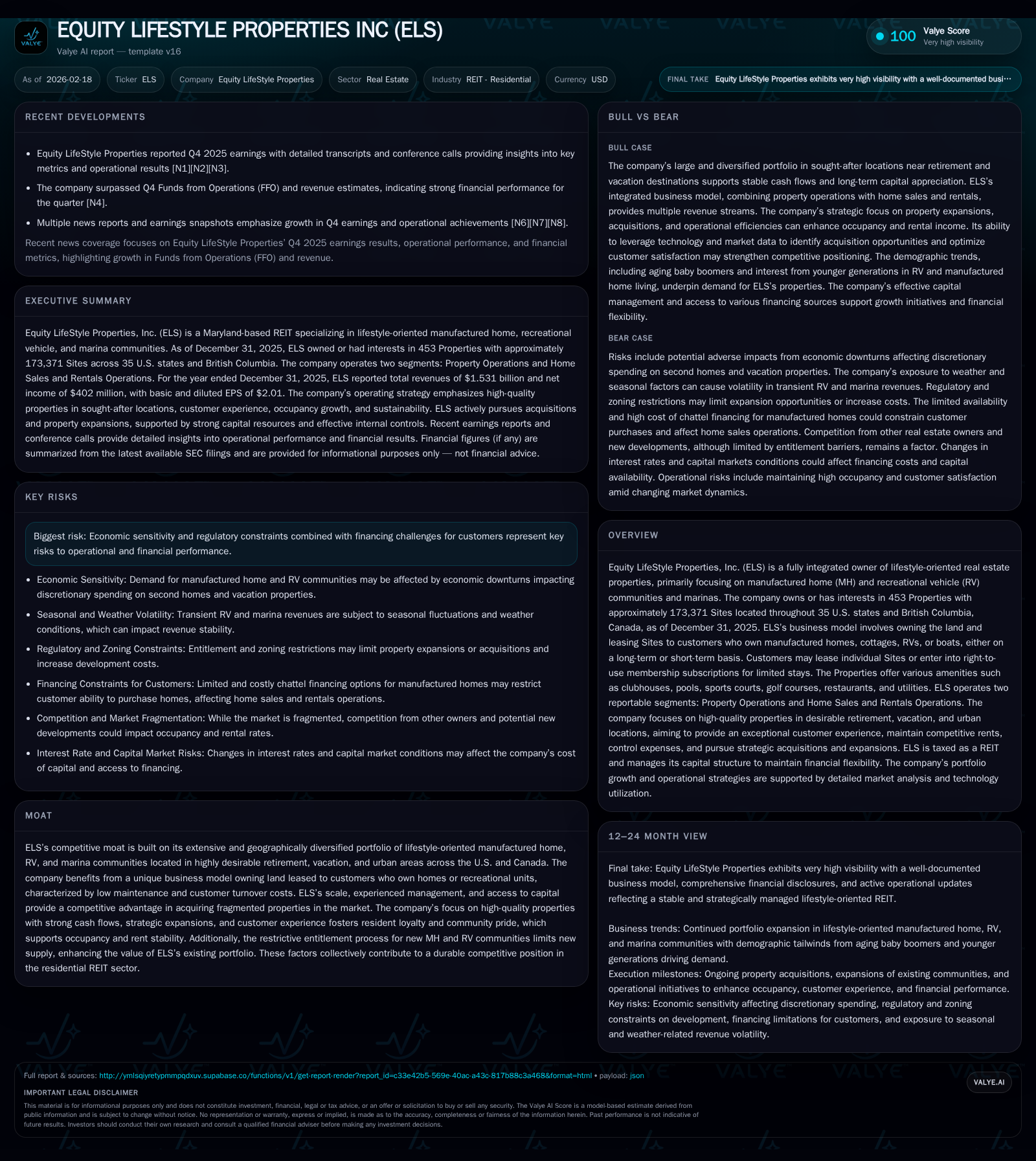
Equity LifeStyle Properties, a prominent REIT specializing in manufactured home, RV, and marina communities, delivered measured growth and disciplined capital management in 2025. Revenue and net income recorded modest year-over-year increases supported by demographic tailwinds and portfolio expansion of over 360 new sites. The company’s strategic debt refinancing lowered interest costs while a 7.9% dividend increase underscores commitment to shareholder returns. Regulatory supply constraints alongside evolving customer financing dynamics present ongoing risk factors shaping the outlook.
Historical Growth Dynamics: Revenue, Earnings, and Operational Highlights
Equity LifeStyle Properties demonstrated a stable growth trajectory over recent years culminating in the fiscal year ended December 31, 2025. Total revenue increased marginally by approximately 0.3% year-over-year to $1.53 billion [F1], reflecting a mature business model focused on land-lease operations within lifestyle-oriented real estate assets such as manufactured home (MH), recreational vehicle (RV) communities, and marinas.
Operating income rose by roughly 2.8% to $391 million, indicating operational leverage achieved through efficiency gains despite relatively flat revenue growth [F1]. Net income grew more robustly at about 4.5%, reaching $402 million as operational improvements and cost controls partially offset the slight softness in operating cash flows [F1].
Operating cash flow (CFO) declined modestly by approximately 4.3% to $571 million [F1], a movement largely attributable to reduced capital expenditures which dropped sharply (approximately -66.6%) due to moderation in property development investments [F1]. This shift signals cautious capital deployment amid ongoing macroeconomic uncertainties while sustaining core portfolio enhancement.
Historical performance (annual)
| FY | Rev ($mm) | Net ($mm) | CFO ($mm) | OpInc ($mm) | Rev YoY | Net YoY |
|---|---|---|---|---|---|---|
| 2025 | 1531 | 402 | 571 | 391 | +0.3% | +4.5% |
| 2024 | 1526 | 385 | 597 | 381 | +2.5% | +16.7% |
| 2023 | 1489 | 330 | 548 | 320 | +2.9% | +10.3% |
| 2022 | 1447 | 299 | 476 |
Note: Omitted columns lack sufficient annual XBRL coverage in the provided tags (need ≥2 annual points): Capex, Buybacks, FCF. Source: SEC companyfacts cache [F1].
Capital returns and efficiency (annual)
| FY | Div ($mm) | ROE% |
|---|---|---|
| 2025 | 388 | 22.9 |
| 2024 | 351 | 22.1 |
| 2023 | 326 | 23.1 |
| 2022 | 296 | 20.7 |
Source: SEC companyfacts cache [F1].
Note: Capital Expenditures data available only for FY2022 & FY2025; CFO shows four-year progression.
The moderation in capex notably contributed to enhanced free cash flow generation estimated at approximately $438 million in 2025 after subtracting capex from CFO [F1]. The company’s equity base remained solid at approximately $1.76 billion at year-end, supporting an approximate return on equity (ROE) of nearly 23%, underscoring strong shareholder value creation from operational earnings [F1].
Growth Drivers: Portfolio Expansion and Demographic Tailwinds
ELS benefits from a distinctive asset base characterized by ownership of the underlying land leased to customers who place manufactured homes or RVs on designated Sites within its communities [S1]. As of December 31, 2025, ELS held interests in a geographically diversified portfolio consisting of 453 properties with approximately 173,371 developed sites spread over key U.S retirement hotspots, vacation destinations, and major urban areas spanning across 35 states plus British Columbia in Canada [S1].
This scale provides considerable competitive advantage allowing ELS to capitalize on fragmented acquisition opportunities within the lifestyle-oriented residential REIT segment; their expertise and capital access facilitate strategic expansions that enhance rental income streams.
Demographically, baby boomers—aging into retirement at an estimated rate of roughly ten thousand per day—continue to anchor demand for second-home options prioritizing active lifestyles [S1]. Coupled with this trend is the increasing interest among Millennials and Generation Z cohorts seeking recreational vehicles as mobile or vacation homes—a synergy noted from research by the Recreational Vehicle Industry Association [S1][N14].
Barriers to supply stem from highly restrictive entitlement processes governing the development of new MH and RV communities [S1]. This regulatory headwind limits fresh competitive supply influxes maintaining scarcity value for existing high-quality properties under ELS’s management.
By integrating amenities like clubhouses, pools, sports courts, golf courses, restaurants, utilities infrastructure, and more into their properties ELS fosters community pride that supports occupancy stability and resident loyalty—key levers for sustained income growth.
2025 Operational Performance: Site Income and Occupancy Trends
The Property Operations segment forms the core of ELS’s revenue base with supporting contributions from Home Sales and Rentals Operations encompassing manufactured home sales and rentals onsite [S13][N1]. In the full year of 2025:
- Core MH base rental income surged by approximately $39 million or +5.5%, signaling robust demand elasticity despite broader economic uncertainties.
- Annual RV and marina base rental revenues grew by about $12 million or +4.1%, benefiting also from net incremental addition of over five hundred Annual RV occupied sites (+506) principally realized during H2 of the fiscal year [S1][N1].
- Operating expenses excluding property management increased only modestly (+1%), showcasing effective expense control amidst expansion activities.
These trends emphasize operational enhancements maintaining strong Funds From Operations (FFO), which correlates with normalized FFO per Common Share growth reported at around +5%, suggesting underlying health beyond GAAP net income variations [S1][N12].
ELS’s right-to-use memberships for short-term stays complement annual leasing contracts providing flexible usage models that contribute recurring cash flow without significant incremental maintenance costs given the land-lease structure.
Strategic Capital Moves: Debt Management, Dividends, and Share Repurchase Stance
In terms of leverage management during 2025, ELS showcased prudence through a combination of scheduled repayments alongside new debt issuances:
- Repaid $86.9 million of secured mortgage debt at maturity aimed at eight loans backed by select MH/RV communities reducing exposure to higher-cost secured borrowings [S4].
- Entered into a new unsecured term loan facility totaling $240 million carrying a fixed effective interest rate of approximately 4.74%, maturing in mid-2030 enabling favorable refinancing conditions compared to legacy arrangements [S4][S10].
- Maintained compliance rigorously with debt covenants ensuring financial flexibility across shifts in interest rates or liquidity markets.
Dividend policy remains an important pillar reflecting confidence in sustainable cash flow generation:
- Increased dividends paid to common shareholders by nearly +7.9% during fiscal year end aligning with an average five-year compounded annual boosted yield growth of about +8.5%, well above sector median averages approximating +5.2% [S6][S22].
- Share repurchases have been minimal in recent years indicating prioritized allocation towards dividends and balance sheet strength rather than aggressive buybacks [F1][S6].
Overall capital allocation reveals disciplined approaches centering on shareholder returns delivery while preserving ample financial headroom for selective acquisitions or expansions.
Future Prospects: Market Demand and Regulatory Environment Constraints
Looking ahead, market demand appears underpinned firmly by sustained demographic drivers combined with shifting consumer preferences toward flexible second-home living solutions:
- Baby boomer retiree inflows will continue pressing demand for affordable retirement communities offering active lifestyle amenities.
- Younger generation enthusiasm around RV ownership bodes well given early-stage penetration suggesting growth runway identified by industry associations like RVIA[S1][N11][N14].
Conversely, stringent local zoning laws and comprehensive entitlement hurdles markedly constrain supply-side expansion restricting new community developments maintaining favorable occupancy but simultaneously limiting rapid capacity scaling [S7].
Economic sensitivities persist surrounding customer financing challenges due to historically limited chattel financing options for MH buyers with high down payments or short amortizations potentially dampening buyer activity should credit conditions tighten further [S14][S7]. Such risks necessitate vigilant monitoring by management as they impact both occupancy renewal rates and home sales profitability.
Key Metrics to Monitor: FFO, Occupancy, and Acquisition Pipeline
Although explicit future guidance was not issued publicly for detailed milestones or forecasts beyond standard FFO reporting periods one can pinpoint critical metrics indicative of performance momentum:
- Normalized FFO per share exhibited mid-single-digit growth (~+5%), reflecting resilient core operations augmented moderately by expansion contributions [N10][S1]. Monitoring subsequent quarterly normalized FFO trends will illuminate continuing earnings quality.
- Occupancy levels particularly within Annual RV Sites remain pivotal; net additions achieved during H2 2025 provide leading indicator data with upward bias that warrant close observation for sustainability amid fluctuating market conditions [N1].
- Acquisition pipeline is active albeit discreet; ELS stated engagement at various negotiation stages without disclosing deal specifics—suggesting measured deal pacing emphasizing quality accretive assets fitting strategic criteria rather than volume chasing [S1][N14].
Investors should watch forthcoming earnings commentary alongside property-level NOI disclosures highlighting margin trends within reportable segments.
Financial Returns: ROE, Cash Flow Generation, and Dividend Policy Overview
Summarizing shareholder value creation demonstrates commendable efficiency given REIT sector norms:
- Return on equity calculated near approximately 22.9%, driven by consistent net income increases leveraging stable asset base equity totaling about $1.76 billion as reported at December 31, 2025[F1][S16].
- Free cash flow generation remains robust around $438 million achieved via controlled capex spending that offsets operating cash flow declines enabling sustained dividend coverage.
- Dividend policy advancing at above-sector-average pace reinforces total equity returns focusing on long-term yield compounding rather than share buyback-driven appreciation which has been negligible recently.[F1][S22]
Alignment between Funds From Operations—a preferred REIT performance metric—and dividends supports quality distribution sustainability essential for trust-dependent investor bases.
This analysis integrates data drawn exclusively from verified financial statements filed with the SEC ([S#]) along with company-specific news releases ([N#]) contextualized against historical companyfacts data ([F1]). It aims solely to provide an informed assessment of Equity LifeStyle Properties’ operational execution and financial stewardship without constituting investment guidance or recommendations.
Disclaimer: This is research-only, informational analysis and not investment advice. It may include AI-generated interpretation and general industry context. Always verify important details using primary sources.

Comments