
Douglas Emmett’s Strategic Scale and Coastal Focus Underline Submarket Strength
Douglas Emmett leverages its dominant position in supply-constrained coastal submarkets to sustain steady growth despite margin pressures and heavy leverage.
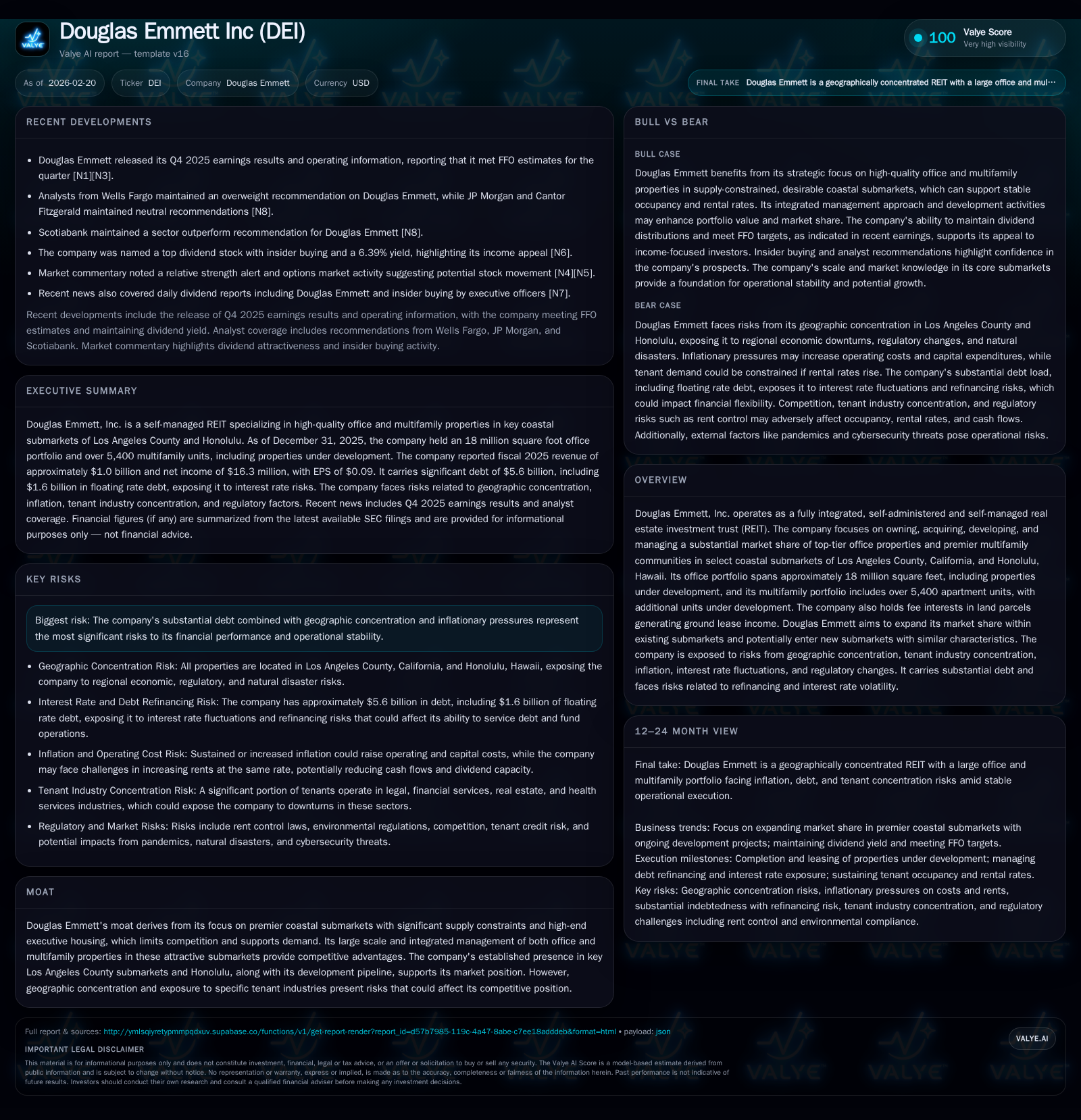
Douglas Emmett, Inc. operates a large integrated portfolio of office and multifamily properties primarily in the highly sought-after submarkets of Los Angeles County and Honolulu. Historical revenue growth has been modest but stable, supported by acquisitions and development initiatives within these constrained coastal markets. The company’s geographic and tenant concentration is both a moat and a risk factor amid inflation and regulatory pressures in California and Hawaii. Operating income and net income trends reveal margin pressure alongside consistent cash flow generation. Capital allocation remains disciplined with steady dividends but no recent buybacks, reflecting conservative management of significant debt levels. The ongoing development pipeline and tenant-focused leasing strategies offer potential avenues for growth, though future milestones revolve around lease-up rates, refinancing outcomes, and operating expense control.
A History Rooted in Premier Coastal Real Estate
Douglas Emmett’s roots lie deeply embedded within the premium coastal markets of Los Angeles County and Honolulu. As a fully integrated REIT, DEI manages approximately 18 million square feet of office properties alongside over 5,400 multifamily apartment units as of the end of FY2025 — both segments benefiting from notable supply constraints characteristic of these locales [S9]. This geographic footprint includes top-tier submarkets such as Beverly Hills, Century City, Santa Monica, Sherman Oaks/Encino, along with Honolulu’s uniquely competitive real estate market.
Financially, the company's top-line has demonstrated modest but consistent expansion: revenues reached approximately $1.0 billion in FY2025, marking a 1.8% increase versus FY2024 [F1]. However, while revenue growth was positive, operating income experienced a slight contraction (-3.7%), with net income declining more sharply by 30.8% year-over-year [F1]. This disparity reflects margin compression pressures amid rising operational costs and competitive leasing environments.
These figures underscore a growth trajectory propelled largely by strategic acquisitions complemented by targeted development projects that aim to deepen Douglas Emmett’s market penetration in constrained submarkets. The emphasis on high-quality, well-located assets supports resilience even as broader REIT headwinds persist.
Historical performance (annual)
| FY | Rev ($mm) | Net ($mm) | CFO ($mm) | Rev YoY | Net YoY |
|---|---|---|---|---|---|
| 2025 | 1004 | 16 | 387 | +1.8% | -30.8% |
| 2024 | 986 | 24 | 409 | -3.3% | +155.1% |
| 2023 | 1020 | -43 | 427 | +2.7% | -144.0% |
| 2022 | 994 | 97 | 497 |
Note: Omitted columns lack sufficient annual XBRL coverage in the provided tags (need ≥2 annual points): OpInc, Capex, FCF. Source: SEC companyfacts cache [F1].
Capital returns and efficiency (annual)
| FY | Div ($mm) | Buybacks ($mm) | ROE% |
|---|---|---|---|
| 2025 | 127 | 0 | 0.9 |
| 2024 | 127 | 0 | 1.1 |
| 2023 | 130 | 109 | -1.9 |
| 2022 | 197 | 3.8 |
Source: SEC companyfacts cache [F1].
Note: Operating Income annual figures not comprehensively available; Buybacks paused after FY2023.
Geographic and Tenant Concentrations: Dual-Edged Advantages
Douglas Emmett’s concentrated presence within a limited number of coastal submarkets affords it meaningful advantages via entrenched local knowledge, scale economies in property operations, and tight supply dynamics which bolster pricing power [S10][S11]. However, this geographic focus also concentrates exposure to fluctuations specific to California’s economic environment — including regulatory shifts like Measure ULA impacting property tax burdens — as well as natural disaster risks inherent in seismic-prone regions [S8][S14].
Tenant concentration presents another layer of complexity: nearly two-thirds of rental revenue hail from four principal sectors — legal (19.7%), financial services (16.8%), real estate (13.3%), and health services (9.9%) [S11]. While these industries often reflect relatively stable demand profiles for office space within premium settings catering to executives and professionals, cyclical downturns or sector-specific shocks could disproportionately affect Douglas Emmett’s revenue quality.
Within these dynamics lie important industry-specific considerations such as 'rent roll-down', which refers to situations where rents upon new lease commencements fall below prior levels due to competitive or economic forces — a phenomenon affecting DEI given competitive pricing pressure across its submarkets [S11]. Lease expirations occurring in bundles or tenant downsizing could also impact occupancy yields if alternative tenants do not fill the vacancies promptly.
Navigating Operating Income Margins and Profitability in 2025
Operating income margins declined slightly during FY2025 despite nominal revenue gains indicating underlying cost pressures or rent adjustments at lease renewals [F1][N1]. Management commentary highlighted that while asking rents remained above lease commencement rents — a metric showcasing 'asking rent flex' constraints — competitive pricing dynamics necessitate concessions or improvements packages reducing effective yields on new leases [N1].
These trends are symptomatic of broader office market challenges where firms recalibrate space needs post-pandemic leading to tempered demand elasticity even within coveted geographies like Los Angeles’ core corridors [N1][S10]. Rising operating expenses linked to maintenance capex—as part of sustained asset renovation strategies—and inflation also weigh on NOI margins.
Tenant Mix and Leasing Strategy Targeting Executive and Professional Sectors
Douglas Emmett deliberately targets small- to mid-size tenants clustered in industries demanding prestigious headquarters within highly amenitized coastal submarkets [S1][N1]. This approach contrasts with larger institutional landlords focused on mega leases but introduces heightened tenant credit risk requiring rigorous 'credit underwriting' protocols at lease inception.
Management emphasizes 'leasing velocity', the pace at which vacant units are leased relative to availability periods—an important barometer for assessing momentum amidst fluctuating market conditions [N1]. Additionally, focus on 'tenant retention' through relationship management and property quality upkeep enhances renewal probabilities mitigating vacancy risk.
This finely tuned leasing strategy aligns well with the appeal of executive residential communities adjacent to office assets allowing integrated lifestyle offerings attractive for talent retention among tenants’ employees.
Capital Allocation Amid Heavy Debt and Modest Returns
As of December 31, 2025, Douglas Emmett carried roughly $5.6 billion in total debt including $1.6 billion exposed to floating interest rates sensitive to market fluctuations—a notable risk factor given recent interest rate volatility [S8][F1]. The company employs partial hedging but remains vulnerable to refinancing challenges if credit conditions tighten.
Return on equity stands muted near approximately 0.9% for FY2025 due in part to significant interest expense burden dampening net earnings despite positive operating cash flow generation ($387 million) [F1]. Importantly however, operating cash flow comfortably covers dividend distributions which remained steady at about $127 million annually reflecting management’s commitment to payout consistency despite pressures [F1][S21].
No share repurchases have been undertaken since FY2024 demonstrating prudence amid macroeconomic uncertainties; this shift signals priority toward liquidity preservation over capital return enhancements currently [F1][S21].
Industry lingo such as 'distribution coverage ratio' underscores this conservatism—the ratio indicating how comfortably CFO covers dividend payout—critical for maintaining REIT status without forced external financing.
Development Pipeline as a Growth Lever within Core Submarkets
DEI pursues controlled expansion through development projects comprising roughly 456 thousand square feet of new office space alongside over one thousand multifamily residential units under construction at FY-end December 2025 [S9][N1]. These endeavors occur exclusively within existing zones exhibiting acute supply constraints enhancing prospects for superior rent escalation upon stabilization.
Capital deployment here reflects deliberate 'construction capex' allocations aimed at increasing intrinsic asset value while diversifying income streams between office leases deemed increasingly challenging versus multifamily demand resilient even amid employment flux.
Forward lease commitments underpinning these developments reduce leasing risk but require careful management of 'stabilization timelines' ensuring projects reach desired occupancy thresholds efficiently amid fluctuating economic conditions.
Inflationary Environment and Regulatory Factors Impacting Operations
Rising inflation impacts Douglas Emmett via escalated routine operating expenses encompassing labor costs (including union considerations for building services), maintenance supplies, insurance premiums, energy usage surcharges, taxes subject to reassessment under local law changes like Measure ULA—all bearing down on net operating income margins [S4][S14][S8].
Simultaneously regulatory caps inherent in California’s rent control regimes restrain the ability to pass through incremental costs fully onto tenants prompting potential compression of profitability metrics.
The interplay between 'pass-through expenses' such as common area maintenance charges versus fixed landlord overhead requires judicious financial engineering alongside proactive tenant negotiation strategies.
What to Watch Forward: Metrics and Milestones in Focus
Absent explicit forward guidance from management on FFO or revenue growth targets [N3], investors should monitor several critical indicators shaping Douglas Emmett's trajectory:
- Occupancy rates evolution amidst competitive leasing markets impacting effective occupancy yield.
- Lease renewal spreads comparing prevailing asking rents against newly signed lease commencement rents ('asking rent flex').
- Scheduled debt maturities aligning with refinancing windows sensitive to credit market environments.
- Successful delivery & lease-up rates within the development pipeline providing incremental cash flows & diversification benefits.
These markers will gauge how effectively Douglas Emmett navigates the twin challenges posed by inflationary headwinds coupled with intense competition for high-quality tenants in its coastal strongholds.
Disclaimer: This report is for informational purposes only reflecting publicly available data as of February 2026; it does not constitute investment advice or recommendations.
Disclaimer: This is research-only, informational analysis and not investment advice. It may include AI-generated interpretation and general industry context. Always verify important details using primary sources.

Comments