
Ultra Clean Holdings’ Volatile Cycle Reflects Semiconductor Demand Shifts and Operational Challenges
The company’s recent financial volatility underscores the intersection of semiconductor cyclicality, customer concentration, and operational execution.
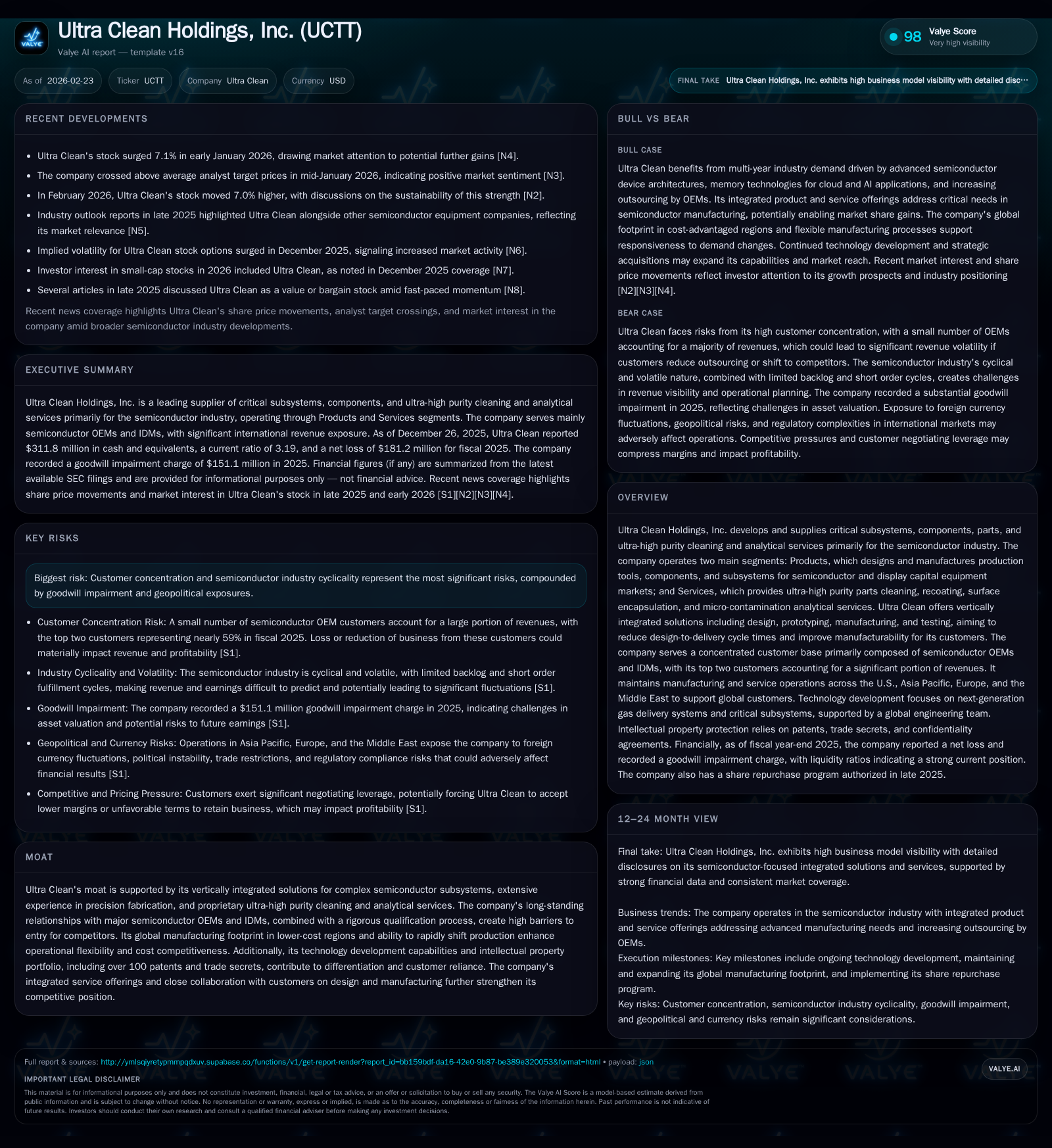
Ultra Clean Holdings experienced a dramatic swing from revenue expansion through 2022 to steep declines and operating losses by 2025, driven largely by semiconductor capital equipment demand fluctuations and supply chain pressures. The firm’s deep integration with key OEM customers creates both resilience and vulnerability amid a volatile market environment. Future growth may hinge on recovering capacity and order stabilization linked to AI-driven semiconductor trends, though risks from customer concentration and geopolitical factors remain significant.
From Expansion to Decline: Ultra Clean’s Revenue and Profit Trajectory 2019–2025
Ultra Clean Holdings' financial history over recent years captures the semiconductor industry's volatile capital equipment cycles clearly. The company grew revenue from approximately $286 million in fiscal year (FY) 2019 — a period reflecting early recovery from earlier industry troughs — to a peak of $2.37 billion by FY2022 [F1]. This surge aligned with expanded investments by semiconductor original equipment manufacturers (OEMs) responding to AI-driven demands for advanced devices.
However, this momentum reversed sharply starting in late 2022 through FY2025. Revenue dropped roughly 27% from the FY2022 high to $1.73 billion reported for FY2023 and held around this level thereafter [F1]. Meanwhile, operating income paralleled this swing: from a solid profit of $120 million at its apex in FY2022 down to an operating loss exceeding $107 million by FY2025 [F1]. Net income mirrored this volatility with a positive figure near $40 million in the peak year slipping into a significant net loss of over $181 million as of FY2025 [F1]. Despite these losses on the income statement, operating cash flow remained positive across these years, ending at roughly $66 million in FY2025 [F1], underscoring substantial non-cash expenses influencing earnings.
Historical performance (annual)
| FY | Rev ($bn) | Net ($mm) | CFO ($mm) | OpInc ($mm) | Rev YoY | Net YoY |
|---|---|---|---|---|---|---|
| 2025 | -181 | 66 | -107 | -864.6% | ||
| 2024 | 24 | 65 | 91 | +176.2% | ||
| 2023 | 1.7 | -31 | 136 | 35 | -26.9% | -177.0% |
| 2022 | 2.4 | 40 | 47 | 120 |
Note: Omitted columns lack sufficient annual XBRL coverage in the provided tags (need ≥2 annual points): Capex, Div. Source: SEC companyfacts cache [F1].
Capital returns and efficiency (annual)
| FY | Buybacks ($mm) | FCF ($mm) | ROE% |
|---|---|---|---|
| 2025 | 3 | 15 | -25.5 |
| 2024 | 0 | 2 | 2.7 |
| 2023 | 29 | 60 | -3.7 |
| 2022 | 12 | -53 | 4.6 |
Source: SEC companyfacts cache [F1].
Note: Some YoY values not computable due to missing consecutive data points.
This earnings volatility highlights Ultra Clean’s parallel exposure to industry capital spending cycles and internal operational challenges.
Critical Drivers Behind Peak Revenues and the Sudden Downturn in Profitability
Ultra Clean's rapid growth into FY2022 owed much to heightened demand stemming from next-generation semiconductor architectures optimized for AI and machine learning applications [S14]. These emerging device designs necessitated sophisticated subsystems like gas delivery systems tailored for advanced nodes including gate-all-around transistors and backside power distribution enhancements [S14]. Semiconductor OEMs heavily invested in expanding capacity and upgrading wafer fabrication tools during this period.
Management commentary during recent earnings calls detailed how this expansion strained supply chains for critical materials and labor pools needed for precision fabrication [N1][S1]. Competition intensified not only among subcontractors but also internally within customers’ own manufacturing groups vying for scarce resources to meet aggressive ramp schedules. As inventories normalized post-peak investment waves starting mid-2023 and broader capital equipment overcapacity emerged industry-wide, pricing pressures mounted leading to margin compression [N1]. Inventory rationalization efforts further curtailed new orders adversely impacting Ultra Clean's Products segment profitability.
Customer Concentration and Qualification as Both Strengths and Risks
A defining characteristic of Ultra Clean's business is its reliance on a small number of large semiconductor OEM customers — primarily Applied Materials and Lam Research — which together accounted for approximately 58.7% of total revenues in fiscal year 2025 [S6][S25]. These relationships are anchored by extensive qualification processes involving audits of Ultra Clean's engineering rigor, manufacturing quality systems, documentation controls, and supply chain reliability [S4][S6].
Qualification entails meeting exacting criteria including design-for-manufacturability (DFM) compliance to ensure production readiness at new technology nodes; thus once approved, clients tend to maintain stable outsourcing engagements due to risk mitigation benefits [S4][S8].
However, this concentration poses upside leverage as well as downside exposure: any strategic decision by these OEMs or integrated device manufacturers (IDMs) to internalize production or shift volume elsewhere directly impacts Ultra Clean’s revenue visibility given minimal contractual purchase guarantees [S4][S9]. Moreover, industry consolidation or shifts toward alternate suppliers heighten negotiating pressure on pricing and terms.
Strategic Vertically Integrated Solutions: Differentiation in the Capital Equipment Supply Chain
Ultra Clean combines subsystem design engineering with precision mechanical fabrication alongside proprietary ultra-high purity cleaning services — spanning process tool part recoating through micro-contamination analytical testing — across its Products and Services segments [S14][S7].
This vertical integration reduces customer supplier complexity by offering end-to-end solutions including prototyping through final assembly/testing of subsystems such as chemical delivery modules or precision robotics frames utilized within wafer fab tools [S7][S14]. Engineering teams collaborate closely with OEM counterparts attending internal quality meetings ensuring component designs facilitate manufacturability improvements while accelerating design-to-delivery cycle times via process automation insights [S4][S8].
In tandem with Services offerings critical for ensuring wafer process yield thresholds amidst shrinking lithographic geometries—the contamination analytics capability allows thorough verification enabling higher fab efficiencies during node transitions [S14][S11]. This synergistic model represents a competitive moat bolstered by proprietary know-how protected chiefly through trade secrets complemented by over one hundred patents primarily owned by customers [S11].
Demand Outlook Anchored to Semiconductor AI-Driven Growth but Constrained by Supply Chain Dynamics
Looking ahead, Ultra Clean anticipates continued elevated demand fueled primarily by AI-related wafer fabrication equipment (WFE) investments necessary for models requiring advanced high bandwidth memory modules and novel packaging methods [N1][S29]. Nonetheless, management highlighted ongoing risks tied to constrained access for scarce critical components alongside a tight skilled labor market that may hinder rapid capacity scaling needed if demand surges abruptly [N1][S25].
Rapidly shifting customer order patterns present additional forecast uncertainty given limited forward visibility endemic within cyclical semiconductor supplier environments [S29]. Cycle time compression pressures require flexible production footprint adjustments that Ultra Clean aims to address via global factory relocations emphasizing lower-cost Asia Pacific facilities coupled with streamlined supply chain management practices [S16][N1].
Key Milestones and What Investors Should Monitor Next
Ultra Clean has not issued formal quantitative guidance at this juncture; thus monitoring focus centers on incoming order backlogs especially from major OEMs given their outsized revenue contribution potential [N3][N1]. Progress on qualification timelines for newly introduced subsystems or enhanced cleaning services will offer signals on penetration into next-generation device programs which typically span multi-quarter approval cycles due to stringent inspections [N1][S29]. Capacity expansion developments notably within Malaysia alongside U.S. sites will be important operational benchmarks reflecting readiness for potential demand rebounds following inventory digestion phases [N1][N3]. Pricing trends amid competitive intensity remain another key variable affecting margin stability.
Capital Allocation Review: Balancing Capex Investment, Cash Flow, and Modest Share Repurchases
Capital expenditure spend decreased steadily from approximately $100 million at the revenue peak year FY2022 down close to $50 million for FY2025 focusing mainly on expanding manufacturing capabilities within strategic locations such as Malaysia plus IT infrastructure modernization including ERP upgrades addressing operational scale efficiencies [F1][S16]. Operating cash flow held steady around $65 million annually despite net losses reflecting strong working capital controls offsetting the depressed earnings base [F1].
Share repurchase activity was modest at roughly $3.4 million in FY2025 compared with $29 million executed during the partial recovery year FY2023; no dividends have been declared historically consistent with reinvestment priorities amid cyclical volatility [F1].[F1] Return on equity (ROE) reflected weighted losses reaching approximately negative 25.5% in FY2025 driven primarily by net income deficits overshadowing equity base performance despite positive operational cash inflows highlighting earnings versus cash flow divergence typical of cyclical fabsupply scaled businesses.
Debt levels remain significant at about $481 million gross with restrictive financial covenants embedding caps on leverage ratios requiring cautious liquidity management lest covenant breaches trigger acceleration risks impacting financial flexibility should profitability challenges persist or worsen materially beyond current projections [S5][F1].
This analysis synthesizes publicly available information including SEC filings ([S1]-[S29]) news transcripts ([N1]-[N4]), companyfacts data ([F1]) as of February 23, 2026. It aims solely to inform readers regarding Ultra Clean Holdings’ corporate performance drivers without providing investment recommendations or price targets.
Disclaimer: This is research-only, informational analysis and not investment advice. It may include AI-generated interpretation and general industry context. Always verify important details using primary sources.

Comments