
Dream Finders Homes Balances Regional Expansion Against Margin Pressures and Rising Interest Rates
A young homebuilder with integrated financial services navigates growth moderation amidst macroeconomic headwinds and capital allocation challenges.
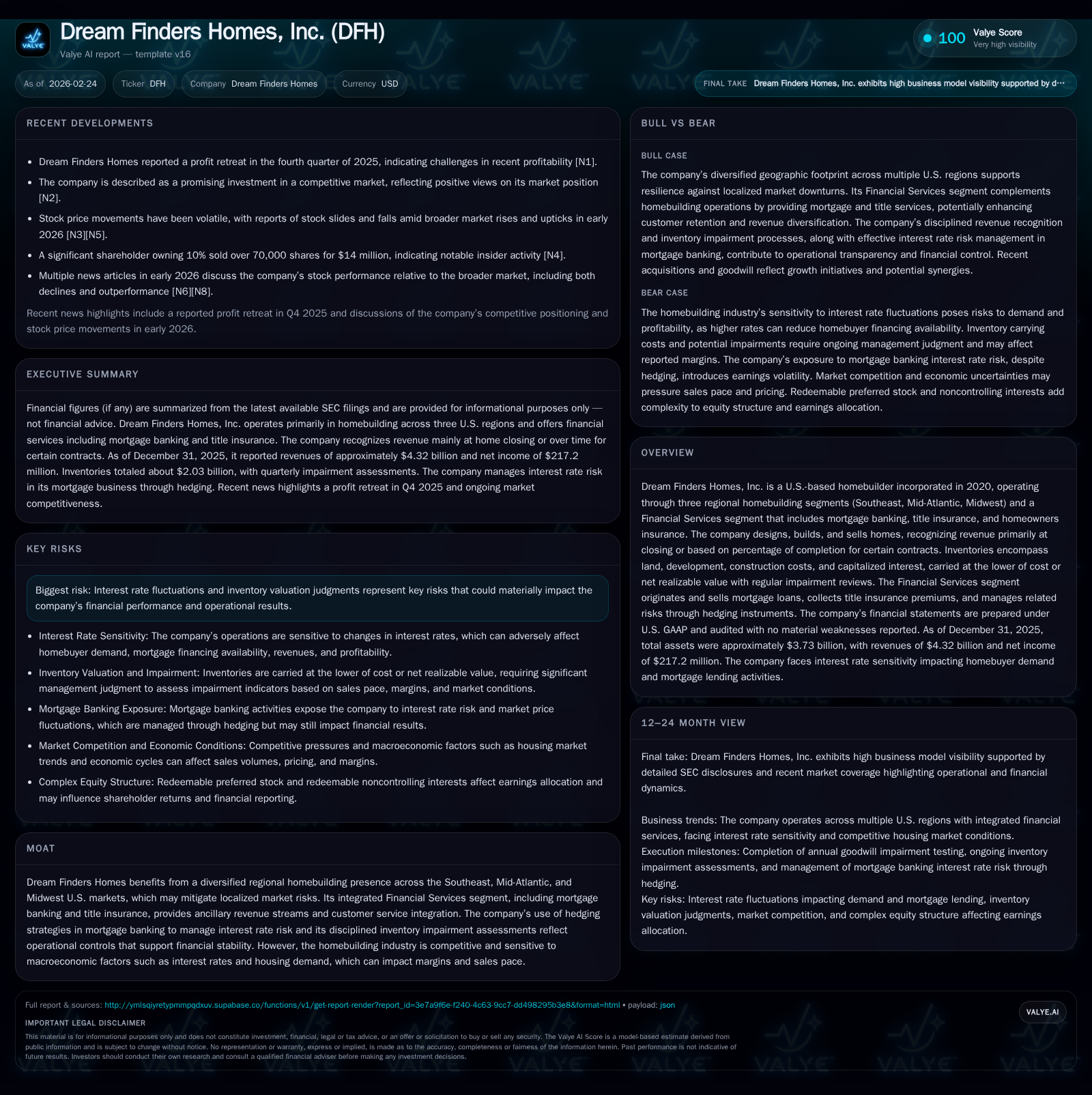
Dream Finders Homes (DFH), a regional U.S. homebuilder established in 2020, operates across Southeast, Mid-Atlantic, and Midwest regions alongside mortgage banking and title insurance operations. After rapid revenue growth since inception, FY2025 saw a modest revenue decline of 2.9% and a 35% net income drop amid rising interest rates affecting housing demand and margins. The company’s strategy includes continued geographic diversification, disciplined inventory management with impairment reviews, and active share buybacks, yet faces risks from interest rate volatility and inventory valuations. With operating cash flow turning negative again after a positive 2023, cash flow dynamics and debt covenants remain critical to monitor moving forward.
Company Overview and Historical Performance
Dream Finders Homes, Inc. (DFH) is a relatively young homebuilder incorporated in 2020 yet has quickly grown its presence across three key U.S. regions: Southeast, Mid-Atlantic, and Midwest. In addition to traditional homebuilding operations encompassing land acquisition, development, construction, and sales, DFH manages an integrated Financial Services segment involving mortgage banking (Jet HomeLoans), title insurance (DF Title), and homeowners insurance (Alliant Title) [S6][S28]. This strategy aims to create ancillary revenue streams while enhancing the customer home buying experience.
Financially, DFH exhibited rapid growth from its early years with revenues increasing from approximately $3.34 billion in FY2022 to over $4.45 billion by FY2024 — representing compounded annual growth above 15%. However, the fiscal year ended December 31, 2025 marked a slight revenue contraction of about 2.9%, closing at $4.32 billion [F1]. This revenue peak followed by moderation reflects macroeconomic pressures including elevated mortgage rates that stifled demand.
Historical performance (annual)
| FY | Rev ($bn) | Net ($mm) | CFO ($mm) | Capex ($mm) | Rev YoY | Net YoY |
|---|---|---|---|---|---|---|
| 2025 | 4.3 | 217 | -101 | 26 | -2.9% | -35.2% |
| 2024 | 4.5 | 335 | -257 | 25 | +18.8% | +13.3% |
| 2023 | 3.7 | 296 | 374 | 5 | +12.2% | +12.8% |
| 2022 | 3.3 | 262 | -28 | 6 |
Note: Omitted columns lack sufficient annual XBRL coverage in the provided tags (need ≥2 annual points): OpInc, Div. Source: SEC companyfacts cache [F1].
Capital returns and efficiency (annual)
| FY | Buybacks ($mm) | FCF ($mm) | ROE% |
|---|---|---|---|
| 2025 | 42 | -126 | 15.2 |
| 2024 | 8 | -282 | 26.9 |
| 2023 | 369 | ||
| 2022 | -33 |
Source: SEC companyfacts cache [F1].
Source: Dream Finders Homes Consolidated Statements of Operations & Cash Flows [F1]
The net income decline of roughly one-third year-over-year reflects margin pressure stemming from higher material costs, labor inflation, longer build cycles potentially influenced by supply chain factors, and reduced volume gains due to softer buyer activity under higher borrowing costs [N1][S14]. Operating cash flows have been volatile; after surging positively in calendar year 2023 (net inflow of $374M), FY2024 and FY2025 show net operating cash outflows (-$257M and -$101M respectively). The persistence of negative cash flow despite ramped capital expenditure (capex) near $26 million annually suggests working capital increases related primarily to inventory absorption amid slower sales.[F1]
Business Model Nuances & Inventory Management
Integral to understanding DFH's operational discipline is its approach toward inventories which include land acquisition costs, development expenditures, construction materials/labor, capitalized interest on qualifying assets, and option fees [S25]. The company carries these at lower of cost or net realizable value with impairment tests conducted quarterly considering sales paces relative to expectations as well as current economic conditions.
Revenue recognition adheres primarily to ASC Topic 606 principles: homes constructed on owned lots are recognized upon closing when title transfers; for certain contracts where the customer retains lot control during construction (typically third-party investors), revenue is recognized on percentage-of-completion measured via elapsed construction days versus estimated total build time [S1][S12]. This hybrid method aids matching economic activities but also means that shifts in closing timing may materially affect short-term revenues.
Despite heightened macroeconomic headwinds through late 2025—like climbing interest rates—the company reported no significant inventory impairments during FY2025's review cycle [S25][S16]. This signals effective price-setting discipline even as sales slow down contrasted against previous years’ more robust market conditions.
Regional Segmentation & Diversification Strategy
DFH generates the bulk of its homebuilding revenues across three primary geographies:
- Southeast: Locations include Jacksonville, Orlando & Tampa (FL), Atlanta & Savannah (GA), Hilton Head & Bluffton (SC), plus custom home operations further north in Florida;
- Mid-Atlantic: Markets span Washington DC metro area; Nashville (TN); Charlotte, Raleigh & Wilmington (NC); Charleston & Greenville (SC);
- Midwest: Predominantly Texas metro areas including Austin, Dallas, Houston and San Antonio combined with Denver (CO) and Phoenix (AZ).
Each region offers differencing demographic drivers—ranging from growing Sun Belt populations hungry for single-family homes to tech corridor expansions in parts of Texas—and varying competitive intensity levels which helps mitigate localized cyclical downturn risk [S6][S28].
The Financial Services segment consolidates mortgage loans originating from Jet HomeLoans along with title insurance premiums collected by DF Title entities—offering complementary profitability levers besides direct home sales throughput [S6][S28]. Key performance metrics here include funded loan volume alongside capture rates on ancillary products.
Capital Structure & Liquidity Profile
As of December quarter-end 2025DFH maintained approximately $1.61 billion in total debt consisting mainly of:
- Revolving credit facility borrowings totaling ~$798 million;
- Senior unsecured notes totaling nearly $591 million split between the recent $300 million issuance due in Sept '30 at a coupon of ~6.875%, along with outstanding $300 million notes maturing Aug '28 bearing ~8.25% interest;
- Mortgage warehouse facilities supporting loan origination activities totaling about $193 million;
- Other miscellaneous borrowings totaling just over $24 million [S5][S7][S19][S23]
The revolving credit facility commits $1.5 billion through August '28 with an accordion up to $2 billion subject to borrowing base limits tied closely to inventory net book values like presold homes or finished lots discounted according to aging categories helping preserve liquidity runway even amid fluctuating working capital requirements [S7][S10][S11]. Covenant terms impose limits on leverage ratios such as max debt/capitalization capped at ~60%, minimum interest coverage greater than twice EBITDA thresholds, tangible net worth floors combining base capital plus retained earnings accumulations — all comfortably met as of last reporting dates with management expecting continued compliance over next twelve months [S7][S19][N1].
Meanwhile Treasury stock buybacks have accelerated meaningfully since the program renewal approvals: increasing authorization ceilings from $25 million up to now an aggregate of $100 million through mid-2027; total repurchases completed rose sharply from under $8 million in FY24 versus nearly $42 million expended by year's end FYE25 reflecting management’s confidence in share valuation but also raising discretionary capital allocation debates given margin pressures persisting simultaneously [S4][S9][S13][N4].
Redeemable preferred stock remains outstanding from an earlier private placement featuring cumulative dividend obligations around the low double digits annually (~9%), adding fixed cost layers but reducing immediate dilution relative common equity issuances [S4].
Industry Contextual Analysis
The broader U.S housing market faces persistent supply-demand imbalances exacerbated by ongoing labor/materials cost inflation combined with lingering COVID-era supply chain restrictions now meeting tighter monetary policy regimes designed to cool overheated housing prices via higher mortgage rates currently above traditional lows seen just few years ago—a notable headwind for builders reliant on expansion-oriented buyers [N10][N1].
Margin pressures arise not just from raw material or subcontractor inflation but also slower turnover resulting in increased inventory carrying costs such as real estate taxes capitalized interest expense portions plus heightened lot deposits especially when options remain unconverted within planned timelines forcing conservative impairment charges or write-down evaluations impacting profitability unevenly quarter-to-quarter [S16][S25].
Mortgage banking complements tend to be volatile given their dependency on interest rate environments where increased rates reduce eligibility footprint for prospective borrowers diminishing volume-based capture rate income despite hedging strategies employed by DFH’s financial services arm to mitigate some exposure risks arising out of fluctuating rate cycles using combination derivative instruments like IRLCs (interest rate lock commitments) or forward sales of MBS contracts [S8][S11].
Future Growth Prospects & Risks
Growth vectors include leveraging regional expansions further into attractive markets exhibiting strong employment trends like Texas metros or southeast coastal hubs while continuing tightening alignment between homebuilding backlog volumes reflecting realistic demand forecasts supported by granular percentage-of-completion accounting for bespoke inventory management allowing improved visibility into future revenues even amidst volatile macro conditions [N2][S6][S12].
Cross-selling capabilities embedded in Financial Services units provide optionality complementary revenue boosts beyond cyclical new construction volumes potentially smoothing earnings curves somewhat.
However key constraints persist:
- Elevated mortgage rates rendering affordability challenging for many buyers thus capping new contract signings,
- Increasing material/labor shortages inflating build costs,
- Potential writedowns if localized markets soften faster than anticipated,
- Dependency on maintaining access within financing covenants including revolving credit availability vital for operational liquidity,
- Changes in consumer sentiment or regulatory shifts affecting real estate transactions or lending environments could precipitate volatility impacting top-line realizations or associated segment profitability metrics [N1][N14].[F1]
What To Watch Next (Analysis)
Absent specific forward guidance disclosed recently beyond typical corporate disclosures around incremental land acquisitions or fund investments managed via DF Capital Funds structures providing selective exposure control on lot acquisitions financed off-balance sheet entities—the following indicators will be critical:
- Sales closings velocity especially newly signed contracts turning into closed homes,
- Margins trends particularly on gross profit per unit given raw input inflation trajectories,
- Operating cash flow direction reflecting working capital management success versus capex commitments,
- Debt covenant ratios vs market conditions able to sustain Revolver/Notes funding cost optimization,
- Share buyback activity pace balanced against free cash flow generation,
- Mortgage origination capture rates alongside derivative valuations protecting financial services economics,
- Any meaningful inventory impairments flagged signaling pricing or demand softness requiring provisioning adjustments. Monitoring these should clarify whether DFH can navigate this transient downcycle profitably while sustaining momentum into more normalized housing market recoveries.
Returns and Capital Allocation Summary
ROE approximated for FY2025 stands around mid-teens (~15%), calculated by dividing net income at ~$217M by shareholders' equity near ~$1.42B indicating reasonable returns versus industry averages though down substantially from prior year peak due primarily to earnings contraction rather than equity shifts alone [F1].
Free cash flow remains negative at roughly -$126 million driven by continued operating losses offset partially by modest depreciation linked capex spend around $26 million focused largely on property/equipment investments related possibly to model homes or infrastructure supporting growing communities plus technology/compliance upgrades [F1][S25].
Dividends are not noted among financial policy disclosures implying retained earnings reinvestment preference consistent since IPO growth phase; however substantial share repurchase programs indicate shareholder return via buybacks prioritized when share prices deemed attractive relative intrinsic values supported by operational outlooks despite near-term earnings softness [S4][N21].
Conclusion
Dream Finders Homes illustrates a compelling example of a modern regional homebuilder incorporating value-added financial services seeking diversification benefits within a challenging environment marked by rising interest rates suppressing affordability pressures while inflationary inputs erode traditional margins. The balance sheet shows adequate liquidity headroom backed by covenant-compliant revolving credit lines offsetting business cycle quirks that affect operating cash flows which have turned negative recently despite healthy revenues. Management has embraced opportunistic share repurchases signaling confidence but simultaneously must manage risk tightly particularly regarding inventory valuations susceptible under shifting consumer demand. As the company matures past early high-growth phases characterized by double-digit topline gains toward steadier state profitability profiles near normalized housing markets it will need careful execution around geographic expansion pacing plus financial services profit maximization without overleveraging capital deployment plans. Investors following Dream Finders should focus closely on sequential operating results clarifying margin trajectory responses coupled with evolving macro fundamentals shaping residential real estate affordability taxation frameworks thus influencing new homebuyer behaviors. While current headwinds have trimmed profits temporarily Dream Finders Homes' integrated platform affords multiple levers enabling adaptation once broader economic trends stabilize.
Disclaimer: This analysis is provided solely for informational purposes based on publicly available data as of February 24, 2026; it does not constitute investment advice or recommendations.
Disclaimer: This is research-only, informational analysis and not investment advice. It may include AI-generated interpretation and general industry context. Always verify important details using primary sources.

Comments