
IOVANCE BIOTHERAPEUTICS Faces Capital and Manufacturing Challenges While Launching Novel TIL Therapies
Iovance’s pioneering tumor infiltrating lymphocyte platform drives innovation amid ongoing losses and complex supply chain hurdles.
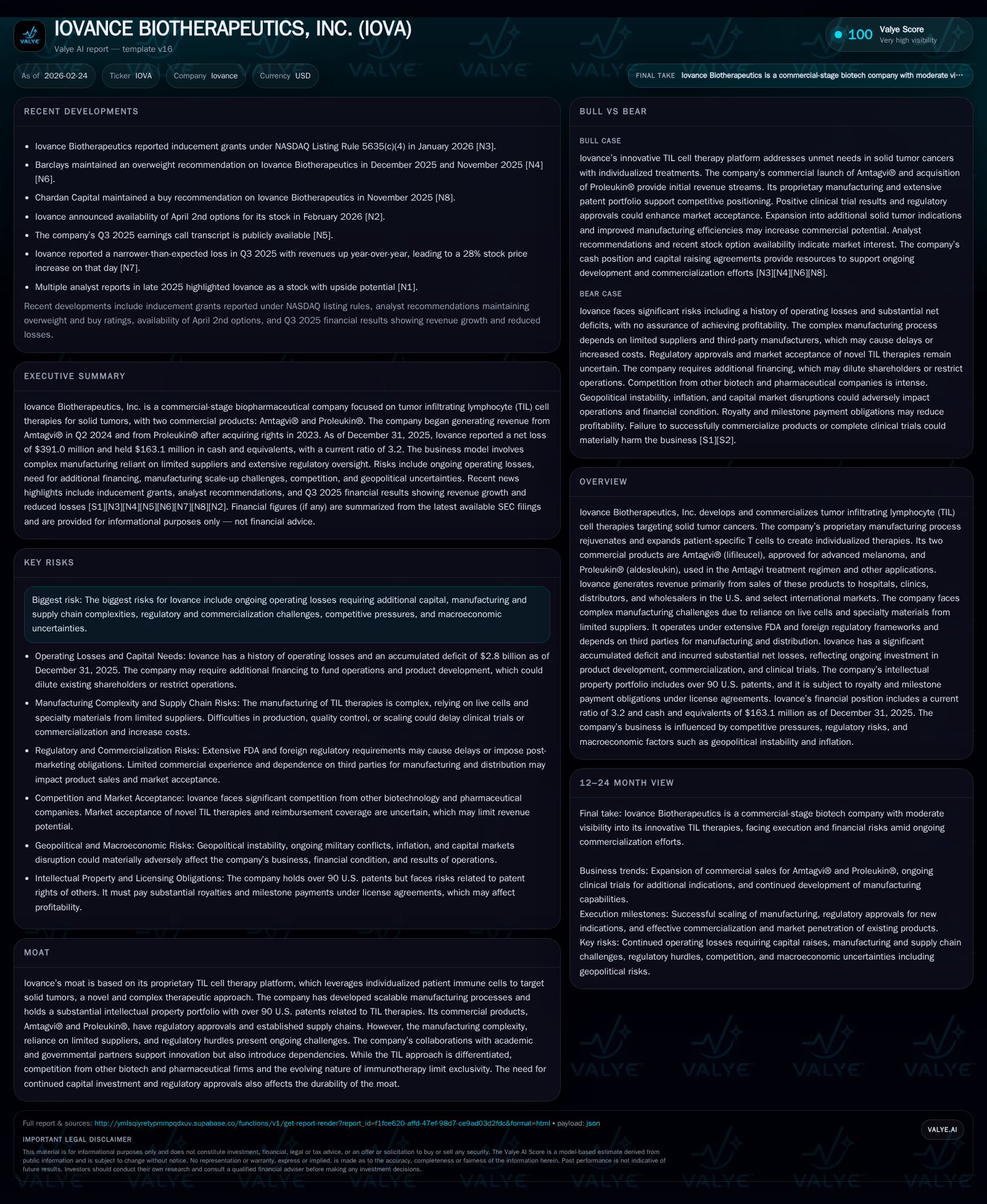
Iovance Biotherapeutics, Inc. specializes in individualized tumor infiltrating lymphocyte (TIL) cell therapies targeting solid tumors, with its main commercial product Amtagvi® approved for advanced melanoma. Historically, the company has operated at substantial losses driven by investment in clinical development and commercialization efforts, complicated by challenging manufacturing processes reliant on living cells and specialty materials. Despite regulatory approval milestones and market launches, Iovance continues to face headwinds related to operational scale-up, funding requirements, regulatory compliance, and competitive pressures within immuno-oncology. Monitoring cash flow trends and capital expenditure is critical given the absence of profitability to date.
Company Overview
Iovance Biotherapeutics, Inc. pioneers tumor infiltrating lymphocyte (TIL) cell therapies aimed at treating solid tumors through personalized immunotherapy. Its core technology involves harvesting patient-specific T cells from tumors, rejuvenating and expanding them ex vivo with a proprietary manufacturing process, aiming to trigger an immune response directly against cancer cells. The flagship commercial product Amtagvi® (lifileucel) received FDA approval for advanced/metastatic melanoma after multiple lines of therapy, marking a notable milestone as one of the first autologous cell therapies targeting solid tumors authorized for market launch. Complementing Amtagvi®, Proleukin® (aldesleukin) is utilized within the treatment regimen and broader applications.
The company’s revenue generation commenced primarily following these approvals as it began supplying hospitals, clinics, distributors, and wholesalers across the U.S. and select international geographies. However, detailed revenue figures prior to 2019 are absent given the absence of marketed products until recently [F1].
Historical Financial Performance & Operating Challenges
From a financial perspective, Iovance has steadily recorded deep operating losses since inception. Examining historical data:
Historical performance (annual)
| FY | Net ($mm) | CFO ($mm) | OpInc ($mm) | Capex ($mm) | Net YoY |
|---|---|---|---|---|---|
| 2025 | -391 | -302 | -403 | 34 | -5.1% |
| 2024 | -372 | -353 | -395 | 11 | +16.2% |
| 2023 | -444 | -362 | -461 | 22 | -12.2% |
| 2022 | -396 | -293 | -399 | 20 |
Note: Omitted columns lack sufficient annual XBRL coverage in the provided tags (need ≥2 annual points): Rev, Div, Buybacks. Source: SEC companyfacts cache [F1].
Capital returns and efficiency (annual)
| FY | FCF ($mm) | ROE% |
|---|---|---|
| 2025 | -336 | -56.0 |
| 2024 | -364 | -52.4 |
| 2023 | -384 | -76.0 |
| 2022 | -313 | -79.2 |
Source: SEC companyfacts cache [F1].
Note: Revenue data reflects zero reported revenue before product commercialization; EBITDA metrics were unavailable in provided tags.
Operating income losses have fluctuated but remained sizeable due to heavy investment in R&D programs and expansion of manufacturing capacity required for cell therapy products’ complexity. Net losses closely follow operating trends albeit marginally lower due to non-operating items.
Operating cash flows continue negative reflecting ongoing expenditures related to clinical operations and product launch activities without offsetting inflows from product sales or partnership revenues yet to reach scale.
Capital expenditures escalated sharply in FY2025 by over 200%, underpinning significant investments into facilities and equipment needed to raise throughput of specialized manufacturing lines crucial for live cell production—highlighting the biological nature of the therapy as a production constraint unlike traditional small-molecule drugs [F1].
Manufacturing & Supply Chain Complexities
Iovance’s commercial model depends on reliably sourcing live autologous cells from patients and extensive expansion using proprietary technologies under strict FDA-regulated environments. Given the sensitivity of the processes–including delicate handling of TILs and required reagents sourced from specialized or sole suppliers—the firm faces intrinsic risks:
- Scaling manufacturing while maintaining quality control remains challenging.
- Dependence on limited third-party vendors exposes potential bottlenecks or supply disruptions.
- Complexity increases cost structures relative to synthetic pharmaceuticals.
- Transitioning from Gen1 to Gen2 manufacturing platforms aims at efficiency gains but regulatory compliance remains uncertain [S1][S2].
These factors contribute significantly to operational risk profiles impacting timelines for clinical trials and commercial availability.
Regulatory & Market Access Environment
Iovance operates within an intensive regulatory framework governing biologics approval and post-marketing surveillance globally:
- Originally pioneering TIL therapies means scarce regulatory precedents causing rigorous FDA scrutiny.
- Post-approval studies and extensive quality reporting add ongoing expense burdens.
- Adherence to healthcare laws such as anti-kickback statutes and false claims acts impose stringent compliance demands with material penalties for violations [S4][S5][S6][S10].[N1]
- Coverage decisions by payors—including Medicare/Medicaid—remain fluid given the novel mechanism of action; reimbursement rates could limit adoption or profitability [S18][S19].
- The Inflation Reduction Act initiated Medicare Part D price controls starting in 2026 potentially pressuring pricing power [S14][S20].
Competitive Dynamics & Pipeline Prospects
Although Iovance enjoys a unique position through its patented TIL platform exceeding ninety active U.S. patents protecting its intellectual property landscape , competitors include both established biotech/pharma companies developing alternative immuno-oncology agents such as checkpoint inhibitors or CAR-T variants targeting solid tumors.
Future growth hinges on multiple factors:
- Expanding label indications beyond melanoma into other solid tumors like cervical and head & neck cancers through ongoing clinical trials.
- Potential regulatory approvals outside the U.S., broadening geographic footprints.
- Successful scale-up of manufacturing lowering costs enabling competitive pricing.
Risks include failure to infringe upon competitive advances in cell therapy design or emerging technological breakthroughs rendering parts of Iovance’s platform obsolete; intense patent litigation risk also exists given IP complexities around biologics [S11][S12][N3].
Capital Allocation & Financial Health
The company’s financial strategy prioritizes reinvestment into R&D capabilities and commercial infrastructure over shareholder returns:
- No dividends or stock buybacks disclosed reflecting reinvestment phase urgency; these metrics are not available in provided XBRL tags [F1].
- Equity base increased steadily through financings offsetting accumulated deficits reaching approximately $699M by end-2025 [F1].
- Return on equity remains deeply negative (~–56%) owing primarily to persistent net losses overshadowing book equity value (calculated from net income / equity at fiscal year-end) [F1].
- Cash reserves ($163M) provide a buffer but further capital raises will likely be necessary given ongoing operating cash outflows (-$302M in FY2025) coupled with capex demands [F1].
- Free cash flow approximates negative $336M in FY2025 (operating cash flow less capital expenditures), underscoring considerable cash burn during this growth phase.
Investor focus should monitor quarterly burn rates versus capital raising activities alongside progress on manufacturing efficiencies that could materially shift cost curves later this decade.
Outlook & Milestones to Watch
Official guidance is not explicitly provided but key milestones include:
- Further commercial uptake indicators of Amtagvi® post-launch.
- Clinical trial readouts supporting label expansions in additional indications reportedly underway per recent communications [N2][N3].
- Progression toward FDA clearance regarding Gen2 process validation which could meaningfully reduce unit costs.
- Developments around insurance reimbursement coverage comprehensiveness affecting market penetration potential.
- Regulatory filings in Europe/Asia-Pacific regions broadening addressable markets.
Pivotal catalysts might also arise from corporate partnerships enhancing distribution or co-development capacity facilitating scale acceleration.
Disclaimer: This analysis is prepared for informational purposes only. It does not constitute investment advice or recommendations regarding buying or selling securities. All financial figures are based on publicly available filings as of February 24, 2026. Future results may vary materially due to numerous risk factors discussed herein including clinical development outcomes and market dynamics.
Disclaimer: This is research-only, informational analysis and not investment advice. It may include AI-generated interpretation and general industry context. Always verify important details using primary sources.

Comments