
Cipher Mining’s Shift from Bitcoin to HPC Data Centers Amid Rising Capital and Regulatory Demands
Cipher Mining pivots to HPC infrastructure development, leveraging its vertical integration while managing operational losses and regulatory complexity.
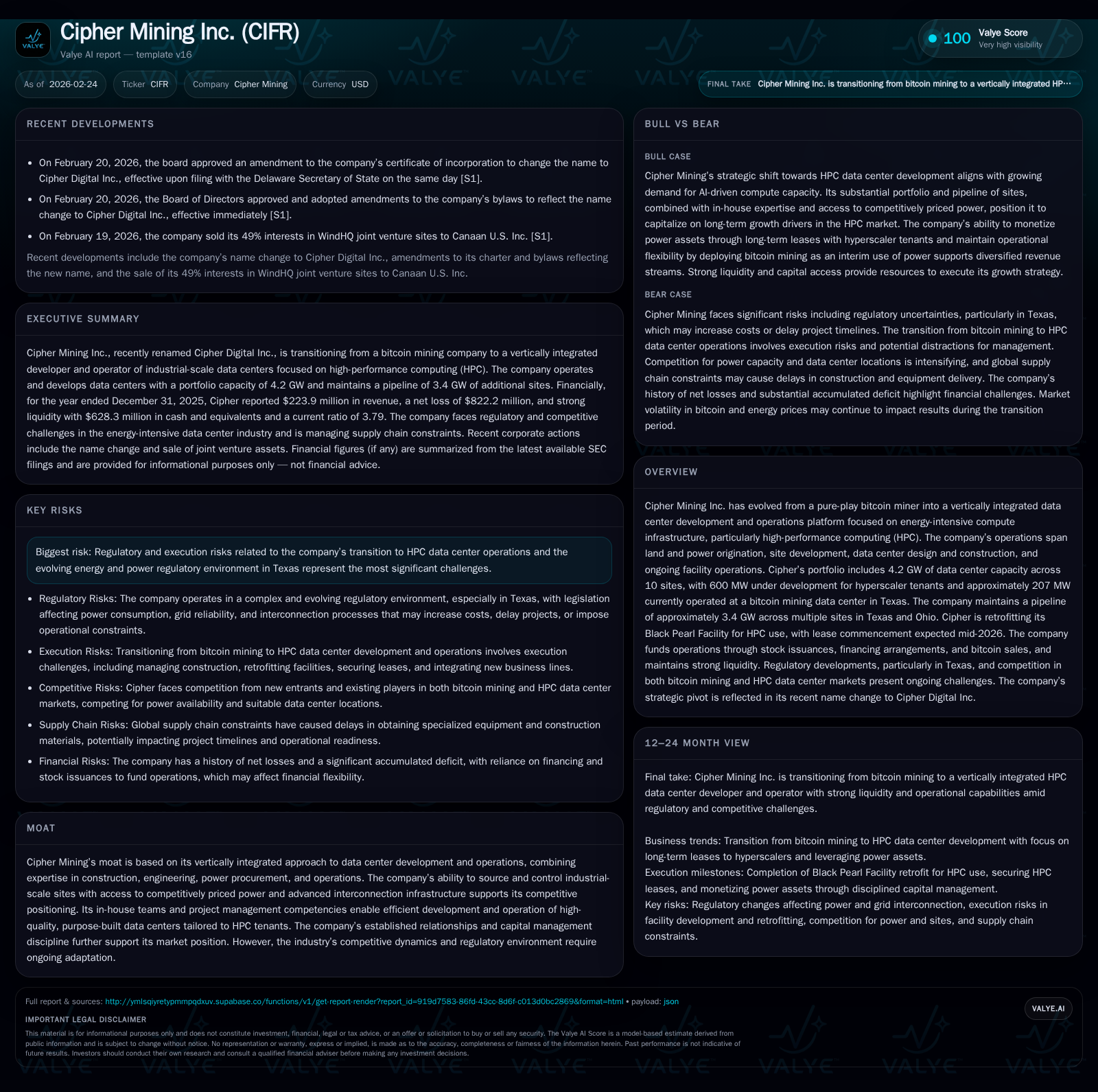
Cipher Mining Inc. (CIFR) has transitioned from primarily a bitcoin miner to an integrated data center developer and operator focusing on high-performance computing (HPC) facilities. Despite revenue growth near 50% in 2025, the company faces substantial losses driven by rising capital expenditures, regulatory costs, and operational scaling during its pivot. Its portfolio now spans over 4 GW of capacity, with a growing HPC pipeline targeting hyperscaler tenants and evolving energy regulations in Texas shaping project economics. Capital allocation prioritizes development spending funded by convertible notes and equity issuances, with no dividend payouts. Investors should watch for the Black Pearl Facility’s mid-2026 HPC lease commencement and the company’s ability to navigate Texas regulatory changes affecting large-load interconnections.
Historical Performance and Growth Drivers
Cipher Mining Inc. has undergone an aggressive transformation since its inception as a bitcoin mining pure play to becoming a vertically integrated builder and operator of energy-intensive computing infrastructure, notably high-performance computing (HPC) data centers. This shift reflects broader industry trends where demand for AI-driven compute resources outpaces reliance on volatile cryptocurrency mining revenues.
Financially, the company demonstrated significant revenue growth from FY2024 to FY2025, with revenues rising from $151.3 million to approximately $224 million—an increase of about 48% [F1]. This uptick stems primarily from expanding data center operations and the initial contributions from leased HPC assets undergoing development.
However, this top-line growth accompanies mounting operational losses: operating income moved deeper into red, registering a loss of approximately $422 million by year-end 2025—a nearly ninefold increase in operating loss compared to FY2024 [F1]. The sharp widening results largely from accelerated capital investment outlays required for facility build-outs such as the Black Pearl Facility retrofit, as well as expenses tied to scaling internal engineering and power procurement capabilities essential for HPC data center operation.
Financial Summary Table
Historical performance (annual)
| FY | Rev ($mm) | Net ($mm) | CFO ($mm) | OpInc ($mm) | Rev YoY | Net YoY |
|---|---|---|---|---|---|---|
| 2025 | 224 | -822 | -208 | -422 | +48.0% | -1742.2% |
| 2024 | 151 | -45 | -88 | -44 | +19.3% | -73.2% |
| 2023 | 127 | -26 | -94 | -20 | +4076.6% | +34.0% |
| 2022 | 3 | -39 | -21 | -37 |
Note: Omitted columns lack sufficient annual XBRL coverage in the provided tags (need ≥2 annual points): Capex, Div. Source: SEC companyfacts cache [F1].
Capital returns and efficiency (annual)
| FY | Buybacks ($mm) | FCF ($mm) | ROE% |
|---|---|---|---|
| 2025 | 90 | -696 | -102.1 |
| 2024 | 28 | -227 | -6.5 |
| 2023 | 4 | -115 | -5.2 |
| 2022 | 3 | -61 | -11.4 |
Source: SEC companyfacts cache [F1].
Note: Dividend payments are not available in the provided tags; buybacks mainly reflect treasury stock repurchases for employee tax withholding related to stock settlements [F1].
Transitioning Business Model and Growth Prospects
Cipher’s historical revenue was predominantly driven by bitcoin mining operations headquartered chiefly at its Odessa facility (~207 MW capacity). As of late 2025, the company publicly emphasized diversification toward HPC data center development—an area with longer contracted revenues through hyperscaler tenants requiring industrial-scale power access and advanced interconnection ecosystems [S25][N2].
The company’s portfolio includes approximately 4.2 GW of data center capacity distributed among ten sites across Texas and Ohio with an additional pipeline appraising roughly another 3.4 GW under site control but not yet operational [S25][S26]. Approximately 600 MW is currently under active development specifically for leasing to hyperscalers as HPC customers; this marks a strategic shift away from solely deploying power for bitcoin mining rigs [S25].
Notably, Cipher is retrofitting its previously bitcoin-oriented Black Pearl Facility for HPC purposes—with a planned lease commencement targeted around mid-2026—signifying a material milestone in its pivot strategy [N2][S26]. This conversion entails substantial capex integration of advanced cooling systems, power distribution upgrades capable of handling hyperscale loads, and technology infrastructure meeting Tier III or higher reliability standards common in HPC environments.
Growth catalysts rest mainly on securing long-term tenancy agreements with major hyperscale cloud or AI computing service providers who value Cipher’s vertically integrated approach encompassing land control, competitive power origination contracts (including fixed-price supply agreements), integrated design-build project management teams specialized in data centers with flexible electrical load profiles [S25], and operational service excellence established through prior bitcoin mining competencies.
Potential constraints include:
- Regulatory Complexity: Texas Public Utility Commission (PUCT) reforms and ERCOT market operator amendments under Senate Bill 6 impose new requirements on large electrical load interconnections (>75 MW), security deposits upfront for grid linkage requests, and batching mechanisms potentially delaying timelines or increasing network upgrade fees [S1][S4][S17].
- Operational Execution Risks: Transitioning assets optimized for bitcoin rigs into HPC-grade facilities requires retraining staff, upgrading hardware deployments including advanced cooling technologies often requisite for AI training workloads, and establishing contractual performance benchmarks aligned with mission-critical tenant demands.
- Market Uncertainty: While blockchain-related revenue factors like bitcoin prices now play a diminished role relative to prior years (since mining comprises smaller share of revenue), economic fluctuations impacting hyperscaler CAPEX decisions could influence demand trajectories.
Capital Structure, Cash Flow Trends & Allocation Priorities
Cipher maintains robust liquidity supported by recent convertible note issuances—including $172.5 million principal at low interest rates due in 2030 plus $1.3 billion zero-coupon convertible notes due in 2031—and equity raises including an ATM program permitting up to $250 million gross proceeds [S5][S12][S19].
Cash and equivalents increased markedly to approximately $628 million at December-end 2025 compared historically to under $6 million a year prior—reflecting successful financing aligned with substantial capex deployment totaling nearly $488 million last year compared to $139 million the prior year [F1][S21]. Operating cash flows remain negative (-$208 million in 2025 vs -$87 million in 2024), underscoring that growth-stage capital consumption has yet to translate into positive operating cash margins [F1].
Free cash flow (operating cash flow minus capex) stood deeply negative (~$696 million outflow), highlighting that current scale-up incurs significant upfront investments before stable leasing revenues accrue.
Regarding capital allocation—no dividends have been declared or paid per latest filings [S10][S19]; share repurchases occurred predominantly for employee RSU tax withholding (~$90 million in year ended December 31, 2025) rather than shareholder distributions.
Competitive Moat & Industry Positioning
Cipher Mining benefits from an extensively vertically integrated model uncommon among pure-play data center operators mainly focused on colocation only: it controls real estate selection tailored explicitly toward large electric loads combined with regional power sourcing strategies securing competitively priced fixed-rate energy contracts critical amid volatile electricity markets notably within ERCOT where grid stability enforcement has increased regulatory scrutiny [S26][N1].
Furthermore, Cipher's in-house expertise covers design-build execution agility essential for deploying HPC-ready facilities capable of handling dense racks powering AI inference/training clusters which require specialized cooling technologies frequently relying on novel liquid cooling methods beyond standard air-cooled solutions typical in legacy crypto mining sites.
These competencies allow Cipher to offer tailored solutions attractive to hyperscale tenants seeking reliable power availability coupled with high-quality infrastructure adaptable over time.
Nonetheless, this moat is counterbalanced by intense competition from both specialized colocation providers expanding into AI compute niches alongside emerging EPC firms serving modular data center builds offering speed-to-market advantages—so continuous innovation plus careful regulatory navigation remain crucial strategic priorities [S25][N2].
Risks Highlighted by SEC Filings & Sector Dynamics
Significant risks stem from regulatory uncertainties around large load interconnection rules instituted by Texas legislators through SB6 affecting payment security deposits upfront plus modified approval workflows batching loads portfolio-wise—potentially escalating project costs or delaying commercial commissioning dates sufficiently to impair contractual milestones targeted with tenants [S1][S17].
Additional risks include:
- Potential adverse consequences if the shift toward HPC hosting fails to attain profitability due to distractions from diversification efforts increasing expenses without corresponding incremental revenue gains.
- Persistent exposure to high operating leverage due to fixed costs associated with power purchase agreements locked at fixed rates requiring sustained utilization levels.
- Continued reliance on external financing evidenced by extensive convertible debt issuance indicating capital intensity remains elevated amidst negative operating free cash flow generation so far.
Legal proceedings are immaterial according to latest disclosures indicating no material lawsuits pending or threatened—a reassuring point given sector-wide litigation challenges common among digital asset firms historically [S16][S17].
What To Watch Next: Milestones & Indicators
While explicit forward guidance remains limited beyond milestone commentary shared in earnings transcripts [N2], key near-term indicators investors may track include:
- Mid-2026 lease commencement date for Black Pearl Facility’s conversion into an HPC hosting environment; successful tenant onboarding here signals validation of strategic pivot.
- Interconnection queue clearance timelines mandated under SB6 frameworks affecting new developments; delays could stress capital deployment cadence.
- Operating expense trends trending downward reflecting efficiencies post-transition versus current elevated capex-driven loss run rate.
- Expansion into remaining pipeline sites totaling ~3.4 GW; contract signings translating these capacities into booked leases signify tangible backlog monetization progress.
- BTC price volatility impact diminishing further; however residual exposure should be monitored given existing mining presence until full transition completed.
Conclusion
Cipher Mining demonstrates ambition rooted in expansive vertical integration within the burgeoning AI-compute infrastructure space but must contend simultaneously with significant capital intensity pressures and complicated energy market regulations increasingly shaping project economics especially within Texas jurisdictions housing core assets.
While revenue momentum is positive reflecting successful expansion efforts exceeding previous years’ results substantially [F1], profitability restoration remains elusive amidst rapid scaling investments yielding heavy losses currently offset by sizable liquidity buffers sustained through convertible notes issuance and equity raises principally earmarked for ongoing buildouts.
The company benefits strategically from owning its site pipelines with scalable power contracts supportive of stable long-term HPC hosting tenancy models yet faces execution risks inherent in this capital-heavy transition phase compounded by evolving regulatory frameworks tightening oversight on large electricity users within ERCOT grids that dictate future growth pace.
Attention surrounding Cipher Mining’s progress on its Black Pearl Facility retrofitting milestone targeted mid-2026 will serve as a tangible signal validating its repositioning trajectory while continued prudent capital management will be essential amid negative free cash flows persisting near term.
This report is based solely on publicly available information including SEC filings and reputable news sources as cited; it does not constitute investment advice.
Disclaimer: This is research-only, informational analysis and not investment advice. It may include AI-generated interpretation and general industry context. Always verify important details using primary sources.

Comments