
Innovative Industrial Properties Faces Refinancing Risks and Tenant Challenges in Regulated Cannabis Real Estate
IIPR’s specialized cannabis-focused REIT grapples with debt maturities, regulatory complexity, and evolving tenant dynamics in 2025.
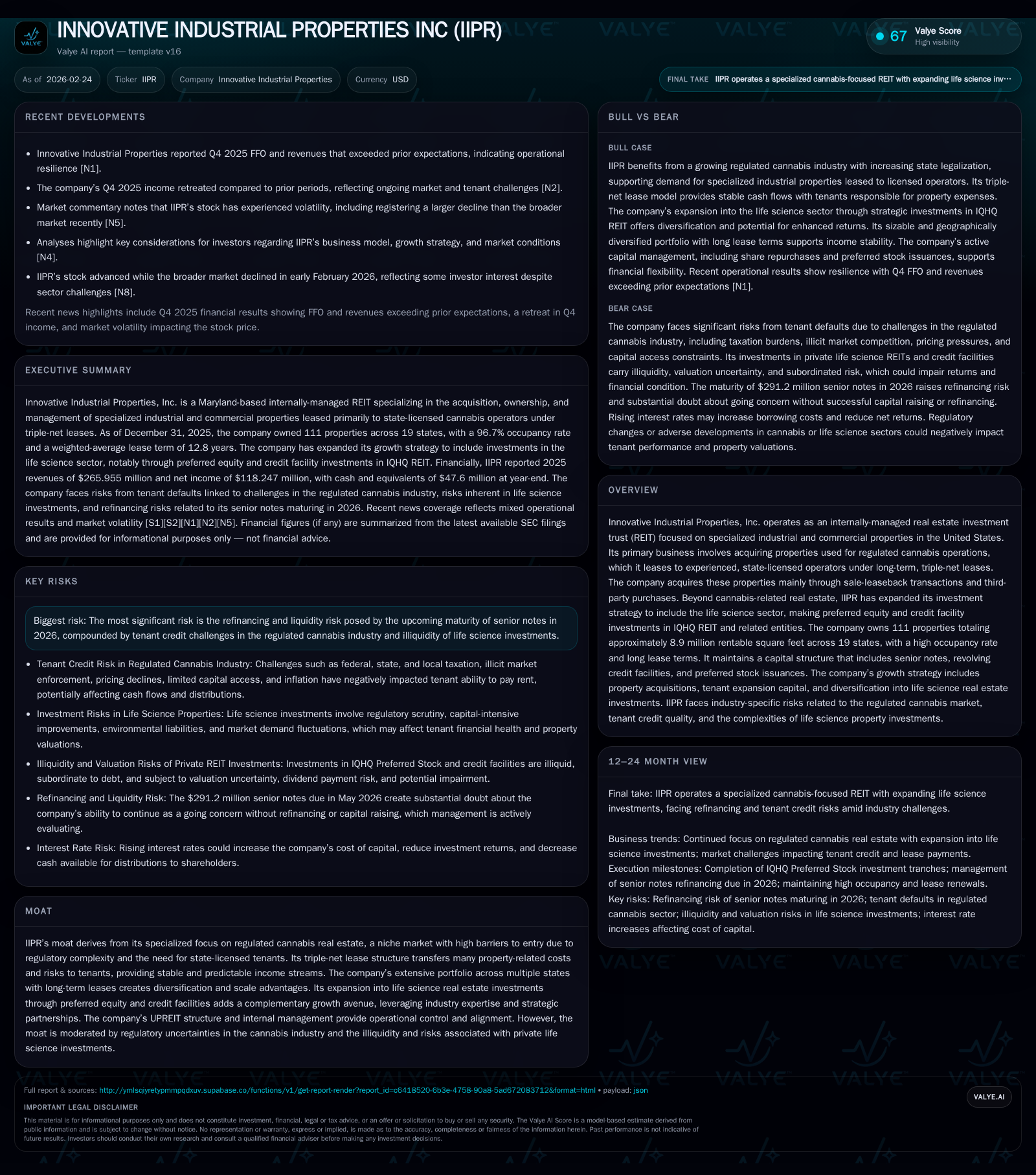
Innovative Industrial Properties, Inc. (IIPR) operates a niche real estate investment trust focusing primarily on properties leased to licensed cannabis operators across the United States. In 2025, the company continued its expansion into regulated cannabis facilities and life science real estate but faced revenue and profitability declines driven by macro pressures on tenants and regulatory uncertainties. A significant refinancing milestone looms with $291 million of notes maturing in mid-2026, while growth prospects hinge on capital deployment into both cannabis assets and life science sectors. Despite healthy occupancy and long leases, tenant credit risk and liquidity remain key headwinds to watch.
Business Overview
Innovative Industrial Properties Inc. (IIPR) is an internally-managed Real Estate Investment Trust (REIT) specializing in industrial properties leased to state-licensed operators within the highly regulated U.S. cannabis industry. Established in 2016 with a UPREIT structure, IIPR owns its portfolio through an operating partnership where it serves as general partner. Its business model centers on acquiring properties primarily through sale-leaseback transactions and third-party purchases and leasing them on triple-net lease terms that shift most operational costs onto tenants [S1][S19].
In recent years, IIPR has diversified by making strategic investments in life science real estate via preferred equity stakes and credit facilities in IQHQ REIT entities under its subsidiary IIP Life Science — a move aiming to leverage growth opportunities outside of cannabis while building on sector expertise [S2][S12].
Historical Financial Performance
IIPR's financials from fiscal years 2022 through 2025 reveal notable volatility reflecting broader industry challenges:
Historical performance (annual)
| FY | Rev ($mm) | Net ($mm) | CFO ($mm) | OpInc ($mm) | Rev YoY | Net YoY |
|---|---|---|---|---|---|---|
| 2025 | 266 | 118 | 198 | 124 | -13.8% | -26.9% |
| 2024 | 309 | 162 | 258 | 168 | -0.3% | -2.4% |
| 2023 | 310 | 166 | 256 | 175 | +12.0% | +7.3% |
| 2022 | 276 | 154 | 234 | 170 |
Note: Omitted columns lack sufficient annual XBRL coverage in the provided tags (need ≥2 annual points): Capex, Buybacks, FCF. Source: SEC companyfacts cache [F1].
Capital returns and efficiency (annual)
| FY | Div ($mm) | ROE% |
|---|---|---|
| 2025 | 216 | 6.4 |
| 2024 | 212 | 8.3 |
| 2023 | 203 | 8.5 |
| 2022 | 184 | 7.9 |
Source: SEC companyfacts cache [F1].
(IIPR has low recurring capex given triple-net lease arrangements—only minor tenant-driven improvements)[F1]. The roughly $309 million revenue peak in 2023 gave way to a material drop in 2025 amid tightening operator financials.
The company delivered operating income losses narrowing from early pandemic dips but encountered a sharp decline in profitability in FY25 tied largely to tenant pressures and increased costs [F1][N1][S1]. Operating cash flow trends mirror these earnings dynamics yet remain well above net income indicating solid underlying cash generation.
Portfolio Composition & Lease Profile
At December 31, 2025, IIPR owned 111 properties spanning around 8.9 million rentable square feet across 19 states [S1][S19]. The operating portfolio comprises 109 properties with a standout occupancy rate at approximately 96.7%, supported by long-term leases averaging almost 13 years—a key factor underpinning revenue stability.
The triple-net lease structure obliges tenants to bear expenses such as structural repairs, maintenance, taxes, and insurance; thus reducing landlord operational risk while providing predictable income streams [S1]. Most tenants hold multiple locations within the portfolio indicating concentrated but manageable tenant exposure [S18].
In addition to cannabis real estate holdings under active leases, the company holds redevelopment projects aggregating some 300k rentable square feet expected online post-2026 [S19].
Industry & Market Dynamics Impacting Growth Prospects
The regulatory patchwork across states generates distinct local market dynamics impacting operator profitability and subsequent leasing demand.
Specifically:
- Price Compression: Unit prices for cannabis products have declined persistently since around 2022 across multiple states due to increased supply, taxation burdens (notably California), illicit market persistence, and competitive pressures—compressing margins for tenants [S1][S18].
- Capital Constraints: Due to cannabis's ongoing federal Schedule I classification restricting access to traditional banking & public markets, operators rely on costly alternative financing; combined with rising rates this shrinks available capital for expansion or stable operations [S1][S27].
- Tenant Credit Risk: Refinancing difficulties for mature operator debts increase default risk or force deleveraging that can reduce leasing commitments or prompt restructuring impacting rental cash flows [S1][S27].
- Supply Chain Challenges & Costs: Inflationary pressures combined with tariffs elevate construction/material costs potentially delaying redevelopment projects or increasing capital expenditures for tenants growing or maintaining their operations [S1][S18].
Overall these factors suggest moderate downside risks on new leasing demand growth though existing long-term leases somewhat buffer immediate impacts.
Capital Structure & Liquidity Profile
As of December 31, 2025:
- Notes due May 2026: Principal outstanding $291 million bearing interest at fixed coupons—with covenants including minimum debt service coverage ratios—pose significant refinancing pressure within the next few months [S4][S5][S14]. Management plans refinancing but outcomes are not certain yet [S24].
- Revolving Credit Facility: Increased commitments raised from $50 million to $87.5 million with $27.5 million drawn at year-end at ~9% interest rate [S4][S6][S7].
- Life Science Credit Facility: A newer revolving facility underscoring diversification into IQHQ investments with $75 million drawn against a $100 million line maturing October 2028 bearing SOFR + premium (floor ~6%) [S6][S8][S10].
- Cash & Equivalents: Stood at approximately $47.6 million at year-end providing some liquidity cushion [F1].
An authorized common stock repurchase program has been deployed moderately ($20 million repurchased in FY25), while Series A Preferred Stock issuance via ATM program raised net proceeds of ~$24 million during the same period adding incremental financing flexibility [S12][S22][N12].
Management currently believes compliance with all covenants is maintained but flags substantial doubt surrounding going concern near-term given debt maturity timing without completed refinancing transactions [S24]. Given typical REIT leverage ratios averaging ~35%-45%, IIPR's approach remains conservative but sensitive given regulatory uncertainty.
Life Science Investments: Adjacent Growth Avenue
The company's venture into life science real estate represents strategic diversification aligned with healthcare sector growth drivers. IIP Life Science owns preferred equity positions plus secured loans (IQHQ Credit Facility) sized over $150 million cumulatively, with contractual funding commitments up to approx $170 million extending through mid-2027 contingent on IQHQ investment schedules [S12][S17][S24].
These holdings generate interest income recognized via effective interest method though face valuation sensitivity given limited liquidity and sector cyclicality risks tied to biotech space fundamentals plus project-specific risks like collateral dependency on Fenway Center asset value [S2][S16].
While providing potential upside beyond cannabis real estate’s constraints (especially as certain operators consolidate or reduce footprint), such investments impose their own risk profile requiring careful balance of capital deployment priorities.
Returns & Capital Allocation Highlights
Analysis of return metrics reveals:
- Estimated Return on Equity approximates 6.4% using latest net income over total equity — modest compared to other industrial REIT peers but reflective of specialized niche risk profile [F1].
- Operating cash flow generation comfortably covers dividend distributions which totaled over $216 million in FY25 implying dividend sustainability assuming stable lease income [F1][S13].
- Share repurchases at management discretion help optimize capital structure when market valuations are attractive; activity so far has been selective.
Effective capital allocation balances organic property acquisitions (one new property acquired during year), redevelopment funding commitments (~$6M), servicing debt/refinancings, funding life science commitments alongside generous dividend pay-outs supporting shareholder yield preferences [F1][S19][S22].
Outlook & Key Milestones To Monitor (Analysis)
Absent explicit formal guidance from management post-FY25 filings, important future developments will include:
Debt Refinancing Execution: Management’s ability to refinance or retire the near-$291M senior notes before May 2026 will be crucial for maintaining financial flexibility.
Tenant Credit Quality Trends: Monitoring reported tenant defaults/restructurings or industry consolidation events will influence projected rent collection stability.
Life Science Investment Funding Pace: The timing of scheduled IQHQ preferred stock purchase tranches given potential delays could impact liquidity needs.
Occupancy Rates & Lease Renewals: Continued high portfolio occupancy with re-leasing metrics on vacated spaces will signal ongoing demand despite sector headwinds.
Cannabis Regulatory Developments: Federal legislative changes regarding legalization/regulation could materially alter capital access dynamics over medium term.
Investors would be wise to watch quarterly updates closely for any signs of changes in these areas as indicators of stabilization or further volatility.
Risks Summary
Primary risks aligning with both internal disclosures and broader sector stresses include:
- Refinancing risk concentrated around May '26 debt maturity compounded by volatile credit markets.
- Tenant operational stress from pricing compression/limited financing raising default potential.
- Life science asset illiquidity potentially impacting recoveries if adverse financial events occur.
- Regulatory uncertainties across key states creating uneven demand fluctuations.
- Macro challenges such as inflation/tariffs pressuring tenant capex budgets and operational cost structures.
- Legal proceedings including SEC investigations related to corporate governance or disclosures introducing reputational or financial risks pending outcomes [S11].
Conclusion
Innovative Industrial Properties’ niche specialization in regulated U.S.-based cannabis real estate combined with expanding footprints into life sciences generates unique growth opportunities balanced against meaningful present-day challenges—including major upcoming refinancing needs and tenant credit headwinds linked closely to the still federally restricted nature of the cannabis industry.
The company maintains high portfolio occupancy coupled with extended lease terms that support steady revenues; however, declining revenues since peak years reflect macroeconomic stressors limiting short-term trajectory acceleration. Strategically navigating refinancing alternatives alongside prudent capital deployment towards life sciences counterparts will likely dictate financial performance resilience moving forward. Keeping a close eye on tenant fundamentals and regulatory evolution will remain critical for assessing realistic growth potential amid evolving legal landscapes.
This analysis is based exclusively on publicly available sources including Innovative Industrial Properties’ SEC filings and recent news reports as cited herein; it does not constitute investment advice or recommendations.
Disclaimer: This is research-only, informational analysis and not investment advice. It may include AI-generated interpretation and general industry context. Always verify important details using primary sources.

Comments