
T-REX Acquisition Corp.'s Bitcoin Mining Pivot Confronts Scale and Liquidity Constraints
The company's shift to cryptocurrency mining highlights growth hurdles amid sector competition and financial strain.
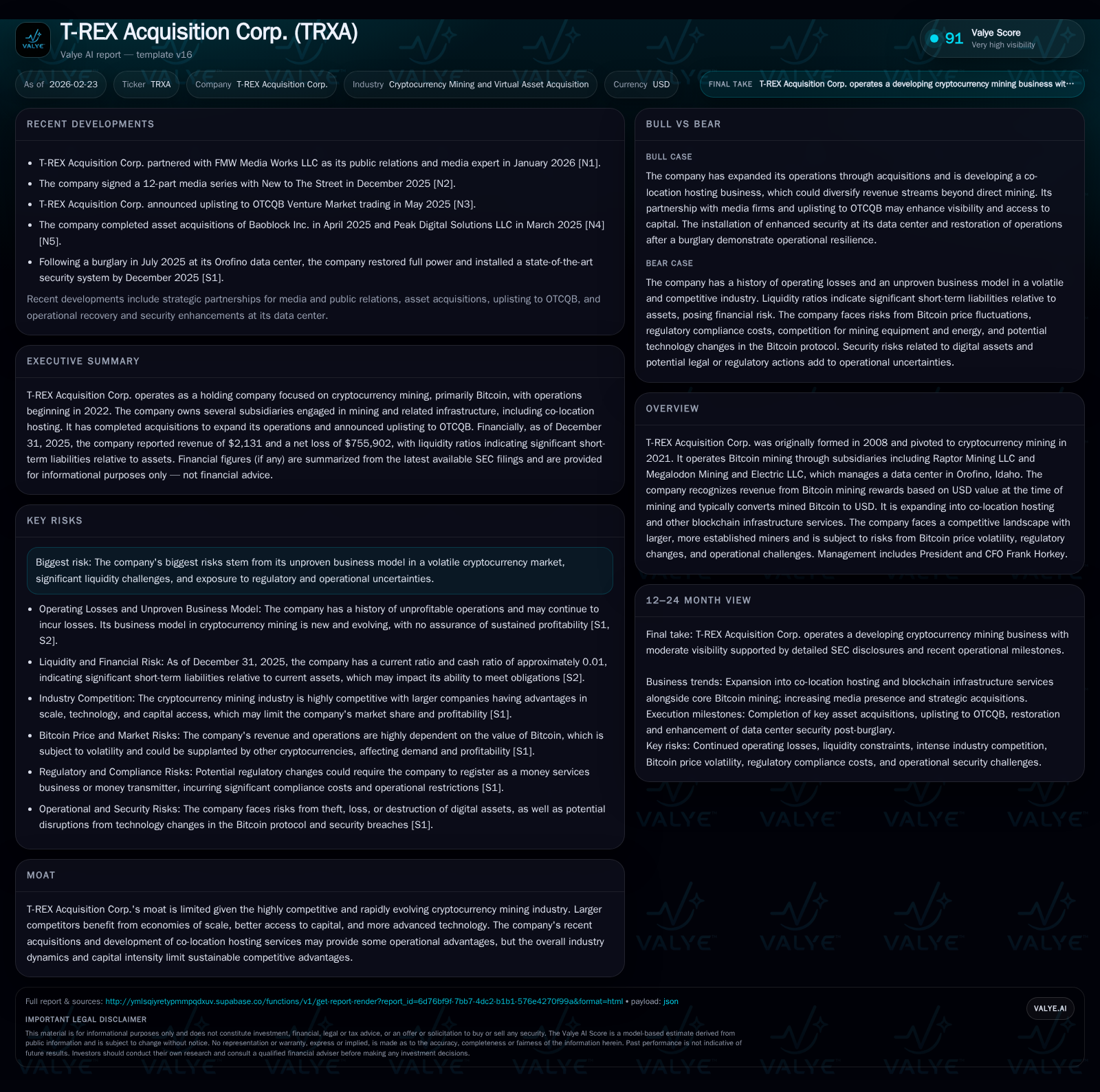
T-REX Acquisition Corp. transitioned from a development-stage entity into Bitcoin mining starting in 2021, operating via subsidiaries including Raptor Mining and Megalodon Mining & Electric. Despite expanding into co-location hosting, it faces operational scale disadvantages versus larger miners and ongoing liquidity pressures. Historical financials reveal growing revenues but persistently steep losses, reflecting the capital-intensive nature of mining and infrastructure ownership. Key risks include Bitcoin price volatility, regulatory uncertainties, and recent operational disruptions such as equipment theft. Future growth hinges on successful scaling of mining capacity and diversification into blockchain infrastructure services amid a rapidly evolving competitive landscape.
Company Background and Business Evolution
T-REX Acquisition Corp., initially founded in 2008 as Plethora Resources, Inc., transitioned multiple times from oil and gas consulting to software services, finally assuming its current focus on cryptocurrency mining starting mid-2021 [S1][S11]. Since February 2022, it has mined Bitcoin primarily through its subsidiary Raptor Mining LLC and operates a proprietary data center in Orofino, Idaho under Megalodon Mining & Electric LLC. The acquisition of this facility in early 2025 marked a strategic step to consolidate hardware deployment and expand into co-location hosting—renting out data center space for third-party miners—which aims to generate diversified revenue streams beyond mining rewards [S1][S6].
Historical Financial Performance
T-REX's historical financials demonstrate the challenging economics intrinsic to a relatively small Bitcoin miner attempting scale in a capital-intensive industry. Revenue for the twelve months ending June 30, 2025 nearly doubled compared to the prior period ($32.4K vs $15.8K) yet remains low in absolute terms reflecting limited scale [F1]. Operating losses deepened substantially over this span (-$2.1M vs -$995K), signaling elevated operating expenses tied to both core mining activities and escalating infrastructure investment culminated by the Orofino data center acquisition [F1][S6]. Net losses mirror this trend with FY25 H1's net at approximately -$2.54M compared with -$1.02M one year earlier.
Liquidity metrics flag heightened risk: as of end-2025, current liabilities stood at roughly $2.11 million against just $12K in current assets—a razor-thin current ratio roughly equal to 0.01—which underscores imminent funding pressures absent new capital infusions [F1]. T-REX relies significantly on notes payable related to the Orofino facility purchase, including an obligation maturing May 2025 that was subject to refinancing efforts [S16][S27].
Historical performance (annual)
| FY | Rev ($) | Net ($mm) | CFO ($) | OpInc ($mm) | Rev YoY | Net YoY |
|---|---|---|---|---|---|---|
| 2025 | 32390 | -3 | -763752 | -2 | +104.7% | -147.8% |
| 2024 | 15824 | -1 | -614853 | -1 | -71.6% | +44.4% |
| 2023 | 55637 | -2 | -188196 | -2 | -10.1% | -42.2% |
| 2022 | 61906 | -1 | -233321 | -1 |
Note: Omitted columns lack sufficient annual XBRL coverage in the provided tags (need ≥2 annual points): Capex, Div, Buybacks. Source: SEC companyfacts cache [F1].
Capital returns and efficiency (annual)
| FY | FCF ($) | ROE% |
|---|---|---|
| 2025 | 238.6 | |
| 2024 | -614853 | 92.4 |
| 2023 | 665.6 | |
| 2022 | -678821 | -170.5 |
Source: SEC companyfacts cache [F1].
Note: Capex data is only available for select years; dividends and share buybacks are not disclosed in available filings.
Operational Highlights and Competitive Positioning
Operating mainly within Bitcoin’s Proof-of-Work protocol utilizing ASIC miners tailored exclusively for BTC mining confines T-REX’s flexibility should alternate cryptocurrencies surpass Bitcoin in prominence or profitability [S1]. The company's strategy of owning its Orofino data center aims at lowering per-MWh electricity costs—critical given electricity often accounts for ~60–70% of miner operating expenses—and expanding into hosting services for third parties provides a potential buffer against sole reliance on mined Bitcoin revenue [S6][S4]. Nonetheless, larger players like Marathon Digital Holdings and Riot Platforms enjoy pronounced scale advantages enabling superior capital access for equipment upgrades and discounts on electricity [S4].
The competitive landscape also implicates procurement risks; T-REX has faced challenges sourcing next-generation miners amidst global hardware shortages prevalent industry-wide. Moreover, a late-2025 theft targeting sixty-six obsolete ASIC S19 miners caused a temporary halt in operations but did not materially impair assets given they were mostly written off previously [S29]. This incident underscores vulnerability in physical security measures amid ongoing expansion phases.
Future Growth Prospects
Growth drivers for T-REX hinge on increasing hash rate capacity primarily through re-equipping the Orofino facility with state-of-the-art ASIC devices at competitive energy rates while simultaneously ramping co-location hosting client uptake [S6]. The firm plans to supplement pure mining revenue by diversifying into blockchain infrastructure ventures such as SaaS offerings related to power curtailments or renewable energy credits trading—an emerging theme within crypto miner ecosystems seeking sustainability alignment [S4].
However, prospects are tempered by:
- The highly volatile price of Bitcoin which materially affects revenue recognition since rewards are converted into USD at prevailing market values upon receipt; significant price downturns threaten miner profitability margins.
- Regulatory uncertainties including potential classification updates imposing registration obligations or anti-money laundering compliance costs [S13][S17].
- Technological risks if alternative cryptocurrencies gain dominance or if planned Bitcoin Core protocol changes alter mining economics unfavorably [S23][S25].
- Persistent liquidity constraints which may curtail timely capital deployment needed for scaling.
The company provides no explicit forward guidance but signals intent to deepen capital investments subject to financing availability and market conditions [S12][S21]. Watching debt refinancing outcomes and incremental greenfield deployments at Idaho will provide near-term milestones.
Returns and Capital Allocation Considerations
Given ongoing operational losses documented in recent periods as well as negative cash flows from operations (approximately -$764K for FY25 H1), T-REX has neither generated positive free cash flow nor achieved profitability since pivoting toward bitcoin mining activities [F1]. There are no dividends or share repurchases authorized or executed according to available SEC filings [S12][S18]. Return on equity calculations are distorted by negative shareholder equity (~-$1 million), reflecting accumulated deficits incurred during transition phases.
Reinvestment focus remains on infrastructure acquisition plus technology upgrades driven by expectations that scale efficiencies combined with stable electricity pricing can eventually improve margins—a common path observed among nascent crypto miners attempting leverage plays versus incumbents with greater scale economies.
Risks Summary
Key risks facing T-REX include:
- Sustained unprofitability coupled with tight liquidity heighten default risk on debt facilities.
- Dependence on Bitcoin’s ongoing dominance exposes operations to vulnerabilities from alternative digital asset innovation or shifting investor preferences.
- Regulatory developments may lead to additional reporting burdens or operational constraints increasing fixed costs.
- Physical security gaps evident from recent theft could cause disruption even if financial loss impact remains contained.
- Market perception challenges stemming from penny-stock status may restrict financing avenues raising cost of capital.
Conclusion
T-REX Acquisition Corp’s strategic transformation into a bitcoin miner complemented by emerging blockchain infrastructure aspirations carries significant operational ambition but is constrained by limited scale relative to sector incumbents and pronounced financial fragility. While doubling revenues evidences growth momentum from nascent levels, persistent deep losses alongside precarious liquidity pose formidable headwinds. Success will largely depend on effective deployment of capital toward scalable mining capacity enhancements at Orofino coupled with profitable diversification efforts amid an evolving regulatory ecosystem governing digital asset firms.
Disclaimer: This report is for informational purposes only and does not constitute investment advice or recommendations.
Disclaimer: This is research-only, informational analysis and not investment advice. It may include AI-generated interpretation and general industry context. Always verify important details using primary sources.

Comments