
Mohawk Industries' Growth Moderates Amid Margin Pressure and Capital Allocation Shifts
Mohawk Industries maintains global leadership in flooring despite cyclical demand and competitive pricing pressures.
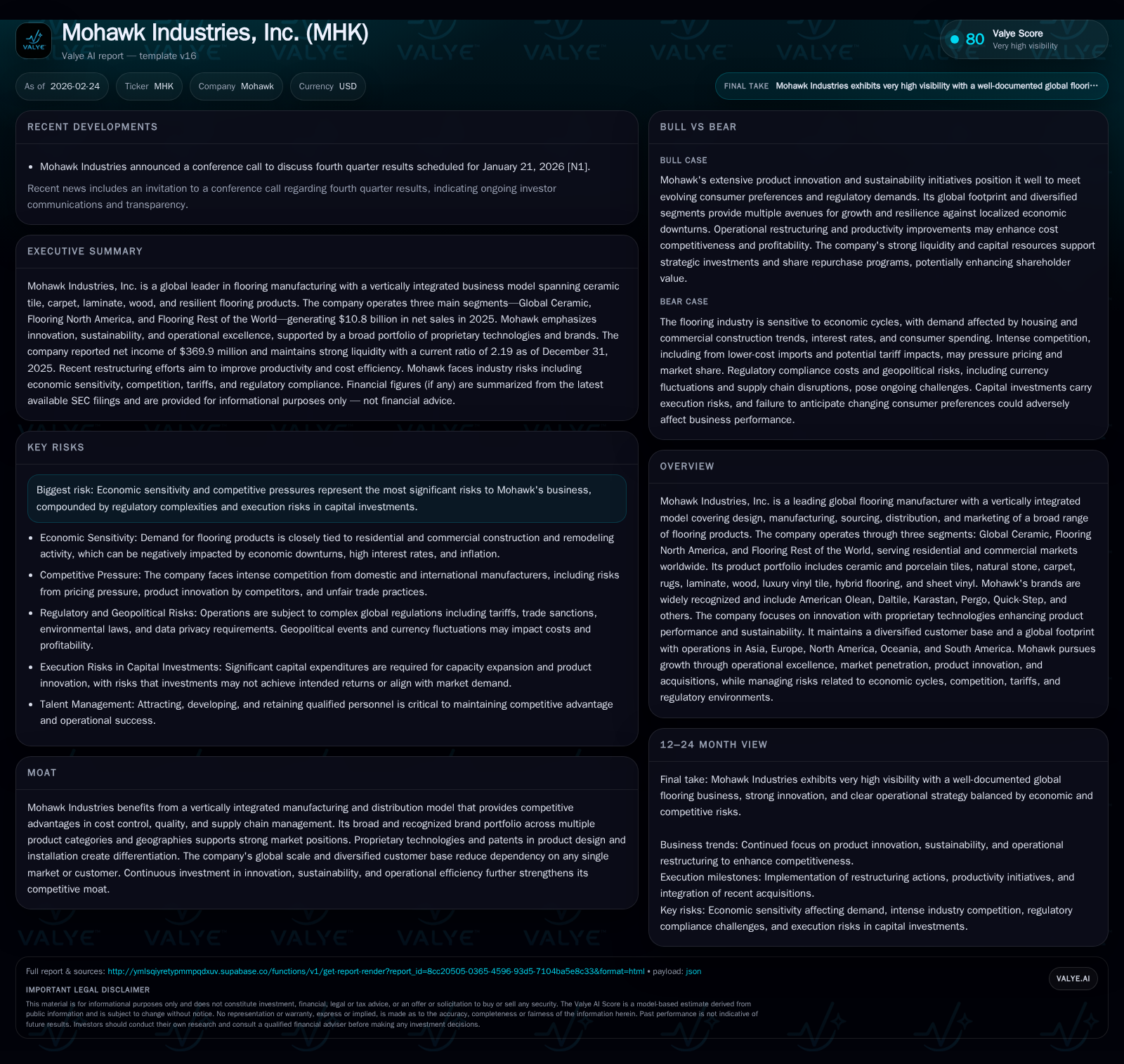
Mohawk Industries, Inc. remains the world's largest flooring manufacturer with a vertically integrated model spanning design to distribution across diverse product categories. Its historical growth was fueled by scale, geographic diversification, and innovation-driven differentiation across ceramic tile, carpet, wood, and resilient flooring segments. Recent results show operating income of $490 million in 2025 down nearly 30% year-over-year alongside a revenue decline of approximately 9%, reflecting ongoing macroeconomic headwinds including higher interest rates and inflation impacting housing markets. Mohawk’s capital allocation favors cautious buybacks amid positive free cash flow generation and strong liquidity. Future growth hinges on navigating economic sensitivities, sustaining innovation investment, and managing cost inflation and tariff impacts in a highly competitive industry environment.
Company Overview and Market Position
Mohawk Industries stands as the largest global flooring manufacturer with a comprehensive vertically integrated business covering all stages from raw material production to final distribution and marketing. It operates through three key segments: Global Ceramic (40% of revenue), Flooring North America (34%), and Flooring Rest of World (26%) [S18], [F1]. The company’s diverse product portfolio spans ceramic and porcelain tiles, natural stone, carpet, rugs, laminate, wood flooring, luxury vinyl tile (LVT), hybrid flooring, and sheet vinyl. Recognized brands such as American Olean®, Daltile®, Karastan®, Pergo®, and Quick-Step® underscore its broad market presence across residential and commercial applications worldwide.
Leveraging scale and proprietary innovations—bolstered by over 3,800 patents spanning varied product technologies—Mohawk competes on design differentiation, installation ease, performance, and sustainability features that appeal to multiple buyer segments [S22], [S26]. The vertical integration confers cost control advantages while facilitating responsiveness to customer demands.
Historical Financial Performance
Mohawk’s financial trajectory illustrates volatility shaped by macroeconomic and competitive pressures:
Historical performance (annual)
| FY | Net ($mm) | CFO ($mm) | OpInc ($mm) | Capex ($mm) | Net YoY |
|---|---|---|---|---|---|
| 2025 | 370 | 1056 | 490 | 440 | -28.5% |
| 2024 | 518 | 1134 | 695 | 454 | +217.8% |
| 2023 | -440 | 1329 | -288 | 613 | -1840.9% |
| 2022 | 25 | 669 | 244 | 581 |
Note: Omitted columns lack sufficient annual XBRL coverage in the provided tags (need ≥2 annual points): Rev, Div. Source: SEC companyfacts cache [F1].
Capital returns and efficiency (annual)
| FY | Buybacks ($mm) | FCF ($mm) | ROE% |
|---|---|---|---|
| 2025 | 150 | 616 | 4.4 |
| 2024 | 163 | 680 | 6.9 |
| 2023 | 0 | 716 | -5.8 |
| 2022 | 308 | 88 | 0.3 |
Source: SEC companyfacts cache [F1].
(Note: Revenue data only available for FY2025; YoY calculations based on reported statistics.)
The year-over-year revenue contraction of about 9% in fiscal 2025 came amid slowing demand linked to reduced home remodeling and new construction activity caused by elevated interest rates impacting mortgage affordability [S1], [S27]. Operating income faced sharper compression (-30%), attributable mainly to increased input costs tied to tariffs on imports and inflationary pressures offsetting pricing strategies [S6]. Net income fell similarly by close to 29%, though remaining positive after recovering from earlier losses in the downturn year of FY2023.
Operational cash flow generation remains robust at over $1 billion annually despite margin pressure alongside controlled capital expenditures (~$440 million), resulting in healthy free cash flow near $616 million in fiscal 2025 capable of supporting ongoing investments plus shareholder returns via buybacks albeit at a moderated pace relative to historical levels [F1].
Segment Insights and Competitive Dynamics
Global Ceramic: This segment is vertically integrated from raw materials through manufacturing of ceramic porcelain tiles, slabs, stone products, as well as installation materials. It holds leadership positions across Europe, the U.S., Brazil, Mexico, Russia and other markets with brands like American Olean® and Daltile®. Distribution channels extend to home centers, independent distributors, e-commerce retailers, builders, and contractors. This comprehensive channel reach aids inventory optimization but also exposes the segment to volatile import competition often priced aggressively due to state subsidies or lower input costs abroad [S7], [S14], [S19].
Flooring North America: Encompassing broadloom carpet, rugs, laminate wood flooring, LVT and vinyl among others sold mostly in the U.S., this segment benefits from recognized brand strength including Mohawk® itself along with Pergo® and Quick-Step®. The company controls much of its delivery network via owned trucks distributed through strategically located warehouses enabling tailored service offerings. However, this segment faces intense competition not only from domestic rivals but imported products particularly affecting rugs & hard surfaces categories where supply/demand imbalances persist. Innovation around proprietary fibers and manufacturing capabilities underpins differentiation efforts here [S11], [S14].
Flooring Rest of World: Covering Europe, Asia Pacific (including Australia/New Zealand), Latin America—this segment offers laminate flooring products including LVT sheets plus wood floors alongside other building materials like insulation boards acquired through recent add-ons (e.g., Lentex Flooring acquisition). The firm licenses various patents globally maintaining revenue streams while integrating acquired entities presents operational challenges including system harmonization and cultural alignment risks that could affect future performance if not managed closely [S15], [S23], [S28].
Future Growth Prospects
Mohawk signals targeted growth anchored primarily on three pillars:
Product Innovation & Sustainability: Expanding offerings in luxury vinyl tiles (LVT), which exhibit robust demand growth due to durability & aesthetic versatility; continuing investment in eco-friendly materials aligning with evolving regulatory standards globally; leveraging patented technologies enhancing installation speed or floor longevity for both residential/commercial end markets [N1], [S6].
Market Penetration & Geographic Diversification: Increasing market share especially outside North America via tailored product mix responsive to regional needs; extending penetration into emerging economies promising stronger housing market activity; leveraging digital platforms such as Omnify™ for real-time sales/inventory synchronization fostering retailer-consumer links reinforcing local buying patterns.
Operational Excellence: Rationalizing manufacturing footprint—closing underperforming facilities while upgrading productivity via automation improvements; optimizing supply chain agility reducing raw material waste amidst commodity price swings; fine-tuning working capital management balanced with capital expenditure discipline keeping capex steady while preserving expansion capacity [S7], [N1].
Potential constraints tempering outlook include:
- Macro uncertainty around interest rate trajectories influencing housing starts/remodeling spending negatively thereby directly impacting unit volumes;
- Competitive intensity necessitating periodic promotional discounts or pricing concessions limiting achievable margins;
- Trade policy volatility causing tariffs inflating cost structures either absorbed internally hurting profitability or partially passed on risking demand erosion;
- Integration risks related to acquisitions inducing transitional inefficiencies or talent retention hurdles reducing synergy capture efficiency.
Capital Allocation & Returns
The Company generated positive operating cash flows exceeding $1 billion consistently since FY2023 despite the challenging backdrop but experienced moderate declines recently (-7% CFO YoY). Capital expenditures hovered around $440 million in fiscal 2025 reflecting steady reinvestment mainly into technology upgrades rather than aggressive capacity expansion typical for earlier growth phases yielding an estimated free cash flow of roughly $616 million last fiscal year enabling balanced capital deployment priorities including debt servicing obligations as well as measured share repurchases totaling near $150 million though down notably versus peak repurchase levels seen pre-pandemic or before weaker earnings episodes occurred.
Return on equity calculated at an approximate low single-digit range (4.4%) indicates room for profitability improvement highlighting that earnings yield from invested capital currently lags previous peaks suffered after the profit contraction period ending FY2023 albeit stabilized somewhat at present levels as the business recovers margin traction gradually alongside easing cost headwinds expected if macro trends normalize over coming quarters.[F1]
Dividends paid data are not available from provided tags; therefore dividend policy impact cannot be assessed at this time.[F1]
Liquidity remains solid backed by nearly $860 million cash equivalents plus revolving credit facilities available per recent filings supporting financial flexibility while undergoing selective mergers/acquisitions consistent with stated strategy emphasizing bolt-on fits or geographic expansions.[S4]
Industry Context & Risks Analysis
The flooring industry demonstrates significant cyclicality inherently linked to construction cycles with end markets spanning new residential builds plus commercial projects augmented substantially by remodeling undertakings which drive majority company sales thus inherently exposed to variations tied closely with consumer confidence indices influenced by interest rates availability of credit consumer discretionary income as well as commercial spending environment conditions.[S27]
Competition is fierce characterized by numerous manufacturers competing primarily on innovation style pricing quality notwithstanding structural trade imbalances giving rise to challenges from imports benefiting unfair advantages like subsidies lowering landed costs exerting pricing pressure reducing domestic players’ leverage.[S6]
Regulatory complexity is rising notably around environmental compliance reporting extended producer responsibility laws requiring producers manage packaging waste take-back obligations adding operational intricacies affecting costs.[S24]
Legal proceedings appear manageable within current scope but vigilance regarding potential product liability claims linked to substances used or occupational exposures remains necessary reflecting ongoing risk monitoring embedded in management processes.[S21]
Information technology system resilience constitutes a strategic imperative given reliance on digital solutions for order fulfillment inventory management synchronizing sales data supporting just-in-time delivery optimizing customer satisfaction metrics facing increasing cybersecurity threats requiring continuous safeguards reinforcement.[S16],[S20]
Monitoring Points Ahead
- Pricing power resilience amid inflationary cost pass-through effectiveness balancing against volume sustainability impacts.
- Execution progress on manufacturing footprint rationalization translating into cost savings without service level degradation.
- Success rate on new product launches integrating sustainability credentials responding swiftly to regulatory landscape changes impacting customer buying criteria.
- Macroeconomic indicators encompassing mortgage lending rates housing starts remodeling expenditure trends serving as leading signals for anticipated demand fluctuations.
- Patent portfolio development pace maintaining technological edge plus licensing revenues stabilizing offering diversified income layer.
- Shareholder return policies evolving considering free cash flow stability vs reinvestment requirements balancing holistic capital management priorities.
This analysis synthesizes publicly reported financial data filed with the SEC through February 24th, 2026 alongside conference call commentary dated February 12th coincident with the company’s latest annual report release. It incorporates regulatory disclosures referencing risk factors competitiveness market segmentation intellectual property human capital related considerations digital infrastructure dependencies legal contingencies environmental compliance commitments strategic initiatives capital structure dynamics that contextualize operational performance within prevailing industry conditions.
Investors should consider these findings distinct from any investment advice or recommendations. Market conditions may shift unexpectedly requiring updated assessments incorporating subsequent disclosures or market developments beyond this reporting cutoff.
Disclaimer: This is research-only, informational analysis and not investment advice. It may include AI-generated interpretation and general industry context. Always verify important details using primary sources.

Comments