
Armstrong World Industries Balances Expansion and Cost Pressures with Robust Cash Flow Generation
AWI’s strategic acquisitions and product diversification support growth amid raw material cost volatility and competitive market dynamics.
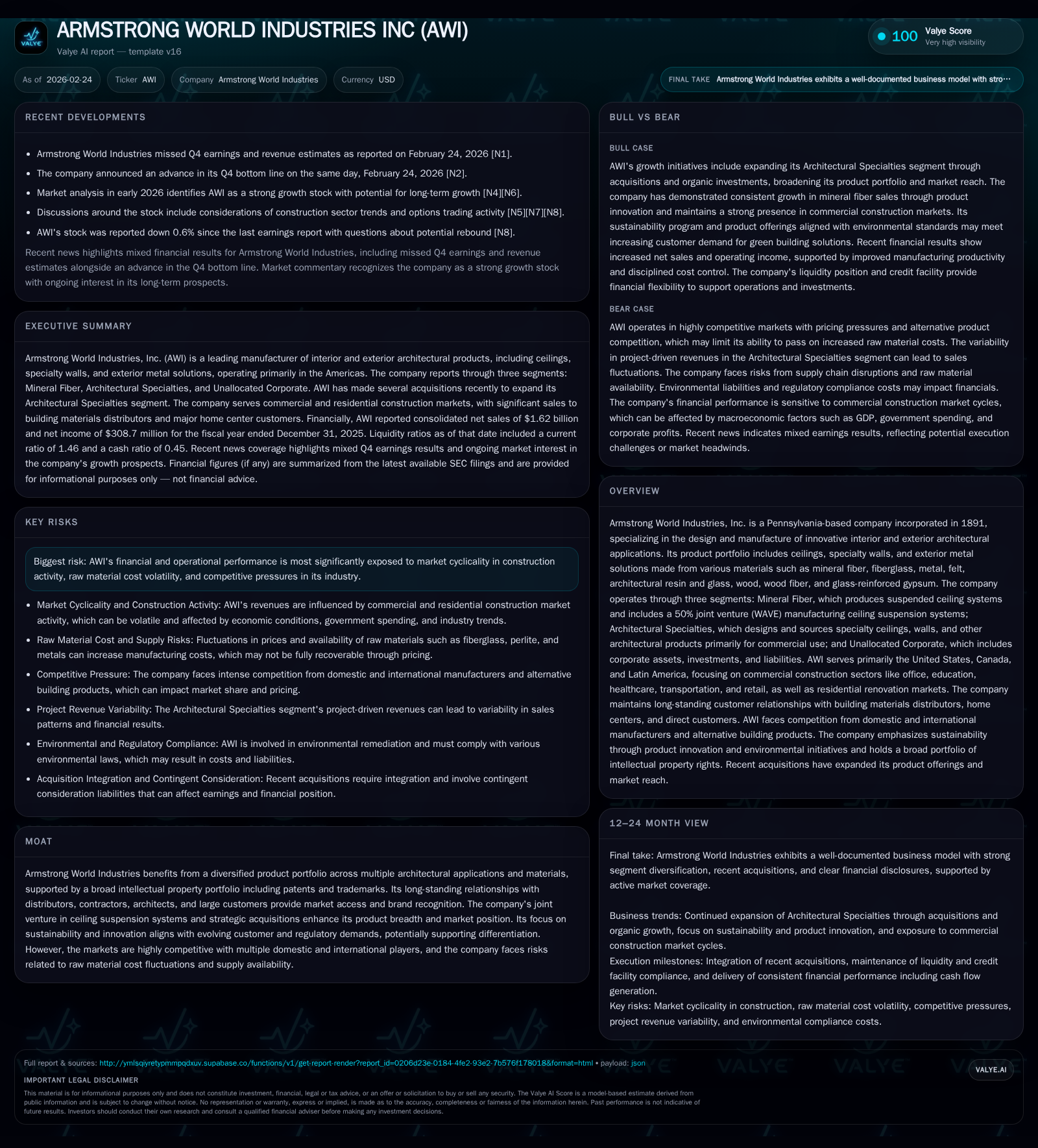
Armstrong World Industries (AWI) demonstrated solid financial performance in 2025, driven by acquisitions expanding its Architectural Specialties segment and ongoing strength in its Mineral Fiber products. The company faces challenges from raw material cost fluctuations and a cyclic commercial construction market but benefits from a diversified portfolio and strong customer relationships. With ample liquidity, an active share repurchase program, and meaningful cash flow generation, AWI is positioned to navigate near-term headwinds while pursuing growth opportunities via innovation and sustainability initiatives.
Company Overview
Armstrong World Industries Inc. (AWI) stands as an established leader in interior and exterior architectural applications across the Americas. Founded in 1891, the Pennsylvania-based manufacturer develops innovative ceilings, specialty walls, and exterior metal solutions utilizing materials ranging from mineral fiber to fiberglass, metal, wood fiber, architectural resin, glass-reinforced gypsum, felt, wood, and glass. AWI also engages in ceiling suspension system manufacture through the Worthington Armstrong Venture (WAVE), a 50%-owned joint venture.
The company organizes operations into three reportable segments: Mineral Fiber; Architectural Specialties; and Unallocated Corporate. The Mineral Fiber segment focuses on suspended mineral fiber and fiberglass ceiling systems often equipped for acoustics, fire resistance, and energy efficiency. Architectural Specialties provides customizable specialty ceilings and walls primarily targeting commercial customers. Unallocated Corporate holds corporate-level assets including investments such as Overcast Innovations LLC.
Historical Performance
AWI’s recent financials reflect a pattern of consistent growth amid challenging macroeconomic factors affecting construction markets. Operating income expanded from $374 million in FY2024 to $431 million in FY2025 (+15.1%), paralleled by net income growth from $265 million to $309 million (+16.5%) [F1]. This positive momentum stems from both organic improvements as well as strategic acquisitions broadening AWI’s product offerings.
The following table summarizes key financial metrics:
Historical performance (annual)
| FY | Net ($mm) | CFO ($mm) | OpInc ($mm) | Net YoY |
|---|---|---|---|---|
| 2025 | 309 | 356 | 431 | +16.5% |
| 2024 | 265 | 267 | 374 | +18.4% |
| 2023 | 224 | 234 | 324 | +10.3% |
| 2022 | 203 | 182 | 279 |
Note: Omitted columns lack sufficient annual XBRL coverage in the provided tags (need ≥2 annual points): Rev, Capex, FCF. Source: SEC companyfacts cache [F1].
Capital returns and efficiency (annual)
| FY | Div ($mm) | Buybacks ($mm) | ROE% |
|---|---|---|---|
| 2025 | 55 | 129 | 34.3 |
| 2024 | 51 | 55 | 35.0 |
| 2023 | 47 | 132 | 37.8 |
| 2022 | 44 | 165 | 37.9 |
Source: SEC companyfacts cache [F1].
Note: Revenue data is not available in provided XBRL tags.
Operating cash flow growth has outpaced net income gains reflecting effective working capital management amidst inventory build tied to acquisitions.
Capital expenditures have remained elevated (~$60 million annualized), supporting capacity expansion especially following acquisitions that broaden manufacturing capabilities [S1][F1].
Segment Analysis
Mineral Fiber
The Mineral Fiber segment produces acoustical ceiling tiles made primarily from mineral fiber and fiberglass materials accompanied by suspension grids supplied mainly through WAVE JV plants (7 manufacturing facilities). This segment accounts for extensive corporate administrative expense allocation due to housing corporate headquarters manufacturing assets.
In recent periods, volume pressures were noted partly due to cyclic softness in renovation-driven demand within office space sectors; however, price hikes on ceiling products during early/mid-2025 helped partially offset margin degradation [S13][S16]. Equity earnings contribution from WAVE increased year-over-year benefitting from favorable unit pricing despite volume softness.
Architectural Specialties
Growth here was significantly driven by recent acquisitions: Zahner (Dec ‘24), 3form (Apr ‘24), Parallel (Dec ‘25), Geometrik (Sep ‘25), plus smaller bolt-ons like BOK Modern (Jul ‘23). These companies specialize respectively in metal architectural solutions, architectural resin/glass products for walls/partitions/ceilings, extruded aluminum exterior components, and wood acoustical ceilings/walls — all adding stylistic/product diversity [S12][S19].
Revenue for this segment rose substantially supported by these acquisitions alongside organic expansion of roughly $36 million; operating income increased over +30%, while SG&A expenses rose due principally to incremental selling investments supporting new product lines.
The project-driven nature of this business introduces revenue variability quarter-to-quarter but offers higher-margin premium/custom product opportunities.
Unallocated Corporate
Includes investments like Overcast Innovations LLC (a modular ceiling cloud system developer) where AWI holds ~19% equity stake acquired via a strategic partnership [S12]. Corporate costs also encompass interest rate swap valuations designed to hedge variable rate debt exposure.
Recent Strategic Moves & Milestones
Between mid-2023 and late-2025, AWI completed multiple acquisitions expanding its Architectural Specialties capabilities: FGM-Parallel LLC (extruded aluminum products), Geometrik Manufacturing (wood acoustical ceilings/walls), Zahner (exterior metal architectural solutions), and 3form (architectural resin/glass products). Additionally, the company invested strategically in Overcast Innovations LLC focusing on prefabricated ceiling cloud systems aimed at reducing waste in construction [S1][S12].
These milestones mark a deliberate pivot toward diversifying away from commodity-sensitive mineral fiber ceilings into differentiated architectural specialty offerings with enhanced design aesthetics and sustainability credentials.
Industry Context & Market Dynamics
Construction market activity remains cyclical with new commercial starts leading revenue opportunities by up to two years [S6]. AWI’s exposure skews toward renovation demand within Mineral Fiber products versus project-driven new construction sales prevalent in Architectural Specialties.
Raw material cost inflation notably affects fiberglass inputs central to Mineral Fiber manufacturing [S15]. The company has implemented periodic price increases including those effective early-2026 to mitigate margin erosion risks [S13].
Distributor consolidation events such as GMS acquisition by Home Depot have not materially impacted AWI’s financials given longstanding customer relationships [S7][S8]. The U.S federal government shutdown in late-2025 caused short-term operational disruptions without lasting effects [S20].
Capital Structure & Liquidity
As of December 31, 2025, AWI held $112.7 million cash alongside undrawn revolving credit capacity of $500 million under a senior secured credit facility amended late-2025 extending maturity to December 2030 [S4][S17]. Total borrowings included a $410.6 million Term Loan A balance priced at SOFR plus low spread after refinancing that lowered interest costs.
Covenant compliance remains intact with EBITDA-to-interest coverage above required minimums while leverage ratios permit strategic flexibility [S10]. Interest rate swaps mitigate floating rate volatility risks across ~$275 million notional amount scheduled through mid-2028 allowing earnings stability against SOFR fluctuations.
Return of capital initiatives remain robust: dividends paid totaled $55 million while share repurchases accelerated sharply consuming nearly $129 million during fiscal year—reflecting management confidence balanced against available liquidity [F1][S17].
Outlook & Growth Prospects
AWI emphasizes profitable growth by strengthening its core Mineral Fiber business complemented by expansion into Architectural Specialties through targeted acquisitions alongside organic innovation focused on sustainability trends such as LEED certification alignment [S18].
Future growth depends on successful integration of acquired firms Parallel and Geometrik whose initial sales contributions are modest but provide medium-term upside via cross-selling synergies. Price increase cadence appears linked strategically to inflation dynamics—as evidenced by late-2025 announced hikes effective early-2026—critical for margin preservation amid competitive pressures [S13].
Returns & Capital Allocation Summary
With FY2025 net income of $309 million against stockholders’ equity of approximately $901 million at year-end, AWI delivered an approximate return on equity of 34% [F1]. Free cash flow approximates $295 million after estimated capex ($60 million annualized), supporting ongoing investments alongside shareholder returns.
Share repurchases are authorized up to $1.7 billion through end-2026; approximately $533 million remains available reflecting significant optionality for opportunistic capital deployment [S17]. Dividends exhibit steady growth consistent with earnings trajectory demonstrating commitment to balanced capital allocation.
Risks & Considerations
Key risks include raw material cost volatility impacting margins especially within Mineral Fiber product lines reliant on fiberglass composites [S15]; cyclical commercial construction spending trends affecting order volumes over multi-quarter pipelines [S29]; competitive intensity across domestic/international peers vying for market share; plus integration execution risk related to recent acquisitions requiring synergy realization while preserving workforce culture amid growth [S18][S26]. Cybersecurity governance is overseen rigorously through Board Audit Committee processes supported by experienced CIO leadership mitigating digital threats impacting operations [S9]. Environmental liabilities related to historic contamination are conservatively provisioned without expected material adverse effects though regulatory scrutiny continues [S22]. Legal exposures are considered manageable without significant impact anticipated currently.
Conclusion
Armstrong World Industries presents a compelling case of a century-old manufacturer transforming via focused acquisition strategy that broadens its product mix beyond commodity mineral fiber ceilings into higher-value specialty architectural solutions paired with innovation investments aligned with sustainability trends. Despite sector cyclicality and input cost headwinds typical of building materials producers exposed to volatile raw materials markets, strong free cash flow generation combined with extended debt maturity profile affords financial flexibility underpinning capital return programs alongside funding M&A ventures. Execution going forward will hinge on integrating recent acquisitions effectively while navigating uncertainties inherent across commercial renovation cycles amid inflationary input pressures demanding prudent price management tactics. Stakeholders should watch quarterly updates for volume trajectories within Mineral Fiber renovation markets juxtaposed against continuing Architectural Specialties project wins plus any shifts in raw materials pricing environment signaling margin volatility ahead.
Disclaimer: This analysis is based solely on information available as of February 24, 2026 provided by SEC filings and credible news sources cited herein; it does not constitute investment advice or recommendations.
Disclaimer: This is research-only, informational analysis and not investment advice. It may include AI-generated interpretation and general industry context. Always verify important details using primary sources.

Comments