
Pinnacle West Capital Corp’s Earnings and Liquidity Profile Amid Regulatory Frameworks
An analytical review of Pinnacle West’s financial performance highlights steady growth underpinned by regulated operations, counterbalanced by liquidity pressures and strategic credit facility adjustments.
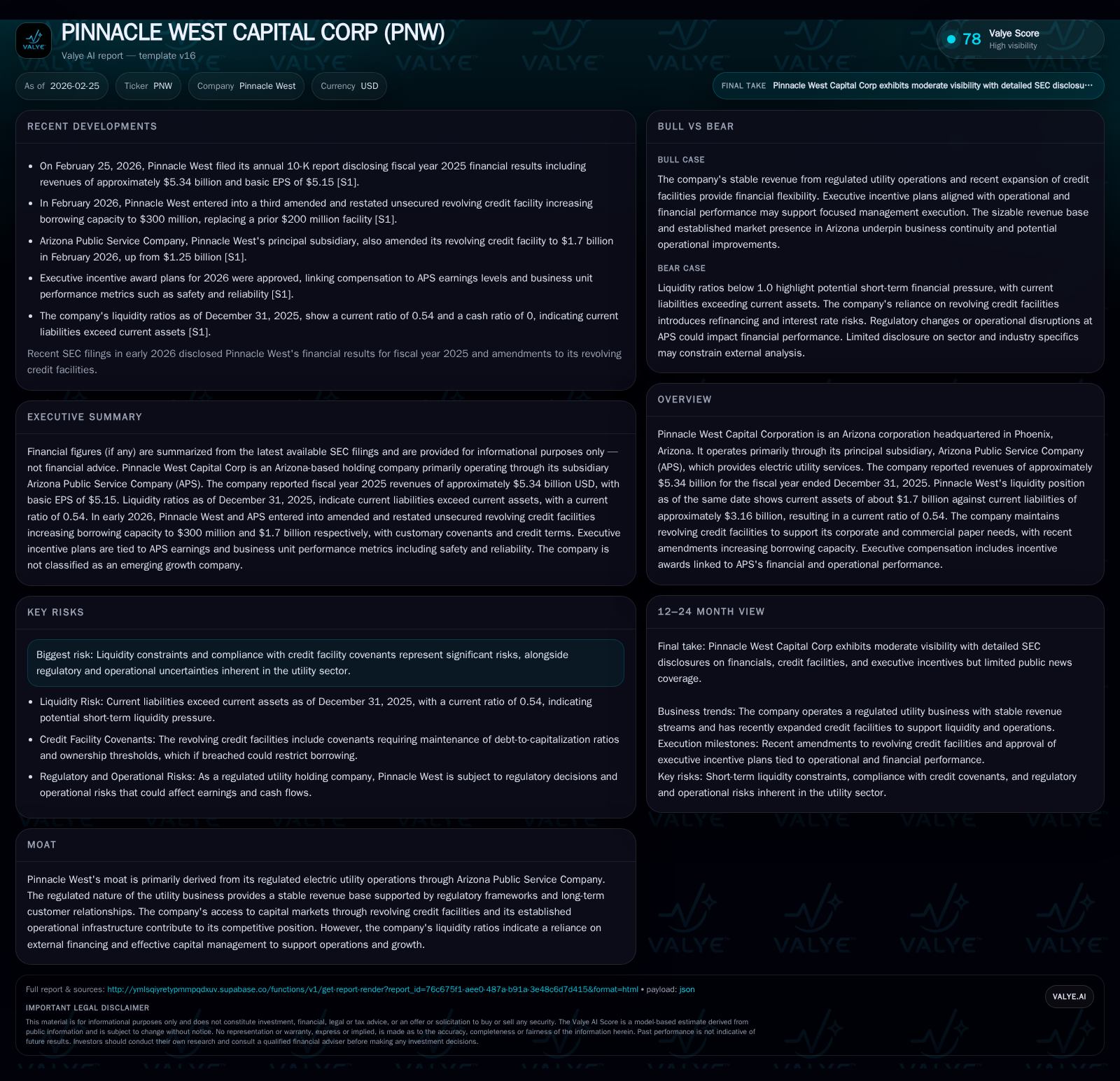
Pinnacle West Capital Corporation demonstrated consistent revenue and operating income growth from 2022 through 2025, driven predominantly by its regulated utility subsidiary Arizona Public Service Company (APS). Despite operational leverage contributing to profitability gains, the company's liquidity position tightened significantly, reflected in a current ratio of 0.54 as of FY 2025, necessitating expanded revolving credit facilities. Capital expenditures accelerated markedly, weighing on free cash flow generation amid ongoing investments in utility infrastructure. The company maintains stable dividend payouts with limited share repurchases, and executive incentives remain closely aligned with operational and financial metrics tied to regulatory performance benchmarks. Key risks center on liquidity management, regulatory uncertainties, and compliance with stringent covenant requirements embedded in recent credit agreements.
Regulated Utility Backbone: Historical Revenue and Operating Income Trajectory
Pinnacle West Capital Corp's earnings growth stems chiefly from its principally owned subsidiary Arizona Public Service Company (APS), a regulated electric utility operating under established state regulatory frameworks. This embedded moat ensures durable revenue streams protected from direct competitive threats due to natural monopoly characteristics inherent in electric distribution.
From fiscal year (FY) 2022 through FY 2025, Pinnacle West achieved a steady expansion in revenues climbing from approximately $4.32 billion to $5.34 billion, equating to a compound annual growth rate close to 6% [F1]. This steady top-line gains reflect regulated rate base expansion initiatives alongside volume growth attributed to incremental customer additions within Arizona's growing markets.
Operating income mirrored this trajectory with a rise from about $732 million in FY 2022 to nearly $1.07 billion in FY 2025—a roughly 11% CAGR—signaling effective operating leverage through cost controls against expanding revenue bases [F1]. Such performance underscores management's ability to translate regulatory-approved tariffs into meaningful profitability increases despite the traditional capital intensity of utility operations.
Historical performance (annual)
| FY | Rev ($bn) | CFO ($mm) | OpInc ($mm) | Capex ($bn) | Rev YoY |
|---|---|---|---|---|---|
| 2025 | 5.3 | 1805 | 1068 | 2.6 | +4.2% |
| 2024 | 5.1 | 1610 | 1012 | 2.2 | +9.1% |
| 2023 | 4.7 | 1208 | 825 | 1.8 | +8.6% |
| 2022 | 4.3 | 1241 | 732 | 1.7 |
Note: Omitted columns lack sufficient annual XBRL coverage in the provided tags (need ≥2 annual points): Net, Buybacks, ROE%. Source: SEC companyfacts cache [F1].
Capital returns and efficiency (annual)
| FY | Div ($mm) | FCF ($mm) |
|---|---|---|
| 2025 | 423 | -820 |
| 2024 | 395 | -639 |
| 2023 | 386 | -639 |
| 2022 | 379 | -466 |
Source: SEC companyfacts cache [F1].
Note: Latest available net income data insufficient for comparable annual trend analysis.
Operating Cash Flows and Capex Dynamics: Investment in Infrastructure
Operating cash flows (CFO) increased consistently from roughly $1.24 billion in FY 2022 to $1.81 billion in FY 2025, an approximate annual growth rate near 12% that illustrates robust underlying cash generation aligned with elevated operating income levels [F1]. However, this positive cash flow environment is partially offset by aggressive capital expenditures escalating from $1.71 billion to nearly $2.62 billion over the same period—a notable year-over-year increase of around +16.7% into FY 2025 [F1][S28].
This elevated capex spend reflects Pinnacle West's strategic prioritization on modernizing grid infrastructure and maintaining generation assets requisite for long-term operational reliability amid evolving regulatory requirements.
Despite healthy CFO expansion, the rapid escalation in capex has squeezed free cash flow substantially into negative territory, with an estimated net outflow of approximately $820 million in FY 2025 alone ( - ) [F1]. This dynamic highlights typical utility sector pressures whereby sustaining capital investments weigh heavily against cash flow availability for other uses.
Liquidity Position and Recent Credit Facility Enhancements
Pinnacle West’s liquidity is marked by a challenging current ratio of only about 0.54 as of December 31, 2025—signaling current liabilities notably exceed current assets ($3.16 billion vs. $1.70 billion) [F1]. This structural shortfall mandates reliance on committed revolving credit facilities and commercial paper programs as critical lines of support.
Strategic financial maneuvering has led Pinnacle West to enter a third amended and restated unsecured revolving credit agreement effective February 18, 2026 increasing borrowing capacity at the parent level from $200 million to $300 million extending maturities through early-2031 [S8][S9][S11][S13]. Simultaneously, APS amended its separate revolving facility expanding capacity from $1.25 billion to $1.7 billion over the same horizon offering additional liquidity buffers for working capital needs.
These facilities maintain customary covenants including limitations on consolidated debt-to-capitalization ratios and require Pinnacle West’s ownership retention over APS equity above defined thresholds . Cross-default provisions ensure any material default triggers accelerated obligations across related entities.
Such layered facility architecture affords Pinnacle West tactical flexibility but also underscores persistent funding dependence amid heightened capex demands and modest FCF generation.
Regulatory Environment and Risk Factors Shaping Future Growth
The company’s competitive moat bares intrinsic ties to regulation governing tariff setting and rate approval processes integral to APS's earnings predictability [S4][S5][S7]. Rate cases submitted periodically before the Arizona Corporation Commission establish allowed returns on invested capital anchoring revenue potential aligned with prudently incurred expenditures.
Risk factors prominently expose sensitivity to regulator rulings which can delay or limit recovery of infrastructure investments or impact operating cost recoveries driving future earnings volatility.[S4] Additionally, compliance imperatives around environmental regulations or grid modernization standards create operational cost upticks that must be absorbed or passed through cautiously.
Operational reliability metrics including customer outage indices and safety measures form part of executive remuneration alignment reflecting governance best practices via the 'APS Promise' initiative—a holistic performance framework inclusive of financial health safeguards [S11][S14].
Capital Allocation: Dividends, Buybacks, and Return on Equity Analysis
Pinnacle West has displayed commitment toward rewarding shareholders through steadily increasing dividends rising from about $379 million paid out in FY 2022 to near $423 million in FY 2025 consistent with underlying earnings strength despite capex outlays [F1][S14][S17][S25]. Dividend payout consistency typifies utility sector norms emphasizing reliable income streams.
Buyback activity remains negligible—with minor share repurchases recorded only in FY 2023 totaling just over $4 million—signaling conservative capital management focused primarily on sustaining investment-grade balance sheets rather than aggressive equity return schemes [F1][S27].
Return on equity based on available metrics hovers around an estimated mid single-digit percentage (~5%), reflecting typical utility industry returns shaped by large asset bases funded extensively through regulated debt structures limiting book equity uplifts [F1].
Executive Incentives Aligned with Operational Performance
Executive compensation packages are explicitly tethered to APS financial results combined with key business unit performance indicators such as employee safety records, customer satisfaction scores, grid reliability statistics, and nuclear operation benchmarks linked directly to Palo Verde operations—the company's significant nuclear asset [S11][S14].
Performance awards feature scalable payouts ranging between target levels at approximately three-quarters base salary up to multiples exceeding base pay depending on metric achievement levels (e.g., CEO target up to 125% base salary reaching max payout twice that amount) subject to clawback provisions reinforcing accountability.[S11]
Such incentive structures align management behavior tightly with both short-term earnings targets and longer-term operational excellence critical under regulated utility frameworks.
Looking Ahead: Monitoring Milestones and Financial Covenants
Absent explicit forward guidance embedded within filings or press releases beyond routine outlook disclosures,[N/A] key monitoring priorities for stakeholders include:
- Compliance adherence with tightening covenant thresholds particularly revolving around consolidated debt-to-capitalization ratios per amended credit facilities,
- Progression of Arizona Corporation Commission rate cases impacting allowed returns,
- Execution discipline around capex commitments crucial for modernizing electricity infrastructure,
- Preservation of liquidity channels supporting working capital requirements amid negative free cash flow periods,
- Achievement metrics under executive incentive plans reflecting embedded financial targets tied closely with regulation-driven operational outcomes.
Maintaining equilibrium between investment imperatives fueled by regulatory demand signals while managing external financing risk presents an ongoing balancing act shaping Pinnacle West’s financial trajectory going forward.
Disclaimer: This analysis is based solely on publicly available filings as noted; no forward-looking advice or investment recommendations are intended.
Disclaimer: This is research-only, informational analysis and not investment advice. It may include AI-generated interpretation and general industry context. Always verify important details using primary sources.

Comments